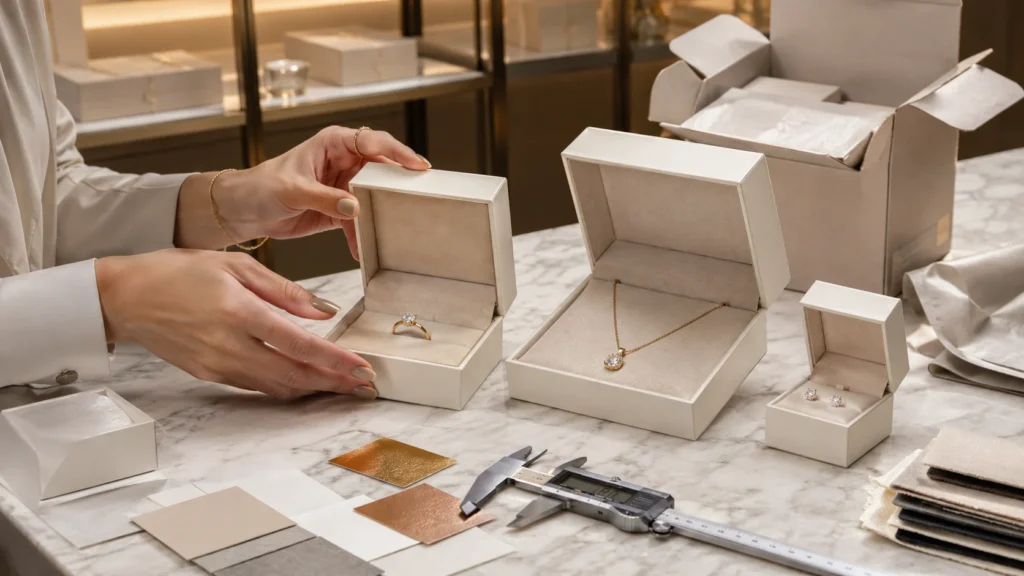

When I work on custom jewelry packaging projects, I rarely see packaging problems appear from one single mistake. More often, the risk comes from small details that were not checked carefully before bulk production. A jewelry box may look beautiful in a photo, the logo may seem elegant in the artwork, and the material may feel suitable from a swatch. But once the real product is placed inside the sample, many practical questions appear. Does the ring sit at the right height? Does the necklace pendant stay centered? Do the earrings remain symmetrical? Can the bracelet be removed easily? Does the insert still hold the product after movement? These are the details that decide whether a jewelry package is truly ready for production.
Before placing bulk jewelry packaging orders, brands should test a physical sample with real jewelry, confirm fit, insert stability, lid clearance, material and logo quality, packing efficiency, shipping protection, MOQ, lead time, and lock the approved sample as the production standard.
I always see jewelry packaging as more than a box around a product. It is part of the first physical experience with the jewelry. The box protects the product, presents the design, supports the brand feeling, and shapes the customer’s first impression before the jewelry is fully handled. Because jewelry is usually small, delicate, and high in perceived value, even small packaging issues can become noticeable. A loose insert, a tight lid, a weak logo finish, a scratched surface, or a shifted necklace can make the final package feel less careful than the product deserves.
This is why I believe a physical sample should never be approved only by appearance. A sample needs to be tested as a real package. I want to place the actual jewelry inside it, close the lid, open it again, remove the product, repack it, check the insert, review the surface, and think about how the packaging will behave during bulk packing and shipping. A good sample should not only look attractive on the sample table. It should also work when repeated across many units, handled by different workers, packed into cartons, shipped through real logistics, and opened by the final customer.
In many projects, I have seen that the most expensive packaging problems are not always caused by poor materials or difficult structures. They often come from unclear approval. The sample was approved, but the insert standard was not recorded. The logo looked good, but the foil color was not confirmed on the final material. The box size was accepted, but the lid clearance was not tested with the real jewelry. The packing method was assumed, but not checked for multiple SKUs. Later, when the bulk order arrives, the buyer feels that the production does not match the sample. In many cases, the problem could have been avoided by a more complete checklist before approval.
This article is written from that practical point of view. I will not only talk about how jewelry packaging looks. I will focus on what needs to be checked before bulk orders, including real product fit, insert stability, box depth, lid clearance, material quality, logo finish, packing efficiency, shipping protection, MOQ, lead time, and approved production standards. These checks help reduce the risk of product movement, poor presentation, difficult removal, inconsistent production, damaged boxes, and unexpected cost or delay.
For me, the goal of a jewelry packaging checklist is simple. Before bulk production starts, the sample should prove that the packaging works in real use. The approved sample should not remain a nice prototype. It should become a clear production reference that the supplier can repeat and the buyer can inspect. When the product, box, insert, material, finish, packing method, and order details are all confirmed, the packaging becomes much more reliable. That is the difference between approving a sample and preparing a jewelry packaging order that can truly support the product from production to delivery.
Quick Checklist Before You Approve Bulk Jewelry Packaging
Before I approve bulk jewelry packaging, I like to use a quick checklist to slow the decision down in a practical way. A jewelry packaging sample may look beautiful at first glance, but bulk production needs more than a good-looking sample. I want to know whether the real jewelry fits inside the box, whether the insert can hold the product, whether the lid closes safely, whether the logo finish works on the final material, whether the package can survive delivery, and whether the approved sample can be repeated consistently in production.
This quick checklist is useful because it brings the most important approval points into one place. It does not replace a full sample review, but it helps me catch the issues that are most likely to become bulk order problems. When I use this checklist, I am not only checking the box as a product. I am checking the complete packaging experience from sample approval to packing, shipping, customer opening, and future reorder consistency.
| Checklist Item | What to Confirm | Why It Matters | Approval Standard |
| Real jewelry fit | Test the actual product inside the sample | Prevent wrong size and poor presentation | The real ring, necklace, earrings, bracelet, or jewelry set should sit naturally inside the sample, look centered and balanced, and match the intended display without looking too empty, squeezed, tilted, or forced. |
| Insert stability | Shake, tilt, open, and close the sample | Avoid product movement during shipping | The jewelry should remain in the approved position after normal handling. The insert should hold the product securely without causing deformation, difficult removal, chain tangling, earring rotation, bracelet sliding, or product contact in set packaging. |
| Lid clearance | Check product height and lid space | Prevent pressure on stones, pendants, or bracelets | The lid should close smoothly without pressing the jewelry, raising the lid, changing the product position, or creating pressure on stones, pendants, earring backs, bracelet curves, or other raised product details. |
| Removal experience | Test how customers take out the jewelry | Avoid tight inserts and poor user experience | The customer should be able to remove the jewelry smoothly without digging, pulling too hard, bending the insert, damaging the display card, catching the chain, or pulling the inner support out of place. |
| Logo finish | Test foil, embossing, debossing, or printing on final material | Avoid unclear branding or production defects | The logo should appear clear, centered, and consistent on the final material, with suitable line thickness, clean foil coverage, accurate registration, visible embossing or debossing depth, and no obvious cracking, blur, misalignment, or weak branding effect. |
| Material quality | Confirm paper, board, lining, and surface texture | Keep presentation and structure consistent | The finished sample should show stable paper texture, suitable board strength, clean lining, neat corners, controlled glue, acceptable surface resistance, and no obvious wrinkles, loose fibers, fingerprints, scratches, odor, stains, or structure weakness. |
| Shipping protection | Check outer carton, mailer box, and cushioning | Reduce damage during delivery | The jewelry box and product should stay protected during the expected shipping route, with suitable mailer box, carton strength, filler, dividers, wrapping, or cushioning to reduce movement, corner damage, surface rubbing, crushing, and presentation changes. |
| Production standard | Record approved sample details | Keep bulk order and repeat orders consistent | The approved sample should be recorded with box dimensions, material, board thickness, insert details, logo position, color, finish, packing method, carton size, quantity per carton, approved photos, approval date, and any tolerance limits for bulk production. |
Prepare Real Product Information Before Checking the Sample
Before I check a jewelry packaging sample, I always want to understand the real jewelry first. This may sound simple, but in many custom jewelry packaging projects, this is the step that decides whether the sample review will be useful or misleading. A jewelry box can look clean, elegant, and well made when it is empty, but that does not mean it is ready for bulk production. The real test starts when the actual ring, necklace, earrings, bracelet, or jewelry set is placed inside the box.
I have seen many packaging discussions start from the outside of the box. The brand may first talk about the paper color, the logo finish, the box style, the ribbon, or the surface texture. These details are important, but they are not enough to judge whether the packaging will work in real use. Jewelry packaging is not only a visual container. It has to hold a small, delicate, and often high-value product in a very precise way. If the product information is incomplete, the sample may be approved too early, and the problems may only appear after the bulk order has already started.
This is why I always believe that a jewelry packaging checklist should not begin with the box. It should begin with the product. Before reviewing the sample, the brand should prepare the real product dimensions, product weight, product photos, product value level, SKU quantity, order quantity, shipping destination, and sales channel. A supplier cannot accurately judge packaging safety, presentation, or production feasibility only from artwork files, rough product names, or a simple sentence such as “this is for a necklace.” The more clearly I understand the jewelry, the more accurately I can judge whether the sample is ready for bulk orders.
Real Product Information Comes Before Box Approval
When I review a jewelry packaging sample, I do not only ask whether the box looks beautiful. I ask whether the box works with the actual product. This difference is important because a sample can pass a visual check and still fail a product-fit check. The outside structure may look correct, the paper may feel good, and the logo may appear clean, but the jewelry may still move inside the box, sit at the wrong angle, touch the lid, or become difficult for the customer to remove.
For a brand preparing bulk orders, this can become a serious problem. If one sample has a small issue, it may look acceptable during an early review. But when the same issue is repeated across one thousand, three thousand, or ten thousand boxes, it becomes a production problem, a customer experience problem, and sometimes a cost problem. A ring that tilts inside one sample may seem minor. A whole batch of ring boxes where the rings lean to one side can make the product feel careless. A necklace that tangles in one sample may be adjusted by hand during a photoshoot. Thousands of necklaces arriving tangled to customers will damage the unboxing experience.
That is why I prefer to collect product information before judging the sample. The box should not be approved as an isolated object. It should be approved as part of a complete packaging system. That system includes the jewelry, the insert, the box depth, the lid clearance, the opening experience, the packing method, the shipping protection, and the way the product will be seen by the final customer.
Check the Actual Jewelry Dimensions, Not Only the Box Size
The first product detail I want to confirm is the actual jewelry dimension. In jewelry packaging, a few millimeters can change the whole result. A box that looks suitable in a drawing may become too shallow when a ring with a raised stone is placed inside. A necklace card that looks balanced in artwork may fail when the real pendant is thicker or heavier than expected. A bracelet may seem easy to pack, but its curve, diameter, and flexibility may require more internal space than the flat measurement suggests.
For rings, I pay close attention to the ring height, stone size, band thickness, and the shape of the top setting. Many people measure only the outside size of the ring, but that is not enough. The height of the stone or decorative setting often decides the required lid clearance. If the box is too shallow, the stone may press against the lid when the box is closed. Even if the pressure is light, it can make the packaging feel unsafe. For premium jewelry, the customer should not feel that the product is squeezed inside the box. The ring should sit securely, but it should also have enough breathing space to look refined.
For necklaces, I want to know the chain length, pendant size, pendant thickness, and the preferred display direction. A necklace is not only a line and a pendant. The chain needs to be controlled so it does not tangle, and the pendant needs to stay in the right visual position. If the pendant is heavy, it may pull the chain downward. If the chain is fine and delicate, it may shift easily during handling. If the box is too large, the necklace may look empty and weak. If the box is too small, the chain may need to be folded in a way that looks unnatural. These details cannot be judged from a product name alone.
For earrings, I need to understand the shape, length, back closure, and pair layout. Stud earrings, hoop earrings, drop earrings, and long statement earrings all behave differently inside packaging. A pair of stud earrings may need accurate hole placement on a card insert. Hoop earrings may need enough space so they do not press against each other. Drop earrings may need vertical space so the decorative part can hang naturally. Long earrings may look elegant in photos but become difficult to fix if the insert does not support their length and balance. If the back closure is thick, the insert also needs enough space behind it. Otherwise, the earrings may push against the inner wall or become hard to remove.
For bracelets, I usually check the diameter, curve, thickness, flexibility, and natural resting shape. A soft chain bracelet can be placed differently from a rigid bangle. A beaded bracelet may need support that prevents it from rolling. A wide cuff bracelet may need a box with more depth and stronger internal protection. If the bracelet is forced into a flat layout when its natural shape is curved, the product may look uncomfortable inside the packaging. Good packaging should make the jewelry look intentional, not forced.
Understand the Jewelry Set Layout Before Designing the Inner Space
Jewelry sets need even more preparation before sample review. A set may include a necklace, earrings, ring, bracelet, charm, or other small accessories. The challenge is not only fitting every item inside the box. The challenge is deciding the display order and visual hierarchy. When a customer opens the box, the most important product should be easy to see, and every item should feel organized rather than crowded.
When I review packaging for a jewelry set, I want to know how many pieces are included, which piece is the visual focus, and how the brand wants the customer to read the layout. Sometimes the necklace should be the center, with earrings placed symmetrically beside it. Sometimes the ring should sit in a raised position because it carries the highest perceived value. Sometimes a bracelet needs more space because it is larger than the other items. If this information is not clear, the insert may be designed only to “fit everything,” but not to present everything well.
A jewelry set box can easily become messy if the layout is not planned early. Products may touch each other, chains may cross over other pieces, earrings may sit too close to the pendant, and small accessories may look lost in empty corners. These problems are not always visible in a drawing. They become clear only when the actual set is placed inside the physical sample. That is why I prefer to understand the full set structure before judging whether the sample is suitable for bulk production.
Product Weight Affects Insert Support and Shipping Stability
Product weight is another detail that brands sometimes overlook. Jewelry is usually small, but small does not always mean simple. A lightweight necklace may shift easily inside the box. A heavier pendant may pull the chain down during shipping. A ring with a large stone may need stronger support to stay upright. A bracelet with beads or metal parts may move inside the box if the insert is not tight enough.
When I check a sample, I want to know whether the jewelry stays in position when the box is gently tilted, opened, closed, and handled. The insert should not only make the product look good when someone places it carefully for a photo. It should hold the product in real packing and transportation conditions. If the jewelry has enough weight to move or pull against the insert, the packaging needs to be adjusted before bulk orders.
This is especially important for e-commerce jewelry brands. In a factory or studio, the sample may be opened slowly and placed on a table. But in real delivery, the package may be moved, stacked, shaken, or turned upside down. If the product weight is not considered, the jewelry may arrive in a different position from the approved sample. The customer does not see the perfect sample on the supplier’s table. The customer sees the final condition after shipping. That final condition is what the packaging must protect.
Surface Sensitivity Should Guide the Contact Materials
I also want to understand how sensitive the jewelry surface is. Some jewelry products can tolerate more contact, while others are easily scratched, marked, or affected by friction. High-polish metal, plated jewelry, pearls, gemstones, delicate charms, and fine chains often need more careful contact material and insert design.
When a brand only focuses on the outside paper or logo finish, it may ignore the parts that touch the product directly. But for jewelry packaging, the inside contact surface is just as important as the outside appearance. If the insert material is too rough, the jewelry may rub against it. If the product moves during shipping, even a soft material may cause friction over time. If the lining material wrinkles, sheds fibers, or feels cheap, it can reduce the perceived value of the jewelry.
I do not like to overpromise that packaging alone can solve every jewelry storage issue, especially when it comes to oxidation or tarnish. Those risks depend on jewelry material, plating, storage environment, humidity, lining material, and whether the brand uses anti-tarnish paper, pouches, or other protective accessories. However, packaging can still help reduce unnecessary movement, direct friction, poor presentation, and careless contact. That is why I prefer to understand surface sensitivity before approving the sample.
Product Photos Help Explain Display Direction and Visual Focus
Measurements are necessary, but photos help me understand the product in a more practical way. Before sample review, I always suggest preparing clear product photos from the front, side, back, and angled views. For many jewelry products, the most important information is not only size. It is how the product should be presented.
A ring may need the stone to face forward. A necklace may need the pendant to stay exactly in the center. A pair of earrings may need to sit at the same height and angle. A bracelet may need to show its curve naturally. A jewelry set may need the most valuable piece to appear first when the box is opened. These visual details cannot always be described clearly by measurements alone.
Good product photos also help avoid misunderstanding between the brand and the supplier. If I can see the actual shape, proportion, thickness, and display direction, I can better judge whether the insert design makes sense. I can also see whether the product should be held tightly, supported softly, laid flat, raised slightly, or separated from other items. In many cases, a photo reveals a packaging risk that a specification sheet does not show.
Product Value Level Changes the Packaging Standard
The value level of the jewelry also matters before sample approval. I do not judge every jewelry package by the same standard, because different products need different levels of presentation, structure, and finishing. A low-cost fashion jewelry item, a mid-range silver necklace, a gold-plated ring, a premium gemstone product, and a luxury jewelry set should not automatically use the same packaging solution.
For higher-value jewelry, small details become more important. The opening feel should be smoother. The insert should hold the product more confidently. The logo should appear clean and precise. The box should feel stable in the hand. The lid should align properly. The inner presentation should feel calm and intentional. If the jewelry value is high, a weak box or loose insert can make the product feel less premium than it really is.
For more affordable jewelry, the goal may be different. The packaging still needs to protect the product and support the brand, but it may also need to control cost, reduce weight, and keep the packing process efficient. I would not suggest using an overly complex structure if it adds cost without improving the customer experience. The right packaging is not always the most expensive packaging. It is the packaging that matches the product value, sales channel, order volume, and brand positioning.
SKU Quantity Should Be Clear Before the Sample Is Approved
Many jewelry brands do not sell only one product. They may have rings, necklaces, earrings, bracelets, charms, and sets across several collections. Before reviewing a sample, I want to know whether the packaging is for one SKU only or for a wider product line. This information can change the entire packaging plan.
If a brand wants a consistent packaging system, the outer box may stay the same while the insert changes by product type. This can help control brand consistency, cost, storage, and repeat orders. But this only works if the SKU plan is discussed early. If the first sample is designed only for one necklace, it may not work later for earrings or bracelets. If the box depth is fixed too early, some inserts may become too shallow or too tight. If each SKU needs a different box size, the MOQ and production planning may become more complicated.
I often look at jewelry packaging as a system, not just a single box. A good system allows the brand to keep a unified visual identity while adjusting the inside structure for different products. This is especially useful for mature brands, importers, and e-commerce sellers who plan to expand their SKU range. If the supplier understands the full SKU structure before sample approval, it becomes much easier to plan inserts, materials, box sizes, and future repeat orders.
Sales Channel Decides What the Packaging Must Survive
Before approving a jewelry packaging sample, I also want to know where and how the product will be sold. Packaging for retail display, gift presentation, e-commerce shipping, wholesale distribution, and promotional sets does not face the same conditions. A box that works well in a store may not be strong enough for direct shipping. A package that is cost-effective for wholesale may not create enough emotional value for a gift product.
For retail use, the packaging needs to support visual presentation. The product should look organized, clean, and attractive when the box is opened. The outside material and logo finish should match the shelf environment and brand image. For gift use, the emotional experience becomes more important. The texture, opening feel, color, and inner display all need to make the product feel more thoughtful.
For e-commerce use, the package must protect the product after it leaves the packing table. The jewelry should stay in position during delivery, and the box should still look clean when the customer receives it. For wholesale or distributor use, consistency, carton packing, SKU identification, and repeat production standards may matter more. If I do not understand the sales channel, I cannot properly judge whether the sample is suitable for real use.
Shipping Destination Affects Packaging Protection
The shipping destination is another detail I like to confirm before bulk order approval. A local retail order, a domestic e-commerce shipment, and an export order to Europe, North America, Australia, or the Middle East may require different protection. Longer transportation usually means more handling, more stacking, more carton pressure, and more chances for the product to move.
For export orders, I usually pay more attention to outer carton strength, box arrangement inside the carton, carton quantity, filler space, and whether the presentation boxes may press against each other. Even if the inner jewelry box is beautiful, it may still need a mailer box, shipping carton, divider, paper filler, or other protective packing method. The goal is not only to protect the jewelry itself. The goal is also to protect the presentation box, because the box is part of the customer experience.
Shipping destination can also affect practical decisions such as carton size, total weight, packing quantity, and transport cost. A box that feels premium may become too heavy or too large for certain e-commerce models. A very lightweight box may save shipping cost but fail to protect the product properly. This balance should be discussed before the sample is approved, not after the bulk order is produced.
Estimated Bulk Order Volume Helps Judge Production Feasibility
Before final sample approval, I also want to understand the estimated bulk order volume. A sample can look good as one piece, but bulk production requires more than appearance. It requires stable material supply, practical assembly, clear quality standards, repeatable insert production, and efficient packing.
If the order is a small test order, the brand may need more flexibility. It may want to test several designs, confirm customer response, or adjust the packaging before scaling. If the order is larger, the approved sample must become a reliable production reference. Every detail should be clear enough for production workers, quality control staff, and packing teams to follow repeatedly.
Order volume also affects cost and planning. A complex insert may be acceptable for a small premium project, but it may slow down packing for a large-volume e-commerce order. A special paper may look excellent, but it may require longer material preparation for a larger quantity. A finish may work beautifully in a sample, but it must also be stable enough for bulk production. This is why I prefer to know the order quantity before judging whether the sample is truly production-ready.
Product Information Helps the Supplier Give Better Suggestions
When a supplier has enough product information, the conversation becomes much more useful. Instead of only saying whether a box can be made, the supplier can help the brand identify risks before bulk production. I can suggest whether the insert should be tighter, whether the box depth should be adjusted, whether the logo size is suitable for foil stamping, whether the material is strong enough, or whether the outer packaging needs more protection.
Without real product information, the supplier may only follow the artwork or requested size. That may seem efficient at the beginning, but it can create problems later. A professional packaging review should not be limited to producing what is shown in a file. It should also consider whether the packaging will work with the product, the packing process, the shipping method, and the customer experience.
This is one of the reasons I believe communication before sample review is so important. The more clearly the brand shares product details, the easier it is for the supplier to protect the project from avoidable mistakes. A good supplier does not only ask for artwork. A good supplier asks for the product reality behind the artwork.
A Good Bulk Order Checklist Starts With the Real Product
In my experience, many jewelry packaging problems happen because the sample is reviewed before the product information is complete. The brand may approve the color, logo, and outside structure, but the actual jewelry fit, insert stability, product height, surface sensitivity, SKU plan, shipping use, and order volume are not fully checked. When this happens, the sample may look finished, but it is not truly ready for bulk production.
A good jewelry packaging checklist starts with the real product because the product decides what the packaging must do. The box must fit the jewelry. The insert must hold it. The lid must close without pressure. The inner surface must protect it. The packaging must support the sales channel. The carton setup must protect the box during shipping. The approved sample must be realistic for the expected order quantity.
Before I review any jewelry packaging sample for bulk orders, I want to make sure the product information is clear enough to support a real decision. This helps avoid approving a beautiful but risky sample. It also helps turn the sample into packaging that can be produced consistently, packed efficiently, shipped safely, and presented well to the final customer.
Check the Real Jewelry Fit Inside the Sample
When I check a jewelry packaging sample before bulk orders, I never treat the empty box as the final answer. An empty box can look clean, balanced, and premium, but jewelry packaging only becomes real when the actual product is placed inside it. This is where I can see whether the sample truly works. I can judge whether the product is centered, whether the insert supports it, whether the inner space feels right, whether the lid closes safely, and whether the customer will see the jewelry in the way the brand intended.
In my experience, many jewelry packaging mistakes start from a simple but costly assumption: the box size looks correct, so the packaging must be correct. I do not agree with that. Jewelry products are small, delicate, and visually sensitive. A few millimeters of extra space can make a ring look loose. A few millimeters of missing space can make a pendant feel squeezed. A slightly wrong hole position can make earrings look uneven. A bracelet that does not follow its natural curve can make the whole package feel forced. Before I approve a sample for bulk production, I need to see the real jewelry inside the real sample, not only the packaging as a separate object.
Why I Never Approve an Empty Jewelry Box Sample
I have seen many samples that looked excellent when they were empty. The paper was smooth, the logo was well positioned, the lid opened nicely, and the structure looked stable. But after the actual jewelry was placed inside, the problems became obvious. The necklace did not sit in the center. The earrings were slightly uneven. The ring leaned forward. The bracelet moved inside the box. The packaging was not wrong as a box, but it was not right for that product.
This is why I never consider an empty jewelry box sample fully approved. An empty sample only tells me whether the structure, material, surface, and basic workmanship are acceptable. It does not tell me whether the packaging can present and protect the jewelry properly. The real product changes everything. It changes the visual balance, the insert requirement, the lid clearance, the removal experience, and the shipping risk.
For bulk orders, this step becomes even more important. A small issue in one sample may seem easy to ignore, but the same issue across thousands of boxes can create a much larger problem. If one necklace looks a little messy in the sample, the brand may adjust it by hand for a photo. But if every necklace requires manual adjustment during packing, the production process becomes slower and less consistent. If one ring leans slightly in a sample, it may look minor. But if customers receive ring boxes where the product does not stand correctly, the brand experience becomes weaker.
The First Opening Impression Tells Me a Lot
When I place the jewelry inside the sample, I like to open the box the way a customer would open it. I do not only look from a production angle. I look at the first impression. The first few seconds after opening the box are very important for jewelry packaging because the customer is not only checking the product. They are feeling the value of the brand.
A good jewelry package should guide the customer’s eye directly to the product. The ring should look stable and centered. The necklace pendant should sit where the eye naturally expects it to be. The earrings should feel balanced as a pair. The bracelet should look relaxed and intentional, not pressed or randomly placed. If the customer has to visually “find” the jewelry inside the box, the packaging has not done its job well enough.
This first opening impression also helps me understand whether the box is supporting the jewelry or distracting from it. Sometimes the packaging is too large, too decorative, or too visually heavy, and the product becomes secondary. Sometimes the packaging is too tight, and the jewelry looks compressed. I want the box and the product to work together. The packaging should elevate the jewelry, not compete with it or weaken it.
I Check Whether the Jewelry Is Truly Centered
Centering is one of the first things I check because it affects the entire presentation. In jewelry packaging, the product does not need to be mathematically centered in every case, but it should feel visually centered. The customer should immediately feel that the product has been placed with care.
For a ring, I look at whether the top setting faces forward and whether the ring stays upright. If the stone, decorative head, or main design detail turns to one side, the ring loses its visual focus. For necklaces, I pay attention to the pendant position. A pendant that shifts even slightly away from the center can make the packaging look less controlled. For earrings, I check whether the left and right pieces sit at the same height and angle. Earrings are especially sensitive because the customer sees them as a pair, and the eye quickly notices imbalance.
I also check whether the product remains centered after the box is opened and closed. A product that looks centered only when it is carefully placed by hand may not be stable enough for real packing and shipping. If the jewelry moves too easily, the issue is usually not the outside box size. It may be the insert structure, slot depth, hole position, card thickness, or inner space control. This is why I treat centering as both a visual check and a functional check.
The Jewelry Should Not Look Too Small for the Box
One common mistake I see is using a box that is slightly too large for the jewelry. I understand why brands sometimes make this choice. A larger box can feel more generous, and it may seem like it gives the product more protection. But for jewelry, larger does not always mean better. If the inner space is not controlled properly, the product may look small, weak, or visually lost.
This is especially common with delicate necklaces, small rings, fine earrings, and lightweight bracelets. When too much empty space surrounds the jewelry, the product can lose its value impression. The customer may feel that the jewelry does not match the packaging scale. Instead of making the product feel premium, the oversized space can make it feel underwhelming.
I do not judge empty space only by measurement. I judge it by proportion. Some premium jewelry packaging uses negative space beautifully, but that space has to feel intentional. It should create calmness and focus. If the empty space feels accidental, the packaging looks unfinished. Before approving bulk production, I always check whether the box size helps the jewelry look more valuable or simply makes the product look smaller.
The Jewelry Should Not Look Squeezed or Crowded
The opposite problem is a box that is too compact. A compact package can be useful for cost control, shipping efficiency, and e-commerce fulfillment, but the jewelry should not look squeezed. When the inner space is too tight, the packaging may become difficult to use and less elegant to open.
I often see this problem in jewelry sets, bracelets, and pendant necklaces. The product technically fits, but the visual presentation feels crowded. The pendant may sit too close to the box edge. The earrings may appear too close to each other. The bracelet may not have enough space to follow its natural curve. Several pieces in a jewelry set may touch or overlap. When this happens, the customer may feel that the packaging was designed only to save space, not to respect the product.
A crowded layout can also create practical risks. Jewelry pieces may rub against each other. Chains may cross into another area. A raised ring setting may sit too close to the lid. Earrings may press into the lining. I always want the packaging to feel secure, but not pressured. The product should look protected without looking trapped.
I Check Ring Height With the Lid Closed
For ring packaging, I always check the sample with the lid closed. Many ring fit problems are hidden when the box is open. The ring may look beautiful in the insert, but the top stone or raised setting may sit too close to the lid. This is especially important for engagement rings, gemstone rings, cocktail rings, or any design with a higher top structure.
When I close the lid, I pay attention to whether the lid moves naturally. If the lid feels slightly lifted, tight, or blocked, I know there may not be enough clearance. I also consider whether the ring may move upward during handling. Even if the ring does not touch the lid during a careful check, it may shift slightly during packing or shipping if the insert does not hold it properly.
I want the ring to feel protected, not compressed. The customer should not sense that the box is barely large enough. A good ring fit gives enough support to keep the ring upright and enough space to protect the top setting. This balance is especially important for premium jewelry because the packaging should create confidence. If the customer feels any pressure, tightness, or awkwardness, the experience becomes less refined.
I Look at the Necklace Pendant Before the Chain
When I check a necklace inside a sample, I first look at the pendant. The pendant is usually the main visual focus, so its position tells me whether the packaging layout is working. If the pendant sits in the center, stays flat, and looks intentional, the presentation usually feels much stronger. If it shifts downward, tilts, or moves to one side, the box may still be usable, but the sample is not ready in my eyes.
After that, I look at the chain. A necklace chain is easy to underestimate because it is thin and flexible, but it can create many problems in real packaging. If the chain is too loose, it may tangle. If it is folded poorly, it may look messy. If it is pulled too tightly, the presentation may feel unnatural. If the card or insert does not control the chain, the pendant may not stay in the correct position after handling.
For bulk production, I also ask whether the packing team can place the necklace neatly in a repeatable way. A necklace sample that requires careful hand styling for every piece may look good during approval, but it may become impractical in a large order. I prefer packaging that helps the necklace naturally fall into the right position with a clear packing method. This makes the final result more stable and reduces variation between boxes.
Earring Fit Depends on Symmetry and Back Closure Space
Earrings need a very careful fit check because they are judged as a pair. Even a small difference between the left and right pieces can make the packaging look uneven. When I place earrings inside a sample, I look at the height, distance, angle, and visual balance between the two pieces.
Stud earrings usually need accurate hole placement. If the holes are slightly misaligned, the earrings may look careless. Hoop earrings need enough space so they do not press into each other or the side of the box. Drop earrings need enough vertical room so they can sit naturally without bending or touching the bottom. Long earrings need even more attention because they can easily tilt, twist, or overlap if the insert does not support them correctly.
The back closure is another detail I always check. Many samples look good from the front, but the back part of the earring may create pressure behind the insert. If the back closure is thick, the insert may need extra depth. If the back closure is difficult to access, the customer may struggle to remove the earrings. I want the earrings to stay stable, but I also want the removal experience to feel smooth. A secure fit should not make the customer fight with the package.
Bracelet Fit Should Follow the Product’s Natural Shape
Bracelets are not always easy to judge from simple dimensions because their shape and flexibility vary a lot. A soft chain bracelet, a rigid bangle, a cuff bracelet, and a beaded bracelet each need a different type of fit inside the sample. When I check bracelet packaging, I look at whether the product rests naturally.
A soft chain bracelet may need a flatter layout or a gentle curve. A rigid bangle may need enough internal space so it does not press against the side wall. A cuff bracelet may need extra depth because of its width and shape. A beaded bracelet may roll or shift if the insert does not control it. These details affect both presentation and shipping stability.
I also look at whether the bracelet feels relaxed inside the box. If the bracelet is forced into a shape that does not match its structure, the packaging can look awkward. Good bracelet packaging should make the product look easy, natural, and well supported. When the customer opens the box, the bracelet should look ready to wear, not like it has been compressed into a space that was not made for it.
Jewelry Sets Need Visual Order, Not Just Enough Space
When I check a jewelry set inside a sample, I do not only ask whether every item fits. I ask whether every item has a clear role in the presentation. A jewelry set often includes several pieces, and the package has to create order. Without visual order, the set may look crowded, confusing, or less valuable.
I look at which item should become the focus. In some sets, the necklace should lead the presentation. In others, the ring or bracelet may carry more value. The earrings may support the main piece and create symmetry. The insert should guide the customer’s eye through the set in a natural way. If every product is placed with the same visual weight, the layout can feel flat. If the spacing is too tight, the products may compete with each other.
The distance between items also matters for protection. Jewelry pieces should not rub against each other during handling or shipping. A pendant should not touch a ring. A chain should not cross over earrings. A bracelet should not press into a smaller accessory. When I review a set, I want each product to have its own defined space, but I also want the whole layout to feel connected. This balance is what makes a jewelry set box feel carefully designed.
I Check How the Jewelry Looks After the Box Is Closed and Opened Again
A jewelry sample should not be judged only in the first open position. I always close the box and open it again. This simple action often shows whether the product is truly stable. If the jewelry shifts after one normal closing, it may move even more during packing, storage, or shipping.
When I open the box again, I look at whether the ring is still upright, whether the necklace pendant is still centered, whether the earrings are still symmetrical, and whether the bracelet has stayed in place. If the product changes position too easily, I know the insert may need adjustment. The packaging should not only create a beautiful moment when someone carefully arranges the jewelry. It should help maintain that moment until the customer opens the package.
This is especially important for e-commerce and export orders. The customer does not see the sample in a controlled meeting room. The customer sees the package after it has been packed, moved, shipped, and delivered. If the product arrives shifted or tangled, the approved sample image no longer matters. The real customer experience has already changed.
I Test Normal Handling, Not Only Static Display
After checking the open and closed position, I also observe how the jewelry behaves during normal handling. I do not mean rough testing at this stage. I mean the kind of movement that happens naturally during packing, inspection, storage, and delivery. I gently lift the box, tilt it slightly, move it, close it, open it, and check again.
This step helps me see whether the jewelry is held by the packaging or only resting loosely inside it. A necklace may slide when the box is tilted. Earrings may rotate if the holes are too loose. A ring may lean if the slot does not grip the band correctly. A bracelet may shift because of its round shape or weight. These are not always visible when the sample is sitting still on a table.
For bulk orders, stability matters because every box will not be handled in the same careful way as the approval sample. If the packaging depends too much on perfect hand placement, the final quality may vary. I prefer a sample that gives the packing team a repeatable result and gives the customer a stable opening experience.
Removal Experience Is Part of the Fit Check
A good fit is not only about holding the jewelry in place. It is also about allowing the customer to remove the product comfortably. I have seen samples where the jewelry looked very secure, but the customer would have to pull too hard to take it out. In my view, that is not a successful fit.
When I test removal, I pay attention to the small feelings. Does the ring come out naturally, or does it feel trapped in the slot? Does the necklace lift smoothly, or does the chain catch on the card? Do the earrings come out without bending the insert? Does the bracelet lift cleanly, or does it pull the whole insert out of the box? These details may seem small from a production point of view, but they matter to the customer.
The removal experience should feel smooth and intentional. Jewelry is often connected to gifting, emotion, and personal value. The customer should not struggle with the packaging at the moment they want to enjoy the product. I want the packaging to protect the jewelry before opening and support the experience during removal.
The Fit Check Should Reflect the Sales Channel
I also think about where the package will be used. A retail jewelry box, a gift box, an e-commerce shipping package, and a wholesale packaging set may need different fit standards. The real jewelry fit should be checked according to the way the product will reach the final customer.
For retail or gift use, I care strongly about the first visual impression. The product should look elegant and ready to present. The empty space, product angle, and inner layout should all support perceived value. For e-commerce use, I care not only about the first impression but also about whether the product stays in position after shipping. A necklace that looks perfect before shipment but arrives tangled is not ready for that sales channel. For wholesale use, I also consider whether the product can be packed quickly and consistently across many units.
This is why I do not review fit as a single fixed standard. I review it in context. The same jewelry may need a slightly different insert, box depth, or packing method depending on whether it will be sold in-store, shipped directly to customers, presented as a gift, or distributed in larger quantities.
I Use Fit Checking to Find Problems Before They Become Bulk Order Costs
The real value of fit checking is that it finds problems while they are still easy to fix. Before bulk production, the brand can still adjust the insert, increase box depth, reduce empty space, change the card position, improve lid clearance, or refine the packing method. After production, these same problems become much harder and more expensive to correct.
When I check the real jewelry inside the sample, I am not trying to criticize the design. I am trying to protect the project. A sample is the best time to discover whether the jewelry looks too empty, too crowded, off-center, unstable, difficult to remove, or risky during shipping. These issues are much easier to solve before the bulk order starts.
This is also where a professional supplier can add real value. The supplier should not only produce the requested box size. The supplier should help the brand understand whether the sample works with the actual product. A good fit check can prevent wrong dimensions, weak presentation, product movement, customer complaints, and inconsistent bulk results.
A Real Jewelry Fit Check Makes the Sample Production Ready
After I finish checking the real jewelry inside the sample, I have a much clearer view of whether the packaging is ready for bulk orders. I want the jewelry to sit centered, balanced, secure, and natural. I want the box to give enough space without making the product look lost. I want the lid to close without pressure. I want the insert to support the product without making removal difficult. I want the presentation to remain stable after normal handling.
A beautiful empty box is only the beginning. A production-ready jewelry packaging sample must prove that it can hold the real product, protect it, present it, and support the customer experience. In my work, this is one of the most important differences between a sample that looks good and a sample that is ready for bulk production.
When the real fit is checked carefully, many future problems can be avoided. The brand can approve the bulk order with more confidence, the supplier has clearer production standards, and the final customer receives packaging that feels intentional rather than accidental. That is why I always place the real jewelry inside the sample before making any serious approval decision.
Test Insert Stability and Jewelry Movement
When I review a jewelry packaging sample before bulk orders, I always spend extra time testing the insert. To me, the insert is not just the inside part of the box that makes the jewelry look neat when the lid is open. It is the part that decides whether the jewelry can stay in the right position during packing, handling, storage, shipping, and final unboxing. A beautiful box can still fail if the insert cannot hold the product properly.
I have seen many samples that looked excellent at first glance. The box opened smoothly, the paper felt premium, the logo looked clean, and the jewelry was arranged nicely inside. But after I closed the box, tilted it slightly, reopened it, or removed and placed the product again, the real problems appeared. The ring leaned to one side. The necklace chain loosened. The earrings rotated. The bracelet moved away from its support. The jewelry set no longer looked organized. These are the details that tell me whether the packaging is ready for bulk production or only ready for a sample photo.
Before approving a bulk jewelry packaging order, I want to know whether the insert can keep the product stable under real conditions. I do not expect the sample to go through extreme testing at this stage, but I do expect it to survive normal movement. If the insert cannot hold the jewelry after gentle tilting, opening, closing, repacking, and handling, it is not yet a reliable production standard. For jewelry packaging, insert stability is not a small detail. It is one of the main reasons the customer either opens a beautiful, controlled presentation or receives a messy product inside a nice box.
Test the Insert as a Functional Part, Not Only a Display Surface
When I look at a jewelry insert, I do not only ask whether it looks clean. I ask whether it can do its job. A display surface can make jewelry look attractive for a few seconds, but a functional insert should keep the jewelry stable from the packing table to the customer’s hands. That difference matters a lot before bulk orders.
In sample reviews, it is easy to be impressed by a neat first arrangement. Someone may have carefully placed the necklace, straightened the chain, aligned the earrings, or adjusted the ring by hand before the sample photo was taken. But bulk production cannot depend on perfect hand styling for every unit. The insert should guide the product into a stable position and help the packing team repeat that result consistently.
This is why I always test the insert after the product is placed inside. I close the box and open it again. I lift the sample and tilt it gently. I check whether the jewelry still sits in the same position. I remove the product and place it back. I watch whether the insert keeps its shape. These small actions show me whether the insert is truly supporting the jewelry or only making the sample look good in one perfect moment.
Check Whether the Jewelry Stays in Place After Normal Movement
The first stability question I ask is simple: does the jewelry stay where it should be after normal movement? Jewelry packaging does not remain still after approval. It will be packed, inspected, stacked, stored, moved into cartons, transported, and eventually opened by a customer. If the product moves too easily during a gentle sample check, it will likely move even more during real shipping.
When I tilt the sample slightly, I look for small signs of movement. A ring may shift inside the slot. A necklace pendant may slide away from the center. Earrings may rotate or change angle. A bracelet may move toward one corner. A jewelry set may lose its clean layout because one product crosses into another product’s space. These changes may seem minor, but they affect the customer’s first impression.
I do not test movement only to prevent damage. I also test it to protect presentation. Jewelry can arrive undamaged but still look poorly packed. A necklace that arrives tangled may not be broken, but it still creates a weak unboxing experience. Earrings that rotate inside the box may not be damaged, but they look less professional. For brands placing bulk orders, the insert must protect both product safety and visual order.
Check Whether the Ring Slot Is Too Loose or Too Tight
For ring packaging, I always pay close attention to the slot. A ring slot looks simple, but it has to balance stability, angle, pressure, and removal experience. If the slot is too loose, the ring may lean, rotate, or sink too deeply. If the slot is too tight, the ring may be hard to remove, and the insert may deform after use.
When I place the ring into the slot, I first check whether the ring stands upright and faces the customer naturally. The top setting, stone, or decorative part should not turn to one side. Then I close and reopen the box to see if the ring stays in position. If the ring changes angle after one normal opening and closing, I know the slot may not be stable enough for bulk production.
I also check how the ring comes out. A secure ring slot should not feel like a trap. The customer should be able to remove the ring smoothly without pulling too hard or damaging the insert. If the slot holds the ring well but creates a poor removal experience, the design still needs adjustment. A good ring insert should feel protective, refined, and comfortable at the same time.
Check Whether the Necklace Card Really Controls the Chain
For necklace packaging, the insert must control both the pendant and the chain. I often see necklace samples where the pendant looks centered at first, but the chain has too much freedom. Once the box is handled, the chain loosens, shifts, or tangles. This is one of the most common problems in necklace packaging before bulk orders.
When I test a necklace card, I look at whether the holding points are doing real work. The card may use small cuts, tabs, holes, slots, folded areas, or hidden fixing points, but the goal is always the same. The chain should stay organized, and the pendant should remain in the intended position. If the pendant moves away from the center after the sample is tilted or closed, the card may need to be adjusted.
I also think about packing efficiency. If a necklace looks good only after careful manual arrangement, it may create problems during bulk production. Workers may need too much time to arrange each piece, and the final result may vary from box to box. I prefer necklace inserts that make the correct placement obvious and repeatable. The best insert does not only hold the necklace. It helps the packing process produce the same clean presentation again and again.
Check Whether Earring Holes Keep Both Pieces Aligned
Earring inserts need very accurate checking because earrings depend on symmetry. When I place earrings into the sample, I look at whether both pieces sit at the same height, angle, and distance. Even a small difference can make the packaging feel less polished because the eye naturally compares the left and right sides.
For stud earrings, the hole position must match the real earring post and back closure. If the hole is too large, the earring may rotate during handling. If the hole is too small, the card may bend or the customer may struggle to remove the product. If the backing is thick, the insert also needs enough space behind the visible surface. Otherwise, the earrings may push forward or sit unevenly.
For hoop earrings and drop earrings, I check whether there is enough room for the product to rest naturally. Hoops should not press into each other or the box wall. Drop earrings should not twist or touch the bottom awkwardly. Longer earrings may need extra support because their weight can pull them out of alignment. Before bulk production, I want the earring insert to keep the pair balanced after normal opening, closing, and handling.
Check Whether Bracelet Support Is Strong Enough for Shape and Weight
Bracelets can be difficult to stabilize because they vary so much in shape and weight. A soft chain bracelet, a rigid bangle, a beaded bracelet, and a wide cuff do not behave in the same way inside a box. When I test bracelet support, I look at whether the product stays in its natural position without rolling, sliding, or being forced into an uncomfortable shape.
A flexible bracelet may need a support that keeps it arranged without making it look stiff. A bangle may need space and side support so it does not move around inside the box. A beaded bracelet may roll if the insert surface is too flat or smooth. A cuff bracelet may need deeper support because of its width and form. These details are easy to miss if the sample is only checked visually.
I also consider whether the bracelet surface is protected. Some bracelets have polished metal, plated surfaces, stones, beads, or delicate finishes. If the insert support is too hard, too narrow, or poorly positioned, it may create pressure points or friction. A stable bracelet insert should hold the product confidently while still respecting its shape and surface.
Check Whether Jewelry Set Compartments Prevent Product Contact
Jewelry set packaging is one of the places where insert stability becomes especially important. A jewelry set may include a necklace, earrings, ring, bracelet, charm, or small accessory in one box. Each item may look fine when placed carefully, but if the compartments are not stable, the products can move into each other’s space during handling.
When I test a jewelry set insert, I look at whether every product has a clear position and enough separation. The compartments should prevent products from rubbing, crossing, or pressing against each other. A pendant should not touch a ring. A chain should not move into the earring area. A bracelet should not push against smaller accessories. If products make contact too easily, the set may arrive messy or even scratched.
I also check whether the visual order remains after movement. A jewelry set should feel organized when the customer opens it. If the main item shifts, if small pieces rotate, or if the layout becomes unclear after the box is closed and reopened, the insert needs more work. A set box should not only fit several products. It should keep the complete presentation stable.
Check Whether the Insert Deforms During Use
A jewelry insert may look good when it is new, but I also want to know how it behaves after real use. Before bulk orders, I check whether the insert bends, wrinkles, collapses, stretches, tears, or loses shape after the jewelry is placed and removed. This tells me whether the material and structure are strong enough for the product.
For a ring slot, I check whether the opening becomes loose after the ring is removed. For an earring card, I check whether the holes stretch or tear. For a necklace card, I check whether the holding cuts bend or wrinkle. For a bracelet support, I check whether the base collapses or shifts after the product is lifted. For jewelry sets, I check whether the compartments keep their shape after each product is removed.
This matters because many customers keep jewelry boxes for storage. If the insert looks damaged after the first use, the packaging feels less valuable. It can also create inconsistency in bulk production. If the insert material is too weak, some units may look clean while others appear bent or uneven before the customer even receives them. I prefer to find this problem during sample approval, not after the full order has been produced.
Check Whether the Insert Returns to a Clean Shape After Product Removal
A stable insert should not only hold the jewelry before opening. It should also look clean after the jewelry is removed. This is a small detail, but it has a strong effect on perceived quality. When the customer takes the product out, the inside of the box should not immediately look tired, stretched, or damaged.
When I remove a ring, I check whether the slot returns to a neat shape. When I remove earrings, I look at whether the card remains flat. When I lift a necklace, I check whether the holding points stay clean. When I remove a bracelet, I watch whether the support keeps its form. If the insert looks worn after one or two normal uses, it may not match the quality level the brand wants to present.
This recovery check also helps me judge the relationship between the product and the insert material. Sometimes the structure is correct, but the material is too thin. Sometimes the material feels good, but the cut is too weak. Sometimes the support works visually, but it cannot recover after pressure. Before bulk production, these details should be corrected so the final package feels durable and intentional.
Check Whether the Insert Still Looks Neat After Repacking
Repacking is a useful test because jewelry packaging is often opened, checked, photographed, inspected, and closed again before it reaches the final customer. During bulk orders, products may also be placed into the packaging, removed for inspection, and packed again. If the insert becomes messy after repacking, it may create inconsistent final presentation.
When I repack the jewelry, I observe how easy it is to return the product to the correct position. A ring should go back into the slot without needing several adjustments. A necklace should not require careful styling every time. Earrings should return to the same height and angle. A bracelet should sit naturally again. A jewelry set should remain easy to organize according to the intended layout.
This is where I can see whether the insert design supports repeatability. Bulk production needs repeatability. If the final presentation depends too much on a skilled worker spending extra time on every piece, the result may become unstable. A good insert should make the correct placement simple, clear, and consistent.
Check Whether the Insert Helps the Packing Team Work Consistently
Insert stability is not only about the customer. It also affects the packing team. In bulk orders, the packaging must be practical to use. If the insert is difficult to understand, slow to pack, or easy to place in the wrong direction, the final order may have inconsistent quality.
When I review the sample, I think about how the packing process will feel across hundreds or thousands of units. Can the worker quickly see where the product should go? Does the insert naturally guide the jewelry into position? Does the necklace need too much manual arrangement? Do the earrings require repeated correction? Does the bracelet move before the lid is closed? Can a jewelry set be packed in the same order every time?
This factory-side thinking is important because a beautiful sample does not automatically mean smooth production. A sample can be perfect when one person prepares it slowly, but bulk packing needs a structure that supports speed and consistency. When the insert helps the packing team work correctly, the brand receives a more stable final result.
Check Whether the Insert Protects the Opening Presentation After Shipping
The final purpose of insert stability is to protect the opening presentation until the customer receives the package. I always imagine the box after shipping, not only the box on the sample table. The jewelry may pass through packing, carton loading, transport, warehouse handling, and final delivery. If the insert cannot control movement, the product may arrive in a different condition from the approved sample.
For e-commerce jewelry orders, this is especially important. A necklace may leave the packing table neatly arranged but arrive tangled. Earrings may leave aligned but arrive rotated. A ring may leave upright but arrive leaning. A bracelet may leave centered but arrive at the side of the box. A jewelry set may leave beautifully organized but arrive visually broken. Even if the products are not physically damaged, the customer experience is damaged.
This is why I always treat insert stability as part of brand protection. The insert protects the visual promise made by the sample. When the customer opens the box, the jewelry should still look like the brand intended. If the insert cannot protect that moment, the packaging is not ready for bulk orders.
I Look for Small Warning Signs Before They Become Big Production Problems
During insert testing, I pay attention to small warning signs. A slightly loose ring slot, a slightly twisted chain, a slightly stretched earring hole, or a slightly wrinkled insert may not seem serious in one sample. But these small signs often become larger problems in bulk production.
In mass production, small variations can appear from material tolerance, manual assembly, cutting accuracy, covering process, glue application, and packing speed. If the sample is already close to failing, the bulk order may create more visible issues. That is why I prefer to solve small instability problems early. A small adjustment before production can prevent many repeated issues later.
I do not see this as being overly strict. I see it as protecting the brand, the supplier, and the final customer experience. Jewelry packaging depends on precision. When the product is small and valuable, small problems are easier to notice. A careful insert stability check helps keep these problems from reaching the customer.
Insert Stability Gives Me Confidence Before Bulk Orders
After I test the insert, I can make a much better decision about whether the sample is ready for bulk production. I want to see that the ring slot holds the ring without forcing it, the necklace card controls the chain, the earring holes keep both pieces aligned, the bracelet support matches the product shape, and the jewelry set compartments prevent contact between products. I also want to see that the insert does not deform easily, can recover after product removal, and can support consistent packing.
In my experience, this step is one of the clearest ways to separate a good-looking sample from a production-ready sample. A good-looking sample may impress the brand for a moment. A stable insert protects the product through the whole journey. It supports the packing team, reduces movement risk, keeps the unboxing presentation clean, and helps the bulk order match the approved sample more closely.
This is why I consider insert stability one of the core checks in a jewelry packaging checklist before bulk orders. The insert should not only decorate the inside of the box. It should hold the jewelry, control movement, protect the presentation, and help the product arrive in the condition the brand approved. When the insert passes this test, I feel much more confident that the packaging can move from sample approval to real production.
Confirm Box Depth, Lid Clearance and Product Removal
When I review a jewelry packaging sample before bulk orders, I always pay close attention to box depth, lid clearance, and product removal because these details decide whether the packaging works in real use. A jewelry box should not only hold the product inside. It should protect the jewelry, keep the presentation clean, close without pressure, and allow the customer to remove the product smoothly. If any of these functions fail, the box may still look attractive, but it is not truly ready for bulk production.
In my experience, this is where many hidden problems appear. A ring may look secure when the lid is open, but the stone may sit too close to the lid after closing. A necklace may look centered at first, but the pendant may rise slightly because of the chain arrangement and touch the top surface. Earrings may look neat from the front, but the back closures may be buried too deeply or pressed against the bottom. A bracelet may look stable inside the insert, but the customer may need to pull too hard to lift it out. These are not only technical problems. They affect how the customer feels when opening the box and how much confidence the brand creates through its packaging.
Check Box Depth as a Real Product Space, Not Just a Measurement
When I check box depth, I do not rely only on the technical drawing or the quoted internal height. Those numbers are useful, but they do not always show the real usable space inside the box. Once the insert, lining, wrapped edges, lid structure, inner paper, glue layer, and product height are all combined, the real available space may be smaller than expected. This is why I always place the actual jewelry inside the sample before judging whether the depth is correct.
Jewelry often has a shape that cannot be understood from a flat measurement. A ring may have a raised stone setting. A pendant may be thicker than it looks in the front photo. A pair of earrings may include posts, clips, or back closures that add hidden height behind the display card. A bracelet may have a natural curve that rises above the insert. If I check only the outside size of the box, I may approve a structure that looks correct on paper but does not give the jewelry enough space in real use.
For me, good box depth should create a balance between protection and presentation. The jewelry should not touch the lid, but it also should not sit so deep that it looks buried. The product should feel protected, but still visible and important when the customer opens the box. This balance is especially important for jewelry because perceived value is strongly affected by the way the product sits inside the package.
Always Close the Lid Before I Trust the Sample
One of the most important checks I do is very simple: I close the lid. I do not approve a jewelry packaging sample only by looking at the open box. Many problems are hidden until the lid comes down. The product may appear perfectly positioned when the box is open, but once the lid closes, the internal clearance may become too tight.
When I close the lid, I pay attention to how the closure feels. A good jewelry box should close naturally. If the lid feels blocked, slightly raised, uneven, or under pressure, I know something inside may be too high. Sometimes the problem is obvious because the lid cannot close fully. Other times it is more subtle. The lid may close, but the feeling is not smooth. For premium jewelry packaging, even this small resistance can make the product feel less secure and less refined.
After closing the lid, I open the box again and check whether the jewelry has moved. This tells me whether the closing action itself is disturbing the product. If a ring changes angle, if a necklace pendant shifts, if earrings rotate, or if a bracelet moves away from its support after the lid is closed, the packaging still needs adjustment. A jewelry box should protect the product when closed and preserve the presentation when opened again.
Check Whether the Jewelry Is Being Pressed After the Lid Closes
A jewelry box can sometimes hide pressure problems. The lid may close, and from the outside everything may look acceptable, but inside the jewelry may be too close to the top. I always want to know whether the product has enough safe space when the box is fully closed.
This matters most for jewelry with raised or uneven surfaces. A ring stone, a pearl pendant, a thick charm, a curved bracelet, or a high earring decoration may sit closer to the lid than expected. If the product touches the lid or feels pressed, the packaging creates risk. Even if the jewelry is not damaged immediately, the customer may feel that the product is not being protected carefully.
I also consider what may happen during shipping. A sample checked gently on a table is not the same as a package moving through packing, warehousing, carton stacking, and delivery. If the product already has very little clearance in the sample, normal movement may increase the chance of pressure. Before approving bulk orders, I prefer to solve this early by adjusting the insert height, box depth, lid structure, or product position.
Ring Stone Height Needs More Attention Than Ring Size
When I check ring packaging, I care about the height of the ring more than many buyers expect. The ring size or band diameter is not enough to confirm the box. The most important risk often comes from the stone height, top setting, crown structure, or decorative design.
A simple band may sit low inside the slot, while a gemstone ring may rise much higher. If the insert holds the ring too upright or too high, the stone may come close to the lid. If the slot is too loose and the ring leans forward, the highest part of the ring may move even closer to the top. This is why I check ring slot stability and lid clearance together. They cannot be separated.
When I close the lid on a ring sample, I want the closure to feel safe and relaxed. The customer should not feel that the ring is being squeezed. For high-value rings, this emotional detail matters a lot. A customer opening a ring box expects care, security, and presentation. If the product feels too close to the lid, the packaging may reduce confidence instead of building it.
Necklace Pendants Need Clear Space Above the Center Area
For necklace packaging, I look closely at the pendant position and thickness. A necklace may look flat in a photo, but the pendant may have raised edges, stones, layered metal, or a curved back. These details can change the required clearance inside the box.
When I place a necklace into the sample, I check whether the pendant sits naturally at the center and whether it has enough space above it when the lid closes. If the pendant is lifted by the chain, the card, or the insert angle, the real clearance may become smaller. Sometimes the chain itself can create extra height if it gathers behind the pendant or is folded too thickly under the card. These small details can affect whether the lid closes safely.
I also check whether the pendant stays in position after the box is closed and opened again. If the pendant shifts, flips, or presses into the lining, the opening presentation becomes weaker. A necklace package should make the pendant look calm, centered, and protected. If the lid clearance or box depth interrupts that presentation, the sample needs to be adjusted before bulk production.
Earring Backs Need Hidden Space Behind the Display Surface
Earring packaging often looks simple from the front, but the back side can create many hidden problems. When I check earrings inside a sample, I do not only look at whether the pair is aligned from the front. I also check where the posts, clips, hooks, or back closures sit behind the insert.
If there is not enough space behind the visible surface, the earring backs may push against the bottom of the box or inner wall. This can make the earrings tilt forward or sit unevenly. It can also make the customer struggle when removing them. A package that looks neat from the front may still feel uncomfortable if the back closure is too hard to access.
I always test removal with the real earrings. I want to know whether the customer can take them out naturally without bending the card, pulling too hard, or damaging the insert holes. If the earrings are held too tightly, the customer may feel frustrated. If they are held too loosely, they may rotate during shipping. A good earring fit should keep both pieces stable while leaving enough space for easy handling.
Bracelet Clearance Should Respect Shape, Curve and Finger Space
Bracelets need careful depth and removal checks because they are not always flat. A soft chain bracelet, a beaded bracelet, a rigid bangle, and a wide cuff each sit differently inside a box. If the packaging does not respect the bracelet’s natural shape, the product may look forced or become difficult to remove.
When I check a bracelet sample, I look at whether the bracelet can rest naturally without being pressed by the lid. I also check whether there is enough space for the customer to lift it. A bracelet may look stable when placed inside, but if the customer cannot easily get a finger under or around it, the removal experience becomes poor. The product should feel secure, but not trapped.
For heavier or rigid bracelets, I also check whether the insert support remains stable when the bracelet is lifted. If the bracelet pulls the insert upward, bends the support, or causes the inner structure to shift, the design may not be strong enough. The box depth, insert shape, and removal space should work together so the bracelet can be presented beautifully and lifted naturally.
Check Whether the Customer Needs to Force the Product Out
A very important part of my review is the removal feeling. I always ask myself whether the customer can take the jewelry out smoothly. If the customer needs to dig, pinch, pull hard, bend the insert, or shake the product loose, the packaging is not ready for bulk production.
This problem often appears when the insert is designed only for stability. The product may not move during shipping, but it may also be too difficult to remove. Good packaging should not create a struggle. It should protect the jewelry before opening and then allow the customer to enjoy the product without stress.
I usually remove the jewelry several times to understand the real experience. A ring should lift cleanly from the slot. A necklace should come out without the chain catching. Earrings should separate from the card without bending the insert. A bracelet should lift naturally without pulling the support out of place. If removal feels awkward, I would rather adjust the sample than let the issue repeat across a bulk order.
Look at the Product Height From the Customer’s Opening Angle
When I check box depth, I also look at the product from the customer’s opening angle. The height of the jewelry inside the box affects first impression. If the product sits too low, it may look hidden or less valuable. If it sits too high, it may feel exposed or unsafe. The best position usually feels protected and visible at the same time.
This is especially important for gift packaging and premium jewelry packaging. When the customer opens the box, the product should appear at a pleasing visual level. A ring should not disappear too deeply into the slot. A necklace pendant should not be hidden under the edge of the insert. Earrings should not sit so low that their shape becomes hard to see. A bracelet should not look like it has fallen into the bottom of the box.
I do not want the box to show off itself more than the product. The depth should support the jewelry, not reduce its presence. A well-controlled depth gives the customer a clear view of the product while still creating a feeling of protection. This is one of the small details that can make jewelry packaging feel more premium without adding unnecessary decoration.
Repack the Jewelry to Check Tolerance in Real Use
I do not check clearance only once. I remove the product, place it back, close the lid again, and check whether the sample still works. This repacking step is important because bulk production and customer use will not always be as perfect as the first sample arrangement.
If a ring is placed at a slightly different angle, it should still have enough clearance. If a necklace chain is not arranged exactly the same way, the pendant should not suddenly touch the lid. If earrings are inserted by different workers, the backs should still have enough space. If a bracelet sits a little differently, the box should still close naturally. Good packaging needs practical tolerance, not only a perfect sample condition.
This is especially important for larger bulk orders. When many units are packed, small differences will happen. The packaging should be designed well enough to handle normal variation. If the sample works only when one person arranges it very carefully, I would not consider it ready for reliable production.
Check Whether Protection Is Reducing Presentation
Sometimes a sample becomes too protective. The box is deep, the insert is tight, and the product is held firmly, but the jewelry loses its presentation. The customer opens the box and sees more structure than product. In my view, this is also a problem.
Jewelry packaging should protect the product, but protection should not hide the product. If a ring sits too low, the emotional impact becomes weaker. If a necklace card covers too much of the chain or pendant, the product may feel restricted. If earrings are pressed too deeply into a card, the pair may lose dimension. If a bracelet is surrounded by too much structure, it may feel less elegant.
When I review a sample, I try to find the right balance. The packaging should make the jewelry feel safe, but it should also make the jewelry easy to admire. If the protection structure becomes visually heavy, I may suggest adjusting the insert height, reducing unnecessary coverage, changing the support shape, or improving the presentation angle.
Check Whether Presentation Still Feels Premium After Removal and Replacement
A jewelry box is often used more than once. Customers may remove the product, try it on, place it back, store it, or use the box for gifting. Because of this, I check whether the packaging still feels premium after the product has been removed and replaced.
If the insert becomes wrinkled after removal, the box loses quality. If the slot stretches too much, the ring may not sit correctly the next time. If the earring holes become loose, the pair may no longer stay aligned. If the necklace card bends, the pendant may not return to the center. These details affect the long-term impression of the packaging.
A strong sample should not only look good before the customer touches it. It should still look good after normal interaction. When I check product removal and replacement, I am really checking whether the packaging can support the customer experience beyond the first opening moment.
Consider the Packing Team as Well as the Final Customer
Box depth and removal are not only customer-side issues. They also affect the packing team during bulk orders. If the product is hard for the customer to remove, it is often also hard for workers to place consistently. If a ring slot is too tight, packing slows down. If necklace placement is too delicate, workers may need too much time to arrange each piece. If earrings are hard to insert from the back, alignment may vary. If bracelets pull the insert out during handling, the packing process becomes unstable.
When I review a sample, I imagine how the packaging will work across hundreds or thousands of units. A sample may look good when prepared slowly by one person, but bulk production needs a repeatable process. The product should be easy to place, easy to check, easy to close, and easy to open. This makes production more consistent and helps the final order match the approved sample more closely.
This factory-side thinking is important for brands that care about stable quality. Packaging is not only a design object. It is also a product that must be assembled and used many times. If the structure is too difficult to pack, the final result may vary from unit to unit.
Treat This Step as a Function Check, Not a Style Decision
I do not see box depth, lid clearance, and product removal as style choices only. They are function checks. They tell me whether the jewelry packaging can work in real life. A box can have the right color, material, logo, and finish, but if the product is pressed, hidden, hard to remove, or visually weakened, the packaging still needs improvement.
This step also helps avoid confusing beauty with readiness. A beautiful sample is not always a production-ready sample. A production-ready sample should prove that the jewelry can be placed correctly, protected safely, displayed clearly, removed smoothly, and packed consistently. That is why I slow down during this part of the review.
Before bulk orders, it is much easier to adjust depth, insert height, finger space, lid structure, or product position. After bulk production, these problems become expensive and frustrating. A careful function check at the sample stage protects the brand from avoidable mistakes later.
A Good Jewelry Box Should Be Easy to Pack, Open and Enjoy
After I finish checking depth, clearance, and removal, I want the sample to pass a very practical standard. It should be easy for the packing team to place the product correctly. It should close without pressure. It should protect the jewelry during handling. It should open with a clean presentation. It should allow the customer to remove the product comfortably. It should still feel premium after normal use.
This is why I always tell brands that packaging is not only about whether the jewelry can fit inside. The real question is whether the jewelry can fit well, look good, stay safe, and come out naturally. A box that only holds the product is not enough for a serious bulk order. A good jewelry package must support the whole journey from production to customer experience.
When these details are confirmed, I feel much more confident about moving the sample toward bulk production. The brand can approve the packaging with clearer expectations, the supplier has a better production standard, and the final customer receives a package that feels thoughtful, protective, and easy to enjoy.
Review Material Quality and Jewelry Compatibility
When I review a jewelry packaging sample before bulk orders, I do not treat material quality as a simple choice from a paper list. A material may look good in a catalog, feel attractive in a small swatch, or sound suitable in a quotation, but the real judgment should happen on the final physical sample. Only the finished sample can show how the paper, greyboard, lining, glue, lamination, surface coating, printing, and finishing work together as one complete jewelry package.
This step is important because jewelry packaging is judged through small details. The product is usually small, delicate, and high in perceived value, so the surrounding packaging must feel clean, stable, and intentional. If the paper is too thin, the box may feel weak. If the greyboard does not support the structure, the lid may not align well. If the lining wrinkles or sheds fibers, the jewelry display will look careless. If the surface catches fingerprints or scratches too easily, the package may look old before it reaches the customer. If the glue leaves odor or visible marks, the whole box can lose its premium feeling.
Before I approve a bulk jewelry packaging order, I want to make sure the material is not only attractive, but also compatible with the jewelry, the structure, the brand image, the printing method, the logo finish, the customer experience, and the expected production volume. This is why I review material quality as part of the final sample approval, not as an early design preference.
I Review the Material After It Becomes a Finished Box
When I check material quality, I always want to see the material in the finished sample, not only as a flat sheet or small paper swatch. A swatch is useful for early selection, but it cannot show the full production result. Once the paper is wrapped around greyboard, folded around corners, combined with glue, laminated, printed, stamped, embossed, or covered over an insert, its behavior can change.
I have seen papers that looked beautiful as flat samples but became difficult around small box corners. Some textured papers felt premium in hand but did not wrap cleanly around tight edges. Some specialty papers looked elegant under showroom lighting but made fine logo details less clear after foil stamping. Some soft-touch surfaces created a beautiful first impression but showed fingerprints after a few rounds of handling. These are not problems that can be fully judged from a material list.
For jewelry packaging, I want the brand to see the real material effect on the actual structure. I want to check the corners, edges, seams, lid, base, insert surface, inside lining, and logo area. The final sample tells me whether the selected material supports the whole box or only looks good as a separate material. Before bulk production, this difference matters a lot because any weakness in the sample may repeat across the full order.
I Check Whether the Paper Thickness Matches the Jewelry Value
Paper thickness is one of the first details I notice when I hold a jewelry packaging sample. I do not believe every jewelry box needs the thickest paper or the heaviest structure, but the paper should match the jewelry value and the brand positioning. If the paper feels too thin for a premium product, the customer may feel that the packaging does not respect the jewelry. If the paper is too stiff for a small delicate box, the corners may become bulky, the wrapping may look less refined, and the box may lose elegance.
When I touch the sample, I pay attention to how the surface feels in the hand. Jewelry packaging is often handled slowly by the customer. The customer may hold the box, open the lid, touch the inner surface, remove the product, and sometimes keep the box for storage. During these small moments, paper thickness affects perceived quality. A stable paper gives the package a more confident feeling. A weak paper can make the box feel temporary or low-cost.
I also check whether the paper thickness works with the structure. A small jewelry box needs precision. If the paper is too thick around folds or wrapped edges, the corners may look heavy. If the paper is too thin, the base material underneath may show unevenness. The right paper thickness should support the jewelry presentation without making the box look rough or overbuilt.
I Check Whether the Greyboard Holds the Box Shape
For rigid jewelry boxes, gift jewelry boxes, drawer jewelry boxes, lid-and-base boxes, and magnetic closure boxes, greyboard quality is one of the most important hidden factors. The customer may not see the greyboard directly, but they will feel it when holding, opening, closing, and using the box. If the board is not strong enough, the box may feel soft, the lid may shift, the corners may lose sharpness, and the structure may not stay stable during shipping or storage.
When I review the sample, I gently press the lid, base, side walls, and corners to feel whether the structure has enough support. I also open and close the box several times to see whether the lid alignment stays stable. For drawer-style jewelry boxes, I check whether the sleeve and tray keep their shape and whether the movement feels smooth. For lid-and-base structures, I look at whether the lid sits evenly and whether the base feels firm enough. For magnetic closure boxes, I check whether the board structure supports the closure without bending or feeling loose.
Greyboard thickness should not be chosen only by cost. It should match the box size, product weight, opening method, insert structure, and shipping expectation. A box that looks good in one sample may still fail if the board is not stable enough for bulk handling. Before approving production, I want to feel that the structure can protect both the jewelry and the presentation box itself.
I Check the Inner Lining Because It Frames the Jewelry
The inner lining is one of the most sensitive parts of jewelry packaging because it sits closest to the product and becomes the background of the presentation. Even when the outer box is beautiful, a poor lining can make the jewelry look less valuable. This is why I always inspect the lining material carefully before bulk approval.
I look at whether the lining surface is clean, smooth, and suitable for the jewelry. Velvet, microfiber, fabric, paper lining, foam-covered material, and other soft surfaces can all create different impressions. Some feel warm and premium. Some look clean and modern. Some are more practical for mass packing. But whichever material is selected, it should not wrinkle easily, shed fibers, attract too much dust, or deform after the product is placed and removed.
I also think about how the lining color supports the jewelry. A dark lining may make gold or silver jewelry stand out strongly, but it may also show lint or dust more easily. A light lining can feel soft and elegant, but it may show stains or glue marks more clearly. A textured lining may add richness, but it should not distract from small jewelry details. The lining should make the jewelry look better, not compete with it.
I Check Whether the Lining Wrinkles, Bubbles or Loses Shape
When I check the inside of the jewelry box, I always look closely at the areas where material stress is most likely to appear. This includes ring slots, necklace card cuts, earring holes, bracelet supports, insert edges, inner corners, and the areas where fabric or paper is wrapped over a shaped structure. These are the places where wrinkles, bubbles, stretching, loose covering, or uneven bonding can appear.
A small wrinkle may seem minor in one sample, but jewelry packaging magnifies small imperfections because the product is small and the customer looks closely. If the lining around a ring slot is uneven, the ring presentation may feel less refined. If the necklace card has bubbles or wrinkles, the pendant may not sit cleanly. If earring holes tear or stretch, the pair may no longer look stable. If the bracelet support collapses slightly, the whole inner structure may feel weak.
I do not expect handmade sample pieces to be absolutely perfect, but I want to understand whether the issue comes from sampling adjustment or from a real material limitation. If the material itself cannot handle the structure cleanly, the bulk order may repeat the problem. In that case, I would rather adjust the lining material, insert structure, covering method, or box design before production starts.
I Check Whether the Surface Shows Fingerprints and Handling Marks
Jewelry packaging is often touched many times before it reaches the customer. It may be handled during production, quality inspection, packing, photography, shipping, retail display, and final unboxing. Because of this, I always check whether the outer surface shows fingerprints, scratches, dust, rubbing marks, or dirt too easily.
Some materials look very premium in a clean sample photo but are more difficult to maintain in real handling. Soft-touch lamination can feel refined, but depending on the color and surface, it may show fingerprints or light marks. Dark matte paper can look elegant, but it may reveal dust or scratches more clearly. Glossy lamination may create a bright finish, but fine scratches can become visible under light. Textured paper may hide some handling marks, but it can affect logo clarity or printing sharpness.
I do not see this as a reason to avoid these materials. I see it as a reason to test them honestly. If a brand chooses a black soft-touch jewelry box, I want them to see how it behaves after being touched. If a brand chooses a light-colored uncoated paper, I want them to understand whether it is easy to keep clean during packing. A material should not only look beautiful at the approval meeting. It should still look acceptable after real production and handling.
I Check Whether the Material Attracts Dust or Loose Fibers
For jewelry packaging, dust and loose fibers can be more visible than many brands expect. Jewelry is often displayed against a dark or smooth background, and small particles can immediately affect the presentation. This is especially important for velvet-like linings, fabric-covered inserts, dark paper surfaces, and boxes used for premium jewelry.
When I review the sample, I look closely at the inner surface and product contact areas. If the lining sheds small fibers, those fibers may attach to metal surfaces, gemstones, pearls, or chains. If the surface attracts dust too easily, the packing team may need extra cleaning time before shipment. If the material creates lint during cutting or assembly, the final box may not look as clean as the sample photo.
This detail matters because jewelry packaging should create a sense of care. A customer opening a box should see a clean product and a clean interior. If dust, fibers, or surface particles are visible, the customer may feel that the package was not handled carefully. Before bulk orders, I want to know whether the material can stay clean during production and packing, not only during sample presentation.
I Check Glue Quality, Odor and Hidden Production Marks
Glue quality is not something customers usually think about, but they notice the result when it goes wrong. In a jewelry packaging sample, I check whether there are visible glue marks, glue overflow, uneven bonding, bubbles, lifting edges, hard spots under the lining, or unpleasant odor. These details can make a premium-looking box feel careless very quickly.
Small jewelry boxes often have tight corners and delicate wrapped areas. If glue is not controlled properly, it may show near seams, inside corners, insert edges, ribbon positions, or lining surfaces. On light-colored materials, glue marks can be easier to see. On fabric lining, uneven adhesive can create bubbles or hard areas. On specialty paper, too much glue may affect the surface or create marks after drying.
Odor is another detail I do not ignore. If a box has a strong glue or chemical smell, it can affect the unboxing experience, especially for gift jewelry or premium products. Some odor may reduce after proper drying and airing, but this should be discussed before bulk approval. I want to confirm that the material combination, adhesive, drying time, and packing schedule will not create a negative customer impression.
I Check Whether FSC Paper Supports the Brand Claim and the Final Result
When a brand chooses FSC paper or wants to communicate responsible sourcing, I review the material from two sides. First, I want to make sure the paper choice and documentation support the brand claim. Second, I want to make sure the final packaging still performs well. FSC paper can be a strong advantage for brands in markets where sustainability and responsible sourcing matter, but it still needs to work as real jewelry packaging.
I do not believe responsible material should be treated as a reason to accept weaker packaging. The paper still needs enough thickness, clean texture, stable color, good wrapping performance, and compatibility with printing or finishing. If the packaging looks weak, rough, or inconsistent, the sustainability message may not fully support the brand experience. The customer should feel that the brand made a responsible choice without sacrificing quality.
I also check whether FSC label use or sustainability language is handled carefully. If the brand wants to use FSC-related claims, the packaging supplier should confirm the correct material and certification process. From a sample approval perspective, I want the final box to match both the visual standard and the responsible sourcing statement. A claim is only useful when it is accurate, supported, and aligned with the actual material used.
I Check Compatibility Between Paper and Printing
Printing can change significantly depending on the paper. A color that looks clean in a digital file may appear dull, darker, lighter, warmer, or less sharp on the final material. This is why I always check the printed result on the actual paper before approving bulk production.
For jewelry brands, color control can be very important. Many brands use subtle tones such as cream, blush, black, grey, deep green, navy, beige, or metallic-inspired colors. These colors can shift depending on coating, paper absorbency, surface texture, and lighting. A coated paper may create sharper colors. An uncoated paper may feel more natural but absorb ink differently. Kraft paper may support a responsible or natural brand feeling, but it can change the final color effect. Textured paper may look rich, but fine printed details may become less sharp.
When I review the sample, I check whether the print is clear, whether the edges are sharp, whether the ink coverage is even, and whether the final color matches the brand expectation. I also look at printed areas near folds and wrapped edges because these areas may reveal cracking, ink stress, or color inconsistency. Before bulk orders, the brand should not rely only on artwork approval. The real printed sample is the standard that matters.
I Check Compatibility Between Paper and Foil Stamping
Foil stamping is often used in jewelry packaging because it can create a refined brand impression, but it is also easy to misjudge before testing. A logo that looks elegant on screen may not stamp clearly on every paper surface. Fine lines, small letters, thin icons, and detailed brand marks all need careful review on the final material.
When I check foil stamping, I look at edge clarity, coverage, alignment, pressure, shine, and whether the foil sits cleanly on the paper texture. On smoother paper, foil may appear sharper. On textured or specialty paper, foil may create a more tactile feeling, but small details may break, fill in, or lose definition. If the logo is too small or too fine, I may suggest adjusting the size, line thickness, or finish method before bulk production.
I also check whether the foil color matches the jewelry brand’s positioning. Gold foil, silver foil, rose gold foil, matte foil, and holographic effects can all create different impressions. For jewelry packaging, the foil should feel intentional and refined. It should not look like a decorative effect added without considering the paper, logo, and product value.
I Check Compatibility Between Material and Embossing or Debossing
Embossing and debossing can add a quiet premium feeling to jewelry packaging, but the result depends heavily on the material, board support, logo design, and pressure control. When I review a final sample, I do not only ask whether embossing or debossing has been applied. I ask whether the effect is clean, visible, balanced, and suitable for the brand.
If the paper is too soft or too textured, the embossed edge may not look sharp. If the board underneath is not stable enough, the pressure may create an uneven result. If the logo design is too detailed, the shape may become unclear. If the debossing is too deep, it may look heavy. If it is too shallow, the customer may not notice it at all. The best result should feel controlled, not forced.
For jewelry packaging, I usually prefer finishes that match the brand’s tone. A luxury brand may want a subtle deboss with clean spacing. A fashion jewelry brand may want a more visible logo effect. A natural or FSC-focused brand may prefer a restrained finish that works with the paper texture. The material must support that final effect, not fight against it.
I Check Whether Lamination and Coating Match Real Handling
Lamination and surface coating can change both the look and function of jewelry packaging. Matte lamination, gloss lamination, soft-touch coating, anti-scratch coating, and other surface treatments can all affect how the box feels and performs. When I review a sample, I do not choose these finishes only by appearance. I check how they behave when touched, opened, packed, and handled.
Matte finishes can feel elegant, but they may show rubbing marks depending on color and material. Gloss finishes can make colors brighter, but they may show scratches more clearly. Soft-touch surfaces can create a premium hand feel, but they may need careful handling to avoid fingerprints. Anti-scratch coating may help improve durability, but the final effect should still match the brand’s visual style.
I also check whether the coating affects later processes. Some finishes may influence foil stamping adhesion, embossing clarity, glue bonding, or edge wrapping. Before bulk production, I want the final sample to prove that the surface treatment works with the whole box, not only with the top paper.
I Consider Tarnish and Surface Risk Carefully
When jewelry packaging involves metal, plated jewelry, silver pieces, pearls, or other sensitive products, I sometimes discuss tarnish and surface risk with the brand. I am careful with this topic because packaging should not be described as a complete anti-tarnish solution unless the proper materials and accessories are used. Tarnish depends on many factors, including jewelry material, plating quality, humidity, storage environment, air exposure, lining material, and whether the brand uses anti-tarnish paper, strips, pouches, or other protective elements.
What packaging can do is reduce some avoidable risks. A stable insert can reduce movement. A suitable lining can reduce rough friction. A well-fitted box can reduce unnecessary contact. A good outer package can reduce dust and handling exposure. These details help protect the product presentation, but they do not replace proper jewelry care or anti-tarnish accessories when those are required.
I prefer to discuss this honestly because it protects both the brand and the customer experience. If a jewelry brand sells products that are more sensitive to tarnish, I would suggest reviewing the contact materials carefully and considering anti-tarnish accessories as part of the full packaging solution. The sample stage is the right time to discuss this, before the material standard is locked for bulk orders.
I Check Whether the Material Can Support Bulk Consistency
A material sample is not enough if the material cannot be repeated consistently in bulk production. Before approving a jewelry packaging order, I think about whether the selected paper, board, lining, coating, and finish can be produced consistently across the required quantity. This is especially important for brands with repeat orders or multi-SKU collections.
Material consistency affects color, texture, hand feel, box strength, insert appearance, logo finish, and customer perception. If one batch of paper is slightly different from another, the brand may notice it when products from different orders are placed together. If lining texture changes between orders, the jewelry presentation may feel inconsistent. If board thickness changes, the box may open or close differently. These details matter for mature brands that care about stable packaging standards.
I always prefer to treat the approved sample as a material reference. The sample should represent the exact paper, board, lining, surface finish, printing, and finishing standard for production. This helps the supplier control quality and gives the brand a clear basis for inspection when the bulk order is delivered.
I Check Whether the Material Supports Packing and Shipping
Material quality should also be reviewed from the packing and shipping side. A jewelry box may look beautiful when placed alone on a table, but it still needs to be packed into inner cartons, master cartons, or mailer boxes. If the material is too delicate, the box may scratch, dent, or mark easily during handling. If the board is not strong enough, the box may deform under stacking pressure. If the surface coating is too sensitive, the boxes may rub against each other during transport.
When I review the sample, I imagine how it will move through the real supply chain. It may be handled by workers, wrapped, inserted into sleeves, packed into cartons, shipped overseas, stored in a warehouse, and then sent to the final customer. The material should be suitable for that journey. A box that looks premium but cannot survive normal handling may create complaints after delivery.
This is why I often check the outer packaging method together with the material. Sometimes the jewelry box material is acceptable, but the carton packing needs improvement. Sometimes a surface is beautiful but needs better protection during shipment. Material review should not stop at the single box. It should consider how the box will be protected until it reaches the customer.
I Use Material Review to Prevent Production Surprises
The purpose of reviewing material quality is not to make the project more complicated. It is to prevent surprises during bulk production. Many packaging problems happen because a material was selected too early and checked too lightly. The brand may approve the color and texture, but later discover that the paper does not wrap well, the foil is not clear, the lining wrinkles, the surface marks easily, or the glue leaves visible traces.
When these issues are found during sampling, they can still be adjusted. The paper can be changed. The board thickness can be improved. The lining can be replaced. The logo finish can be modified. The coating can be reconsidered. The packing method can be strengthened. But after bulk production begins, these changes become expensive and time-consuming.
This is why I take material review seriously before approving bulk orders. I want the brand to understand not only what material is being used, but how that material behaves in the finished package. A good material choice should reduce risk, not create uncertainty.
Material Compatibility Makes the Sample Production Ready
After I review material quality and jewelry compatibility, I can judge whether the sample is closer to being production-ready. I want the paper to have the right thickness and texture. I want the greyboard to support the structure. I want the lining to stay clean and stable. I want the surface to handle real use. I want the glue to be controlled. I want FSC paper, if used, to match the brand claim and final quality expectation. I want printing, foil stamping, embossing, debossing, lamination, and coating to work with the actual material.
For me, this step is not a material introduction. It is a final sample confirmation. Jewelry packaging materials should be checked in the real box, with the real product, under real handling expectations. The material should support the jewelry presentation, the customer experience, the production process, and the brand’s long-term packaging consistency.
When the material passes this review, the brand can move toward bulk orders with more confidence. The package is not only attractive in a sample photo. It has been checked as a real product that needs to be produced, packed, shipped, opened, touched, and remembered by the customer.
Test Logo Artwork and Finishes on the Final Material
When I review jewelry packaging before bulk orders, I never approve logo artwork or decorative finishes only from a digital file. A digital file can show layout, proportion, and brand intention, but it cannot show how the logo will actually behave on the final packaging material. A logo that looks sharp in artwork may become unclear on textured paper. A thin line that looks elegant on screen may break during foil stamping. A Pantone color that looks perfect in a brand guide may shift when printed on kraft paper, uncoated paper, specialty paper, or soft-touch lamination. This is why I always treat logo artwork and finishes as final-sample checks, not only design-stage decisions.
For jewelry packaging, branding details carry more weight than many buyers realize. The product is usually small, and the packaging often creates the first impression of value before the customer touches the jewelry itself. A clean logo, accurate color, controlled foil finish, refined embossing, and balanced placement can make the packaging feel professional and trustworthy. But if the logo is too small, the foil is not clean, the embossing is too shallow, the color is inconsistent, or the finish combination feels excessive, the box may look less premium even if the structure and material are good. Before I approve bulk production, I want to see whether the branding works on the real material, in the real size, with the real production method.
I Start by Checking the Logo on the Actual Box, Not Only the Artwork
When I check logo artwork, the first thing I want to see is the logo applied to the actual packaging sample. I do not rely only on the PDF, dieline, 3D rendering, or digital mockup. Those files are helpful for communication, but they cannot replace the final material test. The paper surface, lamination, coating, greyboard wrapping, ink absorption, foil pressure, and production tolerance all affect the final logo result.
A flat artwork file usually looks clean because every edge is perfect on screen. The real package is different. The logo may sit on a wrapped lid, a textured sleeve, a drawer front, a curved edge, or a surface with soft-touch coating. The paper may absorb ink differently. The foil may react differently to pressure. The embossing or debossing may depend on the board thickness underneath. Once all these factors come together, the logo may look slightly different from the approved file.
When I hold the sample, I check the logo from normal viewing distance first. This is important because the customer will not examine the logo like a factory inspector at first. They will see the overall box impression. Then I look closer to check edges, details, alignment, foil coverage, color consistency, and surface marks. I also view the logo under different light angles because jewelry packaging is often photographed, displayed, handled, and opened in different environments. A logo should not only look good in one perfect sample photo. It should look stable and refined in real use.
Check Whether the Logo Size Is Practical for Production
Many jewelry brands like small and minimal logos because they feel elegant, quiet, and premium. I understand this preference, especially for fine jewelry, gift jewelry, and modern DTC brands. However, a logo that looks refined on screen can become too small when it is actually printed, foiled, embossed, or debossed on a physical box. If the logo is too small, the brand mark may lose clarity, and the packaging may no longer communicate the brand as strongly as intended.
When I check the logo size, I ask myself whether the customer can recognize the brand comfortably. The logo should not shout, but it should not disappear either. If the lettering is too fine, if the icon has small details, or if the spacing between letters is too tight, the production result may become weak. This is especially true for foil stamping and embossing, where small details can fill in, break, or lose definition.
I also check logo size in relation to the box size. A logo that works well on a large jewelry set box may look too large on a small ring box. A logo that feels elegant on a necklace box may become too small on a paper bag or outer sleeve. If the brand uses several packaging sizes, I do not automatically scale the logo in the same way across all boxes. I look at each surface and judge whether the logo has enough breathing space, enough visual strength, and enough production stability.
Check Whether Thin Lines Can Survive Foil Stamping
Foil stamping is one of the most common finishes I see on jewelry packaging because it gives the logo a clean and premium effect. But foil stamping is not magic. It has production limits, especially when the logo uses thin lines, small letters, delicate icons, or very detailed artwork. A design that looks beautiful in vector form may not transfer clearly to the final paper.
When I check foil stamping, I look closely at whether the foil covers the logo evenly. I check whether any fine lines break, whether small letters fill in, whether the edges remain sharp, and whether the foil has missing spots. On smooth coated paper, the foil may appear clean and crisp. On textured paper, kraft paper, recycled paper, or specialty paper, the surface may interrupt the foil transfer. This does not mean these materials cannot be used. It means the artwork and process must be tested together.
If the foil result is not strong enough, I usually consider whether the logo should be slightly enlarged, whether the line thickness should be increased, whether some details should be simplified, or whether a different finish should be used. I do not want the brand to approve a delicate logo in theory and then receive a bulk order where the brand mark looks broken or unclear. For jewelry packaging, the logo should feel precise because precision is part of the perceived value.
Check Whether the Foil Finish Matches the Jewelry Brand Feeling
Foil color and shine also need careful judgment. Gold foil, silver foil, rose gold foil, matte foil, champagne foil, black foil, and other foil effects can all create different brand feelings. A gold foil logo may feel warm and premium. A silver foil logo may feel modern and clean. A rose gold foil may suit feminine or fashion jewelry brands. A matte foil may feel quieter and more refined than a highly reflective metallic finish.
When I check a foil sample, I do not only ask whether the foil looks expensive. I ask whether it matches the jewelry, the paper, and the brand personality. A very shiny foil on a subtle textured paper may look too loud. A soft matte foil on a dark box may look elegant but may also become less visible if the contrast is too weak. A rose gold foil may look beautiful under one light source but shift in tone under another. These are the kinds of details I want to confirm before bulk production.
I also look at how the foil interacts with the product value. For premium jewelry, the foil should feel controlled and intentional. For fashion jewelry, it may be more expressive. For a natural or FSC-focused jewelry brand, the foil may need to be more restrained so it does not conflict with the responsible material message. A finish should support the brand, not simply decorate the box.
Check Foil Position, Alignment and Registration
Even when the foil itself looks clean, the position still needs to be checked carefully. In jewelry packaging, many boxes are small, so even a slight shift can be obvious. A logo that is one or two millimeters off-center may not sound serious, but on a small ring box or earring box, it can make the whole package feel less precise.
When I review the final sample, I check whether the logo is visually centered on the lid, drawer front, sleeve, insert card, or paper bag. I also check the distance between the logo and the edge, the opening direction, the folding line, and the main viewing angle. Sometimes the logo looks centered on the flat artwork but feels slightly off after the box is wrapped and assembled. This can happen because board thickness, wrapped paper edges, die-cut tolerance, or assembly position changes the final visual balance.
Registration becomes even more important when foil is combined with printing, embossing, debossing, or spot effects. If the foil needs to sit over a printed area or inside a debossed shape, the process requires more precision. Before approving bulk production, I want to understand whether the registration requirement is realistic for the order volume. A sample can be carefully adjusted by hand, but bulk production needs repeatable accuracy.
Check Whether Embossing Has Enough Depth and Definition
Embossing can create a premium tactile feeling, but only when the depth and definition are right. If the embossing is too shallow, the logo may disappear under normal lighting. If it is too deep, it may feel heavy or create stress around the paper surface. When I check embossing on jewelry packaging, I look at the logo from different angles and also touch the surface gently to feel whether the effect is clean and controlled.
The final material makes a big difference. Some papers show embossing clearly, while others soften the edges. A textured paper may reduce the sharpness of the embossed shape. A soft paper may not hold the raised detail well. The board underneath also matters because the pressure needs enough support. If the foundation is not stable, the embossed area may look uneven or less refined.
For jewelry packaging, I usually prefer embossing that feels elegant rather than aggressive. The finish should add detail without making the packaging look overdesigned. A fine jewelry brand may need a subtle raised mark. A fashion jewelry brand may want a more visible effect. In either case, I want the final sample to show the real depth, not just the intention written in the specification.
Check Whether Debossing Looks Intentional, Not Weak
Debossing can be very effective for jewelry packaging because it creates a quieter brand expression. It can feel modern, calm, and premium. However, debossing also needs enough clarity to look intentional. If the depth is too shallow, the logo may look like a production mark rather than a design choice. If the depth is too strong, it may look heavy or rough, especially on a small jewelry box.
When I review debossing, I look at the edge definition, surface smoothness, and visibility under normal light. I also check whether the debossed area affects the paper around it. If the paper wrinkles, cracks, or becomes uneven, the finish may not be suitable for that material. If the logo has very small details, I check whether those details still remain visible after debossing.
I also think about the brand style. Some jewelry brands want a very quiet logo, and debossing may be perfect for them. Other brands need stronger visibility, especially if the box is used in retail or photography. In those cases, debossing alone may be too subtle, or it may need to be combined carefully with foil. The sample helps me judge whether the finish supports the intended brand impression.
Check Printing Color on the Real Paper
Printing color should always be checked on the final paper because the same artwork can look different on different materials. A Pantone color or brand color may look correct in a digital file, but paper color, coating, texture, ink absorption, and lamination can all change the result. This is especially important for jewelry brands that rely on subtle tones such as ivory, cream, blush, beige, dark green, navy, charcoal, black, or soft grey.
When I check printed color, I compare the real sample against the brand expectation as closely as possible. I do not only look at the color under one light. I observe it under practical lighting because packaging may be seen in a studio, warehouse, retail store, home, or under natural light. A color that looks warm and elegant in one environment may look dull or slightly different in another.
I also check whether the printing remains clean on the selected paper. On uncoated paper, the ink may absorb more and look softer. On coated paper, the color may appear sharper and more saturated. On kraft paper, the base tone may change the printed color. On textured paper, small text or fine pattern printing may lose clarity. Before bulk production, I want the brand to approve the real printed sample, not only the digital color.
Check Whether Specialty Paper Affects Artwork Clarity
Specialty paper can make jewelry packaging feel unique, but it can also change how artwork appears. Textured paper, pearl paper, kraft paper, recycled paper, colored paper, and other special materials may create a strong tactile impression, but they can affect printing sharpness, foil coverage, embossing clarity, and color accuracy.
When I review artwork on specialty paper, I ask whether the material is supporting the brand or making the logo harder to read. A strong texture may look premium, but it may break small foil details. A recycled paper may support a responsible brand story, but it may create a more natural and less sharp printing effect. A dark colored paper may feel luxury, but the logo process must be chosen carefully so the brand mark remains visible.
This is why I do not separate artwork approval from material approval. The logo, finish, and paper need to be reviewed together. If the brand wants a very fine logo, the paper may need to be smoother. If the brand wants a strong textured paper, the logo may need to be simplified or enlarged. The final sample should prove that the design works on the chosen material, not only that the material looks nice by itself.
Check Whether Logo Placement Works Across Different Jewelry Box Sizes
Many jewelry brands use more than one box size. They may have ring boxes, earring boxes, necklace boxes, bracelet boxes, jewelry set boxes, sleeves, paper bags, and shipping cartons. When I review logo artwork before bulk orders, I want to confirm whether the branding system works across these different formats.
A logo position that looks good on one box may not automatically work on another. A small ring box has limited space, so the logo may need a more careful scale. A necklace box has a longer surface, so the logo may need different visual balance. A drawer box may show the logo on the front panel instead of the lid. A magnetic box may be viewed from a different opening angle. If the same artwork is applied without adjustment, the packaging system may feel inconsistent.
I also check whether the brand has a clear hierarchy. The outer box, inner insert, sleeve, tissue paper, card, or paper bag do not always need the same logo size or finish. Sometimes a strong logo on the outer box and a subtle mark inside creates a better experience. Sometimes too many repeated logos make the packaging feel busy. Before bulk production, I want the brand identity to feel consistent, not mechanically repeated.
Check Whether the Finish Combination Feels Too Heavy
One common mistake I see in premium packaging projects is adding too many finishes because each one sounds valuable on its own. Foil stamping, embossing, debossing, spot UV, soft-touch lamination, textured paper, metallic paper, ribbon, and special coating can all be attractive, but using too many effects together can reduce the elegance of jewelry packaging.
When I look at a sample, I ask whether every finish has a reason. If the paper already has a strong texture, the logo finish may need to be simple. If the foil is already bright, adding embossing and spot UV may become too much. If the jewelry itself is delicate and minimal, the packaging should not overpower it. Luxury often comes from control, not from adding every possible process.
I also think about production risk. Every added finish creates another step, and every step creates another chance for registration issues, surface marks, alignment differences, or inconsistent results. Before bulk orders, I prefer a finish plan that is beautiful but stable. The most expensive finish combination is not always the best one. The best combination is the one that matches the brand, the material, and the production reality.
Check Whether the Logo Still Looks Clean After Handling
A logo finish should not only look good when the sample is fresh. Jewelry packaging will be touched many times during production, quality inspection, packing, shipping, retail display, photography, and customer use. Because of this, I always check whether the logo area remains clean after normal handling.
If the box uses foil stamping, I check whether the foil surface scratches easily, flakes, or shows rubbing marks. If the box uses printing, I check whether the ink sits cleanly on the material. If the surface uses soft-touch lamination, I check whether fingerprints appear around the logo area. If the logo is embossed or debossed, I check whether dust collects in the recessed areas or whether the raised areas mark easily.
This does not mean every surface must be completely resistant to every mark. Some luxury materials require careful handling. But the brand should understand how the finish behaves before approving bulk production. If the sample shows marks too easily during a short review, the issue may become more visible after a full order is packed and shipped.
Check Whether the Logo and Finish Support Photography
Jewelry packaging is often used in product photos, social media content, e-commerce listings, retail displays, and unboxing videos. Because of this, I also think about how the logo finish appears under camera light. A foil logo may reflect strongly. A glossy surface may create glare. A debossed logo may disappear if the light angle is flat. A dark matte box may look beautiful in person but may need careful photography to show the logo clearly.
When I review the sample, I imagine how the brand will use it beyond physical delivery. If the package is part of a product launch, influencer campaign, or e-commerce listing, the logo should photograph well enough to support the brand. This does not mean the packaging should be designed only for photos, but it should not create avoidable visual problems.
For jewelry brands, visual content matters. A package that looks refined in person but unreadable in photos may create challenges for online selling. If the logo finish reflects too much, disappears under light, or creates inconsistent color in photos, I would consider adjusting foil type, logo size, finish contrast, or paper surface before bulk production.
Check Whether the Artwork Is Realistic for Bulk Production
A sample can sometimes be produced with extra care, but bulk production needs repeatability. Before approving logo artwork and finishes, I always think about whether the final result can be repeated across the full order. A very delicate logo, tight registration, multiple overlapping finishes, or complex placement may look good in one sample, but it may create variation during mass production.
This is especially important for mature brands, importers, and distributors who care about consistent quality. If the foil position shifts slightly from box to box, the packaging may look inconsistent. If embossing depth varies, the brand mark may feel unstable. If printed color changes between batches, different SKUs may not look like one collection. These details may not matter much for a single prototype, but they matter in a real bulk order.
When I approve a sample, I want it to become a realistic production standard. I want the supplier to understand the expected logo position, finish clarity, color result, and acceptable tolerance. I also want the brand to know what can be repeated reliably. A good sample is not only beautiful. It is achievable again and again.
Check Whether the Finish Fits the Sales Channel
I also consider where the jewelry packaging will be used. A finish that works well for luxury retail may not be the best choice for e-commerce shipping. A delicate matte surface may feel premium but may need extra protection during fulfillment. A high-gloss logo may stand out in retail, but it may show scratches more easily in transit. A very subtle deboss may feel elegant in person, but it may not be visible enough for online product photos.
When I review the finish, I think about the customer journey. Will the package sit on a shelf? Will it be placed inside a mailer box? Will it be used for gifting? Will it be handled by distributors? Will it be photographed often? These situations affect how the logo and finish should be judged. A finish should not only match the brand style. It should match the way the packaging will be used.
For e-commerce jewelry brands, durability and clean arrival condition may matter more. For retail brands, display impression may matter more. For gift packaging, opening emotion and tactile feeling may matter more. The best finish choice depends on the whole use case, not only the artwork.
Check Whether the Branding Feels Consistent With the Jewelry Itself
The logo and finish should also match the jewelry product. I do not like to judge packaging branding separately from the jewelry. A delicate silver necklace, a bold fashion earring, a minimal gold ring, a gemstone set, and a handmade-style bracelet may all need different packaging expressions.
If the jewelry is minimal, the logo finish may need to be simple and quiet. If the jewelry is bold and fashion-driven, the packaging may support a stronger visual identity. If the jewelry uses warm gold tones, the foil color should not clash with the product feeling. If the brand emphasizes natural materials or responsible sourcing, the finish should not feel overly artificial or disconnected from the claim.
This is where sample review becomes more than a technical check. I look at the box and jewelry together. I ask whether the logo, paper, finish, and product belong to the same brand story. When they work together, the packaging feels intentional. When they do not, the customer may not trust the product value as strongly.
I Use the Final Finish Test to Protect the Brand Standard
The final finish test is one of the last chances to protect the brand standard before bulk production. Once the order starts, changing logo size, foil color, embossing depth, printing color, or artwork position can become expensive and time-consuming. This is why I prefer to slow down and check these details carefully at the sample stage.
I want the logo to be clear enough, the finish to be stable enough, the color to be close enough to the brand standard, and the placement to be consistent enough for real production. I also want the brand to understand the trade-offs. A very delicate logo may need adjustment. A textured paper may reduce fine detail. A strong foil may increase visual impact but also needs careful registration. A soft-touch surface may feel premium but needs handling awareness.
When these details are confirmed on the final sample, the brand can approve the bulk order with more confidence. The supplier also receives a clearer production reference. This reduces misunderstanding and helps keep the final packaging closer to what the brand expects.
A Final Material Test Makes Branding Production Ready
After I test logo artwork and finishes on the final material, I can judge whether the branding is ready for bulk production. I want the logo size to be practical, the line thickness to suit the chosen process, the foil stamping to be clean, the embossing or debossing to be visible, the Pantone color to be close to the brand standard, and the placement to work across different jewelry box sizes. I also want the finish combination to feel refined rather than excessive.
For me, this step is not about explaining every possible packaging finish. It is about confirming whether the selected branding details work on the real box. Jewelry packaging does not need decoration for the sake of decoration. It needs branding that feels clear, controlled, and compatible with the material, product, and production process.
A logo that works well on the final sample gives the brand more than visual identity. It gives confidence. It tells the customer that the product was prepared carefully. It tells the buyer that the supplier understands detail control. It tells the production team what standard to repeat. Before I approve jewelry packaging for bulk orders, I want that branding standard to be visible, tested, and realistic.
Check Packing Efficiency for Bulk Orders
When I review a jewelry packaging sample before bulk orders, I do not only look at the sample as a finished display piece. I also imagine how the same package will be used on a real packing table, with real workers, real products, real inserts, real SKU labels, real cartons, and real delivery deadlines. A jewelry package may look beautiful when one sample is prepared slowly and carefully, but bulk packing is a very different situation. If the packaging cannot be packed efficiently and consistently, the brand may face hidden labor cost, delayed lead time, uneven presentation, and avoidable packing mistakes.
This is one of the checks I value most because it reflects real factory experience. Many jewelry packaging discussions stop at box style, paper material, logo finish, and insert appearance. Those details are important, but they do not fully answer one practical question: can this package be packed smoothly in bulk? If every necklace needs long manual adjustment, if every earring pair is difficult to fix, if bracelet support keeps moving, if multiple SKUs use confusing inserts, or if workers can easily place the insert in the wrong direction, the sample may look good but still create problems in production.
Before I approve a jewelry packaging sample for bulk orders, I want to understand how the packing process will actually work. I want the product to go into the insert naturally. I want the insert direction to be clear. I want different SKUs to be easy to separate. I want the packing team to repeat the same result without guessing. I want the finished package to match the approved sample not only once, but across the full order.
I Look at the Sample From the Packing Table, Not Only From the Customer Side
When I first see a jewelry packaging sample, I look at it from the customer’s point of view. I check whether the box opens beautifully, whether the product looks centered, whether the logo feels premium, and whether the jewelry has a strong first impression. But after that, I change my perspective. I look at the same sample as if I were standing at the packing table.
This second view is very different. From the packing table, I need to ask whether the worker can place the product correctly without slowing down the whole order. I need to ask whether the insert gives enough guidance. I need to ask whether the package can be closed without disturbing the product position. I need to ask whether the jewelry stays neat after the box is moved to the next step. A sample that looks beautiful after careful hand arrangement may not be practical if it requires too much time to repeat.
In real bulk packing, the sample is no longer a single piece. It becomes a workflow. The box, insert, jewelry, pouch, card, sleeve, label, tissue, inner carton, and master carton all become part of one process. If one step is unclear or difficult, it can slow down the whole order. This is why I always review packing efficiency before bulk approval, especially for jewelry brands with multiple SKUs or repeat orders.
I Check Whether Workers Can Place the Product Into the Insert Easily
The first practical check I make is whether the jewelry can be placed into the insert easily. A good insert should not require too much guessing, twisting, pressing, or adjusting. The correct placement should feel natural. If the packing worker needs to try several times before the product sits correctly, the design may not be efficient enough for bulk production.
For rings, I check whether the slot guides the ring to the correct angle quickly. If the ring leans forward or turns sideways unless it is carefully adjusted, workers may spend extra time on every unit. For necklaces, I check whether the pendant naturally falls into the intended center position. If the chain needs to be straightened repeatedly, the process can become slow. For earrings, I check whether the holes match the real posts and whether the backs can be fixed easily. For bracelets, I check whether the support holds the product immediately or whether the bracelet keeps moving before the lid closes.
This step may look small during sample review, but it becomes very important in bulk. A few extra seconds per unit can turn into hours of labor when the order quantity is large. More importantly, difficult placement creates inconsistent results. One worker may place the jewelry one way, another worker may adjust it differently, and the final bulk order may not match the approved sample evenly. I want the packaging to help workers achieve the correct result, not depend on workers correcting the packaging every time.
I Check Whether the Insert Direction Is Obvious
Insert direction is one of the most easily overlooked details in jewelry packaging. Some inserts look almost the same from different angles, but only one direction is correct. If the insert can be placed upside down, backward, or rotated without being noticed, the packing team may make mistakes during bulk production.
When I review a sample, I look at the insert carefully before the product is placed inside. I ask whether the front side is clear. I ask whether the top and bottom are obvious. I ask whether the worker can tell the correct direction quickly. If the insert has necklace cuts, earring holes, ring slots, bracelet supports, or jewelry set compartments, those details should guide the worker naturally. If the orientation is not clear, the final presentation may vary from unit to unit.
This matters because the customer may not know the insert was placed in the wrong direction, but they will feel that the presentation is not quite right. A necklace pendant may sit too low. Earrings may face the wrong side. A bracelet may not follow the intended curve. A jewelry set may lose its visual order. Before bulk production, I prefer to solve this with a clearer insert structure, a visible internal reference, a packing photo, or a simple production instruction. A small improvement at this stage can prevent many repeated mistakes later.
I Check Whether Necklaces Require Too Much Manual Arrangement
Necklaces often create the biggest packing efficiency problem because chains are flexible, light, and easy to tangle. In a sample photo, a necklace can look perfectly centered and smooth, but I always want to know how long it took to make it look that way. If the necklace needs several minutes of hand adjustment each time, the package may be beautiful but not practical for bulk orders.
When I test a necklace package, I place the necklace into the insert more than once. I want to see whether the pendant naturally returns to the correct position. I want to see whether the chain route is clear. I want to see whether the holding cuts, holes, tabs, or card structure keep the chain controlled without requiring too much styling. If the chain slips while the lid is closing, or if the pendant shifts after the box is moved, the packing process may not be stable enough.
This is especially important for e-commerce jewelry brands and wholesale orders. In these orders, packing speed and consistency matter. If each necklace needs long manual correction, labor cost increases and lead time may become longer. If workers rush because the process is too slow, the final customer may receive a necklace that looks messy or tangled. I prefer a necklace insert that makes the correct placement easy, repeatable, and realistic for the order quantity.
I Check Whether Earring Backs Slow Down the Packing Process
Earring packaging can look simple from the front, but the back closure often creates real packing difficulty. A pair of earrings may sit beautifully on the sample card, but during bulk packing, workers need to insert the posts, attach the backs, keep both earrings aligned, and avoid bending or damaging the card. If this process is difficult, the packing speed will slow down.
When I test earrings in a sample, I look at the full placement process. I check whether the holes are easy to find, whether the posts pass through smoothly, whether the backing can be attached without too much pressure, and whether both earrings remain symmetrical after the backs are fixed. If the card is too thick, too soft, too slippery, or not matched to the earring backing, workers may need extra time to correct each pair.
Symmetry is also part of efficiency. If the earring holes are not accurate, workers may keep adjusting the pair by eye. That creates variation and slows production. For jewelry packaging, a pair that is slightly uneven can make the whole package feel less professional. Before approving bulk orders, I want the earring insert to support both fast packing and clean presentation.
I Check Whether Bracelet Support Stays Stable During Packing
Bracelets can be challenging because they do not always stay still after being placed in the box. A chain bracelet may slide, a beaded bracelet may roll, a rigid bangle may shift, and a wide cuff may need more support. When I review bracelet packaging, I check whether the product stays in place before the lid is closed, not only after the final box looks complete.
This is a very practical factory-side detail. If the bracelet moves while the worker is trying to close the box, the worker may need to hold it with one hand and close the lid with the other. That may be manageable for one sample, but it becomes inefficient in bulk packing. It can also create inconsistent product positioning because each worker may use a different method to control the bracelet.
I also check whether the bracelet support makes inspection and repacking easy. In bulk orders, products may be checked, removed, and placed back before final packing. If the bracelet is difficult to replace neatly, the process becomes slower. A good bracelet insert should support the product shape, reduce movement, and allow the packing team to place the product confidently without repeated correction.
I Check Whether Jewelry Set Packing Has a Clear Sequence
Jewelry sets need special attention because several products must be placed into one box in the correct order. A jewelry set may include a necklace, earrings, bracelet, ring, charm, cleaning cloth, warranty card, or small accessory. If the packing sequence is unclear, workers may place items differently from one unit to another.
When I review a jewelry set sample, I ask whether the layout tells the packing team what should go first and where each item belongs. The main piece should have a clear position. Smaller pieces should have clearly defined spaces. The order of placement should feel logical. If the necklace chain needs to be arranged before earrings are inserted, that should be understood. If a bracelet must be placed after a card or pouch, the sequence should be clear. A beautiful layout is not enough if the packing team cannot repeat it easily.
For bulk orders, jewelry set packaging should reduce decision-making. Workers should not need to interpret the design every time. The package should guide them. If the layout is confusing, the brand may need a reference photo, packing instruction, or clearer compartment design. I want the approved sample to become a repeatable standard, not a one-time arrangement that only the sample maker understands.
I Check Whether Multi SKU Packaging Can Create Confusion
Many jewelry brands use similar boxes for different SKUs because it keeps the brand system consistent and reduces packaging complexity. This is a good strategy, but it can create confusion if the inserts are not clearly managed. A ring insert, earring insert, necklace insert, and bracelet insert may look similar at first glance, especially when they use the same color and material. If workers mix them up, the wrong insert may be placed into the wrong box.
When I review multi SKU packaging, I imagine how the components will be arranged in the factory. Are the inserts easy to tell apart? Are the box sizes clearly separated? Are the product codes visible during packing? Can workers distinguish between similar necklace lengths, different earring types, or different bracelet sizes? If the packaging components look too similar, the packing process needs a stronger control method.
This is where labels, SKU identification, separated storage areas, carton markings, and packing reference sheets become valuable. These details may not appear in the final customer-facing design, but they protect production accuracy. A premium jewelry package loses value if the wrong product is placed inside or the wrong insert is used. Before bulk orders, I want the packaging system to be organized enough to prevent this kind of mistake.
I Check Whether Internal Labels or SKU Marks Are Needed
For some jewelry orders, especially multi-SKU orders, I consider whether internal labels or SKU marks are needed during packing. These labels do not always need to be visible to the final customer. Sometimes they are only used on inner cartons, component bags, production trays, or packing instructions. Their purpose is to keep the packing process organized.
If a brand has several similar products, such as necklaces with different pendant styles or earrings with similar shapes, clear identification can reduce mistakes. If the same outer box is used with different inserts, the insert batches should be clearly separated. If the order will be shipped to several markets, distributors, or warehouses, carton labels may also need to be planned carefully.
I see this as part of packaging quality control. Packaging is not only the box the customer sees. It is also the system that helps the right product reach the right customer in the right presentation. If labels, SKU codes, or sectioned packing areas help avoid confusion, they are worth discussing before bulk production begins.
I Check Whether the Packing Flow Is Suitable for Bulk Operation
A sample can be assembled in any order by one person, but bulk packing needs a clear flow. When I review a jewelry packaging sample, I think about the steps required to complete one unit. The product may need to be inspected, placed into the insert, adjusted, closed, sleeved, wrapped, labeled, added to a mailer or inner carton, and then packed into a master carton. If the steps are too complicated or not arranged logically, efficiency will suffer.
I ask myself whether the packing process can be divided clearly. Can workers prepare inserts first? Can products be placed in batches? Can quality checks happen before the box is closed? Can the packaging be stacked safely after assembly? Can finished units be counted and packed without reopening them repeatedly? These questions may sound operational, but they directly affect lead time and consistency.
A practical packing flow reduces unnecessary movement. If workers need to reopen boxes often, move products back and forth, or search for matching components, the process becomes slow. Good packaging design should support a smooth workflow. The more organized the process is, the easier it becomes to keep the final order consistent.
I Check Whether the Packaging Requires Special Training
Some jewelry packaging designs are more complex than they appear. A necklace may need a specific chain route. A jewelry set may require a particular sequence. A ribbon may need to face a certain direction. An insert may need to be pressed into the box in a specific way. If the packing method requires special knowledge, I want that to be recognized before bulk production.
When I review a sample, I ask whether a new worker could understand the packing method quickly. If the answer is no, the project may need training photos, a short packing instruction, or a sample reference at the packing table. For high-value or complex jewelry sets, this may be completely acceptable. But the brand should understand that more training and control may affect packing time and cost.
I prefer to clarify this early because it prevents misunderstanding. A brand may approve a beautiful sample without realizing that the packing method is difficult to repeat. Later, when production takes longer, it may seem like a supplier delay. In reality, the packaging design itself may require more manual work. A careful packing efficiency review helps make this visible before the bulk order starts.
I Check Whether the Packaging Can Be Inspected Efficiently
Packing efficiency is also connected to inspection efficiency. Before a jewelry package is shipped, workers may need to check whether the product is correct, whether the insert is clean, whether the jewelry is centered, whether the logo direction is right, and whether the box closes properly. If the packaging is difficult to inspect, quality control becomes slower.
For example, if a necklace is placed under a flap that hides part of the chain, inspectors may need extra time to check whether it is tangled. If earrings are fixed in a way that hides the back closure, inspectors may need to handle the product more. If a jewelry set has several small compartments, inspectors need a clear reference to confirm whether each item is present. If different SKUs look too similar, inspection teams need strong identification support.
A package that is easy to inspect helps reduce mistakes before shipment. It also helps protect the brand from customer complaints. When I review the sample, I want the packing and inspection process to work together. The easier it is to check the package correctly, the more stable the bulk order will be.
I Check Whether the Packaging Design May Affect Lead Time
Lead time is not only determined by material preparation and box production. Packing complexity can also affect how long the final order takes. This is why I always connect packing efficiency with schedule planning. If a design requires many manual steps, the brand should understand that the packing stage may take longer.
A necklace that requires careful chain arrangement, an earring card that is difficult to fix, a bracelet insert that needs repeated adjustment, or a jewelry set that includes several accessories can all increase packing time. This does not mean the design should be rejected. It means the schedule should be realistic. If the brand needs a fast delivery date, the packaging may need a simpler packing method. If the brand wants a premium and detailed presentation, the timeline should allow enough time for careful assembly.
In my view, it is better to discuss this before production than to discover it during packing. When expectations are clear, the brand can make a better decision. They can choose between a more refined experience and a faster packing process based on their launch date, sales channel, and budget.
I Check Whether Packing Efficiency Changes the Real Cost
The quoted box cost is not always the full cost of a packaging project. If the design takes too long to pack, labor cost can increase. If the packing process requires extra inspection, special handling, SKU separation, or repeated adjustment, the overall project cost may be higher than expected. This is one reason I always check packing efficiency before bulk orders.
Material cost is visible in the quotation, but labor complexity can be less obvious. A package with a lower material cost may not be cheaper if it takes much longer to assemble. A slightly improved insert may cost more as a component but save packing time and reduce mistakes. A clearer SKU system may require more planning but prevent costly mix-ups. These are the kinds of practical decisions that factory experience can help evaluate.
When I review the sample, I look for opportunities to reduce unnecessary labor without reducing the customer experience. Sometimes a small change to the insert opening, card cut, product support, or packing sequence can make the whole process smoother. Good packaging is not only beautiful. It is also efficient enough to produce at the scale the brand needs.
I Check Whether the Sample Can Be Repeated by Different Workers
A sample is often made or arranged by one skilled person. Bulk packing is completed by a team. This is why repeatability is one of the most important parts of packing efficiency. If only one experienced sample maker can make the packaging look right, the design may not be practical enough for bulk production.
When I test repeatability, I think about how much personal judgment is required. If the worker needs to decide how much chain to hide, how tightly to fix earrings, how to curve a bracelet, or how to arrange several jewelry set pieces, the final result may vary. Some boxes may look perfect, while others may look slightly messy. This kind of inconsistency can weaken the brand experience.
A production-ready package should reduce unnecessary judgment. It should make the correct result easy to repeat. The insert should guide placement. The SKU system should prevent confusion. The packing reference should be clear. The process should not depend only on one person’s skill. Before approving bulk orders, I want the sample to be realistic for a team to repeat.
I Check Whether the Packing Method Protects the Approved Presentation
When a brand approves a sample, they are usually approving the visual presentation. They expect the bulk order to look like that sample. But the approved presentation can only be protected if the packing method supports it. If the package is difficult to pack, the final boxes may not match the sample consistently.
This is why I connect packing efficiency with visual consistency. A necklace that is easy to place will more likely stay centered. Earrings that are easy to fix will more likely remain symmetrical. A bracelet that sits naturally will more likely look consistent across units. A jewelry set with a clear order will more likely match the approved layout. The packing method is part of the quality standard.
Before bulk orders, I want the brand and supplier to agree not only on what the final sample looks like, but also on how it will be achieved repeatedly. This may include a sample reference, packing photo, placement instruction, SKU separation method, or inspection standard. The more clearly the packing method is defined, the easier it is to protect the final result.
I Check Whether Packing Efficiency Supports the Sales Channel
Different sales channels require different packing priorities. For e-commerce jewelry brands, packing speed, stable product position, SKU accuracy, and shipping readiness are very important. For retail jewelry brands, visual presentation and display consistency may matter more. For wholesale or distributor orders, carton organization, SKU separation, and easy counting become especially important. When I review packing efficiency, I always think about the sales channel.
If the package is for direct-to-consumer shipping, I want the product to stay neat after handling and delivery. I also want the packing process to be efficient enough for repeated daily fulfillment. If the package is for retail display, I want each unit to look consistent when opened or shown to customers. If the package is for wholesale distribution, I want the outer cartons and SKU labels to be clear so products are easy to manage after arrival.
A packaging sample should not be judged in isolation. It should fit the way the brand sells. The same beautiful box may require different packing support depending on whether it goes to an online customer, a boutique, a distributor, or a gift set campaign. This is why packing efficiency is not only a factory issue. It is part of the full business use of the packaging.
I Check Whether the Packaging Can Handle Repacking and Quality Checks
During bulk production, products are not always packed once and never touched again. Some items may be removed for inspection, photographed, checked against SKU information, or repacked after quality control. If the packaging becomes messy after one repacking, the process may create extra labor and inconsistency.
When I test a sample, I place the product inside, remove it, and place it back again. I check whether the insert still looks clean. I check whether the jewelry returns to the correct position easily. I check whether the box can be closed again without disturbing the layout. This matters because real production often includes inspection and correction steps.
If repacking is difficult, workers may avoid checking carefully because reopening the box takes too much time. That can create quality risk. A good package should allow necessary inspection without damaging the presentation. This practical detail helps the supplier maintain quality and helps the brand receive a more reliable bulk order.
I Check Whether the Components Can Be Stored and Supplied Smoothly
Packing efficiency also depends on how components are stored and supplied during production. A jewelry package may include boxes, inserts, cards, pouches, polishing cloths, warranty cards, stickers, sleeves, ribbons, tissue paper, and cartons. If these components are not easy to organize, the packing line can become slow or confusing.
When I review a sample, I consider whether the packaging components are too similar, too delicate, too easy to mix, or too difficult to count. If multiple inserts are used, they should be separated clearly. If several cards or labels are included, they should be organized by SKU. If the box surface is delicate, it may need protective handling before final packing. These operational details may not appear in the final customer-facing design, but they affect the production result.
A well-organized component system helps the factory work more smoothly. It reduces searching, mixing, counting errors, and unnecessary handling. For bulk orders, this can make a meaningful difference in lead time and consistency. I want the packaging design to support production from component preparation to final carton packing.
I Use a Small Trial Packing Check Before Approving Large Orders
For complicated jewelry packaging, I like to do a small trial packing check before treating the sample as fully ready. This does not need to be a large production run. Even packing several pieces can reveal whether the method is practical. One sample may look fine, but several repeated packing attempts show whether the process is stable.
During this check, I watch whether the product can be placed consistently, whether the insert direction is clear, whether the jewelry stays in position, whether the box closes smoothly, and whether the final units look similar. If the first unit looks perfect but the next few units vary, that tells me the packing method may need improvement. If the process becomes faster after one or two attempts, that may mean the design is easy to learn. If every unit still needs careful correction, the design may be too slow for bulk packing.
This kind of small trial is very useful because it turns a design opinion into a practical production check. It helps the brand understand what will happen when the order scales. It also helps the supplier prepare clearer packing instructions before the full order begins.
Packing Efficiency Helps Prevent Problems That Customers Never See Coming
Customers usually do not know how much work goes into jewelry packing. They only see the final box. If everything is correct, they feel the brand is careful. If the necklace is tangled, if earrings are uneven, if a bracelet is shifted, if the wrong product is inside, or if the packaging feels messy, they judge the brand immediately. They do not think about production flow, labor time, insert direction, or SKU separation.
This is why packing efficiency matters so much. It prevents the hidden production problems that later become visible customer problems. It helps the supplier pack products correctly. It helps inspectors check products efficiently. It helps the brand keep the presentation consistent. It helps the customer receive the product in the condition the brand intended.
For me, this is where real factory experience adds value to a jewelry packaging checklist. A beautiful package is important, but a beautiful package that can be packed correctly at scale is much more valuable. Before bulk orders, I want both.
Packing Efficiency Makes the Sample More Reliable for Bulk Orders
After I finish checking packing efficiency, I have a much clearer understanding of whether the jewelry packaging sample is ready for bulk production. I want the product to be easy to place into the insert, the necklace to require minimal manual adjustment, the earrings to be easy to fix, the bracelet to stay stable, and the jewelry set layout to be clear. I want the insert direction to be hard to mistake, the SKU system to be easy to manage, and the packing flow to match the order quantity, timeline, labor expectation, and sales channel.
In my experience, this step often separates a beautiful sample from a reliable production sample. A beautiful sample can impress the brand once. A reliable sample can be repeated across the full order. It can reduce labor pressure, protect lead time, lower the chance of mistakes, and help the final packaging match the approved standard.
This is why I always include packing efficiency in a jewelry packaging checklist before bulk orders. It is not just a factory concern. It is part of quality control, cost control, delivery control, and customer experience. When the packaging can be packed smoothly, consistently, and correctly, the brand has a much stronger foundation for approving bulk production.
Confirm Shipping Protection and Outer Packaging
When I review jewelry packaging before bulk orders, I do not stop after checking the inner box, insert, logo, material, and product fit. Those details are important, but they only prove that the jewelry package works on the sample table. They do not fully prove that the package can survive packing, carton loading, storage, long-distance transport, warehouse handling, and final delivery. Before I approve a bulk jewelry packaging order, I always want to confirm the shipping protection and outer packaging plan because the final customer does not receive the sample in a quiet showroom. The customer receives the package after it has gone through a real logistics journey.
For jewelry packaging, shipping protection has two responsibilities. It must protect the jewelry product inside the box, and it must also protect the presentation box itself. This second point is very important. Many brands focus only on whether the jewelry will be damaged, but in jewelry packaging, the box is part of the customer experience. If the ring, necklace, bracelet, or earrings arrive safely but the box corners are crushed, the lid surface is scratched, the sleeve is bent, or the foil logo is rubbed, the brand experience is still damaged. A jewelry box is not only a container. It is part of the perceived value.
This is why I check whether the packaging needs an individual mailer box, a corrugated shipping carton, protective paper wrapping, paper filler, layer pads, dividers, inner cartons, or a stronger export carton setup. I do not want to overpack the order, because unnecessary material can increase cost and shipping volume. But I also do not want to underprotect the package, because one damaged delivery can weaken the customer’s trust. The goal is to find a balanced shipping solution that protects both the jewelry and the presentation box without creating unnecessary cost or complexity.
I First Confirm How the Jewelry Packaging Will Be Shipped
Before I judge the outer packaging, I first ask how the jewelry packaging will actually move after production. A box used for retail display has a different shipping requirement from a box used for direct-to-customer e-commerce delivery. A bulk order sent to a distributor has a different requirement from a small order shipped to a brand’s warehouse. A domestic shipment has a different risk level from export shipping across long distances.
This step matters because the same jewelry box can behave very differently in different logistics situations. If the jewelry boxes are packed in master cartons and sent to a retail warehouse, the main concern may be carton strength, stacking, SKU separation, and surface protection between boxes. If the same jewelry box is shipped individually to customers, it may need a mailer box, filler, and better corner protection. If the order is exported overseas, I also think about longer transit time, repeated handling, warehouse storage, and carton compression.
I do not like approving jewelry packaging without understanding this shipping path. A beautiful inner box may be enough for gift presentation, but not enough for parcel delivery. A strong presentation box may still need a mailer because the outside surface must arrive clean and gift-ready. The shipping plan should be connected to the sales channel, not decided as an afterthought after the bulk order is already finished.
I Check Whether the Presentation Box Needs Its Own Mailer Box
For e-commerce jewelry brands, one of the first questions I check is whether the presentation box needs its own mailer box. This is especially important when the jewelry box is part of the customer’s first impression. If a premium ring box, necklace box, or bracelet box is placed directly into a courier bag or thin envelope, the outer surface may be exposed to pressure, dirt, rubbing, moisture, or corner damage during delivery.
A mailer box can help create a protective layer around the jewelry presentation box. However, the mailer itself must be checked carefully. If it is too loose, the jewelry box can move inside and hit the corners. If it is too tight, the mailer may press against the presentation box and damage the surface or corners. If the mailer board is too weak, it may collapse under pressure. If the mailer is much larger than the jewelry box, the brand may pay more for shipping without gaining better protection.
When I test this, I place the actual jewelry box inside the proposed mailer and check the fit from every side. I look at whether the box moves when the mailer is tilted. I check whether there is enough space for light paper cushioning if needed. I also check whether the customer can open the mailer without damaging the presentation box. A good mailer should protect the box but not make the package feel bulky, careless, or difficult to open.
I Check Whether Multiple Jewelry Boxes Rub Against Each Other in Cartons
In bulk orders, jewelry boxes are often packed together in inner cartons or master cartons. This creates a different risk from individual delivery. The boxes may press against each other, rub during transport, or transfer pressure from one layer to another. A single jewelry box may look perfect as a sample, but when many boxes are packed together, the surface and corners may become vulnerable.
When I review carton packing, I look closely at how the jewelry boxes sit together. If the boxes are packed too tightly, their corners may press into each other. If they are packed too loosely, they may move during shipping. If the box has soft-touch lamination, dark matte paper, textured paper, foil stamping, embossing, ribbon, or a sleeve, I pay extra attention because these surfaces can show rubbing marks more easily. Even small scratches or pressure marks can reduce the premium feeling of jewelry packaging.
I also consider the direction of the boxes inside the carton. Some boxes are stronger in one direction than another. A rigid box may handle stacking better when placed flat, while a sleeve box may be more vulnerable if pressure is placed on the sleeve edge. Before approving bulk packing, I want the carton arrangement to support the box structure instead of creating pressure points.
I Check Whether the Carton Size Creates Movement or Pressure
Shipping carton size is one of the most practical details I check because it affects both protection and freight cost. A carton that is too large can allow jewelry boxes to move, hit the sides, and rub against each other. A carton that is too small can squeeze the boxes, crush corners, distort sleeves, or put pressure on the lid. The right carton size should hold the boxes securely without forcing them.
When I check carton fit, I think about real handling. Cartons are lifted, stacked, moved, loaded, unloaded, and sometimes placed under pressure. If there is empty space inside the carton, the contents may shift each time the carton is moved. If the space is filled carelessly, the filler may settle or fail to prevent movement. If the carton is tightly packed without enough tolerance, the boxes may look fine when packed but become damaged after compression.
I also check the relationship between carton size and shipping cost. Jewelry products are usually small and light, but packaging can create high volumetric weight if cartons are oversized. A brand may think the box cost is under control, but freight cost may increase because of inefficient packing volume. Before bulk orders, I want the carton size to protect the product while keeping transport volume reasonable.
I Check Whether Paper Filler Is Needed to Control Movement
Paper filler can be useful when there is empty space inside a mailer box or shipping carton, but I do not use it just for decoration. I check whether it actually controls movement and protects the weak areas of the packaging. If filler is placed in the wrong area, it may look protective but not solve the real problem.
For a single jewelry box inside a mailer, paper filler may help prevent the presentation box from moving during delivery. For multiple boxes in a carton, paper filler may help fill side gaps or protect the top layer. However, if the jewelry boxes are heavy or the carton is large, simple filler may not be enough. In that case, corrugated pads, dividers, or a better carton fit may be more reliable.
I also think about packing efficiency. Too much loose filler can slow down packing and create inconsistent protection. One worker may use more, another may use less, and the final result may vary. Before approving bulk orders, I prefer a clear protection method that workers can repeat. The filler should have a practical role, not just make the package look full.
I Check Whether Dividers or Layer Pads Are Needed
When multiple jewelry boxes are packed into one carton, dividers or layer pads can help reduce rubbing, pressure, and movement. I do not assume every order needs them, but I check whether they would solve a real risk. If the jewelry boxes have delicate surfaces, sharp corners, special finishes, or sleeves, separation may be useful.
Layer pads can help distribute pressure between stacked boxes. This is especially helpful when the boxes are rigid, heavy, or packed in several layers. Dividers can help keep boxes from rubbing side to side. They can also help organize different SKUs inside a carton. For jewelry set boxes or premium gift boxes, this kind of separation may protect the presentation quality better than filler alone.
When I check this, I want the divider or pad to fit the carton properly. A divider that is too loose may shift. A pad that is too thin may not distribute pressure well. A divider that makes packing too complex may slow down production. The best solution is usually simple, stable, and easy for workers to apply consistently.
I Check Whether the Box Corners Can Survive Shipping
Box corners are one of the first places I inspect when reviewing shipping protection. Jewelry box corners are very visible, and even slight damage can make the packaging look less premium. A crushed corner can make a gift box feel used. A dented lid edge can make a luxury jewelry package feel careless. A bent sleeve corner can make the whole box look poorly handled.
When I check corner protection, I look at both the inner box structure and the outer packing method. If the jewelry box uses wrapped greyboard, I check whether the corners are firm and clean. If the box uses folding paperboard, I check whether the corners can resist pressure. If the box has a sleeve, I check whether the sleeve corners are easy to bend. Then I look at how the box sits inside the mailer or carton. If the corners touch the outer carton directly without enough clearance or cushioning, they may be more vulnerable.
I also consider stacking pressure. Even if the corners are not damaged by direct impact, they may be compressed when cartons are stacked. This is especially important for export orders or warehouse storage. Before bulk production, I want to know whether the carton structure and inner arrangement protect the corners through the whole shipping process.
I Check Whether the Jewelry Still Stays in Position After Movement
Outer packaging should protect the box, but the inner insert must also keep the jewelry in place during shipping. I always connect shipping protection with product presentation. The jewelry may not break, and the box may not be crushed, but if the customer opens the package and finds a necklace tangled, earrings rotated, a ring leaning, or a bracelet shifted, the unboxing experience is still weakened.
When I test this, I close the jewelry box, place it into the proposed outer package, move it gently, tilt it, reopen it, and check the jewelry position again. I want to see whether the insert and outer packaging work together. If the outer packaging allows too much movement, the jewelry may shift even if the insert is reasonably designed. If the insert is too loose, even a strong carton may not protect the opening presentation.
This is very important for jewelry because the first opening moment carries emotional value. The approved sample may show the necklace centered and the earrings aligned, but the delivered box must show the same idea. Before bulk orders, I want to confirm that the shipping method does not destroy the presentation that the brand approved.
I Check Whether the Outer Carton Is Strong Enough for Export
For international orders, I pay special attention to export carton strength. Export shipping usually involves longer transit time and more handling than local delivery. Cartons may be stacked, moved by different logistics teams, stored in warehouses, loaded into containers, or transferred between facilities. A weak carton can create damage even if the inner jewelry box is well made.
When I review export packing, I look at carton strength, board grade, sealing method, carton size, box arrangement, and total packed weight. A carton should not be overloaded just to reduce the number of cartons. If it is too heavy, handling becomes harder and the risk of dropping or crushing increases. If the carton board is too weak, stacking pressure may deform the contents. If the sealing is poor, the carton may open or weaken during transit.
I also check whether the carton is suitable for the shipping route. Air shipping, sea shipping, express delivery, and warehouse distribution can create different risks. For long-distance export, I prefer a carton setup that is strong, organized, and not oversized. It should protect the jewelry boxes without creating unnecessary freight volume.
I Check Whether Long Transit Time Can Affect the Presentation Box
Long-distance shipping does not only create impact risk. It can also expose packaging to time, pressure, storage conditions, and environmental changes. Jewelry boxes may stay inside cartons for weeks before reaching the brand, distributor, or customer. During that time, surfaces can rub, corners can press, sleeves can bend, and materials can react to humidity or temperature changes.
When I review the shipping plan, I think about how the presentation box will look after this journey. A dark matte surface may show rubbing marks if boxes are not separated. A soft-touch finish may need more careful protection. A textured paper may hold up well visually but may still collect dust if not wrapped properly. A sleeve may bend if the carton arrangement places too much pressure on one side. A rigid box may keep its shape but still show corner marks if packed too tightly.
I do not overpromise that packaging can control every transport condition, but I do want the outer packing method to reduce avoidable risks. If the presentation box needs to arrive gift-ready, the shipping plan should be strong enough to support that expectation.
I Check Whether Packaging Volume Is Increasing Freight Cost
Shipping cost is a practical concern in bulk jewelry packaging. Jewelry products are usually small, but presentation packaging can quickly increase volume. A large gift box, oversized mailer, loose carton arrangement, or unnecessary empty space can increase freight cost even if the product weight is low.
When I check packaging volume, I look at the full chain from inner jewelry box to mailer box to export carton. I ask whether the inner box size is justified by the product presentation. I ask whether the mailer is larger than necessary. I ask whether the master carton holds a reasonable number of units. I ask whether the carton size creates excessive volumetric weight. These questions are important because freight cost can affect the total landed cost of the packaging project.
At the same time, I do not suggest reducing size blindly. If the box becomes too small, the jewelry may look less valuable or have poor clearance. If the outer carton becomes too tight, the boxes may be damaged. The goal is not to make everything as small as possible. The goal is to avoid wasted space while still protecting the product and presentation.
I Check Whether Outer Packaging Supports SKU Control
For bulk jewelry orders with multiple SKUs, outer packaging is not only about protection. It also needs to support organization. If different jewelry styles, sizes, colors, inserts, or markets are packed together without clear separation, the brand may face sorting problems after delivery. In worse cases, the wrong product may be sent to the wrong customer or distributor.
When I review outer packing, I check whether cartons should be separated by SKU, whether inner cartons need labels, whether different box sizes should be packed separately, and whether inserts or accessories need their own identification. If the outer cartons look identical, clear labeling becomes even more important. If the order includes several similar products, SKU control should be planned before packing begins.
This is a practical detail that many buyers do not think about until they receive the goods. A clean outer packaging system can save time in warehouse receiving, inventory checking, and fulfillment. It also reduces the chance of mixing products. For me, this is part of shipping protection because it protects the order accuracy, not only the physical box.
I Check Whether Protective Wrapping Is Needed Around Each Box
Sometimes a jewelry presentation box needs an additional protective wrap before it goes into a mailer or carton. This may be tissue paper, glassine-style paper, paper sleeve, paper band, or another light protective layer depending on the brand’s style and shipping risk. The goal is to reduce surface rubbing, dust, fingerprints, and minor handling marks.
I consider protective wrapping especially when the jewelry box uses a delicate surface. Dark matte paper, soft-touch lamination, foil stamping, textured specialty paper, and sleeves can all benefit from extra protection in some cases. If boxes are packed closely together, a light wrap can help prevent surfaces from rubbing directly. If the packaging is intended for gifting, the wrap may also improve the opening experience.
However, I do not add wrapping automatically. Extra wrapping adds labor time, material cost, and packing steps. If the box surface is durable and the carton arrangement is already safe, extra wrapping may not be necessary. Before bulk orders, I want the brand to understand why wrapping is being used and whether it supports protection, presentation, or both.
I Check Whether the Outer Packing Method Is Easy to Repeat
A shipping protection plan should be practical for bulk packing. It is not enough for one sample to be protected well. The method must be easy for workers to repeat across the full order. If the protection method is too complicated, workers may apply it inconsistently, which means some boxes may be protected better than others.
When I review the method, I think about the packing steps. Can the worker place the jewelry box into the mailer easily? Is the amount of paper filler clear? Does the divider fit without adjustment? Can layer pads be placed quickly? Can cartons be closed without squeezing the boxes? Can the number of units per carton be counted easily? If the method creates confusion, the risk of inconsistent packing increases.
This is why I prefer protection plans that are simple and defined. The packing team should know exactly how many boxes go into each carton, where the dividers go, how much filler is needed, how the carton should be sealed, and how the cartons should be labeled. A repeatable method is more valuable than a complicated method that only works when one person does it carefully.
I Check Whether the Outer Packaging Matches the Brand’s Sustainability Direction
If a jewelry brand uses FSC paper, recycled paper, or paper-based packaging as part of its brand message, I also consider whether the outer packaging supports that direction. The shipping protection should not feel completely disconnected from the brand’s responsible packaging claim. This does not mean every protective material must be special or expensive, but the overall solution should be thoughtful.
Paper filler, corrugated mailer boxes, paper wrap, and paper-based dividers can often support a responsible packaging direction while still protecting the product. However, I always check performance first. A paper-based solution still needs to control movement, protect corners, reduce rubbing, and support shipping. Sustainability language should not replace practical protection.
For brands that sell in markets where responsible packaging matters, this alignment can be useful. The customer may notice not only the jewelry box but also the outer packaging. If the shipping package feels excessive, messy, or inconsistent with the brand message, it may weaken the experience. Before bulk orders, I like to confirm whether the shipping protection matches both the product risk and the brand position.
I Check Whether the Shipping Plan Protects the Gift Experience
Many jewelry purchases are gifts, so the presentation box often needs to arrive in gift-ready condition. This changes how I review shipping protection. A small surface scratch, crushed corner, bent sleeve, or dirty outer box may not affect the jewelry itself, but it can affect the emotional value of the gift.
When I review gift-focused jewelry packaging, I pay more attention to the condition of the outer presentation box after transport. The customer may not have time to replace a damaged box before giving the jewelry to someone. If the brand promises a premium gifting experience, the shipping plan must protect that promise. A mailer box, protective wrap, or stronger carton may be necessary depending on the sales channel.
I also check whether the customer opening sequence still feels clean. If there is too much filler, the package may feel messy. If there is not enough protection, the box may arrive damaged. The best solution protects the gift presentation while keeping the unboxing experience controlled and pleasant.
I Check Whether a Simple Shipping Test Is Needed Before Approval
Before approving bulk production, I often recommend a practical shipping protection check when the project has higher risk. This does not always need to be a formal laboratory test. Even a simple sample packing check can reveal useful information. I pack the jewelry box into the planned mailer or carton, add the planned protection, move it, tilt it, reopen it, and check both the presentation box and the jewelry position.
For larger orders, international shipping, fragile surfaces, premium gift boxes, or direct-to-customer delivery, a more structured drop test or transit test may be useful. The goal is not to make the package impossible to damage. The goal is to understand whether the proposed protection is reasonable for the expected shipping environment. If the test shows movement, crushed corners, surface rubbing, or product shifting, the protection can be adjusted before production.
This is much easier to fix during sample approval than after the bulk order is shipped. The carton can be resized. A mailer can be changed. A divider can be added. A layer pad can be improved. The insert can be tightened. The outer wrapping can be adjusted. Once the order is produced and delivered, these changes become much more expensive.
I Check Whether Protection and Cost Are Balanced
Good shipping protection is not simply about adding more material. Too little protection creates damage risk. Too much protection increases material cost, labor time, carton size, and freight cost. I always try to find the right balance for the jewelry product, order quantity, shipping distance, sales channel, and brand experience.
For a high-value jewelry gift set, stronger protection may be worth the cost because the customer expects the box to arrive perfectly. For lightweight fashion jewelry, a simpler mailer and controlled filler may be enough. For wholesale orders, strong export cartons and SKU organization may matter more than individual mailers. For e-commerce brands, individual box protection and clean arrival condition are usually more important.
I prefer to make this decision based on real risk instead of habit. Protection should solve a specific problem. If corners are weak, protect corners. If surfaces rub, separate surfaces. If boxes move, control movement. If cartons are oversized, resize them. If freight volume is too high, improve packing efficiency. This practical thinking helps the brand avoid both damage and unnecessary cost.
I Check Whether the Approved Sample Includes the Outer Packaging Standard
One mistake I sometimes see is approving only the jewelry box sample while leaving outer packaging decisions vague. This can create confusion later. The brand may approve a beautiful box, but the supplier may not have a clear standard for mailers, carton packing, dividers, filler, wrapping, or carton labels. Before bulk orders, I prefer to define the outer packaging standard together with the product packaging sample.
This does not mean every detail needs to be complicated. It simply means the final packaging plan should be clear. The supplier should know how each jewelry box will be protected, how many units go into each carton, whether dividers or pads are needed, whether SKUs are separated, how cartons are labeled, and what condition the boxes should be in after packing. This clarity helps prevent disputes and quality problems after shipment.
For brands placing repeat orders, this is even more valuable. Once the outer packaging standard is confirmed, future orders can follow the same method. This improves consistency and helps the brand control both cost and delivery quality over time.
Shipping Protection Turns a Beautiful Sample Into a Delivery-Ready Package
After I confirm shipping protection and outer packaging, I can better judge whether the jewelry packaging is ready for bulk orders. I want the inner jewelry box to be protected by the right outer package. I want a single box to have a suitable mailer if it will be shipped directly to customers. I want multiple boxes to be packed without rubbing or pressure. I want the carton size to control movement without increasing freight volume unnecessarily. I want paper filler, dividers, protective wrapping, and export cartons to be used only where they create real value.
In my experience, this step protects the work already done in the earlier sample checks. The insert may hold the jewelry beautifully, but shipping movement can disturb it. The box material may feel premium, but carton pressure can damage it. The logo finish may look refined, but surface rubbing can mark it. The opening presentation may be perfect in the sample room, but weak outer protection can ruin it before the customer sees it.
Before I approve a bulk jewelry packaging order, I want the full packaging system to be ready for the real journey. The jewelry should stay in position. The presentation box should arrive clean and square. The carton should be strong enough for the shipping route. The packaging volume should be reasonable for freight cost. The outer packing method should be clear enough for bulk production. When these details are confirmed, the packaging is not only beautiful. It is prepared to protect the product, the brand experience, and the customer’s first impression all the way to delivery.
Confirm MOQ, Lead Time and Order Details Before Approval
Before I approve a bulk jewelry packaging order, I always step back from the sample and review the full order details. A sample can look excellent on the table. The box can open smoothly, the insert can hold the jewelry well, the logo can look clean, and the material can feel premium. But a packaging project is not fully ready for bulk production until the buyer and supplier have confirmed the commercial terms, production timing, material plan, tooling requirements, SKU structure, packing method, carton setup, shipping terms, and reorder standard.
This step is especially important for jewelry brands, importers, wholesalers, and distributors because their packaging projects often involve more than one product. A brand may need ring boxes, necklace boxes, earring boxes, bracelet boxes, and jewelry set boxes in one order. An importer may need different colors or logos for different customers. A distributor may need SKU separation, carton labeling, and stable reorder conditions. If these details are not confirmed before approval, the project may still face cost changes, production delays, material shortages, packing mistakes, or inconsistent repeat orders.
In my experience, many bulk order problems are not caused by poor design. They are caused by unclear order information before production starts. A buyer may assume that the MOQ applies to the total order quantity, while the supplier calculates MOQ by size, color, material, or box structure. A buyer may approve a special paper sample without realizing that the paper needs to be reserved in advance. A brand may expect the same sample standard for the next reorder, but the material code, logo finish, insert structure, or carton packing method was never recorded clearly. Before I give final approval, I want the sample to become a clear production standard, not only a good-looking prototype.
I Confirm the MOQ Logic Before Looking Only at the Quantity
When I discuss MOQ for jewelry packaging, I never look only at one number. I first want to understand how the MOQ is calculated. This is important because jewelry packaging orders often include different sizes, colors, structures, materials, and inserts. A buyer may say they want 3,000 pieces in total, but the factory may need to know whether those 3,000 pieces are one box size and one color, or several different packaging variations.
MOQ can be calculated by color when each color requires separate printing, paper preparation, or surface finishing. It can be calculated by size when each box needs a different cutting process, wrapping structure, insert dimension, or carton arrangement. It can be calculated by material when special paper, lining, or FSC paper has its own minimum purchase quantity. It can also be calculated by box type when rigid boxes, folding carton boxes, drawer boxes, and sleeve boxes each need different production setups.
I always clarify this early because MOQ affects cost and production feasibility. If the buyer does not understand the MOQ logic, they may plan too many variations at the beginning and then feel surprised when the unit price becomes higher or when some styles cannot meet the minimum. A clearer MOQ discussion helps the buyer decide whether to simplify colors, standardize box sizes, use one outer box with several inserts, or group several SKUs into a more efficient production plan.
I Check Whether MOQ Is Counted by Color, Size, Material or Structure
For jewelry packaging, MOQ becomes more sensitive when the brand has multiple product lines. A ring box, necklace box, bracelet box, earring box, and set box may all belong to the same brand system, but they may not be counted as one simple production item. If the dimensions are different, each size may require separate cutting, wrapping, insert setup, and carton packing. If the colors are different, each color may require a separate material or printing run. If the surface finish changes, the production process may also need separate setup.
This is why I like to ask very specific questions before approval. If the brand wants the same box in black, white, and beige, I confirm whether each color needs to meet MOQ separately. If the brand wants one outer box for several jewelry types, I confirm whether the same box can be used with different inserts. If the buyer wants different logo versions for different markets, I check whether each logo requires a separate foil plate or printing setup. These details can change the final cost and delivery plan.
Sometimes a small packaging strategy adjustment can reduce MOQ pressure. For example, the brand may use one standard outer box for several necklace styles and change only the insert or product card. An importer may combine several customers’ orders if the box structure and material are the same but the inner labeling is different. A distributor may use one paper color across multiple SKUs to make production more efficient. These decisions should be discussed before the buyer approves the bulk order, because after the sample standard is locked, changing the order structure becomes more difficult.
I Confirm Whether Multi SKU Orders Can Be Combined Efficiently
Jewelry brands often grow by adding more SKUs, and packaging can become complicated very quickly. When I review a bulk order, I always check whether multiple SKUs can be combined in production or whether they need to be handled separately. This is not only a cost question. It also affects material purchase, production scheduling, insert management, packing accuracy, carton labeling, and future reorder planning.
If several SKUs use the same outer box size, same paper, same color, and same logo finish, the outer boxes may be produced together more efficiently. If the only difference is the insert, the factory may produce the box as one batch and manage inserts separately. If the box size, paper color, or logo changes for each SKU, then the order may need separate production runs. If the brand wants different packaging languages, barcode labels, or market marks, those details also need to be confirmed.
I like to discuss this with buyers because it helps them avoid unnecessary complexity. Sometimes the brand does not need five completely different boxes. It may need two standard box sizes and several insert variations. Sometimes the brand can reduce inventory pressure by using one box for necklaces and bracelets with different internal layouts. Sometimes a premium jewelry set does need its own structure because the product value and presentation requirement are different. The goal is not to force everything into one solution. The goal is to make the packaging system practical for production, cost, and long-term supply.
I Confirm Sample Time With the Real Sample Requirement
When buyers ask about sample time, I always clarify what kind of sample they need. A plain structural sample, a printed sample, a sample using final paper, and a sample with final foil stamping, embossing, lining, and insert are not the same. The more closely the sample needs to match final production, the more time it may require.
For jewelry packaging, I usually prefer the buyer to approve a sample that is close enough to the final production standard. This is because small details matter. The ring slot, necklace card, earring hole alignment, bracelet support, lid clearance, paper texture, logo finish, and lining surface may all affect the final decision. If the buyer approves only a digital file or a plain white mockup, they may miss important risks before bulk production.
I also remind buyers that sample time may include more than sample making. It can include dieline confirmation, material preparation, artwork checking, logo plate preparation, structure adjustment, insert testing, and shipping the sample to the buyer. If the first sample needs correction, the schedule should allow time for revision. A rushed sample stage can lead to rushed approval, and rushed approval often creates problems later. Before the buyer plans a launch date or shipping date, the sample approval timeline should be realistic.
I Confirm Bulk Production Time Separately From Sample Approval
After the sample is approved, bulk production still needs its own timeline. I do not like to mix sample time and production time into one vague schedule because buyers need to know when the real order can be completed. Bulk production includes material preparation, printing, surface finishing, board cutting, box forming, wrapping, insert production, assembly, quality inspection, packing, carton preparation, and shipment arrangement. Each step takes time, and each step may be affected by the order complexity.
A simple jewelry box with standard paper and one-color printing may be faster to produce. A rigid jewelry box with specialty paper, custom lining, foil stamping, embossing, a fitted insert, and multi-SKU carton separation will take longer. If the order requires FSC paper, special color matching, custom tooling, or a pre-production sample, the timeline may also be extended. If the packing method is complex, the packing stage itself can become a major part of the lead time.
For importers and distributors, this is very important because they often work backward from a sales season, retail delivery window, trade show, or customer launch date. I always suggest confirming the full timeline before production approval. The buyer should know when materials will be ready, when production begins, when packing is expected to finish, when inspection can happen, and when goods can be shipped. A clear timeline reduces pressure and helps both sides manage expectations.
I Check Whether Special Paper Needs Advance Reservation
Special paper can give jewelry packaging a stronger brand feeling, but it also needs careful planning. Textured paper, colored paper, recycled paper, kraft paper, pearl paper, FSC paper, imported paper, or custom-dyed paper may not always be available immediately in the required quantity. A sample may be made with available material, but the bulk order still needs stable supply from the same or acceptable material batch.
When I review a sample with special paper, I ask whether the material is stock paper or needs to be ordered in advance. I also check whether the same paper can support the required quantity, whether the color may vary between batches, and whether future repeat orders can use the same material. If the buyer is building a long-term jewelry packaging system, material continuity matters as much as the first sample appearance.
This is especially important for mature brands and distributors. A material that looks beautiful but is difficult to source repeatedly may create problems later. The first order may look excellent, but the second order may have a slightly different color, texture, or thickness. Before approval, I want the buyer to understand whether the selected paper is practical for both the current bulk order and future reorder stability.
I Confirm Whether FSC Paper and Related Claims Are Required
If a jewelry brand wants FSC paper or responsible sourcing claims, I always confirm this before production approval. FSC material is not only a paper preference. It may involve certified material sourcing, documentation, chain-of-custody requirements, and correct label or claim usage. A buyer should be clear whether they simply want FSC-certified paper material or whether they need FSC logo usage on the packaging.
This difference matters. If the buyer wants FSC-related labeling, the supplier must handle it properly according to the required process. If the buyer only wants responsible material for internal brand standards, the documentation requirement may be different. Either way, the material should be confirmed before production begins, not after the boxes are already made.
I also check whether the FSC paper works with the final design. Responsible material should still support the jewelry packaging quality. The paper should have suitable thickness, texture, printing performance, wrapping behavior, and finish compatibility. A sustainable material choice is most valuable when it supports both the brand claim and the physical packaging experience.
I Confirm Tooling and Setup Costs Before the Buyer Approves the Order
Jewelry packaging often includes setup costs that buyers may not notice at first. Before approval, I always confirm whether the order requires a die-cut mold, foil stamping plate, embossing plate, debossing plate, custom insert mold, printing setup, special cutting tool, or other production preparation. These costs may be one-time charges, but they still affect the first order budget.
A new box size may require a new cutting tool. A custom foil logo usually needs a foil plate. Embossing and debossing need their own plates. A special insert may require a mold or custom cutting setup. If the brand has several box sizes, the tooling cost may apply to each size. If the logo changes later, the plate may need to be remade. If the insert shape changes, the previous tool may no longer work.
I like to clarify whether tooling can be reused for repeat orders. This helps buyers understand the difference between first-order cost and reorder cost. For importers and distributors, this is especially valuable because they may compare suppliers by unit price but forget to compare setup cost, tooling reuse, and long-term reorder efficiency. A clear tooling discussion makes the real cost structure more transparent.
I Confirm Whether the Finish Requirements Are Fully Defined
Before approving bulk production, I always confirm the exact finish requirements. Jewelry packaging often uses foil stamping, embossing, debossing, printing, lamination, soft-touch coating, spot effects, or special surface treatments. These finishes should not be described only in general terms. The buyer and supplier should confirm where the finish is applied, what color or effect is used, what artwork file controls it, and what standard the sample represents.
For example, if the logo uses gold foil, I want to confirm the specific foil tone and whether it is shiny, matte, champagne, rose gold, or another effect. If embossing is used, I want to confirm whether the depth in the sample is approved. If printing is used, I want to confirm whether the color is close enough to the brand standard. If several finishes are combined, I want to confirm whether the registration tolerance is realistic.
Finish requirements affect cost and lead time because each finish adds process steps and quality control points. A simple jewelry box with one foil logo may be efficient. A box with printing, foil, embossing, spot effect, and special lamination may create a richer result, but it also creates more production complexity. Before approval, the buyer should understand what is included and what impact it has on price, schedule, and production stability.
I Check Whether Artwork Files Are Truly Final
A bulk order should not move into production if the artwork is still uncertain. I always confirm whether the logo file, printing artwork, dieline, insert layout, foil file, embossing or debossing file, barcode, label, product information, compliance text, and carton mark are final. Even a small change can affect production setup, tooling, printing, or packing.
Jewelry packaging often uses minimal artwork, but minimal does not mean simple. A small logo position change can affect foil plate placement. A small box size change can affect the dieline, insert, carton quantity, and shipping volume. A new barcode can affect label layout and SKU management. A different market requirement can affect packaging copy or carton marks.
Before approval, I prefer to ask the buyer to treat all files as production files, not draft files. Once materials are prepared and tools are made, changes become more expensive and can delay the schedule. A careful final artwork confirmation protects both the buyer and the supplier from avoidable mistakes.
I Confirm Whether Multi SKU Inserts Need Separate Quantities and Standards
Even when the outer box is the same, inserts can create major order complexity. Jewelry inserts may differ by product type, product size, layout, lining material, color, hole position, slot depth, compartment shape, or packing method. Before bulk approval, I always confirm insert quantities and standards separately from the outer box quantity.
This matters because inserts are easy to underestimate. A buyer may order one box style for several necklace SKUs, but each necklace may need a slightly different card cut or chain control method. Earrings with different post positions may need different holes. Rings with different stone heights may need different slot support. Bracelets may need different support shapes depending on whether they are chain bracelets, bangles, cuffs, or beaded styles.
If the insert details are not confirmed clearly, the outer boxes may be correct while the product presentation still fails. I want the buyer to confirm which inserts are needed, how many of each are required, how they will be identified, and whether they can be reused for future SKUs. For jewelry packaging, the insert is not an accessory detail. It is part of the production standard.
I Check Whether Packing Method Is Included in the Quotation
When buyers compare packaging quotations, they often focus on the box unit price. I like to check whether the packing method is included clearly because it can affect labor cost, carton quantity, material usage, and shipping risk. A box price without packing details may not show the full production requirement.
If each jewelry box needs tissue wrapping, a pouch, an insert card, a cleaning cloth, a warranty card, a sleeve, a paper band, a SKU label, or a protective mailer, those steps should be included in the packing plan. If the packaging requires product placement into the insert, the time and method should also be understood. If the order is only for empty packaging boxes, that is different from an order where the supplier helps pack products inside.
Before approval, I want both sides to know what the supplier is responsible for. Are they producing empty boxes only? Are they inserting cards or pouches? Are they packing jewelry products into the boxes? Are they adding labels? Are they preparing cartons by SKU? The answer affects cost, timing, and quality control. Clear packing responsibility prevents confusion later.
I Confirm Carton Quantity, Carton Size and Unit Packing
Carton details should be confirmed before bulk order approval, especially for importers, distributors, and brands planning shipping cost. I want to know how many jewelry boxes will be packed in each inner carton, how many inner cartons will go into each master carton, what the carton size will be, what the estimated carton weight is, and whether the packaging needs dividers, pads, filler, or protective wrapping.
These details affect freight quotation and warehouse receiving. If the carton size is too large, volumetric weight may increase. If the carton is too heavy, handling risk may increase. If the carton packing is too loose, boxes may move and become damaged. If different SKUs are mixed without clear labels, the buyer may spend extra time sorting after delivery.
For bulk orders, I prefer to confirm carton packing with the same seriousness as box design. The presentation box creates brand value, but the carton protects that value during transport. A clear carton plan also helps buyers estimate shipping cost more accurately before they commit to the order.
I Confirm Whether Shipping Terms Are Clearly Understood
Shipping terms can affect both cost and responsibility, so I always confirm them before final approval. Buyers may work under EXW, FOB, CIF, DDP, or other terms depending on their purchasing process. The important thing is that both sides understand what is included and where responsibility changes.
If the order is EXW, the buyer may need to arrange pickup from the factory. If it is FOB, the supplier may handle delivery to the port under agreed conditions. If the buyer asks for door-to-door delivery, the supplier may need to quote more complete logistics service. These differences affect not only cost but also documentation, timing, customs coordination, and risk management.
For jewelry packaging, shipping terms matter because packaging volume can affect freight cost significantly. The product may be small, but the boxes, mailers, and cartons can create volume. Before approval, I want the buyer to understand the estimated shipping volume and the logistics responsibility. This helps avoid surprises after production is finished.
I Confirm Whether a Pre-Production Sample Is Needed
For some jewelry packaging orders, I strongly prefer a pre-production sample before full mass production. This is especially useful when the project includes special paper, strict brand colors, delicate foil stamping, embossing, debossing, custom inserts, multi-SKU structures, or high order quantity. A pre-production sample is closer to the real production setup than an early design sample, so it can catch problems before the full batch begins.
The pre-production sample can confirm the final material, logo position, finish effect, insert fit, lid clearance, packing method, and carton arrangement. It also gives the buyer one last chance to compare the production setup against the approved sample. If something is wrong, the supplier can correct it before producing thousands of pieces.
Not every order needs this extra step. For simple repeat orders, the approved sample and previous production standard may be enough. But for a new jewelry packaging project, especially one with high value or complex details, a pre-production sample can reduce risk. I like to discuss this before approval so the buyer can plan the timeline properly.
I Confirm Whether the Approved Sample Will Become the Bulk Standard
A physical sample is useful only if it becomes a clear standard. Before approval, I always confirm whether the approved sample will be kept as the production reference. The supplier should understand that the sample represents box size, material, paper texture, board thickness, lining, insert structure, logo position, finish effect, opening feel, packing method, and overall presentation.
If the standard is not clear, bulk production may drift away from the sample. The paper may be close but not the same. The logo may be similar but slightly shifted. The insert may hold the jewelry differently. The surface finish may feel slightly different. The carton packing may not match the approved protection method. These changes may seem small individually, but together they can reduce the brand experience.
I prefer the buyer and supplier to document the approved standard with photos, specifications, material codes, artwork files, sample notes, and packing instructions. The physical sample should not be treated as a casual reference. It should become the basis for production and inspection.
I Confirm Whether Reorder Conditions Are Practical
Jewelry brands often reorder packaging when a product sells well. Importers and distributors may reorder even more frequently for their customers. Before the first bulk order is approved, I like to discuss reorder conditions because they affect long-term planning.
I confirm whether the tooling can be reused, whether the foil plate will be kept, whether the material can be sourced again, whether the MOQ will remain the same, and whether the unit price may change if reorder quantity changes. I also ask whether the supplier can keep the approved sample standard and production notes for future orders. These details help the buyer understand whether the packaging is suitable for a long-term supply relationship.
Reorder conditions also help the brand manage inventory. If the packaging has a long material lead time, the buyer may need to reorder earlier. If special paper is difficult to source, the brand may need to plan more stock. If the MOQ is high for each variation, the brand may need to simplify its packaging system. These decisions are easier to make when reorder terms are discussed from the beginning.
I Confirm Whether Future Changes Will Affect Cost or Lead Time
Many brands adjust their packaging after the first order. They may change logo size, paper color, insert structure, box depth, barcode labels, carton marks, or SKU combinations. Before approval, I like to explain that some changes are simple, while others can affect tooling, material, cost, and lead time.
A small change to a printed label may be easy. A change to the box size may require a new dieline and cutting tool. A change to foil artwork may require a new stamping plate. A change to insert shape may require new sampling and possibly new tooling. A change to paper color may require new material preparation. If the buyer understands this early, they can make better decisions about what should be finalized now and what can remain flexible later.
This is especially helpful for growing jewelry brands. They may want to test the market first and refine packaging later. That is a reasonable strategy, but the cost of future changes should be understood. A packaging system is easier to manage when the buyer knows which parts are stable and which parts may need future adjustment.
I Confirm Whether Quality Tolerance Is Understood
Before approving bulk production, I also like to discuss quality tolerance. Packaging is a physical product, and small variations can happen in paper color, printing shade, foil position, embossing depth, handwork, wrapping corners, and carton packing. The approved sample should become the standard, but the buyer should also understand what level of variation is normal and what level is not acceptable.
For jewelry packaging, tolerance can be more sensitive because the boxes are small and the customer may notice details closely. A slight logo shift on a large shipping carton may not matter much, but the same shift on a small ring box may be visible. A small color difference may be acceptable for some natural kraft paper but not acceptable for a luxury brand color. A minor surface mark may be acceptable inside a shipping carton but not on a customer-facing gift box.
I prefer to align these expectations before production. If the buyer has strict requirements, they should be communicated clearly. If the supplier knows which details are most important, quality control can focus on them. This reduces disputes and improves trust when the bulk order is inspected.
I Confirm Whether Inspection Standards Are Clear Before Shipment
Inspection should not be left vague. Before bulk production begins, I want to know what will be checked before shipment. For jewelry packaging, inspection may include box dimensions, surface cleanliness, logo position, print color, foil quality, embossing depth, lid fit, insert fit, jewelry placement, packing method, SKU accuracy, carton labels, and outer carton condition.
If the order is for empty packaging, the inspection focus may be on box quality and carton packing. If the supplier is also placing jewelry products inside the packaging, inspection must include product placement, insert stability, and SKU matching. If the order includes several SKUs, carton separation and labels become very important. If the goods are exported, carton strength and packing arrangement should also be checked.
A clear inspection standard helps both sides. The supplier knows what must be controlled. The buyer knows what to expect before shipment. If there is a third-party inspection, the inspector also needs clear criteria. Before approval, I prefer to define the inspection focus based on the approved sample and order requirements.
I Confirm Whether the Buyer Needs Photos or Videos Before Shipment
For many overseas buyers, importers, and distributors, shipment approval may depend on production photos, packing photos, or short videos before goods leave the factory. I always like to confirm whether the buyer needs this support. It can help the buyer check surface appearance, logo finish, packing arrangement, carton labels, and SKU separation before shipment.
Photos and videos do not replace full inspection, but they can reduce uncertainty. If the buyer cannot visit the factory, visual confirmation can provide reassurance. For complex jewelry packaging orders, I may suggest photos of the finished box, open box, insert, logo close-up, carton packing, carton labels, and master carton arrangement. These records can also help future reorders because they show how the approved order was packed.
This should be discussed before shipment, not after the cartons are already sealed and loaded. If the buyer wants visual confirmation, the supplier can prepare it as part of the order process. This small step can improve communication and reduce last-minute concern.
I Confirm Payment Milestones and Approval Responsibility
Although packaging quality is the main focus, I also like to confirm basic approval responsibility before bulk production. The buyer should know who approves the final sample, who confirms artwork, who approves the pre-production sample if needed, and what happens after approval is given. If several people are involved, such as a designer, buyer, founder, distributor, or brand manager, the decision process should be clear.
This matters because delayed approvals can delay production. If the designer approves artwork but the buyer has not confirmed MOQ or shipping terms, the project may still be blocked. If the buyer approves the sample but the brand owner later requests a logo change, the schedule and cost may change. If the distributor needs customer approval, that timeline should be included.
I prefer one clear approval path. Once the sample, artwork, quotation, and order details are approved, the supplier can move forward with more confidence. Clear approval responsibility helps prevent confusion and protects the production schedule.
I Confirm Whether the Order Details Are Written Clearly
Before final approval, I want all key order details written clearly. Verbal discussion is useful, but a bulk order should have a written standard. This may include quotation details, product specifications, material names, box dimensions, artwork files, finish requirements, insert details, sample approval notes, production timeline, packing method, carton quantity, shipping terms, and reorder conditions.
A written standard protects both buyer and supplier. If a question appears later, both sides can return to the same reference. If the buyer places a reorder, the supplier can repeat the previous standard more easily. If there is a quality dispute, the approved details help clarify expectations. Without written confirmation, small misunderstandings can become larger problems.
For jewelry packaging, where details are small and important, written confirmation is especially valuable. A box may look simple, but the production standard includes many hidden decisions. I want those decisions recorded before bulk production begins.
I Confirm the Order From a Long-Term Supply Perspective
When I work with jewelry packaging buyers, I do not only think about the first order. I also think about whether the packaging system can support future orders. A mature brand does not want to rebuild packaging from zero every time. An importer needs stable production for different customers. A distributor needs repeatability, SKU control, and predictable timing.
This is why I check whether the approved sample is practical for long-term supply. Are the materials stable? Can the tooling be reused? Can the MOQ support future reorder quantities? Can the supplier keep the finish consistent? Can the same carton packing method be repeated? Can the packaging system expand to new SKUs later? These questions help the buyer avoid building a packaging system that looks good once but becomes difficult to maintain.
A good jewelry packaging order should not only solve the current purchase. It should create a foundation for smoother future cooperation. When the order details support repeatability, the buyer gains more control over cost, schedule, and brand consistency.
Final Order Confirmation Turns a Sample Into a Production Agreement
After all these details are confirmed, the jewelry packaging sample becomes more than a physical prototype. It becomes a production agreement. The buyer knows the MOQ logic, sample timeline, production lead time, material availability, tooling cost, finish requirements, SKU plan, packing method, carton quantity, shipping terms, inspection standard, and reorder conditions. The supplier knows exactly what must be produced and how the final order should be packed and delivered.
This is why I treat order confirmation as a core part of the jewelry packaging checklist before bulk orders. A beautiful sample is important, but a beautiful sample without clear order details can still lead to cost changes, delays, and production confusion. A clear order standard protects the buyer, supports the supplier, and helps the final customer receive packaging that matches the approved sample.
Before I give final approval for bulk production, I want every major detail to be clear enough to repeat. The packaging should not only look ready. The order should be ready. When MOQ, timing, material, tooling, SKU structure, packing, shipping, inspection, and reorder standards are confirmed, the project has a much stronger chance of moving smoothly from sample approval to bulk delivery.
Lock the Approved Sample as the Bulk Production Standard
When I approve a jewelry packaging sample before bulk production, I never see it as only a beautiful physical sample. I see it as the control point for the entire bulk order. The sample should not only show the buyer what the box looks like. It should tell the supplier what must be repeated, tell the production team what standard to follow, tell the packing team how the product should be placed, and tell the quality control team what they should compare against before shipment.
This step is one of the most important parts of a jewelry packaging checklist because many buyers have the same concern: the sample looks good, but the bulk order may not be the same. In my experience, this problem often happens when the approved sample is not locked clearly. The buyer may approve the appearance, but the production team may not receive complete details about dimensions, material, board thickness, insert size, logo position, foil color, embossing depth, surface finish, packing method, carton size, and quantity per carton. When the approved standard is vague, even a professional supplier can misunderstand what the buyer considers important.
For jewelry packaging, this risk is even higher because small differences are easy to notice. A slightly lower insert can make the jewelry look less premium. A slightly different foil tone can change the brand feeling. A slightly softer board can make the box feel weaker. A slight shift in logo position can look obvious on a small ring box. A different packing method can make the necklace arrive in a different position from the approved sample. This is why I always lock the approved sample as the bulk production standard before production starts. A sample should become a shared agreement, not only a visual approval.
I Treat Sample Approval as a Production Control Decision
When a buyer says the sample is approved, I do not think the process is finished. I think the production control process is starting. Sample approval means the buyer has accepted a specific box size, structure, material feel, color result, insert fit, logo finish, opening experience, and packing presentation. If these approved details are not transferred correctly into production, the sample approval loses its value.
A sample can be made slowly and carefully. It can be adjusted by hand, checked several times, photographed under good light, and presented in the best condition. Bulk production is different. The factory needs to repeat the same result many times. Materials are prepared in larger quantities. Workers handle components in batches. Printing, foil stamping, cutting, wrapping, inserting, packing, and carton loading all happen through a production process. Without a clear approved standard, small changes can appear at each stage.
This is why I like to treat sample approval as a serious production decision. I want the buyer and supplier to agree on what exactly has been approved. I want the approved sample to be connected with written specifications, production photos, artwork files, material references, packing notes, and tolerance expectations. When this is done properly, the sample becomes a real quality control tool.
I Lock the Box Dimensions in More Than One Way
When I lock the approved sample, I start with the box dimensions. I do not only record a simple length, width, and height. For jewelry packaging, I also care about the usable inner space, lid depth, base depth, insert position, product height, and lid clearance. These details affect whether the jewelry fits safely and whether the opening presentation feels premium.
A box may have the same outer dimensions but still feel different if the insert height changes. It may have the same length and width but create a different customer experience if the depth changes. A ring box that becomes slightly shallower may create pressure on a high stone setting. A necklace box that becomes slightly deeper may make the pendant look visually lower. A bracelet box that changes internal depth may affect how naturally the customer can lift the product.
Before bulk production, I want the approved dimensions to be clear enough for production and inspection. The supplier should know the target size, and the buyer should understand the accepted tolerance. This helps avoid disputes later. If a bulk box is measured and compared with the sample, both sides should know whether the difference is acceptable or whether it affects function and presentation.
I Record the Paper Material as a Real Production Standard
Paper material should be recorded carefully because it strongly affects the look and feel of jewelry packaging. I do not like vague material descriptions such as “black paper,” “textured paper,” or “premium paper” when a bulk order is ready to start. Those descriptions may be useful during early discussion, but they are not enough for production control.
When I lock the approved sample, I want the paper type, color, texture, thickness, coating, lamination, and material code to be recorded as clearly as possible. If the box uses FSC paper, that should also be noted properly. If the paper has a special texture, the texture should be treated as part of the approved look. If the paper is soft-touch, matte, glossy, uncoated, kraft, colored, or specialty paper, the supplier should not change it without buyer confirmation.
This matters because even small paper changes can make the bulk order feel different. A different paper batch may affect color. A different coating may affect hand feel. A different texture may affect foil stamping. A different surface may show fingerprints or scratches differently. For jewelry packaging, the paper is not only a material. It is part of the brand experience.
I Confirm Board Thickness Because It Changes the Feeling of the Box
For rigid jewelry boxes and premium gift-style jewelry boxes, board thickness must be locked clearly. The customer may never see the greyboard inside the structure, but they will feel it immediately when they hold the box. If the board is too thin, the box may feel weak. If it is too thick for a small design, the corners may become bulky or the box may feel heavy in the wrong way.
When I approve a sample, I check how the box feels in the hand, how the lid aligns, how the base supports the insert, and how stable the edges and corners feel. Once that feeling is approved, the board thickness should not change casually. A small change in board thickness can affect lid fit, drawer movement, magnetic closure strength, corner finishing, shipping weight, and carton quantity.
I always prefer to record the board thickness as part of the approved production standard. This is especially important for reorders. If the first order uses one board thickness and the reorder uses another, the customer may feel the difference even if the surface paper looks similar. A mature jewelry brand needs the box to feel consistent from one production batch to the next.
I Lock the Insert Material, Size, Height and Placement
The insert is one of the most important details to lock because it directly controls the jewelry presentation. A box can have the same outside structure, but if the insert changes, the customer experience changes. The ring may stand at a different angle. The necklace pendant may sit too high or too low. The earrings may no longer align. The bracelet may not lift naturally. A jewelry set may lose its visual order.
When I lock the insert standard, I record the insert material, lining, size, thickness, support height, slot position, hole position, compartment layout, product placement direction, and removal experience. I also want the approved sample photos to show how the product should sit inside the box. This is very useful for the packing team because the insert is not only a component. It is also an instruction for how the jewelry should be presented.
For bulk orders, insert consistency is critical. If the insert is slightly loose, the jewelry may move during shipping. If it is too tight, customers may struggle to remove the product. If the insert height changes, lid clearance may change. If the insert material changes, the surface may wrinkle, shed fibers, or feel different. Before production starts, the insert should be locked with the same seriousness as the outer box.
I Record the Logo Position on the Finished Box, Not Only the Artwork
Logo position should be approved on the finished packaging sample, not only on the flat artwork. A logo can look centered in the design file but feel slightly off after the paper is wrapped, the lid is formed, the drawer front is assembled, or the sleeve is folded. For small jewelry boxes, this difference can be very visible.
When I lock the logo position, I check where the logo sits on the actual box surface. I look at the distance from the edges, the relationship with the opening direction, the visual center after assembly, and the way the customer sees the logo when holding or opening the box. If the logo appears on several components, such as the lid, insert card, paper bag, sleeve, or mailer, each position should be confirmed.
This is especially important for jewelry brands with several box sizes. A logo that works on a large necklace box may not scale well to a small ring box. A logo that looks balanced on a square box may feel different on a long bracelet box. Before bulk production, I want the supplier to know the exact approved logo position for each packaging format.
I Confirm Printing Color With the Physical Sample
Printing color should be locked with a physical reference because digital color is not enough. A color can look correct on screen but appear different on the final paper. The result depends on paper color, coating, ink absorption, printing method, lamination, and lighting. Jewelry packaging often uses subtle brand colors, so this detail should not be handled casually.
When I approve a sample, I compare the printed color with the brand expectation. If the brand uses Pantone references, I check whether the printed result is close enough on the actual material. If the box uses cream, beige, blush, dark green, navy, grey, black, or other refined colors, I check whether the final tone supports the jewelry brand positioning. Once the buyer approves the result, that sample should become the reference for bulk production.
I also like to discuss reasonable color tolerance before production. Physical printing may have slight variation, especially between different batches or repeat orders. But the supplier and buyer should understand what level of variation is acceptable. The approved sample gives the target, and the tolerance discussion helps both sides judge the bulk order fairly.
I Lock Foil Color, Foil Coverage and Stamping Quality
Foil stamping is often a key brand detail in jewelry packaging, so I lock it carefully. The foil color should be recorded clearly, whether it is gold, champagne gold, silver, rose gold, matte gold, black foil, or another tone. I also check the foil shine, edge clarity, coverage, registration, and whether small logo details remain clean.
A foil logo may look beautiful in one sample, but bulk production needs repeatability. If the foil pressure changes, the logo may become too light or too heavy. If the foil color changes, the brand feeling may shift. If the stamping plate position is not controlled, the logo may move slightly. If the logo has fine lines, the foil may break or fill in if the process is not managed well.
When I lock the sample, I want the foil result to be treated as a standard. The supplier should know that the approved foil tone, position, sharpness, and coverage are important. The buyer should also understand if the logo design has production limits. This helps prevent the bulk order from looking less refined than the approved sample.
I Confirm Embossing or Debossing Depth With Touch and Light
Embossing and debossing are subtle details, but they can strongly affect the perceived quality of a jewelry box. I do not approve them only by saying the logo is embossed or debossed. I check whether the depth, clarity, pressure, and surface condition match the brand expectation.
When I review the sample, I look at the embossed or debossed area under different lighting angles. I also touch it gently because the tactile feeling matters. If the depth is too shallow, the logo may disappear. If it is too deep, it may look heavy or distort the paper. If the edge is not clean, the finish may feel less premium. The approved depth should be recorded as part of the production standard.
This is especially important when embossing or debossing is combined with foil, printing, or textured paper. The final effect depends on material, board support, logo design, pressure, and registration. Once the buyer approves the effect, the supplier should use that sample as the reference for production and inspection.
I Record the Surface Finish and How It Should Feel
Surface finish is another detail that should be locked because it affects both appearance and hand feel. Matte lamination, gloss lamination, soft-touch coating, anti-scratch coating, uncoated paper, textured paper, and specialty surfaces all create different customer experiences. If the finish changes, the packaging may no longer feel like the approved sample.
When I check the surface finish, I hold the box, touch it, look at it under light, and check whether it shows fingerprints, scratches, dust, rubbing marks, or glue traces easily. If the buyer approves a soft-touch finish, the hand feel should become part of the standard. If the buyer approves a textured paper, the texture should be repeated. If the buyer approves a matte black surface, the supplier should not switch to a slightly different finish without confirmation.
For jewelry packaging, touch matters because customers often handle the box slowly. They may keep it for storage or gifting. The surface finish should support the brand’s value, not only look good in a photo. This is why I record the finish clearly before bulk production.
I Confirm the Product Placement and Packing Method
A jewelry packaging sample does not only approve the empty box. It also approves how the jewelry should be placed inside. I always lock the packing method because it affects the final presentation. If the product placement is not controlled, the bulk order may technically use the correct box but still look different from the sample.
For rings, I confirm the angle and depth of the ring in the slot. For necklaces, I confirm the pendant position and chain arrangement. For earrings, I confirm alignment and backing position. For bracelets, I confirm the natural resting position and removal direction. For jewelry sets, I confirm the layout sequence and the space between items. If the package includes a pouch, polishing cloth, warranty card, tissue paper, sleeve, label, or ribbon, I also confirm where those components should be placed.
This step is important because packing is often done by a team. If the approved sample does not include clear placement guidance, different workers may pack the products differently. I prefer to use approved photos or a packing reference sample so the team can repeat the same presentation across the order.
I Lock the Outer Packing Method Together With the Inner Box
The approved sample should not stop at the inner jewelry box. The outer packing method should also be recorded because it protects the box during transport. If the buyer approves a premium jewelry box but the carton packing method is not defined, the boxes may arrive with crushed corners, surface rubbing, or inconsistent carton organization.
When I lock the outer packing method, I confirm whether each jewelry box needs a protective wrap, sleeve, mailer box, paper filler, divider, layer pad, inner carton, or export carton. I also confirm how the boxes are arranged inside cartons, whether they are packed flat or upright, whether different SKUs are separated, and whether carton labels are needed. This is part of the bulk production standard because shipping protection affects the final customer experience.
A box that arrives damaged is not the same as the approved sample, even if the factory produced it correctly. The outer packing method is what helps preserve the approved condition until delivery. This is why I include it in the locked standard.
I Record Carton Size and Quantity Per Carton
Carton size and quantity per carton may seem like logistics details, but they are important for production control, shipping cost, and warehouse receiving. If the carton size changes, the boxes may fit differently. If the quantity per carton changes, the carton weight, shipping volume, and protection method may change. For importers and distributors, these details also affect inventory planning.
When I confirm carton details, I record the carton size, the number of jewelry boxes per inner carton, the number of inner cartons per master carton, carton weight if available, carton marking, and SKU separation method. I also check whether the carton size is reasonable for protection and freight cost. A carton that is too large may allow movement. A carton that is too tight may crush the boxes. A carton that is too heavy may increase handling risk.
These details should be approved before shipment planning. If the buyer needs freight estimates, warehouse planning, or distributor instructions, carton information is essential. For repeat orders, keeping the same carton standard also makes future logistics easier.
I Use Approved Sample Photos as a Shared Visual Record
I always like to keep approved sample photos because they help reduce misunderstanding. A physical sample is the strongest reference, but photos are easier to share among buyer teams, supplier teams, production workers, packing staff, and quality inspectors. Clear photos make the approved standard visible to everyone involved.
When I take or request approved photos, I want them to show the closed box, open box, product placement, insert details, logo close-up, corner quality, lid clearance, surface finish, packing method, and carton arrangement if possible. These photos help confirm what the buyer approved and what the supplier should repeat. They are especially useful when there have been several sample versions.
Photos cannot fully replace the physical sample because they cannot show weight, touch, material thickness, or opening feel. But they are very useful for visible details. If a question appears during production, the team can refer to the approved photos and compare the current result with the accepted standard.
I Record the Buyer Approval Date and Version
When a jewelry packaging sample goes through several rounds of adjustment, the approval date and sample version become important. I have seen projects where one sample had the correct material but the wrong logo position, another had the correct logo but an old insert, and another had the final insert but a different paper. If the final approved version is not recorded clearly, production may accidentally follow the wrong reference.
This is why I like to record the buyer approval date, approved sample version, and final confirmation note. The buyer should clearly confirm which sample is approved for bulk production. The supplier should confirm that production will follow that version. If any details are still pending, they should be listed separately instead of hidden inside a general approval message.
A clear approval record protects both sides. It shows when the buyer approved the sample, what was approved, and what standard production should follow. This is a simple detail, but it can prevent serious confusion later.
I Clarify Which Details Can Have Tolerance and Which Cannot
Bulk production is physical manufacturing, so some tolerance is normal. However, not every detail has the same tolerance. Before production starts, I like to clarify which details are flexible and which details must be controlled closely. This makes inspection fairer and reduces disputes.
For jewelry packaging, logo position, lid closure, insert fit, color tone, foil clarity, product placement, and surface cleanliness can be very sensitive. A small difference may be noticeable because the box is small and the product is high in perceived value. On the other hand, some carton-related details or hidden internal areas may have a wider practical tolerance as long as they do not affect protection or customer experience.
I believe tolerance should be discussed before production, not after the goods arrive. The approved sample shows the target. The agreed tolerance explains how closely the bulk order must match that target. When both sides understand this, quality control becomes more practical and communication becomes smoother.
I Make Sure the Production Team Receives the Same Standard as the Buyer
One hidden risk in packaging production is poor internal handover. The buyer may approve the sample with the sales team, but the production team, printing team, finishing team, assembly team, packing team, and quality control team all need to understand the same standard. If the approved details are not passed clearly to the production floor, mistakes can happen even after the buyer gives approval.
When I lock a sample, I want the production team to receive the full standard. They should know the box dimensions, paper material, board thickness, logo process, color reference, insert structure, packing method, carton details, and special attention points. If the surface is easy to mark, handling should be careful. If the foil logo is position-sensitive, registration should be watched closely. If the insert direction is easy to confuse, packing guidance should be provided.
A good supplier does not only keep the approved sample in an office. The standard must reach the people who actually make, assemble, and pack the order. This internal communication is one reason the bulk order can stay close to the approved sample.
I Compare First Production Pieces With the Approved Sample
Before the full batch moves too far, I like to compare the first production pieces with the approved sample. This is one of the most useful control points in bulk production. If a problem appears in the first pieces, it can often be corrected before it repeats across thousands of boxes.
When I compare first production pieces, I look at the overall feeling first. Does the box feel like the approved sample? Then I check the details. Are the dimensions correct? Does the paper match? Is the board thickness right? Is the logo position accurate? Does the foil look clean? Is the embossing or debossing depth acceptable? Does the insert hold the jewelry correctly? Does the lid close smoothly? Does the surface finish feel the same? Is the packing method being followed?
This comparison should happen early enough to make adjustments. If the approved sample is not used until final inspection, the factory may miss the chance to correct issues during production. I prefer to use the sample actively as a control tool from the first production stage.
I Use the Approved Sample During Final Inspection
The approved sample should also be used during final inspection before shipment. At this stage, the question is not only whether the bulk boxes look good. The real question is whether they match the approved sample. This makes inspection more objective.
When I inspect against the approved sample, I compare size, structure, paper texture, color, logo position, foil color, embossing or debossing depth, insert fit, lid closure, surface cleanliness, product placement, and packing method. I also check whether carton packing follows the approved standard. If the order includes multiple SKUs, I compare each SKU with its approved reference.
This final comparison helps protect the buyer from receiving packaging that slowly changed during production. It also protects the supplier because the quality standard is clear. Instead of relying only on personal opinion, both sides can compare the bulk order with the sample and approved records.
I Keep the Approved Sample for Reorders
For jewelry brands that plan repeat orders, the approved sample should be kept carefully. The first order is not the end of the packaging standard. It is the beginning of a repeatable system. If the brand reorders later, the supplier should be able to compare the new production with the original approved sample.
I also like to keep the supporting information together with the physical sample. This includes material codes, board thickness, artwork files, foil plate information, printing color references, insert drawings, packing photos, carton size, quantity per carton, and approval records. These details help future orders stay consistent.
This is very important for mature jewelry brands, importers, and distributors. They may reorder packaging after several months, add new SKUs, or supply different markets. If the approved standard is preserved, the packaging system becomes much easier to maintain. If the standard is lost, every reorder may feel like a new project.
Locking the Sample Reduces the Risk of Sample Good, Bulk Different
The main reason I lock the approved sample is to avoid the common problem of “sample good, bulk different.” This problem does not always come from careless production. Sometimes it comes from unclear approval. Sometimes it comes from material substitution. Sometimes it comes from missing notes. Sometimes it comes from poor handover. Sometimes it comes from a packing method that was never defined. The result is the same: the buyer receives a bulk order that does not feel like the approved sample.
A locked sample standard reduces this risk because it gives everyone the same reference. The buyer knows what was approved. The supplier knows what to repeat. The production team knows what details matter. The packing team knows how the product should be placed. The quality control team knows what to inspect. If a question appears, the approved sample and records help guide the answer.
For jewelry packaging, this is not just a technical step. It protects the brand experience. The box, insert, logo, material, finish, and packing method all influence how the customer feels when opening the product. If those details are controlled, the bulk order is much more likely to match the brand’s expectation.
The Approved Sample Becomes the Agreement for Bulk Production
After I lock the approved sample, I feel much more confident about moving into bulk production. The sample is no longer only a prototype. It becomes the agreement that connects design, production, packing, inspection, shipping, and future reorders. It represents the approved box dimensions, paper material, board thickness, insert material and size, logo position, printing color, foil color, embossing or debossing depth, surface finish, packing method, carton size, quantity per carton, approved sample photos, and buyer approval date.
This is why I consider this step one of the most important parts of a jewelry packaging checklist before bulk orders. A good sample is valuable only when it can be repeated. A clear production standard helps the supplier control details, helps the buyer inspect fairly, and helps the final customer receive packaging that feels consistent with the brand promise.
Before I approve a bulk jewelry packaging order, I want the approved sample to be locked clearly enough that no one needs to guess what should be produced. When the sample becomes the production standard, the project moves from visual approval to real quality control. That is the difference between approving a sample and preparing a reliable bulk order.
Final Jewelry Packaging Checklist Before Bulk Orders
Before I approve a jewelry packaging sample for bulk production, I like to bring every important detail back into one final checklist. At this stage, I do not want to rely only on memory, first impression, or a quick visual approval. A jewelry box may look beautiful when it is opened on a desk, but bulk production requires a deeper review. I need to confirm whether the real jewelry fits properly, whether the insert keeps the product stable, whether the lid closes safely, whether the customer can remove the jewelry easily, whether the material and logo finish match the approved standard, whether the packing process can be repeated in bulk, and whether the outer packaging can protect the box during delivery or export.
I see this checklist as the final bridge between sample approval and bulk production. It helps the buyer slow down before making a decision, and it helps the supplier understand what needs to be repeated. In real jewelry packaging projects, many problems do not happen because the brand ignored packaging completely. They happen because one small detail was approved too quickly. The box size was accepted, but the lid clearance was not checked. The logo looked good in the artwork, but it was not tested on the final paper. The insert looked clean in the sample photo, but it did not keep the necklace stable after handling. The material felt premium, but the surface showed fingerprints too easily. The sample was approved, but the production standard was not recorded clearly.
That is why I always recommend using a final checklist before placing bulk jewelry packaging orders. This checklist is not only for beginners. It is also useful for experienced buyers, importers, distributors, and brand teams because it organizes the approval process into clear checkpoints. When all these areas are confirmed, the sample becomes more than a nice prototype. It becomes a practical, tested, and documented standard for production, packing, shipping, inspection, and future reorders.
| Checklist Area | Questions to Ask Before Approval | What I Confirm on the Final Sample |
| Product fit | Does the real jewelry fit correctly inside the sample? | I place the actual ring, necklace, earrings, bracelet, or jewelry set inside the box and check whether it sits naturally, looks balanced, and matches the intended presentation. |
| Insert stability | Does the jewelry stay in place after shaking and handling? | I close, open, tilt, gently move, and repack the sample to see whether the jewelry shifts, rotates, tangles, leans, or touches other products. |
| Lid clearance | Is there enough space between the product and the lid? | I close the lid with the real jewelry inside and check whether stones, pendants, earring backs, bracelet surfaces, or raised parts are pressed or disturbed. |
| Removal experience | Can customers remove the jewelry easily? | I test whether the customer can lift the jewelry out smoothly without digging, pulling too hard, bending the insert, or damaging the product display. |
| Material quality | Does the final material match the approved sample? | I check the paper texture, paper thickness, greyboard support, lining material, glue control, surface cleanliness, and overall hand feel on the finished sample. |
| Logo finish | Is the logo clear on the final paper surface? | I review the logo size, line thickness, foil stamping, embossing, debossing, printing clarity, and logo position on the actual material. |
| Color matching | Are Pantone or brand colors confirmed under real light? | I compare the printed color or material color with the brand expectation under practical lighting, not only from the digital file. |
| Surface finish | Does the surface resist visible scratches, marks, or fingerprints? | I handle the sample normally and check whether the surface shows rubbing marks, fingerprints, dust, glue traces, scratches, or dirt too easily. |
| Packing process | Can the product be packed efficiently in bulk? | I check whether workers can place products into inserts quickly and consistently without long manual adjustment, SKU confusion, or unclear insert direction. |
| Shipping protection | Is the outer packaging strong enough for delivery or export? | I confirm whether the package needs a mailer box, paper filler, divider, protective wrapping, inner carton, or export carton setup. |
| MOQ and lead time | Are order quantity, sample time, and production time confirmed? | I confirm how MOQ is calculated, whether materials need preparation, whether tooling costs are included, and whether the sample and production timeline is realistic. |
| Production standard | Is the approved sample recorded as the bulk order standard? | I record box dimensions, material, board thickness, insert details, logo position, color, finish, packing method, carton size, quantity per carton, approved photos, and buyer approval date. |
I Use This Checklist to Avoid Approving a Sample Too Quickly
When a jewelry packaging sample looks good at first glance, it is easy to move quickly into approval. I understand why this happens. Buyers often have launch schedules, purchasing deadlines, product release plans, and internal pressure from sales or marketing teams. Once the sample looks close to the desired result, the natural reaction is to approve it and start production. But in my experience, this is also the moment when small risks can be missed.
A final checklist helps me slow down in a structured way. Instead of asking only whether the sample looks attractive, I ask whether it works as a real package. I check how the jewelry sits inside the box, how the insert controls movement, how the lid closes, how the customer removes the product, how the logo appears on the final material, how the surface handles normal touch, how the package will be packed in bulk, and how it will be protected during shipping. These checks turn approval from a visual decision into a production decision.
This is important because bulk production repeats every approved detail many times. If the approved sample has a small weakness, the weakness may appear across hundreds or thousands of units. If the necklace needs too much manual adjustment in the sample, bulk packing may become slow. If the foil logo is slightly too small, the bulk order may look weak. If the carton size is not confirmed, shipping damage or freight cost may become a problem. The checklist helps me catch these issues before they become expensive.
I Start the Checklist With the Real Jewelry Fit
The first thing I check is always the real product fit. I do not approve jewelry packaging based on an empty box because the empty box cannot show whether the packaging truly works. A jewelry box only becomes meaningful when the actual product is placed inside it. The ring, necklace, earrings, bracelet, or jewelry set must fit the box in a way that feels intentional, balanced, and suitable for the brand.
When I place the jewelry inside the sample, I look at the overall visual impression first. The product should not look lost inside the box, and it should not look squeezed. A ring should stand at the correct angle. A necklace pendant should appear centered and controlled. Earrings should feel symmetrical as a pair. A bracelet should follow its natural shape instead of being forced into an awkward position. A jewelry set should have clear order, enough spacing, and a premium display feeling.
I also look at the fit from the customer’s point of view. The customer will not measure the box. They will open it and immediately judge whether the jewelry looks valuable, protected, and well presented. If the real product does not sit correctly, the packaging may reduce the perceived value of the jewelry. This is why product fit is the first checkpoint before bulk approval.
I Check Insert Stability Because Jewelry Must Stay in Position
After product fit, I check whether the insert can keep the jewelry stable. A jewelry insert should not only make the product look organized when the box is open on a table. It should hold the jewelry during packing, handling, storage, shipping, and final unboxing. If the insert cannot control movement, the package may look good in the sample room but fail when the customer receives it.
When I test insert stability, I close the box, open it again, tilt it gently, move it slightly, and check whether the product stays in the approved position. I also remove the product and place it back to see whether the insert keeps its shape. A ring slot should not be too loose or too tight. A necklace card should control the chain and pendant. Earring holes should keep both pieces aligned. A bracelet support should hold the product without forcing it. Jewelry set compartments should prevent products from rubbing or moving into each other’s space.
This check is important because the customer’s first impression depends on the condition of the jewelry when the box opens. The product may be physically safe, but if it arrives shifted, tangled, tilted, or messy, the experience still feels weak. A stable insert protects the presentation, not only the product.
I Confirm Lid Clearance Before Trusting the Box Structure
Lid clearance is one of the most practical checks in jewelry packaging because many problems are hidden until the lid closes. A product may look good when the box is open, but the stone, pendant, earring back, bracelet surface, or raised decoration may sit too close to the lid. If the lid presses the product or disturbs the insert, the box is not ready for bulk production.
When I check lid clearance, I close the box slowly with the real jewelry inside. I pay attention to whether the lid closes naturally or feels blocked, raised, uneven, or tight. After closing, I open the box again and check whether the product has moved. If a ring leans after the lid closes, if a necklace pendant shifts, if earrings rotate, or if a bracelet moves away from its support, I know the internal height or insert structure may need adjustment.
A good jewelry box should protect the product without pressing it. This is especially important for rings with raised stones, necklaces with thicker pendants, earrings with back closures, and bracelets with curved surfaces. The box should have enough safe space while still keeping the product visually close enough to feel premium. This balance should be confirmed on the final sample before production begins.
I Test Whether the Customer Can Remove the Product Smoothly
A jewelry package should not only hold the product securely. It should also allow the customer to remove the jewelry comfortably. This is why removal experience is part of my final checklist. A product that is too difficult to remove can make the package feel poorly designed, even if the box looks beautiful.
When I test removal, I take the product out the way a customer would. I do not use special tools, and I do not handle it like a factory technician. I ask whether the product lifts naturally. A ring should not feel trapped in the slot. A necklace should not catch on the card or tangle when lifted. Earrings should not require the customer to bend the insert. A bracelet should not pull the support out with it. A jewelry set should allow each item to be removed without disturbing the whole layout too much.
This step matters because jewelry often carries emotional value. The customer may be opening a gift, trying on a new piece, or receiving a premium product for the first time. If they need to dig, pull hard, or fight with the insert, the packaging interrupts that moment. Before bulk approval, I want the removal experience to feel smooth, thoughtful, and consistent with the jewelry value.
I Review Material Quality on the Finished Box, Not Only the Swatch
Material quality should be checked on the finished sample because the final box can behave differently from a material swatch. A paper may look good as a flat sheet, but after wrapping, folding, gluing, printing, laminating, and finishing, the result may change. This is why I always review material quality as part of the final checklist.
When I hold the sample, I check whether the paper feels suitable for the jewelry value. I check whether the greyboard supports the box shape, whether the lining looks clean and stable, whether the insert material is appropriate, whether glue is controlled, and whether the surface feels consistent with the approved expectation. I also look for wrinkles, bubbles, fiber shedding, odor, glue overflow, corner issues, and surface marks.
Jewelry packaging is sensitive to material details because the product is usually small and the customer looks closely. If the lining wrinkles, the jewelry display feels less premium. If the board feels weak, the box loses confidence. If the surface marks easily, the box may look old before reaching the customer. The material should not only be attractive. It should perform well in the real finished sample.
I Check the Logo Finish on the Final Paper Surface
Logo finish should always be checked on the final material. A logo can look perfect in a digital file but change after it is printed, foiled, embossed, debossed, or applied to textured paper, kraft paper, specialty paper, coated paper, or soft-touch lamination. The final sample is where I can see whether the brand mark is truly production-ready.
When I check the logo, I look at size, line thickness, clarity, position, registration, foil coverage, embossing depth, debossing depth, and how the finish interacts with the surface. If the logo is too small, it may lose visual strength. If the lines are too thin, foil stamping may break. If the paper is too textured, fine details may become unclear. If the foil position shifts, the box can feel less precise. If the finish combination is too heavy, the package may lose its refined feeling.
For jewelry packaging, the logo is more than decoration. It is a trust signal. A clean, controlled logo makes the package feel professional. A weak or messy logo can reduce perceived value. This is why I include logo finish as a separate approval area in the final checklist.
I Confirm Brand Color Under Practical Lighting
Color matching is another detail that needs physical confirmation. A Pantone color, brand color, or printed tone may look correct in a digital file, but the final result depends on paper, coating, ink absorption, lamination, texture, and lighting. Jewelry brands often use subtle colors, so even a small shift can change the feeling of the packaging.
When I check color, I look at the sample under practical lighting instead of relying only on screen approval. A cream paper may look elegant in one light but too yellow in another. A blush tone may feel soft in artwork but dull after printing. A dark green or navy box may look premium if printed well, but flat if the ink or paper does not support the color. Black packaging may look luxury, but surface finish and dust visibility also matter.
I want the buyer to approve the real color on the final sample. Once approved, the sample becomes the color reference for production. This helps avoid the common issue where the brand expected one color from the digital file but received a different feeling in the bulk order.
I Check Surface Finish After Normal Touch and Handling
Surface finish should be checked after normal handling because jewelry packaging is touched many times before the customer receives it. A box may look flawless when untouched, but it may show fingerprints, scratches, dust, rubbing marks, glue traces, or dirt after being handled during production, packing, shipping, photography, or retail display.
When I test the surface, I hold the box naturally, open and close it, touch the logo area, and look at it under light. Soft-touch lamination may feel premium, but it can sometimes show fingerprints. Dark matte paper may look elegant, but it can reveal dust or scratches. Gloss lamination may look clean, but it may show fine marks. Textured paper may hide some handling marks, but it can affect logo clarity.
I do not expect every surface to be perfect under all conditions. Different materials have different strengths and trade-offs. What matters is that the buyer understands the surface behavior before approval. If the finish is sensitive, the packing method or protective wrapping may need to be adjusted. The sample should be checked as a real handled product, not only as a fresh display piece.
I Review Whether the Packing Process Works in Bulk
Packing process is one of the most useful checkpoints because it connects sample beauty with real production efficiency. A jewelry package may look excellent when one sample is arranged by hand, but bulk orders require repeated packing. If each product takes too long to place, the order may become slower, more expensive, and less consistent.
When I review packing process, I check whether workers can place the product into the insert easily. A necklace should not need long manual arrangement every time. Earring backs should not be difficult to fix. A bracelet should stay stable before the lid closes. Jewelry set compartments should make product placement clear. The insert direction should not be easy to place incorrectly. Multi-SKU orders should not create confusion between similar inserts, labels, or box sizes.
This is especially important for jewelry brands, importers, and distributors with many SKUs. A good packing process reduces labor time, helps protect lead time, and makes the final presentation more consistent. In my view, a production-ready sample should be beautiful and packable. If it is beautiful but difficult to pack, the bulk order may not match the sample consistently.
I Confirm Shipping Protection for Both the Jewelry and the Box
Shipping protection should be included in the final checklist because the inner jewelry box is not always enough. The package must protect the product inside and the presentation box outside. If the jewelry arrives safely but the box is crushed, scratched, dirty, or dented, the customer experience is still damaged.
When I review shipping protection, I check whether the jewelry box needs a mailer box, paper filler, protective wrapping, dividers, layer pads, inner cartons, or export cartons. I also check whether multiple boxes press against each other, whether the carton size is too large or too tight, whether box corners are vulnerable, and whether the jewelry stays in position after movement. For export orders, I pay extra attention to carton strength, long-distance handling, SKU separation, and shipping volume.
This check should not become a full e-commerce packaging guide. The purpose here is narrower and more practical. I want to confirm whether the approved jewelry packaging can survive the actual shipping path before bulk production begins. The shipping method should protect the presentation that the brand approved in the sample.
I Confirm MOQ, Lead Time and Commercial Details Before Final Approval
A sample can be physically ready but commercially unclear. That is why I include MOQ and lead time in the final checklist. Before approving a bulk jewelry packaging order, I want the buyer to understand how MOQ is calculated, how long sampling takes, how long production takes, whether special paper needs advance preparation, whether tooling costs apply, and whether multiple SKUs can be combined efficiently.
MOQ may be based on size, color, material, box type, logo version, or finish requirement. Lead time may depend on material availability, printing, foil stamping, embossing, insert production, packing complexity, inspection, and shipping arrangement. Tooling costs may include foil plates, die-cut molds, embossing plates, debossing plates, or insert molds. These details affect both cost and production stability.
For buyers, importers, and distributors, this step is critical. It helps avoid surprises after approval. If the buyer confirms only the sample appearance but not the order details, the project may still face delays, extra cost, or production confusion. A professional approval should include both physical packaging checks and commercial order confirmation.
I Lock the Approved Sample as the Production Standard
The final checkpoint is locking the approved sample as the bulk production standard. This is where the sample becomes a reference for production, packing, inspection, shipping, and future reorders. Without this step, the buyer may approve a sample visually, but the supplier may not have a complete standard to repeat.
When I lock the standard, I record the box dimensions, paper material, board thickness, insert material and size, logo position, printing color, foil color, embossing or debossing depth, surface finish, packing method, carton size, quantity per carton, approved photos, and buyer approval date. These details help prevent the common problem of the sample looking good but the bulk order looking different.
I also like to keep approved sample photos from multiple angles. Photos can show the closed box, open box, product placement, insert details, logo close-up, surface finish, lid clearance, packing method, and carton arrangement. The physical sample and written notes together create a stronger production reference. This gives the buyer and supplier a shared standard before the order begins.
I Use the Checklist to Protect Long-Term Reorder Consistency
For jewelry brands that plan repeat orders, the final checklist is not only useful for the first bulk order. It also protects future consistency. A brand may reorder the same box several months later, add new SKUs, or expand into different markets. If the approved standard is not recorded, the reorder may not match the first order.
When I think about reorders, I want material codes, board thickness, logo finish, color references, insert drawings, carton specifications, packing photos, and approved sample notes to be kept. This helps the supplier repeat the same standard later. It also helps the buyer inspect future orders more confidently.
This is especially valuable for mature brands, importers, and distributors. They need stable packaging across different orders and sales channels. A final checklist helps create a packaging system rather than a one-time sample approval. That system can support long-term supply, repeat production, and stronger brand consistency.
I Use the Checklist to Improve Communication Between Buyer and Supplier
A final checklist also improves communication. Packaging projects involve many small decisions, and not every team member sees the same details. The buyer may focus on brand appearance. The designer may focus on artwork. The supplier may focus on production feasibility. The packing team may focus on product placement. The quality control team may focus on inspection. Without a shared checklist, different people may care about different details.
When I use a checklist, everyone has a clearer reference. The buyer knows what to approve. The supplier knows what to produce. The production team knows which details matter. The packing team knows how the product should be placed. The inspection team knows what to compare against. This reduces misunderstanding and makes the project more stable.
For jewelry packaging, this is very important because many problems are small but visible. A slightly different logo position, a slightly loose insert, a slightly crowded layout, or a slightly weak surface finish can affect the customer’s impression. The checklist helps make these details visible before production.
I See the Final Checklist as a Risk-Reduction Tool
The final checklist is not only a formality. It is a risk-reduction tool. It helps reduce the risk of wrong product fit, unstable inserts, poor lid clearance, difficult removal, weak material, unclear logo finish, color mismatch, fragile surface, slow packing, weak shipping protection, unclear MOQ, delayed lead time, and inconsistent bulk production.
In real packaging projects, risks often appear when approval is too general. A buyer may say the sample is approved, but that approval may not clearly cover material, finish, insert, packing, carton, or tolerance. Later, when the bulk order arrives, the buyer may feel disappointed because the final result does not match what they imagined. A checklist helps turn imagination into a clear standard.
This is why I prefer a careful approval process. It does not slow the project down unnecessarily. It prevents the project from becoming more difficult later. A few extra checks before production can save much more time, cost, and frustration after production.
The Final Checklist Turns a Good Sample Into a Reliable Bulk Order
After I complete the final jewelry packaging checklist, I can make a much more confident approval decision. I know whether the real jewelry fits, whether the insert holds it, whether the lid closes safely, whether the customer can remove the product easily, whether the material quality is suitable, whether the logo finish works on the final paper, whether the color is approved under real light, whether the surface can handle normal use, whether the packing process is efficient, whether the shipping protection is strong enough, whether MOQ and lead time are clear, and whether the approved sample has been locked as the production standard.
This is the real value of the checklist. It does not only help the buyer decide whether the sample looks good. It helps the buyer decide whether the sample is ready to be repeated. A good sample is only the beginning. A reliable bulk order needs clear standards, tested details, practical packing, protected shipping, and documented approval.
Before I approve any jewelry packaging bulk order, I want the checklist to show that the package is ready for real production, not only sample photography. When every area is confirmed, the buyer can move forward with more confidence, the supplier can produce with clearer guidance, and the final customer is more likely to receive jewelry packaging that looks, feels, and performs as the brand intended.
Common Mistakes to Avoid Before Placing Bulk Jewelry Packaging Orders
After I finish the main jewelry packaging checklist, I like to review the common mistakes that can still happen before a buyer approves a bulk order. I do not place this section at the beginning of the article because I do not want the whole topic to become a “mistakes” article. The main purpose of this guide is to help jewelry brands, importers, distributors, and purchasing teams approve packaging more confidently. However, these mistakes are still worth discussing because they often appear at the final stage, exactly when the buyer feels the sample is almost ready.
In my experience, most jewelry packaging mistakes do not happen because the buyer is careless. They happen because the sample looks good too early. A clean box, a nice paper texture, a centered logo, and a beautiful photo can make the project feel finished. But jewelry packaging needs more than a good first impression. It needs real product fit, insert stability, lid clearance, finish compatibility, packing efficiency, shipping protection, and a locked production standard. If one of these areas is skipped, the bulk order may not perform like the approved sample.
I always treat these common mistakes as a final warning before approval. They help me look at the sample one more time from the buyer’s side, the factory side, the packing side, and the customer side. A good jewelry package should not only satisfy the design team. It should also be practical for production, easy to pack, stable during shipping, consistent across SKUs, and repeatable for future orders.
Mistake 1: Approving an Empty Box Sample Without Real Jewelry
One of the most common mistakes I see is approving an empty jewelry box sample without testing it with the real product. An empty box can be very convincing. The paper may look premium, the structure may feel clean, the logo may be in the right place, and the insert may appear neat. But an empty box only proves that the box itself can be made. It does not prove that the packaging works for the jewelry.
When I review a jewelry packaging sample, I always want to place the actual ring, necklace, earrings, bracelet, or jewelry set inside the box. Real jewelry has height, weight, curves, surfaces, closures, chains, stones, and small details that measurements alone cannot fully explain. A ring may have a raised stone that needs more lid clearance. A necklace may have a pendant that must stay centered while the chain is controlled behind the card. Earrings may need enough space for back closures. A bracelet may need support that follows its natural shape instead of forcing it flat. A jewelry set may need visual order so that every item looks intentional.
This mistake often happens when buyers approve the packaging based on dimensions or a sample photo. The supplier may say the inner size is large enough, and technically it may be. But “large enough” is not the same as “well presented.” A box can fit the jewelry and still make the jewelry look small, crowded, tilted, unstable, or difficult to remove. For jewelry packaging, the goal is not only to place the product inside the box. The goal is to present the product in a way that supports perceived value.
I also like to test the sample after closing and reopening the box. Sometimes the jewelry looks fine when placed carefully in an open box, but after the lid closes, the product shifts or becomes pressed. A necklace may move away from the center. Earrings may rotate slightly. A ring may lean forward. A bracelet may slide away from its support. If the sample is approved without this real product test, the buyer may only discover the problem after bulk production.
Before I approve any jewelry packaging sample, I want the empty box to become a real package. That means the actual product must be inside it. Only then can I judge fit, balance, clearance, movement, removal, and opening presentation. This single step helps avoid many problems that are impossible to see from an empty box alone.
Mistake 2: Confirming Box Size Before Insert Structure
Another mistake is confirming the box size before the insert structure is finalized. At first, this seems logical because many buyers think the outer box size should come first. They may confirm the box length, width, and height based on the product measurement, and then ask the supplier to design the insert afterward. But in jewelry packaging, the insert is not a small detail added at the end. It directly affects the usable space, product height, lid clearance, customer removal, and final presentation.
When I work on jewelry packaging, I always review the box and insert together. The outer box creates the main space, but the insert decides how that space is used. A ring slot may lift the ring higher than expected. A necklace card may require space behind the card to control the chain. Earring backs may need hidden depth behind the display surface. A bracelet support may take up more room than the product measurement suggests. A jewelry set insert may need separate compartments to prevent friction and keep the layout organized.
If the box size is locked before the insert is tested, the project may run into several problems. The lid may press the jewelry after the insert is added. The product may sit too low and look less premium. The customer may not have enough finger space to remove the product. The insert may need to become thinner or weaker just to fit the approved box. The supplier may need to remake the sample after discovering that the approved size does not support the real product presentation.
This mistake is especially common when brands want to control cost or shipping volume. They may choose a smaller box to reduce material use and freight cost. I understand that logic, and I also care about efficient packaging. But if the box becomes too tight for the insert and product, the customer experience suffers. Jewelry packaging needs a balance between compact size, product protection, premium display, and easy removal.
I prefer to use product information, insert structure, lid clearance, and final presentation together before locking the box size. The final box size should not be decided only by the jewelry measurement. It should be decided by how the jewelry sits inside the insert, how the lid closes, how the customer removes the product, how the box looks when opened, and how the package will be packed and shipped. This makes the size decision more reliable for bulk production.
Mistake 3: Ignoring Jewelry Movement During Shipping
A third mistake is checking the sample only in a still position and ignoring jewelry movement during shipping. A jewelry box may look perfect when it is placed on a desk, but shipping is not still. The package may be tilted, stacked, carried, shaken, dropped lightly, compressed, or moved through several logistics steps before it reaches the customer. If the insert does not control the jewelry well, the product may move even when the box itself is not damaged.
When I check a sample, I always think about what happens after the box leaves the packing table. A necklace may be centered when packed, but the chain may loosen or tangle during movement. Earrings may look aligned, but they may rotate if the holes or backs are not controlled properly. A ring may stand upright in the sample, but it may lean if the slot is too loose. A bracelet may sit neatly on a support, but it may slide if the support does not match the product shape. A jewelry set may look organized, but small pieces may touch each other if the compartments do not separate them well.
This mistake can be especially damaging for e-commerce jewelry brands because the customer often sees the package for the first time after individual delivery. The product may not be broken, but the opening presentation may still feel disappointing. A tangled necklace can make the brand look careless. Uneven earrings can make the package look rushed. A shifted bracelet can make the insert feel poorly designed. For jewelry, presentation is part of the product value, so movement matters.
I usually test this by closing the box, moving it gently, tilting it, reopening it, and checking whether the jewelry still looks like the approved sample. This is not meant to replace formal shipping testing when the project needs it, but it is a practical early warning. If the product moves during a simple sample check, it may move more during real transit. That tells me the insert, product fixing method, or outer protection needs improvement.
Shipping movement should be checked before bulk approval, not after complaints appear. Once the boxes are produced and packed, changing the insert or outer protection becomes much harder. Before approval, the buyer still has the chance to adjust slot tightness, chain control, earring holes, bracelet support, compartment spacing, filler, mailer box, or carton setup. This is why I never judge jewelry packaging only by how it looks when it is standing still.
Mistake 4: Choosing Finishes Before Testing the Final Material
Another mistake is choosing packaging finishes before testing them on the final material. A finish can look beautiful in a digital mockup, on a reference photo, or on a different sample card. But the final effect depends heavily on the actual paper surface, coating, texture, thickness, board support, and production process. For jewelry packaging, where branding details are often small and refined, this difference can be very noticeable.
When I review finishes, I always want to see them on the final paper or the closest possible production material. Foil stamping may behave differently on smooth coated paper, textured paper, kraft paper, soft-touch lamination, and specialty paper. Thin logo lines may break, fill in, or lose sharpness. Embossing may look weak if the material does not hold the pressure well. Debossing may disappear if the surface is too textured. Printing color may shift after lamination or because the base paper color affects the ink. A finish that looks premium in the artwork may look less controlled on the actual box.
This mistake often happens because finishes are attractive and easy to choose emotionally. A buyer may want gold foil because it feels luxury, embossing because it feels premium, soft-touch lamination because it feels high-end, and spot effects because they look special. These options can work very well, but only when they match the material and the brand style. Too many finishes can also make a jewelry box feel busy instead of refined. Luxury packaging often comes from control, not from adding every process available.
I also pay attention to how finishes behave after handling. A foil logo may look clean when fresh, but it should also resist obvious rubbing or flaking under normal use. A soft-touch surface may feel elegant, but it may show fingerprints easily. A dark matte box may look premium, but it may reveal dust and scratches. A textured paper may hide marks better, but it may reduce fine logo clarity. These trade-offs should be understood before bulk production.
Before approving a finish, I prefer to test logo size, line thickness, foil tone, embossing or debossing depth, printing color, registration, surface reflection, and handling marks on the final material. This helps avoid the problem where the brand approves a beautiful idea but receives a bulk order that does not match the intended feeling. A finish should not only be selected. It should be proven on the real box.
Mistake 5: Forgetting Packing Efficiency for Multiple SKUs
Many jewelry packaging samples are approved one piece at a time, but bulk orders are rarely experienced one piece at a time inside the factory. A brand may have several necklace styles, multiple earring designs, different ring sizes, bracelet variations, gift sets, and market-specific labels. If packing efficiency is not checked before approval, the order can become slow, confusing, and inconsistent.
When I review packaging for multiple SKUs, I always imagine the packing table. I ask whether workers can identify each insert quickly, whether the product placement is obvious, whether the insert direction can be placed wrong, whether similar boxes need labels, and whether different SKUs should be separated by trays, bags, cartons, or reference photos. A single sample may look simple, but when ten similar inserts are placed together, the risk of confusion increases.
Necklace packaging is a common example. A necklace may look beautiful when one sample is arranged slowly, but if every unit requires long chain adjustment, bulk packing becomes inefficient. Earrings can also slow down packing if the back closures are hard to fix or if the holes are not aligned well. Bracelets may move before the lid is closed if the support is unstable. Jewelry sets may require a clear packing sequence so that workers do not arrange items differently from unit to unit.
This mistake affects more than labor time. It affects lead time, consistency, SKU accuracy, and customer experience. If the packing process is too difficult, workers may rush. If similar inserts are not clearly managed, the wrong product may be packed with the wrong insert. If the jewelry needs too much manual styling, the final boxes may not all match the approved sample. These problems are easy to overlook when the buyer only reviews one perfect sample.
Before bulk approval, I like to do a small practical packing check. I place the product into the insert several times, remove it, replace it, close the box, and check whether the result stays consistent. For multi-SKU orders, I also check whether the components can be organized clearly. This is a very factory-side detail, but it is valuable for buyers because it helps protect schedule, cost, and consistency.
Mistake 6: Not Recording the Approved Sample as the Production Standard
The final mistake is not recording the approved sample as the bulk production standard. This is one of the biggest reasons buyers later feel that the sample was good but the bulk order is different. The issue may not always be that the supplier intentionally changed the quality. Sometimes the problem is that the approved details were never locked clearly enough for production, packing, and inspection.
When I approve a jewelry packaging sample, I want the physical sample to become a controlled reference. I record the box dimensions, paper material, board thickness, insert material and size, logo position, printing color, foil color, embossing or debossing depth, surface finish, packing method, carton size, quantity per carton, approved sample photos, and buyer approval date. These details tell the factory what must be repeated and tell the buyer what should be inspected.
If this standard is not recorded, too much depends on memory. The sample team may know one version, the production team may receive another version, and the packing team may not know the final approved product placement. The buyer may think the paper texture is approved, but the production note may only mention the paper color. The logo position may have been adjusted in the final sample, but the old artwork may still be used. The insert may have been improved after testing, but the earlier insert drawing may remain in the production file. These small gaps can create big differences in bulk.
I also like to keep approved photos because they help everyone see the same standard. Photos of the closed box, open box, product placement, insert, logo close-up, surface finish, lid clearance, and packing method can reduce misunderstanding. The physical sample is still the strongest reference, but photos are easier to share with production, packing, quality control, and overseas buyer teams.
For jewelry brands that plan repeat orders, recording the approved standard becomes even more important. A reorder may happen months later. If the material code, board thickness, foil plate, insert structure, color reference, and packing standard are not saved, the next order may not match the first one. A well-recorded sample helps the supplier repeat the packaging more consistently and helps the buyer build a stable packaging system over time.
I Use These Mistakes to Check the Sample One Last Time
Before a buyer places a bulk jewelry packaging order, I use these mistakes as a final review. I ask whether the sample has been tested with real jewelry, whether the insert and box size were confirmed together, whether movement during shipping has been checked, whether finishes were tested on the final material, whether multi-SKU packing efficiency has been considered, and whether the approved sample has been recorded as the production standard. If any answer feels uncertain, I prefer to solve it before approval.
This does not mean every jewelry packaging project needs to become complicated. A simple packaging order can still have a simple approval process. But even simple orders should be checked carefully at the points that matter most. A ring box still needs real product fit. A necklace box still needs chain control. An earring box still needs alignment. A bracelet box still needs support. A bulk order still needs packing clarity and a recorded standard.
I see this final mistake review as a way to protect the buyer’s decision. Once bulk production begins, changes become slower and more expensive. Once goods are shipped, the buyer has fewer options. Before approval, however, the sample can still be adjusted, the material can still be confirmed, the insert can still be refined, the finish can still be tested, and the production standard can still be recorded clearly.
Avoiding These Mistakes Makes Bulk Orders More Predictable
When these common mistakes are avoided, the jewelry packaging order becomes much more predictable. The buyer knows the package has been tested with the real product. The supplier knows the approved structure, material, finish, and packing method. The production team has a clear reference. The packing team understands how to repeat the presentation. The quality control team can compare the bulk order against a locked standard. The final customer is more likely to receive packaging that feels intentional, stable, and consistent.
In my experience, this is what separates a good sample from a reliable bulk order. A good sample can impress the buyer once. A reliable bulk order can protect the brand experience across every unit. That is why I do not treat these mistakes as minor details. I treat them as practical warnings that help the buyer approve the order with more confidence.
Before placing bulk jewelry packaging orders, I want the buyer to feel that the sample has been tested, confirmed, and recorded properly. When that happens, the packaging is not only attractive. It is ready for production, ready for packing, ready for shipping, and ready to represent the jewelry brand in front of real customers.
FAQ
What should I check before ordering custom jewelry packaging in bulk?
Before ordering custom jewelry packaging in bulk, I always start by checking the physical sample with the real jewelry inside. This is the most important step because a jewelry package cannot be judged only by the box shape, artwork file, quotation, 3D rendering, or empty sample. The real product tells me whether the packaging truly works. A ring, necklace, earrings, bracelet, or jewelry set may look simple in measurements, but once it is placed into the box, many practical details become much clearer.
I usually check the box size, insert fit, product movement, lid clearance, customer removal experience, material quality, logo finish, color matching, surface finish, packing process, shipping protection, MOQ, lead time, and approved production standard. These details are connected. For example, a box may look beautiful, but if the insert is loose, the necklace may move during shipping. A logo may look clean in the digital file, but if it is too thin for foil stamping on textured paper, the final result may look weak. A box may feel premium in one sample, but if the packing method is too slow for multiple SKUs, bulk production may become inefficient.
When I review a bulk jewelry packaging order, I also check whether the packaging can be repeated consistently. I do not only ask whether one sample looks good. I ask whether hundreds or thousands of pieces can be produced, packed, inspected, shipped, and reordered under the same standard. This is especially important for jewelry brands, importers, and distributors because they often work with multiple product types, different SKUs, seasonal launches, and repeat orders. A good bulk order should not only be attractive. It should be practical, stable, and clearly documented.
I also confirm the commercial and production details before final approval. MOQ should be clear, especially if the packaging includes different colors, sizes, materials, structures, or inserts. Sample time and bulk production time should be confirmed separately. If the project uses special paper, FSC material, foil stamping, embossing, debossing, custom inserts, or export cartons, I want to know whether extra preparation, tooling, or production time is needed. These details help prevent hidden cost, delayed lead time, and misunderstanding after production starts.
Why should I test real jewelry inside the packaging sample?
I always test real jewelry inside the packaging sample because many problems cannot be seen from an empty box. An empty jewelry box can look clean, premium, and well made, but it does not prove that the product actually fits. It does not show whether the jewelry sits at the right height, whether the insert holds the product properly, whether the lid presses the product, whether the customer can remove the jewelry easily, or whether the product stays in position after handling.
Real jewelry has details that drawings and size measurements cannot fully explain. A ring may have a high stone setting that needs more clearance than the ring band itself. A necklace may have a pendant that needs to stay centered while the chain must be controlled behind the card. Earrings may need space for posts, hoops, drops, or back closures. A bracelet may be flexible, round, curved, heavy, or easy to slide. A jewelry set may need each item to sit in a clear visual order without touching or competing with the others.
When I place the real product inside the sample, I can see whether the packaging makes the jewelry look more valuable or less valuable. If the box is too large, the jewelry may look small and weak. If the box is too tight, the product may look forced or difficult to remove. If the insert is too loose, the jewelry may move. If the insert is too tight, the customer may struggle during removal. These are not small details. They directly affect the customer’s first impression when the box is opened.
I also like to close the box after placing the jewelry inside, then open it again. This helps me check whether the product has moved, whether the lid touches the jewelry, whether the chain has shifted, whether earrings remain symmetrical, and whether the bracelet stays supported. A sample should not only look good when arranged carefully by hand. It should still look right after normal use, packing, and movement.
Should I approve bulk jewelry packaging based only on photos?
I do not recommend approving a new bulk jewelry packaging order based only on photos. Photos are useful, but they are not enough for full approval. A photo can show the overall appearance, color direction, logo position, and product presentation, but it cannot fully show structure, touch, board thickness, opening feel, insert tightness, lid clearance, product removal, material quality, surface handling, or real packaging strength.
A jewelry box may look perfect in a photo because the product was carefully arranged before the picture was taken. The necklace may have been straightened by hand. The earrings may have been adjusted carefully. The lighting may hide small surface marks. The angle may make the box look more balanced than it feels in real use. This does not mean photos are misleading on purpose. It simply means photos cannot replace physical checking.
When I hold a physical sample, I can feel whether the board is strong enough, whether the paper texture matches the brand positioning, whether the lid opens smoothly, whether the drawer slides properly, whether the magnetic closure feels stable, and whether the insert supports the jewelry correctly. I can also test the surface after handling, check for glue odor or glue marks, confirm foil clarity, and see whether the product can be removed naturally. These details are difficult to judge accurately from photos alone.
However, photos are still valuable after the physical sample is approved. I like to keep approved sample photos as part of the production standard. Photos of the closed box, open box, insert, logo close-up, product placement, lid clearance, surface finish, and packing method can help the buyer, supplier, production team, and quality control team share the same reference. In my view, photos should support sample approval, but they should not replace the physical sample for a new or important jewelry packaging project.
How can jewelry brands avoid product movement during shipping?
To avoid product movement during shipping, I first check the insert before I think about the outer carton. Many buyers focus on the shipping box, but the jewelry must first be held correctly inside its own packaging. If the insert is too loose, the product can move even inside a strong outer carton. If the product moves inside the presentation box, the customer may open the package and see a necklace tangled, earrings rotated, a ring leaning, or a bracelet shifted out of position.
For rings, I check whether the slot holds the ring at the right angle without pressing it too tightly. For necklaces, I check whether the card or insert controls both the pendant and the chain. For earrings, I check whether the holes and backing space keep the pair aligned. For bracelets, I check whether the support matches the product’s shape and weight. For jewelry sets, I check whether each compartment prevents contact and friction between products. The insert should protect the product presentation, not only fill the box.
After checking the insert, I test movement. I close the box, move it gently, tilt it, reopen it, and check whether the jewelry still sits in the approved position. This simple test can reveal many risks before bulk approval. If the product shifts during this kind of light handling, it may shift even more during real transport. In that case, I may adjust the insert tightness, add better product support, improve chain control, change the box depth, or refine the fixing method.
Outer packaging also matters. A single jewelry box may need a mailer box if it is shipped directly to customers. Multiple jewelry boxes in one carton may need layer pads, dividers, paper filler, protective wrapping, or a stronger export carton setup. The carton should not be too large, because empty space allows movement. It should not be too tight, because pressure can damage corners and surfaces. The goal is to protect both the jewelry and the presentation box, so the customer receives the product in the same condition the brand approved in the sample.
What details should be recorded after approving a jewelry packaging sample?
After approving a jewelry packaging sample, I always record the details that need to be repeated in bulk production. This is one of the most important ways to avoid the common problem where the sample looks good, but the bulk order looks different. A physical sample should become a production standard, not only a beautiful reference piece.
I record the box dimensions, paper material, board thickness, insert material, insert size, product placement, logo position, printing color, foil color, embossing or debossing depth, surface finish, packing method, carton size, quantity per carton, approved photos, and buyer approval date. If the order includes multiple SKUs, I also record which insert, label, carton mark, or packing method belongs to each SKU. These details help the supplier repeat the approved sample and help the buyer inspect the bulk order fairly.
I also like to keep approved sample photos from several angles. The photos should show the closed box, open box, insert, logo close-up, product placement, lid clearance, surface finish, and packing method. For more complex projects, carton packing photos are also useful. Photos cannot replace the physical sample, but they help everyone involved understand the same approved standard.
This record becomes even more valuable for repeat orders. If the brand reorders the same jewelry packaging several months later, the supplier can return to the approved sample standard instead of relying on memory. This helps keep material, color, logo finish, insert structure, and packing method more consistent over time. For mature jewelry brands, importers, and distributors, this kind of record is part of long-term packaging control.
Do I need a pre-production sample before bulk jewelry packaging production?
For many new jewelry packaging projects, I prefer to discuss whether a pre-production sample is needed before mass production begins. This is especially useful when the order uses special paper, strict brand colors, foil stamping, embossing, debossing, custom inserts, complex jewelry sets, multiple SKUs, or a large production quantity. A pre-production sample is usually closer to the real bulk production setup than an early design sample, so it can reduce risk before the full batch is made.
A pre-production sample can help confirm the final material, board thickness, box structure, logo position, foil effect, printing color, embossing depth, insert fit, lid clearance, product placement, packing method, and sometimes even the carton setup. This gives the buyer one more chance to compare the production result with the approved sample before the factory continues with the full order.
Not every project needs a separate pre-production sample. If the packaging is simple, the structure is already tested, or it is a repeat order with no changes, the original approved sample may be enough. But for premium jewelry packaging, new suppliers, new box structures, or high-value launches, I see the pre-production sample as a useful control step. It gives both the buyer and supplier more confidence before production scales up.
I also remind buyers that a pre-production sample may add time to the schedule. It should be planned early, not requested at the last moment. If the launch date is tight, the buyer and supplier should decide whether the added sample step is necessary based on risk level. In my view, when the packaging has many important details, the extra confirmation is often worth the time.
How do I know if the jewelry insert is suitable for bulk production?
I judge a jewelry insert by how well it works with the real product and how easily it can be repeated in bulk packing. A suitable insert should hold the jewelry securely, present it beautifully, allow smooth customer removal, keep its shape after handling, and help workers pack the product consistently. It should not only look clean in one sample photo.
When I test an insert, I place the real jewelry into it several times. I check whether the product naturally goes into the correct position or whether it needs too much adjustment. For necklaces, I check whether the chain route is clear and whether the pendant stays centered. For earrings, I check whether the holes match the real posts and whether the backs are easy to fix. For rings, I check whether the slot holds the ring at the approved angle. For bracelets, I check whether the support holds the product before and after the box is closed. For jewelry sets, I check whether the compartments create separation and visual order.
I also check whether the insert supports bulk operation. If one skilled sample maker can arrange the product beautifully, that is not enough. The packing team needs to repeat the same result across the full order. If the insert direction is easy to confuse, if similar inserts for different SKUs are hard to tell apart, or if the product needs too much manual styling, the insert may create production inefficiency. A good insert should make the correct result easier to achieve.
The insert should also survive handling. I look for bending, wrinkling, loose covering, fiber shedding, deformation, and poor recovery after product removal. A beautiful insert that loses shape after one or two uses may not be reliable enough for jewelry packaging. Before bulk approval, I want the insert to be stable, clean, product-friendly, and production-friendly.
How can I avoid the problem of “sample good, bulk different”?
To avoid the problem of “sample good, bulk different,” I always lock the approved sample as the bulk production standard. This means the buyer and supplier should not only say that the sample is approved. They should record what has been approved in enough detail so the production team can repeat it and the quality control team can inspect against it.
I confirm the box dimensions, paper material, board thickness, insert structure, insert material, logo position, printing color, foil tone, embossing or debossing depth, surface finish, product placement, packing method, carton size, and quantity per carton. I also keep approved photos and the buyer approval date. When these details are recorded, the sample becomes a real production reference instead of a general impression.
This process reduces misunderstanding. The sales team, sample team, production team, packing team, and quality control team all need to understand the same standard. If the approved sample is not transferred clearly, small changes can happen during production. The paper may be similar but not the same. The logo may shift slightly. The insert may follow an older version. The packing method may be interpreted differently. These small gaps can make the bulk order feel different from the sample.
For repeat orders, this becomes even more important. If the supplier keeps the material code, tooling information, artwork file, foil plate detail, insert drawing, packing photo, and approved sample record, the next order can follow the same standard more easily. A good sample is valuable only when it can be repeated. That is why I treat sample approval as a production control step, not only a design approval.
How should I check MOQ and lead time before approving a jewelry packaging order?
Before approving a jewelry packaging order, I always check how MOQ is calculated and how the lead time is divided. MOQ may not always be based on the total order quantity. It may be calculated by box size, color, material, structure, logo version, insert type, or finish process. A buyer may think they are ordering enough units in total, but if the order includes several different sizes or colors, each variation may need to meet a separate production minimum.
Lead time should also be confirmed carefully. Sample time and bulk production time are different. Sample time may include dieline design, material preparation, sample making, finish testing, insert adjustment, and sample shipping. Bulk production time may include material ordering, printing, foil stamping, cutting, wrapping, insert production, assembly, quality inspection, packing, carton preparation, and shipment arrangement. If the order uses special paper, FSC material, custom inserts, or complex finishes, the timeline may be longer.
I also check whether tooling costs are needed. Foil stamping plates, embossing plates, debossing plates, die-cut molds, and insert molds may affect the first order cost. Some tooling can be reused for repeat orders, while some changes may require new setup. This should be clear before approval so the buyer understands the real project cost.
For buyers, importers, and distributors, MOQ and lead time are not just supplier details. They affect launch schedules, inventory planning, shipping booking, retail delivery windows, and reorder timing. I prefer to clarify these details before production starts because they are much easier to manage early than after materials are purchased or boxes are already made.
What outer packaging should I consider for bulk jewelry packaging orders?
For bulk jewelry packaging orders, I always think about outer packaging based on the shipping route and sales channel. The inner jewelry box may look premium, but it is not always enough for delivery or export. The outer packaging must protect both the jewelry product and the presentation box. If the jewelry arrives safely but the box corners are crushed or the surface is scratched, the brand experience is still damaged.
For direct-to-customer shipping, a single jewelry box may need a mailer box, light paper cushioning, or protective wrapping. For bulk export orders, the packaging may need inner cartons, master cartons, dividers, layer pads, paper filler, SKU labels, and stronger carton setup. For wholesale or distributor orders, carton organization and SKU separation may be just as important as physical protection.
When I check outer packaging, I look at whether the carton is too large, too tight, too weak, or too heavy. A carton that is too large allows movement. A carton that is too tight can crush corners. A weak carton can deform during stacking. A carton that is too heavy may increase handling risk. I also check whether several jewelry boxes rub against each other inside the carton, especially if they have soft-touch surfaces, foil logos, textured paper, sleeves, or delicate corners.
The best outer packaging is not always the heaviest or most expensive. It should match the real shipping risk. I want the solution to control movement, protect corners, reduce surface rubbing, support carton stacking, keep SKUs organized, and avoid unnecessary shipping volume. This makes the packaging more practical for both delivery and cost control.
When I review jewelry packaging before bulk orders, I never want the approval decision to depend only on appearance. A beautiful sample is important, but beauty is only one part of the packaging standard. Before production starts, I want to know whether the real jewelry fits correctly, whether the insert holds the product securely, whether the lid closes without pressure, whether the customer can remove the jewelry smoothly, whether the logo finish works on the final material, and whether the approved sample can be repeated consistently in bulk production.
For me, jewelry packaging should always be checked as a real physical experience. It is not only a box, a dieline, a material swatch, or an artwork file. It is something that will be opened, closed, packed, shipped, displayed, gifted, stored, and handled by real people. A ring box needs to protect the stone height and keep the ring upright. A necklace box needs to control the chain and keep the pendant centered. An earring box needs to hold both pieces symmetrically. A bracelet box needs to support the natural product shape. A jewelry set box needs to create order, separation, and emotional value when the lid opens.
This is why I always recommend checking the physical sample with real jewelry before placing bulk orders. An empty box can look clean, but it cannot reveal product movement, tight removal, poor lid clearance, chain tangling, weak insert support, or unstable presentation after shipping. These problems may look small during sampling, but they can become much more serious when repeated across hundreds or thousands of pieces. The earlier they are found, the easier they are to correct.
I also believe that a jewelry packaging checklist should include the details that many people overlook. Packing efficiency matters because a sample that takes too long to arrange may slow down bulk production. Shipping protection matters because the jewelry box itself must arrive clean, square, and gift-ready. MOQ, lead time, tooling cost, material availability, carton quantity, and reorder conditions matter because packaging is also a purchasing and supply chain decision. The approved sample standard matters most because it helps avoid the common problem of the sample looking good while the bulk order feels different.
Before I approve a jewelry packaging project for production, I want the sample to become more than a nice prototype. I want it to become a clear production reference. That means the box dimensions, paper material, board thickness, insert structure, logo position, printing color, foil color, embossing or debossing depth, surface finish, packing method, carton size, quantity per carton, approved photos, and buyer approval date should be confirmed. When these details are recorded, both sides have a clearer standard for production, inspection, shipping, and future reorders.
In my experience, good jewelry packaging is not created by one impressive sample alone. It is created by careful confirmation before bulk production. The best result comes when the product, box, insert, material, finish, packing method, shipping protection, and order details all work together. This kind of preparation helps reduce hidden risk, protect the customer experience, and make the final packaging feel consistent with the value of the jewelry inside.
At BorhenPack, I see custom jewelry packaging as a long-term packaging supply project, not only a one-time box order. If you are preparing custom paper jewelry boxes, rigid jewelry boxes, folding carton jewelry boxes, paper inserts, sleeves, paper bags, or FSC paper packaging for bulk production, we can help review the structure, material, insert fit, logo finish, sample details, packing method, and production standard before the order moves forward.
If you are looking for a reliable paper box packaging supply partner, BorhenPack can support your project from sample development to bulk production, with practical attention to product fit, material quality, logo finishing, packing protection, and repeat order consistency. My goal is simple: help your jewelry packaging look right in the sample, work well in real use, and stay consistent when it moves into bulk production.