


To choose FSC certified packaging for your brand, verify the supplier’s FSC certification, confirm the correct FSC label type and logo use, select suitable FSC paper materials, balance printing finishes with sustainability claims, review cost and lead time, and approve a physical sample before bulk production.
When I work on custom paper packaging projects, I often find that FSC certified packaging is one of the most discussed topics, but also one of the easiest areas to misunderstand. Many people think that choosing FSC packaging simply means selecting a paper with a green label or adding an FSC logo to the artwork. In real packaging development, the decision is more detailed than that. FSC certified packaging involves paper sourcing, supplier certification, chain-of-custody control, material selection, logo use, printing choices, finishing processes, cost, lead time, sampling, and repeat production consistency. If any of these parts are handled too casually, the final package may not support the claim in the way the brand expects.
To choose FSC certified packaging for your brand, verify the supplier’s FSC certification, confirm the correct FSC label and logo use, select suitable FSC paper materials, balance printing finishes with sustainability claims, review cost and lead time, and approve a physical sample before bulk production.
I always see FSC certified packaging as more than a sustainability detail. It is also a sourcing decision, a packaging performance decision, and a brand communication decision. The paper must come from the right certified source, but the finished package must also protect the product, print correctly, feel appropriate in the hand, survive handling or shipping, and match the brand’s positioning. A cosmetic carton, a jewelry gift box, a candle rigid box, a paper shopping bag, and a corrugated e-commerce mailer may all use FSC certified materials, but they do not share the same structure, paper thickness, surface requirement, or production logic.
One of the most common mistakes I see is treating FSC certification as a shortcut for every environmental claim. FSC certification mainly supports responsible sourcing of forest-based materials. It does not automatically mean that the finished package is recyclable, plastic-free, compostable, biodegradable, or suitable for every product category. A package may use FSC certified paper and still include lamination, foil stamping, spot UV, magnets, ribbons, foam inserts, or other finishing and structural elements. These choices may be suitable for premium packaging, but the brand’s communication should remain accurate. I believe responsible packaging becomes more trustworthy when the claim is specific rather than exaggerated.
Another important point is that FSC certified paper and FSC logo use are not the same thing. A project may use FSC certified paper materials without printing the FSC logo on the package. If the FSC logo will appear on the final packaging, the supplier must confirm the correct label type, license code, logo size, color, clear space, placement, and approval process. I have seen packaging designs completed first and revised later because the FSC label could not be used in the expected way. This is why I always prefer confirming FSC logo use before final artwork, not after the design has already been approved.
Material choice also matters. FSC certified paper is not one single material. It may include paperboard for folding cartons, kraft paper for bags, coated paper for clean printing, corrugated board for mailer boxes, specialty paper for premium gift packaging, wrapping paper for rigid boxes, and paper-based inserts or dividers for product protection. The right material should be chosen based on the product’s size, weight, fragility, sales channel, printing needs, surface finish, budget, and customer experience. I do not believe a certified material is automatically the best material. It still needs to fit the product and the purpose of the package.
Cost, MOQ, and lead time should also be reviewed realistically. FSC certified packaging may affect price depending on paper availability, order quantity, material grade, printing method, finishing process, packaging structure, certification handling, and supplier capability. A simple folding carton, a luxury rigid box, a paper bag, and a corrugated mailer box do not follow the same production timeline or minimum order logic. In my experience, the lowest unit price is not always the safest decision. A better choice should also consider sample approval, shipping protection, damage risk, production stability, and repeat order consistency.
This guide is written to help make FSC certified packaging easier to understand from a practical packaging point of view. I will explain what FSC certified packaging means, why brands choose it, how to verify the supplier, how to understand FSC label types, how to choose materials for different packaging formats, how to handle logo use before artwork, how to balance premium finishes with sustainability claims, and what to check before ordering. My goal is to make the decision clearer, more accurate, and more useful, so FSC certified packaging becomes a real packaging advantage rather than only a label printed on the box.
What Is FSC Certified Packaging?
When I explain FSC certified packaging to brand owners or packaging buyers, I usually start with a simple idea: FSC certified packaging is paper-based packaging made with materials that can be traced through a recognized responsible sourcing system. It is not only about using paper that looks natural, brown, recycled, or environmentally friendly. The real value of FSC certified packaging is that the paper material is connected to a certification process that helps verify where the material comes from and how it moves through the supply chain before it becomes a finished box, bag, mailer, sleeve, insert, or printed packaging component.
In practical packaging projects, this distinction matters a lot. I often see buyers use words such as eco-friendly, recyclable, recycled, sustainable, kraft, natural, and FSC as if they all mean the same thing. They do not. FSC certified packaging has a more specific meaning. It refers to packaging made with forest-based materials that follow FSC chain-of-custody requirements. Depending on the material source and the final claim allowed for the packaging, the paper may come from FSC-certified forests, recycled sources, or controlled sources. This means the packaging is not judged only by its appearance, but by whether the material and production process can support a clear and verifiable claim.
For a brand, this is important because packaging is often seen by customers, retailers, distributors, and internal sustainability teams. If a brand says its packaging is responsibly sourced, the claim should be supported by more than a natural paper texture or a green message printed on the box. FSC certification gives brands a more structured way to explain paper sourcing, especially when packaging is used for retail display, e-commerce delivery, gift presentation, product launches, or export markets where sourcing standards are more closely reviewed.
FSC Certified Packaging Is More Than Just FSC Paper
One of the most common misunderstandings I see is that buyers think FSC certified packaging simply means buying FSC paper. In reality, the paper material is only one part of the decision. A packaging project also involves the paper supplier, printer, packaging converter, production process, artwork approval, and final packaging claim. If a brand only wants to use FSC-certified paper material internally, the requirements may be different from a project where the brand wants to print the FSC label on the final packaging.
This is why I always separate three ideas when discussing FSC packaging with buyers. The first idea is using FSC-certified paper material. The second idea is producing packaging through a supplier that can maintain FSC chain-of-custody control. The third idea is placing the FSC label or logo on the finished packaging. These three ideas are related, but they are not exactly the same. A supplier may be able to source paper that is FSC certified, but that does not automatically mean the finished packaging can carry an FSC label. If the final box, paper bag, or mailer needs to show an FSC label, the production and documentation must follow the correct certification process.
This difference is especially important before the artwork is finalized. I have seen packaging designs where the FSC logo is placed beautifully near the barcode, on the bottom panel, or beside the recycling symbol, but the certification and label-use details have not yet been confirmed. That creates risk because the design may need to be changed later. A better approach is to confirm the FSC material, supplier certification, label type, and logo-use requirements before the final artwork goes into proofing or sample production.
What FSC Chain of Custody Means in Packaging
The phrase chain of custody may sound technical, but I think of it as the traceable path that certified material follows before it becomes finished packaging. In a paper packaging project, material may pass through several stages, including the forest source, pulp production, paper mill, paper distributor, printer, packaging manufacturer, and final product assembly. FSC chain of custody is designed to help maintain control over certified material as it moves through these stages.
For packaging buyers, the key point is that FSC certification is not only about the first source of the paper. It is also about whether the certified status can be maintained through production. If certified paper is mixed, converted, printed, laminated, die-cut, folded, glued, wrapped, or assembled without the proper control system, the final claim may become unclear. This is why supplier verification is such an important part of choosing FSC certified packaging.
In real packaging production, this matters because packaging is rarely just a flat piece of paper. A folding carton may involve paperboard, printing ink, coating, lamination, die-cutting, folding, and gluing. A rigid gift box may involve greyboard, wrapping paper, printed paper, inner lining, inserts, magnets, ribbons, or other components. A paper bag may involve paper, handles, reinforcement cards, glue, printing, and finishing. A corrugated mailer may involve fluting paper, liner paper, printing, cutting, folding, and sometimes inner protection. FSC certification focuses mainly on the forest-based materials and the chain-of-custody control behind them, so the buyer needs to understand which parts of the packaging are being claimed as FSC certified and how those materials are controlled.
What Materials Can Be Used in FSC Certified Packaging?
FSC certified packaging can use different types of paper-based materials, depending on the packaging structure and the product requirements. In many projects, FSC-certified paperboard may be used for folding cartons, cosmetic boxes, retail boxes, sleeve packaging, product cards, and small paper inserts. FSC kraft paper may be used for paper bags, natural-looking boxes, envelopes, wraps, and simple retail packaging. FSC coated paper may be chosen when the brand needs cleaner printing, brighter color, or a more polished visual effect. FSC corrugated board may be used for mailer boxes, shipping boxes, subscription boxes, and e-commerce packaging that needs stronger protection during transport.
For premium packaging, the material selection can become more detailed. A rigid box may use a thick board structure for strength and a printed or specialty paper wrap for the outer surface. In that case, the buyer should not assume that the whole structure is automatically FSC certified without checking the material details and supplier process. The wrapping paper, inner paper, paperboard, insert material, and printed components may each need to be reviewed depending on the claim the brand wants to make.
This is why I prefer to discuss FSC materials together with packaging function. A beautiful FSC paper is not always the right choice if the product is heavy, fragile, oily, moisture-sensitive, or easily damaged during shipping. A candle jar may need stronger board and better internal support. A cosmetic product may need clean color reproduction and a smooth surface. A jewelry product may need a refined texture and stable insert. An e-commerce product may need a corrugated structure that survives courier handling. FSC certification helps support responsible sourcing, but the material still needs to work as real packaging.
What Types of Packaging Can Be FSC Certified?
FSC certified packaging can apply to many paper-based packaging formats. It is not limited to one product category or one box style. In brand packaging projects, FSC materials may be used for folding carton boxes, rigid gift boxes, paper bags, corrugated mailer boxes, shipping boxes, product sleeves, drawer boxes, lid-and-base boxes, paper inserts, molded pulp inserts, paper cards, hang tags, belly bands, tissue paper, and other printed paper components.
This wide application is one reason brands often consider FSC certified packaging when they want packaging consistency across different product lines. A beauty brand may use folding cartons for skincare products, paper bags for retail stores, and gift boxes for holiday sets. A jewelry brand may use rigid boxes, paper sleeves, printed cards, and paper bags. An e-commerce brand may use mailer boxes, shipping cartons, thank-you cards, and paper-based protective inserts. In these situations, FSC certified materials can help the brand build a more consistent sourcing story across multiple packaging formats.
However, each format still needs its own technical review. A paper bag needs to be checked for carrying strength, handle type, paper thickness, surface finish, and printing durability. A folding carton needs to be checked for board stiffness, folding accuracy, color performance, and product fit. A rigid box needs to be checked for structure, wrapping quality, opening experience, insert fit, and surface texture. A corrugated mailer needs to be checked for compression resistance, transit protection, and size efficiency. FSC certification adds responsible sourcing value, but it does not replace the normal packaging development process.
FSC Certified Packaging Is Not the Same as Recycled Packaging
Another point I often clarify is the difference between FSC certified packaging and recycled packaging. Some FSC certified packaging may include recycled material, especially when the final label is related to FSC Recycled. However, FSC certified does not always mean recycled, and recycled does not always mean FSC certified. These terms describe different things, and brands should not use them interchangeably without checking the material and certification details.
Recycled packaging usually focuses on the use of recovered paper or post-consumer or pre-consumer recycled content. FSC certified packaging focuses on whether the forest-based material is sourced and controlled under the FSC system. In some cases, a brand may prefer FSC Mix because it offers a balance of certified, recycled, or controlled material sources. In other cases, FSC Recycled may better match the brand’s sustainability message. The right choice depends on the material availability, label requirements, packaging performance, and the brand’s communication needs.
This distinction is important because customers are becoming more sensitive to unclear environmental claims. If a brand says a box is recycled, FSC certified, recyclable, compostable, plastic-free, or sustainable, each claim should mean something specific. FSC certification can support responsible sourcing claims, but it should not be used as a replacement for every other environmental claim. A package can be FSC certified but still use finishes or structures that affect recyclability. A package can contain recycled content but not carry an FSC label. Understanding these differences helps brands communicate more accurately.
FSC Certified Packaging Is Not the Same as General Eco Friendly Packaging
I also like to separate FSC certified packaging from the broader idea of eco friendly packaging. Eco friendly packaging is a general phrase that can include many different strategies, such as reducing material use, using recycled content, choosing recyclable structures, avoiding unnecessary plastic, right-sizing the box, using paper-based cushioning, or improving shipping efficiency. FSC certified packaging is more specific because it focuses on responsible sourcing and traceability of forest-based materials.
This difference matters because broad sustainability language can be attractive but sometimes unclear. A kraft paper box may look natural, but that does not automatically prove responsible sourcing. A white paper bag may look less natural, but it may still use FSC-certified paper. A luxury rigid box may have a premium finish and still use FSC materials in certain paper-based components. A simple recycled mailer may support recycled content but still need to be evaluated for strength and delivery performance.
From my experience, brands make better packaging decisions when they treat FSC certification as one part of a larger packaging strategy. Responsible sourcing is important, but so are product protection, customer experience, printing quality, cost control, production consistency, and shipping performance. FSC certified packaging should help the brand tell a more credible sourcing story, but the packaging still needs to function well in real use.
Why FSC Certified Packaging Matters Before Making Design Decisions
Before a brand chooses paper type, box style, surface finish, or logo placement, it should understand whether FSC certification is part of the packaging requirement. This is because FSC details can influence material selection, supplier selection, artwork layout, label placement, production documentation, and approval timing. If these details are ignored until the end of the project, the brand may need to revise the artwork, change the material, adjust the claim, or delay production.
I usually suggest confirming FSC requirements early in the packaging development process. If the brand needs the FSC label printed on the packaging, that should be discussed before the artwork is finalized. If the brand only needs FSC material but does not need the logo, that should also be clear. If the packaging includes multiple paper components, the buyer should understand which components are FSC certified and which are not. This early clarity helps avoid confusion between the brand team, designer, buyer, and packaging supplier.
This is especially important for brands with multiple SKUs or repeat orders. A single packaging project may be easy to adjust, but a full product line can become complicated if FSC material, label type, paper color, finish, and supplier documentation are not managed consistently. When FSC certified packaging is planned from the beginning, the brand can make more stable decisions across paper boxes, paper bags, mailers, inserts, and printed accessories.
The Basic Meaning Buyers Should Remember
If I had to summarize FSC certified packaging in a practical way, I would say it is paper-based packaging supported by a controlled sourcing and traceability system. It helps brands move beyond vague environmental language and gives them a clearer way to talk about responsible paper sourcing. But it is not a shortcut that automatically solves every packaging decision.
A brand still needs to choose the right material, structure, thickness, printing method, finishing process, supplier, logo use, sample standard, and production plan. FSC certification can support the sourcing side of the packaging, but the final package must also protect the product, represent the brand, meet cost expectations, and perform well during storage, shipping, retail display, or customer unboxing.
This basic understanding is important before moving into the next decisions. Once a brand understands what FSC certified packaging actually means, it becomes much easier to evaluate whether FSC is needed, how to verify supplier certification, which label type applies, how to select materials, and how to avoid mistakes before bulk production.
Why Brands Choose FSC Certified Packaging
Brands choose FSC certified packaging because paper packaging is no longer evaluated only by its shape, color, strength, or printing effect. In many brand packaging projects, I see buyers paying closer attention to where the paper comes from, whether the sourcing claim can be verified, and whether the final packaging can support the brand’s responsibility message without sounding vague. FSC certified packaging gives brands a more structured way to connect packaging design with responsible paper sourcing, customer trust, retail expectations, and long-term brand credibility. It is not only about making packaging look more sustainable. It is about helping a brand explain its paper packaging choices with clearer evidence and more confidence.
Responsible Paper Sourcing Has Become Part of Brand Decision-Making
When I work with brands on paper packaging projects, I often notice that FSC certification appears early in the conversation when the brand already has a stronger sense of responsibility, market positioning, or retail channel requirements. The buyer may start by asking about paper thickness, box structure, printing color, or surface finish, but sooner or later the discussion often moves to sourcing. They want to know whether the paper can be responsibly sourced, whether the material claim can be supported, and whether the packaging will still fit the expectations of their customers, retailers, or distributors.
This shift is important because paper packaging can look simple from the outside, but it still comes from forest-based materials. A folding carton for skincare, a rigid box for jewelry, a kraft paper bag for retail, a corrugated mailer for e-commerce, or a printed sleeve for a candle product all depend on paper sourcing before they become finished packaging. If a brand wants to speak about responsibility, it should understand that the sourcing story begins long before the box is printed or assembled.
I see FSC certified packaging as a practical response to this concern. It gives brands a way to move beyond appearance and ask a better question: can the paper sourcing behind this packaging be traced and supported by a recognized system? That question is especially valuable for brands that want to build trust in markets where customers and business partners are more sensitive to environmental claims.
Brands Need More Than Natural-Looking Packaging
A natural-looking package can create a strong first impression, but I always remind buyers that appearance is not proof. Brown kraft paper, minimal printing, recycled textures, green icons, and simple typography can all make packaging feel responsible, but none of these design choices automatically prove that the paper is FSC certified or responsibly sourced. This is one of the reasons brands choose FSC certified packaging. They want their responsibility message to be based on more than visual style.
In real packaging development, I often see brands fall into this confusion. They may assume that kraft paper is always more sustainable than coated paper, or that a recycled-looking texture automatically means the material has a verified environmental claim. But packaging is more complicated than that. A white paper box can use FSC certified material, while a natural kraft box may not. A premium printed paper bag may support responsible sourcing, while a plain-looking box may have no verified paper source at all.
This is why FSC certification can be valuable. It gives the brand a more specific and structured sourcing claim. Instead of relying only on the feeling created by the packaging design, the brand can connect its paper material to a certification system. From my point of view, this is much stronger than simply making the packaging look eco-friendly.
FSC Certified Packaging Makes Sustainability Communication More Specific
Many brands want to talk about sustainability, but I often see that packaging language can become too broad. Words such as eco-friendly, green, natural, recyclable, responsible, and sustainable are easy to use, but they are not always clear. Each word can mean something different depending on the material, structure, printing process, finish, local recycling system, and product category. When a brand uses these words without detail, the message may sound attractive but still feel incomplete.
FSC certified packaging helps make the message more specific. It does not claim that every part of the packaging is perfect for the environment. It does not automatically mean the packaging is plastic-free, compostable, recyclable in every market, or made entirely from recycled content. What it does is help the brand communicate one important point more clearly: the paper-based material is connected to a responsible sourcing and chain-of-custody system.
I think this level of specificity is useful for both the brand and the customer. The brand can avoid making a broad claim that is difficult to explain, while the customer receives a clearer signal about the paper sourcing behind the packaging. In my experience, a precise claim is usually more trustworthy than a general sustainability statement. A brand does not need to say too much if it can say the right thing clearly.
FSC Certification Helps Reduce the Risk of Vague Environmental Claims
One of the biggest risks in packaging communication is saying something that sounds positive but is not specific enough. I often see this when brands describe packaging as sustainable without explaining why. Is it because the material is recyclable? Is it because it uses less plastic? Is it because it contains recycled content? Is it because the paper is responsibly sourced? Is it because the package is lighter and reduces shipping impact? Without a clear explanation, the claim can become vague.
FSC certified packaging helps reduce this risk because it supports a defined sourcing claim. It gives the brand a clearer foundation when talking about forest-based materials. This does not mean FSC certification should be used as a broad claim for the entire product, the entire company, or every environmental impact of the package. I think the more professional approach is to use FSC certification as a specific part of the packaging story.
This is especially important as consumers, retailers, and regulators become more aware of greenwashing. A brand that says its packaging is eco-friendly may invite questions if the claim is not supported. A brand that explains its paper packaging uses FSC certified materials is making a more focused statement. It is easier to understand, easier to verify, and less likely to sound exaggerated when used correctly.
Retailers and Distributors Often Expect Clearer Packaging Documentation
In many packaging projects, the pressure to use FSC certified packaging does not come only from end consumers. I often see it coming from retailers, distributors, importers, or internal procurement teams. A retail buyer may ask whether the paper packaging uses certified material. A distributor may need packaging documentation before selling into a specific market. An importer may prefer certified packaging because it is easier to explain to downstream customers. A brand team may need FSC information to support its own sustainability report or packaging policy.
This is where FSC certified packaging becomes a business tool, not only a material choice. It helps different parties speak a more common language. The brand, supplier, distributor, retailer, and customer may all understand packaging at different levels, but FSC certification gives them a clearer reference point when discussing paper sourcing.
I find this especially relevant for brands selling into Europe, the United Kingdom, North America, Australia, and other markets where responsible sourcing has become a more common part of packaging conversations. Even when FSC certification is not required for every product, having a clear packaging sourcing standard can make product review and supplier communication smoother. It helps the brand look more prepared, especially when entering new retail channels or working with more demanding business partners.
FSC Certified Packaging Can Strengthen Customer Trust
Packaging is often the first physical moment between a brand and its customer. Before the customer touches the product itself, they may hold the paper bag, open the carton, remove the sleeve, receive the mailer, or notice the printed details on the box. This moment shapes how the customer judges the brand. If the packaging feels careless, inconsistent, or disconnected from the brand’s values, it can weaken trust before the product is fully experienced.
I do not believe FSC certified packaging automatically creates trust by itself. Trust also depends on the quality of the structure, the printing, the fit, the opening experience, and the way the packaging protects the product. But FSC certification can add an important layer to the trust-building process when the brand wants to show that it has considered paper sourcing responsibly.
For brands in beauty, wellness, jewelry, candles, fashion accessories, food gifts, home fragrance, and premium lifestyle categories, this can be especially meaningful. These brands often sell not only a product, but also a feeling of care, quality, responsibility, or refinement. If the packaging supports that message with a clear sourcing standard, the customer experience becomes more coherent.
FSC Packaging Supports Premium Positioning Without Losing Responsibility
Some buyers still think FSC certified packaging belongs only to simple kraft boxes or natural-style brands. I do not agree with that view. FSC certified packaging can also support premium packaging, luxury gift boxes, cosmetic cartons, jewelry boxes, candle packaging, retail paper bags, and refined e-commerce packaging. Responsible sourcing and premium presentation do not have to conflict with each other.
The important point is that FSC certification and luxury appearance solve different parts of the packaging decision. FSC certification supports the sourcing side of paper-based materials. Premium packaging quality comes from structure, paper selection, thickness, printing accuracy, surface texture, finishing, assembly, and consistency. A brand can use FSC certified materials while still creating a polished visual and tactile experience.
I often see this as a strong opportunity for mature brands. They do not want packaging that only looks responsible but feels weak or poorly finished. They also do not want packaging that looks premium but conflicts with their responsible sourcing message. FSC certified packaging can help create a balance between these two needs, as long as the brand chooses materials and finishes carefully.
FSC Certified Packaging Helps Brands Build Consistency Across Different Packaging Formats
Many brands do not use only one type of packaging. A beauty brand may need folding cartons, gift boxes, paper bags, sleeves, mailer boxes, and printed inserts. A jewelry brand may need rigid boxes, paper cards, tissue paper, paper bags, and shipping packaging. A candle brand may need single candle boxes, gift set boxes, corrugated shippers, inserts, and product cards. An e-commerce brand may need mailer boxes, paper fillers, shipping cartons, thank-you cards, and branded sleeves.
When I look at packaging from this wider perspective, FSC certification can help brands build a more consistent sourcing direction across different formats. If the brand only considers FSC for one box but ignores the paper bag, insert, mailer, or printed card, the overall packaging story may become fragmented. The customer may receive several paper-based packaging components, but the sourcing message may only apply to one of them.
This does not mean every paper component must always carry the same FSC label or claim. In many real projects, different components may have different material requirements, supplier processes, or cost considerations. But the brand should understand the full packaging system and decide where FSC certification matters most. This kind of planning helps maintain consistency as the brand grows, adds new SKUs, or expands into new sales channels.
FSC Certification Helps Internal Teams Make Better Packaging Decisions
A packaging decision usually involves more than one person. In many brand projects, I see product managers, designers, buyers, marketing teams, sustainability teams, operations teams, and suppliers all involved at different stages. Each team may care about a different part of the packaging. The designer may focus on appearance. The buyer may focus on cost and supplier capability. The sustainability team may focus on sourcing claims. The operations team may focus on packing efficiency and shipping performance. The product team may focus on presentation and customer experience.
FSC certified packaging can help these teams work with a clearer framework. It gives them a defined topic to confirm early in the project. Does the brand need FSC certified material? Does the final package need the FSC label? Which components are included? Has the supplier been verified? Can the claim be used on the artwork? These questions help reduce confusion before the project moves into sampling or production.
I believe this is one of the practical advantages of FSC packaging. It encourages brands to think earlier and more carefully about sourcing, artwork, claims, supplier control, and documentation. When these details are discussed too late, they can cause redesigns, delays, or unclear communication. When they are discussed early, the project becomes easier to manage.
FSC Certified Packaging Can Support Long-Term Supplier and Production Planning
For brands with repeat orders or multiple product lines, packaging consistency is not only about design. It is also about material availability, sourcing stability, documentation, production standards, and supplier capability. FSC certified packaging can support long-term planning because it encourages brands to choose suppliers and materials with a clearer sourcing process.
I often find that this matters more after the first order. During the first packaging project, a brand may focus heavily on the look of the box or bag. But once the product sells well and repeat orders begin, the brand starts to care more about consistency. Will the paper look the same next time? Will the claim still be valid? Can the same material be sourced again? Can the supplier keep the same production standard? Can the packaging be expanded to new SKUs?
FSC certification does not solve every production issue, but it does make the sourcing side more controlled. For brands that want to build long-term packaging systems, this can be useful. It helps the brand avoid treating each order as a separate one-time project and instead think about packaging as part of a repeatable supply chain.
FSC Certified Packaging Is Useful When Entering More Demanding Markets
When brands enter new markets, packaging expectations often become more complex. A product that sells well online may later move into retail. A local brand may start exporting. A small product line may expand into multiple countries. At each stage, packaging may face new questions about materials, compliance, documentation, sustainability, shipping strength, language, labeling, and customer expectations.
From my experience, FSC certified packaging can help brands prepare for this growth. It gives them a more organized answer when business partners ask about paper sourcing. It also helps reduce the need to rebuild packaging claims from the beginning when the brand enters a channel where certified materials are preferred or requested.
This is why I think brands should not view FSC packaging only as an immediate cost item. For some brands, it may also be part of future readiness. If the brand expects to work with more retailers, distributors, or international customers, choosing FSC certified packaging early can make later conversations easier.
FSC Certified Packaging Is Not Only About Sustainability
The biggest point I want to make is that FSC certified packaging is not only an environmental choice. It is also a brand decision, a sourcing decision, a communication decision, and sometimes a channel readiness decision. Brands choose FSC certified packaging because they want their paper packaging to be easier to explain, easier to verify, and more aligned with customer and partner expectations.
I see FSC certification as one layer of a complete packaging strategy. It does not replace product protection, packaging structure, material strength, printing quality, cost control, sample approval, or production consistency. A box can be FSC certified and still fail if it is too weak, too expensive, poorly printed, badly fitted, or unsuitable for shipping. At the same time, a well-designed package can become more credible when its paper sourcing is also clearly supported.
This is why brands should choose FSC certified packaging with a practical mindset. The goal is not only to add a label or follow a trend. The goal is to make paper packaging more responsible, more credible, and more useful for long-term brand communication. When FSC certification is used correctly, it helps a brand move from vague sustainability language to a more verifiable packaging story.
Check Whether Your Brand Really Needs FSC Certified Packaging
Before choosing FSC certified packaging, I always believe a brand should first understand why it needs FSC in the first place. FSC certification can be valuable, but it should not be treated as a decoration, a trend, or a simple logo that can be added to packaging at the end of the design process. In real packaging projects, the need for FSC may come from many different directions, such as retailer requirements, customer expectations, internal sourcing policies, sustainability communication, export market standards, or the brand’s own long-term packaging strategy. This is why I prefer to slow down at this stage and help the reader separate the actual purpose behind the decision. Some brands only need FSC certified paper materials. Some brands need finished packaging produced through an FSC certified process. Some brands specifically need the FSC label or logo printed on the final packaging. These three needs are closely related, but they are not the same. If a brand can understand this difference early, it can avoid confusion in material selection, artwork approval, supplier communication, sampling, cost control, and bulk production.
Start by Asking Why FSC Matters to Your Brand
When I discuss FSC certified packaging with a brand, I do not begin by asking whether FSC is good or bad. I begin by asking what the brand wants FSC to achieve. This question is important because different brands may have very different reasons for choosing certified packaging. A mature retail brand may need FSC packaging because its buyers or distributors request certified paper materials. A beauty brand may want FSC certified cartons because its customers care about responsible sourcing. A jewelry brand may want FSC paper bags and gift boxes because the packaging needs to support a refined and thoughtful brand image. An e-commerce brand may want FSC mailer boxes because the shipping package is the first physical touchpoint after an online purchase.
This first question helps the brand avoid choosing FSC blindly. If the goal is retailer approval, the brand may need documentation and supplier certification more than a visible logo. If the goal is customer-facing communication, the FSC label and artwork placement may become more important. If the goal is internal sourcing improvement, the brand may choose FSC materials even without printing the FSC logo on the package. If the goal is long-term brand consistency, the brand may want to apply FSC material planning across boxes, bags, sleeves, inserts, and mailer packaging. The decision becomes much clearer when the purpose is understood before the material is selected.
I think this is one of the most overlooked parts of FSC packaging. Many buyers start by asking whether a supplier can make FSC packaging, but they have not yet defined what they actually need. A clearer question would be whether the brand needs FSC materials, an FSC certified production process, visible FSC labeling, or documentation for future audits and retail communication. Once the purpose is clear, the rest of the packaging decision becomes more practical and less confusing.
Consider the Markets Where Your Products Are Sold
The market where a brand sells its products can strongly influence whether FSC certified packaging is necessary. When a brand sells in markets where sustainability expectations are higher, paper sourcing becomes more visible. This is often the case in the United Kingdom, Germany, France, the Netherlands, the Nordic countries, North America, Australia, and other markets where consumers, retailers, and distributors are more familiar with certified materials. In these markets, packaging is not only judged by whether it looks attractive, but also by whether the material choices feel responsible and credible.
I do not think every product sold in these markets must automatically use FSC certified packaging. That would be too simple. A brand still needs to consider product category, sales channel, budget, packaging visibility, and customer expectations. However, if the brand already communicates natural ingredients, ethical sourcing, premium lifestyle, wellness, clean beauty, sustainable gifting, conscious fashion, or responsible retail, FSC certified packaging can support that message more clearly. The packaging becomes part of the brand’s proof, not just part of the brand’s appearance.
This matters even more when a brand moves from early product testing into broader retail or international distribution. At the testing stage, a brand may focus mainly on cost, speed, and basic presentation. But when the product enters more demanding sales channels, packaging claims become more important. If FSC requirements are considered too late, the brand may need to change materials, revise artwork, adjust supplier selection, or delay production. I always prefer to check market expectations early, because it is easier to build FSC requirements into the packaging plan than to add them after the design and quotation are already complete.
Check Whether Retailers or Distributors Require Certified Materials
Retailers and distributors often influence packaging decisions more than brands expect. A brand may not initially plan to use FSC certified packaging, but once it begins working with a larger retailer, importer, distributor, or corporate buyer, certified material requirements may appear. The retailer may ask whether the paper packaging uses certified materials. A distributor may need sourcing documentation before introducing the product into a new region. An importer may prefer FSC certified packaging because it makes the product easier to explain to its own customers and sales channels.
From my experience, this is one of the most practical reasons to choose FSC certified packaging. It is not always about the final consumer seeing the FSC label. Sometimes the real value is in the documentation, supplier verification, and ability to answer business partner questions. A product manager or buyer may need to prove that the brand has considered responsible sourcing. A distributor may need records for future reference. A retailer may want certified packaging as part of its supplier evaluation. In these cases, FSC becomes part of business readiness.
This is why I suggest brands check retailer and distributor requirements before the packaging is finalized. If a sales channel requires FSC certified materials, the brand should not wait until the final artwork stage to ask about certification. The supplier’s FSC status, material availability, certification scope, label type, and documentation process should be confirmed before sampling. Otherwise, a project that looks ready for production may suddenly require changes because the packaging claim cannot be supported in the way the retailer expects.
Decide Whether FSC Is Needed for Internal Sourcing or Customer Communication
A brand may need FSC certified packaging for reasons that are not visible to the customer. This is something I think many people underestimate. Some brands choose FSC certified materials because they have internal sourcing policies, sustainability goals, procurement standards, or corporate responsibility reporting needs. In these cases, the FSC logo may never appear on the final packaging, but the material choice still matters to the company.
This kind of internal need is different from customer-facing communication. If the brand wants customers to see the FSC claim directly on the box, bag, mailer, sleeve, or hang tag, then the artwork, logo approval, label type, and trademark requirements become more important. If the brand only needs FSC material records for internal sourcing purposes, the focus may be more on supplier documentation, purchase records, material specifications, and repeat order consistency. Both needs are valid, but they require different planning.
I usually encourage brands to decide early whether FSC will be used as an internal sourcing standard, a visible packaging claim, or both. This decision affects how the packaging should be developed. A brand that only needs FSC materials may keep the packaging design clean and avoid adding extra marks. A brand that needs the FSC label printed on the package must plan the label position, size, license code, color, and approval process before artwork is finalized. When the brand understands this difference, it can avoid unnecessary redesigns and communication problems.
Understand the Difference Between FSC Paper and FSC Certified Packaging
One of the most common misunderstandings I see is the idea that using FSC paper automatically means the final packaging is FSC certified. In reality, FSC paper is only one part of the process. A brand may choose FSC certified paperboard, FSC kraft paper, FSC coated paper, or FSC corrugated board, but the final packaging claim also depends on how the material is handled, converted, printed, assembled, and documented.
This matters because packaging production often involves several steps. A folding carton may be printed, laminated, die-cut, folded, and glued. A paper bag may include paper, handles, reinforcement cards, printing, and finishing. A rigid box may include wrapping paper, board, inner lining, inserts, glue, magnets, or ribbon. A mailer box may use corrugated board, printing, cutting, and folding. If the project needs an FSC claim on the final packaging, the certified material must remain properly controlled through the production process.
I think buyers should understand this before they request quotations. Asking for FSC paper is not the same as asking for FSC certified packaging. If the final packaging needs to carry an FSC label, the buyer should confirm whether the supplier has the proper FSC Chain of Custody certification and whether the production process can support the claim. This early clarification helps prevent a situation where the brand buys certified paper but later discovers that the finished packaging cannot use the FSC label as expected.
Understand the Difference Between FSC Certified Packaging and FSC Logo Use
Another important point is that FSC certified packaging and FSC logo use are not exactly the same thing. A brand may produce packaging using FSC certified materials through a certified process, but printing the FSC label or logo on the final package still requires proper use of FSC trademarks. The logo cannot be treated like a normal design icon that can be placed anywhere in the artwork without confirmation.
When I review packaging artwork, I often pay attention to this point because it can affect the whole design process. Designers may leave space for the FSC logo near the barcode, on the bottom panel, on the side panel, or beside recycling information. However, if the label type, license code, minimum size, clear space, color requirements, and approval process are not confirmed, the design may need to be revised later. This can create delays, especially when the brand is already close to sampling or mass production.
A brand does not always need the FSC logo printed on the package. Some brands may prefer to use FSC certified materials but keep the package visually minimal. Other brands may need the FSC label because customers, retailers, or distributors expect to see it directly. The important thing is to make this decision intentionally. If the logo is needed, it should be planned from the beginning. If the logo is not needed, the brand should still know what material documentation it requires.
Separate Three Needs Before Making a Decision
When I help buyers clarify FSC requirements, I always separate the decision into three practical levels. The first level is using FSC certified paper materials. This means the brand wants the paper itself to come from an FSC controlled sourcing system. The second level is producing FSC certified packaging. This means the finished package must be made through a process that maintains FSC chain-of-custody control. The third level is printing the FSC label or logo on the final packaging. This means the certification claim becomes visible to customers, retailers, or other users of the package.
These three levels are easy to mix together, but they lead to different decisions. If a brand only needs FSC certified paper materials, the main focus is material selection and supplier documentation. If a brand needs FSC certified packaging, the supplier’s certification and production process become more important. If a brand wants the FSC label printed on the final package, the artwork, label type, trademark rules, and approval process must also be confirmed.
I find this separation extremely useful because it helps buyers ask better questions. Instead of simply asking whether a supplier can make FSC packaging, the buyer can explain whether the project requires FSC material sourcing, FSC certified production, visible FSC labeling, or all three. This makes supplier communication more precise and reduces the risk of misunderstanding during quotation, sampling, and production.
Think About How Visible the Packaging Is to the Customer
The visibility of the packaging should also influence the FSC decision. Not every packaging component has the same communication value. A retail box on a shelf is highly visible. A paper shopping bag carried by a customer is visible in public. A mailer box delivered to the customer’s door is part of the unboxing experience. A hang tag or printed card may be handled directly by the buyer. These visible components can make FSC certification more meaningful for brand communication.
Other components may be less visible but still important. An inner divider, paper insert, protective wrap, or shipping carton may not always need to carry the FSC label, but the brand may still want certified paper materials for consistency. In these cases, FSC can support the brand’s sourcing direction even if it does not become a major part of the customer-facing design.
I think this is a practical way to avoid overusing or underusing FSC claims. A brand may decide to print the FSC label on the main retail carton but not on every insert. It may use FSC certified paper for the paper bag but keep the design clean without a visible label. It may use FSC corrugated board for mailer boxes because the delivery package is a major brand touchpoint. The right decision depends on how the packaging is seen, used, and understood by the customer.
Match FSC Decisions to Product Category and Brand Positioning
A brand should also consider whether FSC certified packaging supports its product category and positioning. In some categories, the connection is especially clear. Beauty and skincare brands often use packaging to express purity, quality, responsibility, and trust. Jewelry brands use packaging to create emotional value and refined presentation. Candle and home fragrance brands rely on packaging to communicate lifestyle, gifting, and sensory experience. E-commerce brands depend on mailer boxes and shipping packaging to create a strong first impression after online purchase.
In these categories, FSC certified packaging can support the brand message when it is used correctly. It shows that the brand has considered the sourcing of its paper packaging, not only the visual design. However, it should still fit the product’s practical needs. A candle box must protect a heavy or fragile jar. A cosmetic carton must hold its shape and print color accurately. A jewelry box must feel stable and elegant. A mailer box must survive handling during delivery. FSC certification supports sourcing, but the packaging still needs to perform.
This is why I do not treat FSC as a replacement for packaging quality. A brand should not choose a certified material if it fails to protect the product, weakens the unboxing experience, or creates poor printing results. The best decision is one where FSC certification supports the brand’s responsibility message while the packaging still meets the product’s structural, visual, and functional requirements.
Consider Whether FSC Fits Your Budget MOQ and Timeline
FSC certified packaging can also affect cost, MOQ, and lead time, so the brand should check whether these factors fit the project before making the decision. In some cases, FSC certified materials may be readily available and easy to use. In other cases, a specific FSC paper grade, thickness, texture, color, or coating may require more planning. The situation can vary depending on the packaging type, material availability, supplier process, printing method, and order quantity.
I often remind brands that certification is not the only packaging requirement. A start-up brand may love the idea of FSC packaging but may also face budget limits and small order quantities. A mature brand may care more about repeat order consistency and documentation. An e-commerce brand may need packaging that balances responsible sourcing with shipping strength and cost efficiency. A premium brand may need FSC materials that still support a refined surface and excellent printing effect.
This does not mean FSC certified packaging is always difficult or expensive. It means the brand should evaluate it realistically. If FSC is important for the sales channel or brand positioning, then cost and MOQ should be planned around that requirement. If the project is still in early testing and the FSC logo is not necessary, the brand may choose a simpler approach first and upgrade later when the product line becomes more stable.
Confirm FSC Requirements Before Artwork and Sampling
The best time to confirm FSC requirements is before artwork approval and sample production. I see this as a critical stage because the brand can still make changes without causing major delays. Once the artwork is finalized, dies are prepared, samples are produced, or bulk materials are ordered, changing FSC details becomes more difficult and sometimes costly.
If the brand wants to print the FSC label, the artwork should leave the correct space and follow the proper label requirements. The design team should not guess the logo size, color, label type, or license code. If the brand only needs FSC materials without visible labeling, the artwork may not need to change much, but the buyer should still confirm the material specification and documentation with the supplier.
This early confirmation helps every party work more smoothly. The designer understands what can appear on the package. The buyer understands what material and certification details are required. The supplier understands what needs to be quoted and produced. The brand avoids last-minute changes. In my experience, this is one of the simplest ways to prevent FSC-related problems before they happen.
Avoid Treating FSC as a Last-Minute Marketing Add-On
One mistake I often see is treating FSC as a last-minute marketing add-on. A brand may complete the packaging design, choose the structure, approve the material, and prepare for production before asking whether an FSC logo can be added. At that stage, the answer may not be simple. The material may not support the desired claim. The supplier may not be certified for the required process. The label type may not match the artwork. The logo placement may need approval. The packaging may need to be redesigned.
This situation can be frustrating because it is avoidable. FSC should be considered early, not because it needs to control the whole project, but because it can affect material, supplier selection, claim language, artwork, and documentation. If the brand knows from the beginning that FSC is required, the project can be planned properly. If FSC is added too late, it may create unnecessary delays and confusion.
I think the best approach is to treat FSC as a project requirement, not a final decoration. It should be discussed at the same time as packaging type, paper material, printing method, surface finish, MOQ, lead time, and sample approval. When FSC is part of the early planning conversation, it becomes much easier to manage.
Know When FSC May Not Be the First Priority
Although FSC certified packaging can be valuable, I do not believe it should always be the first priority for every packaging project. In some cases, product protection, structural strength, budget control, fast sampling, or basic packaging fit may be more urgent. A brand testing a very early product idea may first need to confirm box size, product positioning, and market response before investing in more detailed certification requirements. A fragile product may need to solve damage risk before focusing on visible sustainability claims. A low-margin product may need to balance material choices carefully.
This does not mean FSC is unimportant. It means the brand should understand its stage and priorities. For some brands, FSC should be built into the packaging from the beginning. For others, it may be introduced after the product line becomes more stable, the sales channel becomes clearer, or the brand’s sustainability communication becomes more developed. A thoughtful decision is better than a rushed decision.
I prefer this honest approach because it helps brands choose FSC certified packaging for the right reason. If FSC supports the brand’s market, channel, customer expectations, sourcing policy, or communication goals, it can be a strong choice. If the brand is not ready to use the claim properly, it may need to prepare the packaging strategy first.
The Practical Way to Decide Whether You Need FSC Packaging
The practical way to decide whether your brand really needs FSC certified packaging is to connect the certification to a real business purpose. I would ask whether the product is sold in markets where responsible sourcing matters, whether retailers or distributors request certified materials, whether customers expect clearer sustainability communication, whether the brand wants to print the FSC label, whether internal teams need sourcing documentation, and whether FSC fits the project’s budget, MOQ, timeline, and packaging performance requirements.
If several of these answers point toward FSC, then FSC certified packaging is likely worth considering seriously. If the only reason is that the term sounds good, the brand should pause and define the purpose more clearly. The goal is not to reject FSC, but to use it correctly. Certification has the most value when the brand understands what it needs, how it will communicate the claim, and what must be confirmed before production.
For me, this section is the decision gate before the brand moves deeper into supplier verification, label selection, material choice, logo use, printing, sampling, and bulk production. Once the brand knows whether it needs FSC materials, FSC certified packaging, or the FSC label on the final packaging, every next step becomes more focused. That clarity protects the brand from confusion and helps turn FSC from a vague sustainability idea into a practical packaging decision.
Verify the Supplier’s FSC Certification
Verifying the supplier’s FSC certification is one of the most important steps when choosing FSC certified packaging because this is where many misunderstandings begin. In my experience, buyers often ask whether a supplier can use FSC paper, but that question alone is not enough. A supplier may be able to purchase FSC-certified paper from a paper mill or paper distributor, but the final packaging claim depends on more than the paper itself. If a brand wants finished FSC certified packaging or wants to print the FSC label on a box, paper bag, mailer, sleeve, card, or other packaging component, the supplier, printer, or packaging converter involved in production must be able to handle the FSC claim properly. This is why I always treat FSC verification as a risk-control step before artwork approval, sampling, and bulk production.
Do Not Stop at the Question “Can You Use FSC Paper?”
When I communicate with buyers about FSC packaging, one of the first things I explain is that “FSC paper” and “FSC certified packaging” are not automatically the same thing. A supplier may answer yes when asked whether it can use FSC paper, but that answer may only mean it can source paper that was originally certified. It does not always mean the supplier can produce finished packaging that carries an FSC claim or print the FSC label on the final product.
This difference becomes important because packaging production involves several steps after the paper is purchased. Paper may be printed, laminated, cut, creased, folded, glued, wrapped, assembled, packed, and sometimes processed by different workshops or partners. If the brand needs the final package to be FSC-labeled, the certified material must remain properly controlled through the relevant production process. If this control is not in place, the final packaging may not be eligible to carry the FSC claim, even if the starting paper material was FSC certified.
I usually suggest that buyers ask a more precise question from the beginning. Instead of only asking whether the supplier can use FSC paper, I would ask whether the supplier has valid FSC Chain of Custody certification and whether that certification covers the production of the specific packaging type being ordered. This question is more useful because it connects the certification directly to the finished packaging project, not just to the raw material.
Understand Why FSC Chain of Custody Certification Matters
FSC Chain of Custody certification matters because it helps connect certified forest-based materials to the finished product through a controlled and traceable process. In simple terms, it is the system that helps confirm how certified material is identified, handled, recorded, and transferred from one stage of production to another. For a packaging buyer, this means the supplier should be able to show more than access to certified paper. It should also be able to manage the material properly during production.
I like to explain this with real packaging examples because it makes the concept easier to understand. A folding carton may start as paperboard, but it becomes packaging only after printing, surface treatment, die-cutting, folding, and gluing. A paper bag may include the main paper, handle material, reinforcement paper, glue, printing, and finishing. A rigid box may involve wrapping paper, greyboard, inner lining, printed paper, inserts, magnets, ribbons, or other components. A corrugated mailer may involve liner paper, fluting paper, printing, cutting, folding, and final packing. If the packaging needs an FSC claim, the certified paper-based materials and the production process need to be handled in a way that supports that claim.
This is why I do not see FSC certification as a simple document attached to a quotation. I see it as part of production control. A professional supplier should understand how FSC materials are managed inside its production process and should be able to explain this clearly. If the supplier only says “we can do FSC” but cannot explain how the claim is controlled, I would slow down and verify more carefully before moving forward.
Check the Supplier’s FSC Certificate
The first document I would ask for is the supplier’s FSC certificate. This certificate helps confirm whether the company is actually certified and whether the certification is active. However, I would not treat the certificate as a formality. I would read the details carefully because the certificate tells the buyer much more than just whether the supplier has FSC.
The company name on the certificate should be checked first. In some cases, the certificate may belong to a paper mill, a material supplier, a related company, a trading company, or another factory in the supply chain. That does not always mean the certificate is useless, but the buyer needs to understand which company is actually responsible for the FSC claim on the finished packaging. If the company named on the certificate is not the same company producing, selling, or controlling the FSC-labeled packaging, the buyer should ask how the claim will be handled.
I would also check the certificate number, certification body, issue information, and validity period. A certificate that was valid last year may not be valid today. A supplier may have had certification in the past but failed to renew it, changed its scope, or moved production to another facility. If the packaging project depends on an FSC claim, the brand should not rely on an old PDF or a vague promise. It should confirm that the supplier’s certification is current before approving the packaging plan.
Confirm the FSC License Code Before Artwork Approval
The FSC license code is another detail that should be confirmed before the packaging artwork is finalized. When the FSC label appears on packaging, the license code identifies the certified organization connected with that label use. This code is not a random design element, and it should not be copied from another package, downloaded from an online example, or inserted by the designer without supplier confirmation.
I have seen artwork situations where the FSC logo was placed beautifully on the bottom panel of a box or near the barcode, but the license code was not confirmed. This creates unnecessary risk because the artwork may need to be revised later. If the wrong code is used, or if the label is used before the correct approval process, the finished packaging may create a compliance problem for the brand and the supplier.
My preferred approach is to confirm the FSC label and license code before the final artwork is approved. If the supplier is the certified party responsible for the packaging claim, the supplier should guide the buyer on the correct label type, license code, size, color, and placement requirements. This protects the brand from last-minute artwork changes and helps make sure the final printed package matches the certification process.
Review Certificate Validity Instead of Assuming It Is Still Active
Certificate validity is easy to overlook, especially when a supplier sends a certificate quickly and the buyer is in a hurry to move forward. But I always recommend checking whether the FSC certificate is still active. Packaging projects often take weeks or months from quotation to sampling to mass production, and repeat orders may continue for years. If the certificate expires or changes during that period, the brand needs to know.
This is especially important for brands that sell through retailers, distributors, or export channels. If a retailer later asks for FSC documentation, the brand may need to show that the packaging claim was supported by a valid certified process at the time of production. If the certificate was expired or unclear, it can create problems after the packaging has already been printed and delivered.
I do not think buyers need to become FSC experts, but they should build a habit of checking dates. A valid certificate at the time of discussion is better than an old file saved from a previous project. For repeat orders, I would also check again before production, especially if the supplier has changed materials, factories, subcontractors, or production methods.
Understand the Certification Scope
The certification scope is one of the most important details in FSC verification because it tells the buyer what the certified company is actually approved to handle. A supplier may have FSC certification, but the scope may not automatically cover every product, process, or packaging format. This is why I always suggest looking beyond the certificate title and checking whether the scope matches the real packaging project.
For example, a company may be certified to trade paper materials, but the buyer may need printed folding carton boxes. Another company may be certified for printed paper products, but the project may involve rigid box assembly. A supplier may be strong in corrugated packaging but not paper bags. A printer may be certified for printing, but not for final packaging conversion. These differences can affect whether the finished packaging can carry an FSC claim.
I would connect the scope directly to the packaging being ordered. If the brand needs FSC folding cartons, the scope should support that kind of paper packaging production. If the brand needs FSC paper bags, the relevant bag production process should be covered. If the brand needs FSC rigid boxes, the buyer should understand which paper-based components are included and how the supplier manages the claim. If the brand needs FSC mailer boxes or shipping boxes, the corrugated material and converting process should be clear. This level of review may feel detailed, but it is much safer than assuming one certificate covers everything.
Confirm Whether the Supplier Is Allowed to Produce FSC-Labeled Packaging
Not every supplier that can source certified paper is able to produce FSC-labeled packaging. This point is very important because many brands want the FSC logo to appear on the final package. If the packaging will carry the FSC label, the supplier must be able to support that claim through the correct certification and trademark process.
When I evaluate this, I do not only ask whether the supplier has FSC paper. I ask whether the supplier can produce packaging that is eligible to display the FSC label. This includes checking the supplier’s Chain of Custody certification, the material claim, the label type, the packaging format, and the approval process for the artwork. If the supplier cannot clearly explain how the FSC label will be handled, the buyer should not rush into final artwork or production.
This is also where the buyer needs to be honest about the project goal. If the brand only wants FSC material for internal sourcing records, visible label use may not be necessary. But if the brand wants the FSC label printed for customers, retailers, or distributors to see, then the supplier’s ability to produce FSC-labeled packaging becomes essential. Without that ability, the brand may end up with certified material but no right to use the label in the expected way.
Make Sure the Packaging Type Is Covered by the Supplier’s Process
A supplier’s FSC certification should be connected to the actual packaging type, not only the general idea of paper packaging. This matters because different packaging formats have different production processes. A folding carton is not produced the same way as a rigid gift box. A paper shopping bag is not produced the same way as a corrugated mailer. A hang tag is not the same as a printed sleeve or molded pulp insert. If a brand wants an FSC claim, the production process for that specific packaging type should be reviewed.
I often see buyers assume that if a supplier can make one FSC paper product, it can automatically make every FSC packaging product. That is not always a safe assumption. A supplier may have a certified process for printed paper cards but not for assembled paper bags. It may handle FSC corrugated mailers but not rigid boxes with multiple components. It may produce folding cartons but outsource special finishing or assembly to another workshop. If those outsourced steps are not handled properly, the final claim may become unclear.
This is why I suggest confirming the packaging type early. The buyer should explain exactly what is being produced, whether it is a folding carton, rigid box, paper bag, corrugated box, sleeve, insert, card, hang tag, or a combination of several components. The supplier should then confirm how its FSC certification applies to that specific project. This helps avoid confusion when the packaging is more complex than a simple printed sheet.
Pay Attention to Multi-Component Packaging
Multi-component packaging needs extra attention because the FSC claim may not apply to every part in the same way. A rigid gift box, cosmetic set box, jewelry package, candle gift set, or e-commerce kit may include several paper-based components, such as the outer box, inner tray, sleeve, paper card, hang tag, tissue paper, divider, or shipping carton. Some components may be FSC certified, while others may not be included in the same claim.
I always think buyers should clarify which components are covered before approving the final packaging communication. If the FSC label appears on the outer package, the buyer should understand what the label refers to and whether the claim is accurate for the finished product. If only certain paper components use FSC material, the brand should avoid making a claim that sounds broader than the project supports.
This is especially important for premium packaging because the structure can be more complicated. A rigid box may include greyboard, wrapping paper, inner lining, EVA foam, ribbon, magnets, glue, or plastic elements. FSC certification mainly concerns forest-based materials and the chain-of-custody process behind them. If the brand wants to communicate responsibly, it should be clear about which materials are included in the FSC claim and which are not.
Understand the Role of Printers, Converters, and Subcontractors
In packaging production, the company you speak with may not handle every step internally. There may be a paper mill, paper distributor, printer, packaging converter, rigid box assembler, paper bag workshop, corrugated plant, or finishing partner involved. This is normal in many packaging supply chains, but it makes FSC verification more important.
If the final packaging requires an FSC claim, the buyer should understand which company is responsible for maintaining Chain of Custody control. If the supplier is certified but outsources printing or assembly, the buyer should ask how those steps are managed. If the printer is certified but the final assembler is not, the claim may need careful review. If a trading company handles the order but another factory produces the packaging, the buyer should know whose certificate supports the final claim.
I do not expect every buyer to audit the entire supply chain by themselves, but I do expect a professional supplier to explain the arrangement clearly. The supplier should be able to tell the buyer who is certified, who controls the FSC claim, who approves the label, and how documentation will be provided. If the explanation is unclear, the buyer should be cautious because the risk may appear later when the packaging is already printed.
Be Careful When Working Through Trading Companies
Trading companies and sourcing agents can be useful, but they can also make FSC verification more complicated. A trading company may say it can provide FSC packaging because one of its partner factories has certification or because it can buy FSC paper. That may be true, but the buyer still needs to understand who is actually certified and who is responsible for the final packaging claim.
From my experience, the risk is not the existence of a trading company itself. The risk is unclear responsibility. If the packaging will carry an FSC label, the buyer should know which certified organization’s license code will appear, which company controls the production, and which company can provide documentation. If the trading company is not certified and the manufacturer is certified, the process may still be possible, but it must be handled correctly. If nobody can clearly explain the connection, the brand should not rely on vague statements.
For mature brands, importers, distributors, and retailers, this clarity is especially important. They may need to provide records later, repeat the same order, or respond to customer questions. A transparent supply chain makes FSC packaging easier to manage. An unclear supply chain may create problems long after the first sample looks acceptable.
Clarify Whether the Brand Itself Needs FSC Certification
A common misunderstanding is that the brand buying the packaging must always be FSC certified. In many cases, a brand that only buys finished FSC-labeled packaging from a properly certified supplier does not need to become FSC certified itself. The manufacturer, printer, converter, or supplier responsible for producing and selling the FSC-labeled packaging through the certified chain usually needs the correct certification.
This is helpful for brand owners because it means they can often purchase finished FSC-labeled packaging without building their own Chain of Custody system. However, I would still be careful with the word “usually” because the exact requirement can depend on how the brand uses the claim, whether it sells certified products onward, whether it makes FSC promotional claims, and how ownership of the certified product is handled in the supply chain. If the brand plans to make broader FSC claims beyond using finished packaging, it should confirm the requirement through proper FSC guidance or a qualified certification body.
For most packaging buyers, the practical focus is to work with a properly certified supplier and make sure the finished packaging claim is handled correctly. The brand should understand what it can say, what can appear on the packaging, what documentation will be available, and who is responsible for the FSC label approval. This is usually more important than assuming the brand must immediately become certified itself.
Confirm Documentation Before Sampling and Bulk Production
I always recommend confirming FSC documentation before sampling and definitely before bulk production. The reason is simple: problems are easier to fix before the package is printed. If the supplier’s certification, label type, license code, or scope is unclear after artwork approval, the project may need revisions. If the issue is discovered after mass production, the cost and timeline impact can be much more serious.
Before sampling, I would want the supplier to confirm the FSC material option, the relevant certificate information, and whether the final package can carry the FSC label if needed. Before bulk production, I would want the artwork label, license code, placement, and approval process to be clear. If the brand only requires FSC material without visible label use, I would still confirm what documentation will be available for the order.
This kind of early confirmation helps the designer, buyer, supplier, marketing team, and production team work from the same understanding. It prevents the common situation where the designer assumes the logo can be printed, the buyer assumes the supplier is certified, the supplier assumes the brand only needs FSC paper, and the marketing team assumes the final package can make a visible claim. Clear documentation reduces these misunderstandings.
Verify FSC Details Again for Repeat Orders
FSC verification should not be treated as a one-time task. If a brand places repeat orders, it should still check whether the supplier’s certificate remains valid, whether the same material is being used, whether the production location has changed, and whether the artwork label is still correct. Repeat orders may feel routine, but changes can happen quietly in the background.
I have seen repeat packaging projects where the design stayed the same but the material source changed. I have also seen cases where a supplier changed production partners, adjusted the paper grade, or updated its certification documents. If the packaging carries an FSC label, these changes should not be ignored. The brand needs to make sure the FSC claim is still supported.
This is especially important for brands with multiple SKUs or long-term retail programs. A product line may start with one FSC carton and later expand to several boxes, paper bags, sleeves, and mailer packaging. Each new format or repeat order should be checked against the certification process. This habit helps maintain consistency and protects the brand’s packaging communication over time.
Watch for Vague or Overconfident Supplier Answers
One of the ways I judge supplier reliability is by listening to how the supplier answers FSC questions. A professional supplier does not need to overcomplicate the explanation, but it should be able to answer clearly. It should know whether it has FSC Chain of Custody certification, what certificate supports the project, what license code applies, what scope is covered, whether the packaging type can be labeled, and how the artwork approval process works.
If a supplier only says “yes, we can do FSC” without offering details, I would ask more questions. If the supplier says the FSC logo can be added anywhere, I would be cautious. If the supplier cannot explain whether the brand needs FSC material, FSC-labeled packaging, or only documentation, I would slow down. If the supplier provides a certificate from another company without explaining the production relationship, I would verify the supply chain more carefully.
Good FSC handling is not only about having a certificate. It is also about understanding the process. A supplier that understands FSC requirements can help the buyer avoid mistakes before they become expensive. A supplier that gives vague answers may still be able to produce packaging, but the buyer should not rely on assumptions when the final packaging claim affects brand credibility.
Verification Protects the Brand’s Packaging Claim
The purpose of verifying a supplier’s FSC certification is not to make the packaging project more difficult. It is to protect the brand’s claim, artwork, production timeline, and credibility. FSC certified packaging can support responsible paper sourcing and stronger sustainability communication, but only when the claim is accurate and properly controlled.
I see verification as a professional step in packaging development. Just as a brand checks box size, paper thickness, printing color, insert fit, and shipping strength, it should also check FSC certificate details when certification matters. The supplier’s certificate, license code, validity, scope, production process, packaging type, and label-use arrangement all help determine whether the project can truly support the FSC claim.
When this step is handled early, the rest of the project becomes much smoother. The buyer knows what can be claimed. The designer knows how to plan the artwork. The supplier knows what standard must be followed. The brand avoids vague environmental language and communicates with more confidence. In my view, this is why supplier FSC verification is one of the most important parts of choosing FSC certified packaging.
Understand the Main FSC Label Types
Before I choose or approve FSC certified packaging for a brand project, I always make sure the FSC label type is understood clearly. The FSC label is not just a small sustainability mark placed on a box, paper bag, sleeve, mailer, or hang tag. It represents a specific material claim behind the packaging, and that claim must match the actual paper source, the supplier’s certification, the chain-of-custody process, and the production route used to make the final packaging. This is why I never suggest choosing an FSC label only because it sounds stronger, looks better in the artwork, or feels more suitable for marketing. FSC 100%, FSC Mix, and FSC Recycled each have a different meaning, and the right label is the one the packaging can truly support.
FSC Labels Help Buyers Understand the Paper Sourcing Claim
When I explain FSC labels to packaging buyers, I like to start with the purpose behind the label. A label on packaging should help the reader understand what kind of responsible paper sourcing claim is being made. It is not only a symbol for the design team to place near the barcode or on the bottom panel. It is a communication tool that links the finished packaging to a certified sourcing and production system.
This is important because many brands want their packaging to show responsibility, but responsibility must be expressed accurately. A brown kraft paper surface may look natural, a recycled texture may feel more sustainable, and a minimal design may create a clean environmental impression, but none of those visual elements tells the buyer which FSC claim applies. The FSC label gives a more specific explanation, but only when it is used correctly.
I often see buyers assume that all FSC labels have the same meaning, or that the brand can simply choose the one that sounds most attractive. This is where mistakes begin. FSC 100%, FSC Mix, and FSC Recycled are not different design styles. They are different material claims. If the label type does not match the actual material and production process, the packaging claim becomes inaccurate. For a brand, that can weaken trust rather than strengthen it.
FSC Labels Should Be Confirmed Before Packaging Design Is Finalized
I always prefer to confirm the FSC label type before final artwork approval because the label affects the design, the message, and the production process at the same time. If the design team places an FSC label into the artwork too early, before the material and supplier certification have been confirmed, the brand may need to revise the file later. This may sound like a small correction, but in real packaging development it can affect dielines, sample proofs, internal approvals, retail submissions, and production timing.
The FSC label includes more than the logo itself. It usually involves the correct label wording, the correct license code, the correct size, suitable placement, allowed colors, and clear space around the mark. These details need to be confirmed through the certified process. If a designer copies an FSC logo from another packaging file or uses an online example as a placeholder, the final artwork may not be usable.
From my experience, the best sequence is to confirm the packaging material first, then verify the supplier’s FSC certification, then confirm the applicable FSC label type, and only after that place the correct label into the artwork. This keeps the design process clean and prevents the brand from building its packaging communication around a label that may not apply to the final package.
FSC 100% Means the Material Comes from FSC Certified Forests
FSC 100% is often the label that brands notice first because the wording feels direct and powerful. In simple terms, FSC 100% means the material used in the product or packaging comes from FSC-certified forests. For a brand that wants to communicate a clear connection to certified forest management, this label can feel very attractive. It gives a strong sourcing message when the material and production process truly support it.
However, I always remind buyers that FSC 100% is not a label the brand can choose only because it sounds best. The paper material must actually qualify for the FSC 100% claim. If the brand is making a folding carton, paper bag, rigid box wrap, corrugated mailer, sleeve, insert, or paper card, the supplier needs to confirm whether the specific paper material used in that project supports the FSC 100% label. The label must follow the material reality, not the brand’s marketing preference.
In real packaging projects, FSC 100% may not always be available for every paper grade, thickness, color, coating, texture, or printing requirement. A beauty brand may want a smooth white paperboard with high color accuracy. A jewelry brand may want a textured specialty paper for a refined rigid box. A candle brand may need stronger board because the product is heavier. An e-commerce brand may need corrugated board that performs well during shipping. Whether these materials can support FSC 100% depends on paper availability, supplier sourcing, production process, and certification control.
I do not see FSC 100% as automatically better for every project. It can be the right choice when the material supports it and the brand’s sourcing message needs that level of clarity. But if the required material is difficult to source, too costly, unstable for repeat orders, or unsuitable for the packaging function, the brand should evaluate other FSC label options with a practical mindset.
FSC Mix Is Often a Practical Option for Brand Packaging
FSC Mix is very common in commercial packaging, and I think buyers should understand it correctly. FSC Mix means the material may include FSC-certified material, recycled material, or controlled material. For many paper packaging projects, this label can be practical because packaging production often needs to balance sourcing responsibility with printability, strength, cost, paper availability, and repeat order stability.
I sometimes see brands hesitate when they hear the word “Mix” because they think it sounds weaker than FSC 100%. I do not think that is the right way to look at it. FSC Mix still has a defined meaning under the FSC system. It does not mean the material is random, uncontrolled, or simply “partly eco-friendly.” It means the paper-based material follows an FSC claim that may include an eligible combination of sources under a certified control system.
For many brand packaging projects, FSC Mix can be a realistic and reliable option. A cosmetics brand may need folding cartons with stable board stiffness and accurate printing. A paper bag project may need enough strength to hold retail products without tearing. A corrugated mailer project may need shipping performance and material consistency. A gift box project may need a paper wrap that looks premium while still supporting responsible sourcing. In these situations, FSC Mix may provide a better balance between certification, packaging performance, cost, and supply availability.
I usually suggest that buyers do not judge FSC Mix only by the wording. Instead, they should ask whether the material meets the packaging’s real needs and whether the supplier can support the correct FSC claim. If the label is accurate, the certificate is valid, and the packaging performs well, FSC Mix can be a strong and practical choice for many brands.
FSC Recycled Means the Material Comes from Recycled Sources
FSC Recycled is especially relevant for brands that want their packaging communication to focus on recycled material. In simple terms, FSC Recycled means the material comes from recycled sources. This label can be easier for customers to understand because the idea of recycled paper is familiar. Many people may not fully understand chain-of-custody certification, but they can understand that recovered material is being used again.
I often see FSC Recycled considered for e-commerce packaging, natural product packaging, stationery, lifestyle products, wellness products, handmade goods, paper mailers, product cards, sleeves, and kraft-style packaging. For these categories, recycled content may fit the brand’s story very naturally. It can help the packaging feel responsible without relying only on design style or broad environmental language.
However, I always warn buyers not to judge recycled claims by appearance. A paper that looks brown, rough, speckled, or fiber-rich is not automatically FSC Recycled. A paper that looks smooth, white, or clean may still contain verified recycled material depending on the grade and production process. The claim must come from the actual material source and supplier certification, not from the visual texture of the paper.
FSC Recycled also needs to be evaluated for packaging performance. Recycled paper materials can vary in surface smoothness, stiffness, color tone, folding performance, print absorption, and strength. This does not mean recycled paper is unsuitable. It simply means the brand should test the material carefully. If the packaging needs sharp color, premium finishing, strong structure, clean folding lines, or reliable shipping protection, a physical sample becomes especially important before bulk production.
The Label Type Depends on the Actual Paper Material
One of the most important points I want buyers to understand is that the FSC label type follows the actual paper material. A brand cannot decide to use FSC 100%, FSC Mix, or FSC Recycled only because one label looks better on the packaging or sounds stronger in marketing copy. The selected paper material must support the label, and the supplier must be able to maintain the correct certification process.
This becomes more important when the packaging includes multiple paper components. A folding carton may be simple, but a rigid gift box may include wrapping paper, greyboard, inner lining paper, paper inserts, and printed cards. A paper bag may include body paper, handle paper, reinforcement cards, and printed panels. A gift set may include an outer box, sleeve, divider, hang tag, paper card, and shipping carton. Each component may have its own material source and certification status.
When I review this kind of packaging, I like to understand which part of the package is included in the FSC claim. If only the outer wrapping paper is FSC certified, the claim should not be communicated as if every component in the package has the same certification. If the brand wants the FSC label to represent the finished package more broadly, the supplier needs to confirm how the materials and process support that claim. This is why label selection should be connected to the full packaging structure, not only the most visible paper surface.
The Label Type Also Depends on the Production Process
The paper material is only one part of the FSC label decision. The production process is just as important. Even if the correct material is selected, the final packaging claim still depends on whether the supplier can maintain proper FSC chain-of-custody control during production. Printing, coating, laminating, die-cutting, folding, gluing, wrapping, assembling, and packing can all be part of the packaging process.
I think this is where many brands underestimate the complexity of FSC certified packaging. They may choose an FSC material and assume the label question is solved. But if the supplier does not have the right certification scope, or if part of the production is handled outside the certified process, the final FSC label may not be allowed. This is especially important for complex packaging such as rigid boxes, paper bags with handles, gift sets, multi-component packaging, or packaging that involves subcontracted finishing.
A professional supplier should be able to explain how the selected material moves through production and how the FSC claim is maintained. If the supplier cannot connect the material, label type, certificate scope, and production process clearly, I would not finalize the artwork yet. The label must be supported by both material and process.
Brands Should Not Choose the Label Based Only on Marketing Preference
I understand why marketing teams may have a preference. FSC 100% sounds strong. FSC Recycled sounds easy to understand. FSC Mix may sound practical but less dramatic. However, the FSC label is not a marketing phrase that can be selected freely. It is a verified claim, and verified claims need to be accurate.
When I help brands think about FSC labels, I always separate communication desire from certification reality. The brand may prefer one label, but the supplier must confirm which label the packaging actually qualifies for. If the material is FSC-certified forest material, FSC 100% may be possible. If the material includes a controlled combination of eligible sources, FSC Mix may apply. If the material comes from recycled sources, FSC Recycled may be the correct label. The brand’s preference can guide the discussion, but it cannot override the material and certification requirements.
This is important for trust. A brand that uses the correct FSC label accurately looks more professional, even if the label is not the one the marketing team first preferred. A brand that forces a stronger-sounding claim without support creates risk. In my view, responsible packaging communication is not about choosing the most attractive claim. It is about choosing the claim that the packaging can honestly support.
FSC Label Type Can Influence Packaging Material Selection
The FSC label decision can affect material selection more than many buyers expect. If a brand wants a specific label type, the range of available papers may become narrower. The desired paper thickness, texture, coating, whiteness, recycled content, stiffness, or print surface may not always be available under the preferred label. This is why I prefer to discuss FSC label requirements before the brand becomes too attached to one material.
For example, a brand may want FSC Recycled because recycled material fits its sustainability story, but it may also want a very smooth white paperboard for premium cosmetic printing. Another brand may want FSC 100% for a luxury rigid box, but the specialty paper texture it likes may not be available under that claim. An e-commerce brand may want FSC certified corrugated board, but it also needs enough compression strength for shipping. These situations are common, and they show why FSC label decisions must be balanced with real packaging performance.
I usually suggest that brands ask the supplier what FSC material options are available for the desired packaging type before finalizing the design direction. This helps the brand compare sourcing claim, surface effect, printing result, cost, MOQ, and lead time together. A good FSC label is only useful when the material can actually support the packaging’s visual and functional requirements.
FSC Label Type Can Affect Cost MOQ and Lead Time
FSC label type may also influence cost, minimum order quantity, and production lead time. I do not think it is accurate to say that one FSC label is always more expensive than another, because the final cost depends on the specific paper, material grade, supplier stock, paper mill availability, order quantity, packaging structure, printing method, and finishing process. However, I do think buyers should understand that requiring a specific label can sometimes limit material options and increase planning needs.
If a paper material is readily available under the required FSC claim, the project may move smoothly. If the paper is special, imported, textured, unusually thick, highly white, coated, recycled, or required in a custom color, the supplier may need more time to source it. The MOQ may also change if the paper mill or paper distributor requires a minimum quantity. For brands with tight launch schedules, this can become a real issue.
This is why I encourage brands to confirm FSC material and label options early. If the label type is important for a retailer, distributor, or brand sustainability message, it should be included in the quotation stage. If it is discussed only after design approval, the brand may discover that the preferred material is not available, the cost is higher than expected, or the lead time is longer than the product launch allows.
The FSC Label Should Match the Packaging Format
Different packaging formats may lead to different FSC label decisions. A folding carton, rigid gift box, paper bag, corrugated mailer, shipping box, sleeve, insert, hang tag, and paper card do not always use the same material or production process. Because of that, they may not all carry the same FSC label, even when they belong to the same brand.
I often see brands wanting one consistent FSC label across all packaging components because it feels simpler. That can be a good goal, but it is not always practical. A corrugated mailer may be better suited to one FSC claim, while a premium coated carton may use another. A shopping bag may use FSC kraft paper, while a product card may use FSC Recycled stock. A rigid gift box may include several components, each with different sourcing requirements. The brand should not force one label onto every format without checking whether the materials support it.
What matters most is that each label is accurate and that the brand’s overall communication remains clear. If different packaging formats use different FSC labels, the brand should manage the message carefully. It should not make one broad claim that creates confusion. I believe accuracy is more valuable than artificial simplicity.
FSC Labels Need to Match the Brand’s Written Sustainability Claims
The FSC label printed on packaging often connects with the brand’s website, product page, sustainability statement, retail listing, product insert, or sales material. I always suggest that brands make sure these written claims match the actual FSC label. If the packaging uses FSC Mix, the brand should not describe the material as if it all comes only from FSC-certified forests. If the packaging uses FSC Recycled, the brand should not communicate it as a virgin forest-based claim. If the packaging uses FSC certified material but does not carry the FSC logo, the public wording needs to be handled carefully.
This may seem like a small writing issue, but it affects brand credibility. Retailers, distributors, informed customers, and sustainability teams may compare the packaging label with the brand’s written claims. If the language is broader than the label supports, the claim may feel careless or exaggerated. Even if the brand has good intentions, unclear wording can create unnecessary doubt.
I prefer simple and accurate sustainability communication. A brand does not need to overstate the claim to make it meaningful. If the packaging uses FSC certified materials, say it clearly in the right context. If the packaging carries an FSC label, make sure the written explanation matches the label type. If only certain components are covered, avoid language that makes the entire packaging system sound certified unless that is accurate.
Confirm the FSC Label Before Sampling and Bulk Production
The FSC label should be confirmed before sampling and definitely before bulk production. A sample is not only used to check color, structure, texture, size, and fit. It should also help confirm whether the label position, scale, readability, and placement work on the real package. Sometimes a label may look fine in a flat artwork file but feel too crowded, too visible, too small, or poorly positioned once the box or bag is physically made.
I usually like to check the FSC label in the context of the whole package. On a folding carton, the label might work best near other required information on the back or bottom panel. On a paper bag, it may need to be placed where it does not interfere with branding or handle reinforcement. On a mailer box, it may appear on a flap or side panel. On a rigid box, it may need to be subtle enough to preserve the premium look while still following requirements. These design decisions should be confirmed before production.
If the brand waits until after bulk production to notice a label problem, there may be no easy fix. Reprinting packaging can be expensive, and using incorrect labels can create credibility or compliance issues. Early confirmation is much safer.
The Right FSC Label Builds Trust Because It Is Accurate
The reason I pay so much attention to FSC label types is simple: the right label builds trust because it is accurate. Brands often focus on the visual impact of packaging, but trust also comes from the claims printed on that packaging. If a brand uses the correct FSC label, communicates it properly, and supports it with the right supplier process, the packaging message becomes stronger and more believable.
I do not think brands should chase the strongest-sounding label. They should choose the label that honestly reflects the paper material and production process. FSC 100% can be powerful when it truly applies. FSC Mix can be practical and credible when it matches the material source. FSC Recycled can be meaningful when the packaging is genuinely made from recycled sources. Each label has value when used correctly.
For me, understanding FSC label types is not a small technical step. It is part of choosing FSC certified packaging responsibly. It helps the brand avoid wrong claims, helps the designer create accurate artwork, helps the buyer communicate clearly with suppliers, and helps the customer trust the packaging message. The label may be small on the package, but the decision behind it is an important part of professional packaging development.
Choose FSC Materials Based on Packaging Type
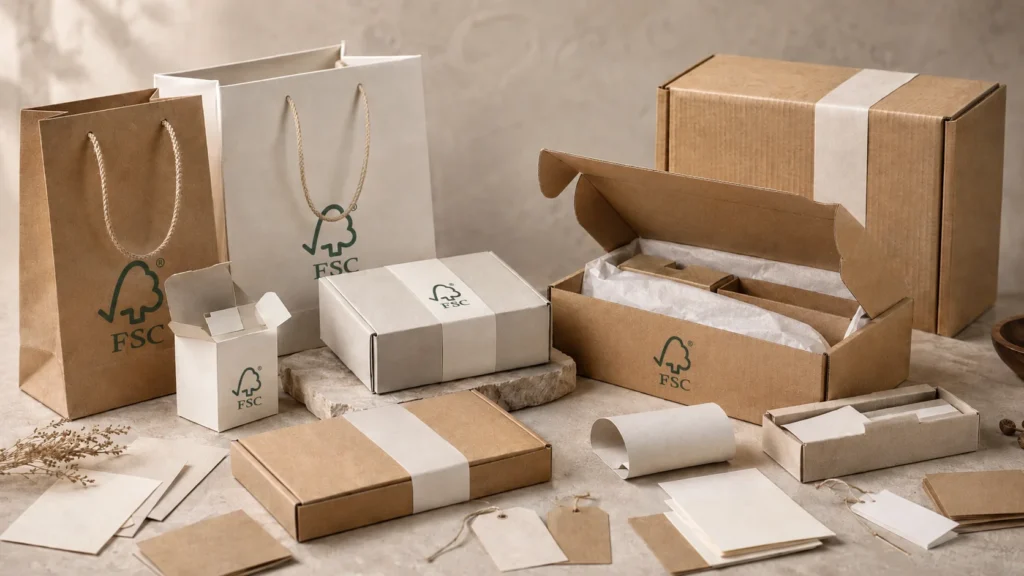
When I choose FSC materials for a packaging project, I do not start by asking only which paper is certified. I first look at what the packaging needs to do. A folding carton, a paper bag, a corrugated mailer, a shipping box, a rigid gift box, a sleeve, and a paper insert all use paper in different ways. Some packaging needs to print beautifully. Some packaging needs to carry weight. Some packaging needs to protect fragile products during shipping. Some packaging needs to feel premium when a customer opens it. FSC certification helps support responsible paper sourcing, but it does not replace the normal material selection process. The right FSC material still needs to match product weight, protection needs, printing effect, surface texture, structure, budget, production quantity, and brand positioning.
FSC Material Selection Should Start with Packaging Function
When I work through material choices with buyers, I always begin with the packaging function before discussing the paper name. This is because the same FSC certification requirement can lead to very different material choices depending on how the package will be used. A skincare carton displayed on a retail shelf does not need the same paper logic as a corrugated mailer box used for e-commerce delivery. A luxury jewelry rigid box does not need the same structure as a lightweight paper sleeve. A paper shopping bag that carries several products must be judged differently from a product card or hang tag.
This is where I often see brands make a mistake. They ask for FSC paper as if FSC paper is one fixed material. In reality, FSC certification can apply to different paper materials, and each material has its own performance. FSC kraft paper, FSC coated paper, FSC paperboard, FSC corrugated board, FSC specialty paper, and FSC wrapping paper can all support responsible sourcing, but they do not behave the same way in printing, folding, cutting, gluing, carrying, wrapping, or shipping.
For me, the better question is not simply whether the material is FSC certified. The better question is whether the FSC certified material is suitable for the exact packaging format and product condition. If the material is certified but too weak, too rough for the artwork, too thin for the box structure, too unstable for repeat production, or unsuitable for the brand’s price position, the final packaging will still create problems. FSC certification gives the material a sourcing foundation, but the packaging still needs to work physically, visually, and commercially.
FSC Materials for Folding Carton Boxes
Folding carton boxes are one of the most common packaging formats where brands consider FSC certified materials. I often see folding cartons used for cosmetics, skincare, candles, food gifts, supplements, small electronics, jewelry accessories, stationery, and other retail products. Because folding cartons are usually printed, die-cut, folded, and glued from flat paperboard, the material needs to support clean creasing, stable structure, accurate printing, and efficient production.
For folding cartons, FSC-certified paperboard is often the starting point. If the brand needs a smooth and bright surface for high-quality printing, FSC-certified SBS paperboard can be a strong option. SBS is often chosen when the brand wants clean white surfaces, refined color reproduction, and a more polished retail appearance. I usually see this direction in beauty packaging, skincare cartons, fragrance packaging, premium supplements, and other categories where the box surface carries much of the brand identity.
FSC-certified coated paper or coated paperboard can also be useful when the artwork needs sharper graphics, stronger color density, or a more finished visual effect. Coated surfaces can make printed colors look cleaner and more controlled, especially when the design includes fine lines, gradients, full-color images, or Pantone matching. However, I still like to check the surface carefully because coating, lamination, ink absorption, and finishing choices can affect the final appearance. A paper that looks good in a sample book may behave differently once it is printed, creased, folded, and handled in real production.
FSC kraft paper or kraft paperboard is often chosen when the brand wants a more natural, simple, or responsible look. I see this material direction in organic skincare, handmade goods, wellness products, natural food, lifestyle accessories, and brands that want a warmer or more understated packaging style. However, I always remind buyers that kraft paper affects color. White ink, black ink, dark logos, and simple line graphics may work beautifully, but bright colors, subtle skin tones, delicate gradients, or exact brand colors may not appear the same as they would on white paperboard. The material can support a strong brand feeling, but the artwork needs to be designed with the paper surface in mind.
CCNB can also appear in folding carton projects when the buyer needs a more cost-sensitive paperboard solution with a printable coated side and a grey or recycled-looking back side. If an FSC claim is required, the buyer still needs to confirm whether the selected CCNB material and supplier process support the required FSC label. I would not choose CCNB only because it is economical, and I would not reject it only because it is not as premium as SBS. I would first check the product weight, box size, printing requirement, folding performance, price target, and brand positioning. A good folding carton material is the one that balances all of these factors honestly.
FSC Materials for Paper Bags
Paper bags may look simple, but I consider them one of the packaging formats where material selection is especially important. A paper bag is not only printed packaging. It is also a carrying tool, a retail touchpoint, and sometimes a moving advertisement for the brand. When a customer holds the bag, the material needs to feel suitable for the product and strong enough for real use. If the paper tears, the handle fails, or the surface scratches easily, the brand experience becomes weaker, even if the paper is FSC certified.
FSC kraft paper is often selected for paper bags when the brand wants a natural and practical appearance. It can work well for lifestyle brands, food products, wellness goods, handmade products, eco-conscious retail, and simple gift packaging. I like kraft paper when the brand identity fits its honest and tactile feeling. However, I always check paper weight, handle construction, bottom reinforcement, glue strength, and product load before approving it. A kraft paper bag should not only look responsible. It should also carry the product safely.
White card paper can be useful when the brand wants the paper bag to feel cleaner and more structured. I often see this choice in cosmetics, jewelry, fashion accessories, beauty retail, gift packaging, and premium store packaging. The white surface gives the designer more control over printed colors and logo presentation. If the bag needs a crisp logo, a specific brand color, or a refined retail appearance, white card paper may be more suitable than kraft paper. If FSC certification is required, the buyer should confirm whether the selected white card paper supports the intended FSC claim and whether the supplier can maintain the certified process.
FSC coated paper can create a smoother and more polished paper bag surface. It may be used when the brand wants strong printing, full-color artwork, photographic images, or a more commercial retail look. However, I think coated paper should be evaluated together with finishing choices. Matte lamination, gloss lamination, foil stamping, embossing, debossing, and special coatings can all change the bag’s look and touch. They can also influence cost, recyclability perception, and sustainability communication. FSC certification supports responsible sourcing, but the brand still needs to decide whether the final surface treatment matches the message it wants to send.
Specialty paper can bring a stronger tactile and premium feeling to paper bags. Textured paper, dyed paper, soft-touch paper, and other decorative paper options can make a shopping bag feel more distinctive. I see this often in jewelry, fragrance, luxury gifts, fashion, and premium lifestyle brands. But specialty paper should not be chosen only by appearance. Some specialty papers may be less suitable for heavy items, deep creases, strong ink coverage, or large bag sizes. When FSC specialty paper is required, availability, MOQ, color consistency, printing effect, and repeat supply should all be checked before the brand commits to the material.
FSC Materials for Corrugated Mailer Boxes
Corrugated mailer boxes are different from retail cartons because their main job is to protect products during delivery. I often tell e-commerce brands that the mailer box is both a shipping structure and a customer experience tool. It has to survive courier handling, stacking, vibration, pressure, and sometimes rough movement, while still presenting the brand well when the customer opens it. FSC-certified corrugated board can support responsible sourcing, but the board still needs the right strength and structure.
When choosing FSC corrugated board for mailer boxes, I first look at product weight, product size, fragility, and shipping distance. A lightweight clothing item may need a different board structure from a glass cosmetic bottle, candle jar, ceramic item, or electronics accessory. If the product is fragile, the outer board alone may not be enough. The brand may also need paper inserts, dividers, molded pulp, paper cushioning, or a tighter internal fit to reduce product movement.
I also look at the mailer’s closing structure. Some mailer boxes need locking tabs, dust flaps, tear strips, double adhesive strips, or easy-return features. These design details affect the paperboard’s folding behavior and durability. If the corrugated material is too weak, the locking structure may not hold well. If it is too thick for the design, the box may be difficult to fold or close neatly. FSC certification does not solve these structural issues by itself, so the material and dieline must be checked together.
Printing on corrugated mailer boxes also needs realistic expectations. Direct printing on kraft corrugated board creates a different effect from printing on white corrugated board or laminated printed paper. Kraft surfaces can create a natural e-commerce feeling, but colors may appear less bright. White surfaces can make branding clearer and cleaner, but may cost more depending on the material and printing method. I usually suggest testing color and surface effect before bulk production, especially when the brand wants the mailer box to be part of the unboxing experience.
FSC Materials for Shipping Boxes
Shipping boxes are often less glamorous than retail packaging, but I consider them essential to the final customer experience. A brand may spend a lot of money on beautiful FSC folding cartons, rigid boxes, paper bags, or gift packaging, but if the outer shipping box is weak, the inner packaging can arrive crushed, dirty, or deformed. This is why I never separate shipping protection from packaging material selection.
FSC-certified corrugated board can be used for shipping cartons, outer cartons, export cartons, and protective transit packaging. In this case, I focus on board strength, carton size, stacking pressure, product weight, packing method, and transportation route. A carton used for local delivery may not need the same strength as one used for international shipping, warehouse storage, pallet stacking, or multi-stage distribution. If the product is heavy or fragile, the board grade and carton structure should be chosen carefully.
For brands that sell through e-commerce, shipping packaging can also affect customer perception. Even if the outer carton is plain, it should arrive clean and intact. If the box is oversized, products may move too much inside. If the box is too small, the retail packaging may be compressed. If the board is too weak, corners may crush. If the packing method is poor, even an FSC-certified carton may fail during delivery. Responsible sourcing and physical protection need to work together.
I also think shipping boxes are important for brands that manage wholesale, retail distribution, or export orders. The outer carton affects how products are packed, stacked, counted, labeled, and received. If FSC certification is part of the brand’s packaging policy, the shipping carton may also need to be reviewed as part of the wider packaging system. The brand may not always print an FSC label on the outer shipping box, but it may still choose FSC corrugated board for sourcing consistency.
FSC Materials for Rigid Gift Boxes
Rigid boxes require a more detailed material discussion because they are usually made from several components. A rigid box may include greyboard or paperboard for structure, wrapping paper for the outer surface, inner lining paper, printed paper, inserts, magnets, ribbons, glue, or decorative elements. When a buyer asks about FSC certified rigid boxes, I always try to clarify which paper-based components are expected to support the FSC claim and how the supplier will manage the production process.
The outer wrapping paper is often the most visible part of a rigid box. It determines much of the box’s color, texture, printing effect, and hand feel. FSC wrapping paper can be used when the brand wants responsible paper sourcing on the visible surface. For luxury cosmetics, jewelry, candle sets, fragrance products, and premium gifts, the wrapping paper may need to feel refined, smooth, textured, or soft to the touch. If the material looks good but cracks during wrapping, scratches easily, or does not hold ink well, the premium feeling will be lost.
The structural board also matters. Rigid boxes are chosen because they feel strong, stable, and premium. The board thickness, density, flatness, and assembly quality all affect the final result. If the brand wants FSC-related claims for the board or other paper-based components, this should be confirmed with the supplier. I do not assume that every part of a rigid box automatically carries the same certification claim, especially when the structure includes multiple paper and non-paper materials.
Inserts are another important part of rigid boxes. A jewelry box may use paperboard inserts, velvet-covered inserts, foam, EVA, or molded pulp depending on the product. A cosmetic gift box may use paperboard dividers or molded pulp trays. A candle gift set may need stronger dividers because glass jars are heavy and fragile. If the brand wants the packaging to be more paper-based and aligned with FSC sourcing, paper inserts or molded pulp may be worth considering, but the material must still protect the product and create the right presentation.
FSC Materials for Sleeves and Belly Bands
Sleeves and belly bands are small packaging structures, but they can have a strong effect on brand presentation. I often see them used around boxes, product sets, candles, cosmetics, books, stationery, food gifts, and subscription products. A sleeve can add branding without replacing the main box, and a belly band can hold a product set together while adding a printed communication area. If FSC material is used, these components can support the brand’s responsible sourcing message in a simple and visible way.
The material for a sleeve needs to balance stiffness and flexibility. If the paper is too thin, the sleeve may wrinkle, tear, or feel low quality. If it is too thick, it may not slide smoothly over the product or inner box. If the product needs a close fit, the material thickness can affect the tolerance. I always like to check the physical movement of the sleeve because a design that looks perfect on a flat dieline can feel too tight or too loose in real use.
Printing also matters for sleeves and belly bands. Since these components often carry the brand logo, product name, sustainability message, or visual pattern, the paper surface must match the artwork. FSC coated paperboard may work well for clean graphics and strong colors, while FSC kraft paper may work better for natural or minimal designs. Specialty paper can create a premium touch, but it should be tested for folding, scuff resistance, and print clarity.
FSC Materials for Paper Inserts and Dividers
Paper inserts and dividers are often overlooked, but I think they are very important for both protection and presentation. An insert holds the product in place, controls movement, improves the unboxing experience, and can make the inside of the package feel organized. If the brand wants to reduce plastic or foam, FSC paperboard inserts, kraft paper inserts, molded pulp inserts, or paper dividers may be considered depending on the product.
For lightweight cosmetics, skincare items, small bottles, and accessories, FSC paperboard inserts can be a practical option. They can be die-cut and folded to hold products in position. For multiple items, paper dividers can separate products and reduce rubbing. For fragile or heavier items, the insert needs to be stronger and better fitted. A candle set, glass bottle, ceramic item, or delicate gift product may need thicker material, deeper structure, or additional cushioning.
I always remind buyers that inserts should not be chosen only because they are paper-based or FSC certified. The insert must actually hold the product securely. If the product shifts during shipping, the outer package may still be damaged internally even when the box looks intact from the outside. The insert should be tested with the real product, not only estimated from dimensions. This is especially important for e-commerce packaging and gift sets, where presentation and protection need to work together.
FSC Materials for Paper Cards Hang Tags and Printed Accessories
Paper cards, hang tags, thank-you cards, instruction cards, product cards, and other printed accessories may seem secondary, but they often influence how customers judge the brand. These small pieces are touched, read, photographed, or kept by customers. If the brand uses FSC certified materials for these components, it can extend the responsible paper sourcing message beyond the main box or bag.
For printed cards, I usually consider paper stiffness, surface smoothness, color reproduction, writing feel, and tactile quality. A thank-you card may need a soft and natural texture. A jewelry card may need firmness and a clean surface to hold earrings or necklaces. An instruction card may need clear printing and good readability. A hang tag may need durability because it is attached, handled, and sometimes rubbed during transport.
FSC paperboard, kraft paper, coated paper, and specialty paper can all be used for these accessories, but each creates a different feeling. A kraft tag can feel natural and simple. A coated card can look polished and commercial. A textured card can feel more premium. A recycled-looking card can support a more responsible story. The right material should match the brand’s tone and the way the accessory will be used.
Match FSC Material to Product Weight Protection and Risk
Product weight and fragility are always central to my material decision. If the product is light and not fragile, a folding carton or paper sleeve may be enough. If the product is heavy, breakable, liquid-filled, sharp-edged, or easily scratched, the material choice needs more protection logic. FSC certification does not change the physical risk of the product. A certified paper box can still fail if the material is too weak or the structure is poorly designed.
For cosmetics, I look at bottle shape, cap protection, product surface, and whether the item may leak or scratch. For candles, I pay attention to glass weight, jar diameter, lid height, and how much movement the product may have inside the box. For jewelry, I think about small product positioning, surface protection, and presentation stability. For e-commerce products, I focus on shipping movement, compression, and whether the package will face multiple handling stages.
This is why I prefer to match FSC material with product risk. A brand may want a beautiful FSC paperboard box, but if the product needs stronger protection, the packaging may require a rigid structure, corrugated outer box, paper insert, molded pulp tray, or additional cushioning. Good FSC packaging should not only carry a sourcing claim. It should also protect the product well enough to preserve the customer experience.
Match FSC Material to Printing Color and Surface Finish
Printing and finishing can change how FSC materials perform and how customers perceive the packaging. I always like to review the artwork before confirming the final paper because some designs depend heavily on paper surface. A design with delicate gradients, photography, metallic effects, or accurate brand colors may require a smoother and more controlled paper surface. A simple black logo on kraft paper may work beautifully, but a full-color cosmetic illustration on the same kraft surface may not meet the brand’s expectation.
FSC coated paper and white paperboard usually provide better color control for detailed printing. FSC kraft paper creates a more natural effect but can make colors darker or less bright. FSC specialty paper can add texture, but the texture may affect ink coverage and foil stamping. FSC corrugated board can be printed directly, but the result depends on the board surface and printing method. This is why I prefer physical proofing or at least material testing before production.
Finishing choices should also be reviewed with the material. Matte lamination can create a clean, modern feeling. Soft-touch lamination can make packaging feel more premium. Foil stamping can add luxury. Embossing and debossing can make the surface more tactile. Spot UV can highlight details. However, these finishes may affect cost, surface behavior, production complexity, and sustainability communication. FSC certified packaging can still look premium, but the brand should make sure the material and finish support the same message.
Match FSC Material to Brand Positioning and Customer Experience
Material is not only technical. It also communicates brand positioning. When I hold a packaging sample, I can often feel whether the material matches the brand before I even read the copy. A thin paper bag for a premium jewelry brand may feel inconsistent. A heavy rigid box for a low-priced everyday product may feel excessive. A rough kraft carton for a clean clinical skincare brand may not match the visual identity. A glossy coated box for a natural handmade brand may feel too commercial.
FSC certified materials can support many different brand styles, but the material needs to be chosen intentionally. A kraft material may express simplicity, naturalness, and honesty. A smooth white paperboard may express cleanliness and precision. A textured specialty paper may express craftsmanship and luxury. A corrugated board may express practicality, protection, and e-commerce reliability. A recycled paper surface may express material reuse and a more grounded sustainability message.
I think this is where good packaging becomes more thoughtful. The FSC claim supports responsible sourcing, while the material surface supports the emotional experience. The customer does not separate these two things when they touch the package. They feel the paper, see the print, notice the structure, and judge the brand as a whole. This is why material choice should always connect certification with customer experience.
Consider Material Availability for Repeat Production
A packaging material should not only look good in the first sample. It should also be available for repeat production. I pay close attention to this because many brands do not think about repeat orders until the product starts selling well. If the selected FSC material is difficult to source again, the brand may face color differences, texture changes, delivery delays, MOQ problems, or price changes later.
This is especially important for brands with multiple SKUs or long-term retail programs. A beauty brand may need the same carton material across several product sizes. A jewelry brand may need matching boxes, cards, and bags. A candle brand may need seasonal gift boxes and repeat single-product boxes. An e-commerce brand may need mailer boxes every month. If the FSC material is unstable, the packaging system becomes harder to manage.
I usually suggest asking about material availability, alternative paper options, batch consistency, MOQ, and lead time before final approval. A rare specialty paper may be beautiful, but it may not be practical for repeat orders. A common FSC paperboard may be less dramatic, but it may be more stable for a growing product line. The best material is not only the one that looks good today. It is the one the brand can rely on over time.
Test FSC Materials with Real Products Before Bulk Production
I never fully trust a material decision until I see how it works with the real product. Paper specifications, sample books, and supplier descriptions are useful, but they cannot fully show how the finished packaging will behave. A folding carton may look good when flat but feel weak after assembly. A paper bag may look strong but fail under real product weight. A mailer box may look neat but allow too much product movement. A rigid box may look premium but have poor lid fit or rough corner wrapping.
This is why sample testing is important for FSC certified packaging. For folding cartons, I check stiffness, crease lines, color result, surface finish, and product fit. For paper bags, I check carrying strength, handle comfort, bottom support, and print durability. For corrugated mailers, I check box strength, closure, product movement, and protection. For rigid boxes, I check wrapping quality, opening feel, corner finishing, insert fit, and overall presentation. For sleeves, inserts, cards, and tags, I check paper thickness, cutting accuracy, print result, and handling feel.
A physical sample helps confirm whether the FSC material works in the real packaging format. It also helps the brand see whether the responsible sourcing claim is supported by a package that feels strong, attractive, and appropriate for the product. In my view, this is the point where certification becomes real packaging.
The Best FSC Material Is the One That Balances Certification and Performance
The main point I want readers to understand is that FSC material selection should never be separated from packaging performance. FSC certification helps answer the sourcing question, but it does not automatically answer the structure, protection, printing, cost, or brand experience questions. A certified material still needs to be suitable for the product and the packaging format.
When I choose FSC materials, I look at the whole project. I consider whether the packaging is a folding carton, paper bag, corrugated mailer, shipping box, rigid box, sleeve, insert, card, or hang tag. I consider whether the product is light, heavy, fragile, premium, retail-ready, or shipped through e-commerce. I consider whether the artwork needs bright color, natural texture, luxury finishing, or simple branding. I consider whether the brand needs low MOQ, repeat order stability, export packing, or retail consistency.
The best FSC certified packaging is not the one with the most attractive certification claim alone. It is the packaging where the FSC material, structure, printing, protection, cost, production process, and brand experience all work together. When these elements are balanced, FSC certified packaging becomes more than a responsible sourcing choice. It becomes a practical and credible packaging solution for the brand.
Match FSC Packaging to Your Product Needs

When I choose FSC certified packaging for a brand project, I never look at certification alone. FSC certification can support responsible paper sourcing, but the package still has to do the real work of packaging. It must protect the product, present the brand properly, fit the sales channel, support printing and finishing, control product movement, and survive retail handling or shipping conditions. This is why I always match FSC packaging to the product first. A cosmetic carton, a jewelry gift box, a candle box, an e-commerce mailer, and a retail packaging system may all use FSC certified materials, but they do not need the same structure, paper strength, insert design, or surface treatment. The best FSC certified packaging is not simply the packaging with the right label. It is packaging that uses responsible paper materials while still working correctly for the product, the brand, and the customer experience.
I Start by Understanding the Product Before Choosing the Packaging
Before I think about box style, paper material, or FSC label type, I first look at the product itself. I want to understand its size, weight, shape, surface, fragility, value, sales channel, and how the customer will receive it. This step is important because packaging should not be chosen from a catalogue only because a structure looks attractive. A package that works well for a skincare tube may not work for a glass candle jar. A box that feels suitable for a necklace may not protect a ceramic product. A mailer that works for apparel may be too weak for cosmetics or gift sets.
I often see brands start with a preferred packaging style before they fully understand the product risk. They may want a folding carton because it is cost-effective, or a rigid box because it feels premium, or a corrugated mailer because it looks suitable for e-commerce. These choices may be reasonable, but they still need to be tested against the product. If the product is heavy, the board thickness and structure need to support that weight. If the product is fragile, the package needs to control impact and movement. If the product has a delicate surface, the inside of the packaging should prevent rubbing and scratching. If the product is sold online, the package must handle shipping pressure, not only look good in photos.
This is why I treat FSC certification as one layer of the decision. It answers the paper sourcing question, but it does not answer every packaging performance question. A certified paperboard can still be too thin. A certified corrugated mailer can still be oversized. A certified rigid box can still have a poor insert. A certified paper bag can still fail if the handle structure is weak. I believe a good FSC packaging decision starts with the product’s real needs and then selects certified materials that can meet those needs.
Cosmetic Packaging Needs Clean Printing Accurate Color and a Premium Surface Feel
Cosmetic packaging usually requires a high level of visual control because beauty customers often judge a product before they open it. The box surface, color, typography, finish, and touch all influence how the product is perceived. When I work with cosmetic packaging, I pay close attention to whether the FSC material can support clean printing, accurate color, sharp details, and a surface feel that matches the brand positioning.
For skincare, makeup, fragrance, and beauty tools, the printed box is often part of the brand’s identity. Many cosmetic brands use soft colors, fine text, delicate lines, gradients, metallic accents, product illustrations, or precise Pantone colors. These details need a paper surface that can carry the artwork properly. FSC certified SBS paperboard, coated paperboard, or high-quality white paperboard may be suitable when the brand needs bright colors, clean contrast, and a refined retail appearance. If the brand chooses FSC kraft paper for a more natural look, I would remind the buyer that the paper color will affect the printing result. Colors may become warmer, darker, or less sharp than they would on a white coated surface.
The surface feel also matters in cosmetic packaging. A clean matte texture, soft-touch finish, smooth coated surface, or subtle embossed detail can help the packaging feel more premium. However, I do not choose finishes only for appearance. I think about whether the finish supports the brand’s message and whether it works with the FSC material. A luxury skincare brand may want a soft matte FSC carton with minimal printing. A natural beauty brand may prefer a more tactile kraft or uncoated paper surface. A clinical skincare brand may need a clean white surface with precise text and strong readability.
Protection is another important part of cosmetic packaging. Bottles, jars, droppers, pumps, tubes, and compacts all have different shapes and different risks. A box that is too loose can allow the product to move. A carton that is too thin can deform during packing or shipping. A product with a shiny or coated surface may be scratched if it rubs against the inside of the box. For some cosmetic products, I would consider paper inserts, folded paperboard supports, sleeves, or outer shipping packaging. FSC certification adds sourcing value, but cosmetic packaging still needs to protect the product and preserve the brand’s visual standard.
Jewelry Packaging Needs Structure Presentation and Insert Precision
Jewelry packaging is different because the product is often small, delicate, emotional, and high in perceived value. A ring, necklace, bracelet, or pair of earrings may not need heavy-duty packaging by weight, but it needs strong presentation control. When I think about FSC certified jewelry packaging, I focus on structure, opening experience, insert fit, surface texture, and the feeling the package creates when the customer first sees the jewelry.
For jewelry brands, the packaging must make the product feel secure and intentional. If a necklace moves inside the box, twists around itself, or hides under the insert, the product loses part of its impact. If a ring is not held upright, it may look less valuable. If earrings are not positioned neatly, the presentation can feel careless. This is why insert design is so important in jewelry packaging. FSC paperboard inserts, paper cards, paper sleeves, and paper-based components can support responsible sourcing, but the shape, cut, tolerance, and product positioning must be precise.
Rigid boxes are often used for jewelry because they create a stable and premium structure. FSC wrapping paper, FSC specialty paper, or certified paper-based components may be used depending on the claim and design. However, I always look beyond the outer paper. I check whether the lid fits smoothly, whether the corners are wrapped cleanly, whether the drawer slides evenly, whether the magnetic closure feels balanced, and whether the insert holds the jewelry securely. A beautiful FSC paper surface cannot compensate for a poor opening experience or weak product positioning.
Jewelry packaging also often includes matching paper bags, cards, sleeves, hang tags, and shipping boxes. I think these supporting components should not be treated as afterthoughts. A premium jewelry box paired with a thin paper bag or weak product card can weaken the full brand experience. If FSC certified materials are used across these components, the brand can create a more consistent responsible sourcing story. But the materials still need to match the emotional value of the product. Jewelry packaging should feel refined, protective, and thoughtful, not only certified.
Candle Packaging Needs Stronger Materials Because of Glass Jars and Product Weight
Candle packaging often needs more structural strength than buyers expect. Many candles are packed in glass jars, ceramic vessels, metal tins, or heavy containers. Even when the product looks simple, it can be dense, fragile, and vulnerable to impact. When I choose FSC certified packaging for candles, I pay close attention to paperboard thickness, rigid structure, corrugated protection, insert design, and how much movement the candle may have inside the package.
A small lightweight candle may work well in an FSC folding carton if the carton fits tightly and the product is mainly sold through retail. But a larger glass candle jar often needs stronger support. The package may need thicker FSC paperboard, a rigid box structure, a corrugated mailer, a fitted paper insert, molded pulp protection, or a protective shipping carton. If the candle is sold online, I would be even more careful because shipping creates more impact, vibration, compression, and handling risk.
I also think candle packaging needs to protect the product surface, not only prevent breakage. Glass jars may have printed labels, metallic lids, coated surfaces, or decorative finishes. If the jar rubs against the box or insert, it may arrive with scratches or marks. If the candle moves inside the box, the lid may loosen, the glass may hit the corners, or the retail packaging may become damaged. FSC certified paper materials can be used to create stronger and more responsible candle packaging, but the structure must be designed around the actual jar size, product weight, and shipping path.
Candle packaging is also closely connected to gifting and lifestyle presentation. A candle box should often feel warm, stable, and gift-ready. The paper texture, color, opening experience, and insert arrangement should match the scent, price point, and brand story. FSC certification can support the responsible sourcing side, but the buyer should still check whether the final package feels worthy of the candle inside. For me, good FSC candle packaging must balance strength, safety, and emotional presentation.
E-commerce Packaging Needs Shipping Strength Right-Sized Structure and Inner Protection
E-commerce packaging has a different purpose from shelf packaging. It must protect the product through delivery while also creating a strong first physical impression for the customer. When I review FSC certified e-commerce packaging, I focus on corrugated strength, right-sized structure, closure design, internal product movement, inner protection, and how the customer opens the package.
A common mistake I see in e-commerce packaging is using a box that is too large. The brand may think extra space is safer, but empty space often creates more movement. If the product slides inside the package, it may hit the corners, damage the retail box, or create a messy unboxing experience. A right-sized FSC corrugated mailer should hold the product securely while still allowing enough room for paper cushioning, inserts, dividers, or protective wrap when needed.
Board strength is also important. A mailer for apparel does not need the same protection as a mailer for cosmetics, candles, glass products, electronics accessories, or gift sets. If the product is fragile or heavy, the brand may need stronger corrugated board, a more secure locking structure, inner dividers, molded pulp, or an additional shipping carton. FSC certified corrugated board supports responsible paper sourcing, but the board still needs to survive real courier handling.
I also consider unboxing. For many online brands, the mailer box is the first real brand touchpoint after the customer orders. The box should open cleanly, protect the product, and present the contents in an organized way. If the brand uses FSC certified materials but the package arrives crushed, oversized, or filled with random protection, the customer experience suffers. E-commerce FSC packaging should not be responsible only in material sourcing. It should also be efficient, protective, and pleasant to open.
Retail Packaging Needs Consistency Across Boxes Bags Sleeves and Displays
Retail packaging has to perform in a public environment. It may sit on a shelf, be handled by customers, placed in a display, scanned at checkout, packed into a shopping bag, or compared side by side with competing products. When I choose FSC certified packaging for retail, I look at the full packaging system, not only one box. The folding carton, rigid box, sleeve, paper bag, hang tag, display packaging, and printed card should feel consistent in material quality and brand expression.
Consistency matters because retail customers often judge a product line visually. If one carton uses a bright white paperboard, another has a warmer paper tone, and another uses a different finish, the product line may look uneven unless the difference is intentional. If the paper bag feels cheaper than the product box, the store experience may feel disconnected. If a sleeve scratches easily after customer handling, the product may look old even before purchase. FSC certification supports sourcing, but paper color, print quality, surface durability, and structural consistency still need to be managed carefully.
Retail packaging also needs to handle repeated touch. A box may be picked up many times before purchase. A paper bag may carry multiple products. A sleeve may be pushed on and off. A display tray may hold products for a long period. The material should resist deformation, rubbing, bending, and surface damage as much as the product category requires. FSC certified material should be selected with these real retail conditions in mind.
I think brands with retail channels should plan FSC materials across the packaging family. A beauty brand may use FSC folding cartons, paper bags, gift boxes, and sleeves. A jewelry brand may use rigid boxes, cards, hang tags, and bags. A candle brand may use single candle boxes, gift boxes, and retail display packaging. When these formats are planned together, the brand can create a clearer responsible sourcing message and a more controlled retail presentation.
Gift Packaging Needs Emotional Value and Practical Product Control
Gift packaging has a special role because it is often designed to create emotional impact. It is not only a container. It is part of the giving experience. When I choose FSC certified materials for gift packaging, I consider how the package looks when opened, how the products are arranged, how secure they feel, and whether the overall presentation matches the price and occasion.
Many gift packages contain multiple products. A skincare set may include bottles, jars, tubes, and cards. A candle gift set may include several glass jars or accessories. A jewelry gift set may include different small items that need separate positioning. A food gift box may include products with different shapes and weights. In these cases, the FSC outer box is only one part of the solution. The inner insert, divider, sleeve, paper card, and shipping protection can be just as important.
I often see gift packaging fail when the outside looks beautiful but the inside is poorly controlled. Products may shift, tilt, collide, or look unorganized when the box is opened. This weakens the gift value immediately. FSC certified paperboard, rigid box structures, paper inserts, molded pulp trays, paper dividers, and sleeves can all be used to build a more responsible gift packaging system, but the structure must be developed around the exact products.
The material should also match the emotion of the gift. A premium gift box may need textured FSC paper, refined printing, clean wrapping, and a stable insert. A natural gift set may work better with kraft paper and simple printing. A holiday box may need stronger color and decorative finishing. The key is not to make gift packaging heavy or complex for no reason. The key is to create a package that feels thoughtful, protects the products, and supports the brand’s responsible sourcing message.
Product Weight Should Guide Material Thickness and Structure
Product weight is one of the first practical details I check because it directly affects material choice. A lightweight product can often use a simpler FSC folding carton, sleeve, or paperboard structure. A heavier product may need thicker board, rigid construction, corrugated protection, stronger glue, reinforced paper bags, or better inner support. If the product weight is ignored, the packaging may deform, tear, collapse, or feel unreliable.
A glass candle jar, ceramic product, bottled cosmetic set, or heavy gift item needs different packaging logic from a small paper card, fabric item, or lightweight accessory. For paper bags, product weight affects paper GSM, handle type, bottom reinforcement, and glue strength. For folding cartons, it affects board thickness, tuck style, and box size. For mailer boxes, it affects corrugated board grade and closure strength. For rigid boxes, it affects board thickness, lid fit, and insert support.
I do not like choosing material thickness only from a standard chart because the product shape and packing method also matter. A compact heavy product may put pressure on the bottom of the box. A tall bottle may need side support. A round jar may roll if the insert is not fitted. A set of products may create uneven weight distribution. This is why I prefer checking the real product in a physical sample before approving the final FSC packaging structure.
Product Fragility Should Guide Protection and Insert Design
Fragility is different from weight. A product may be light but fragile, or heavy but not easily damaged. I always separate these two factors because they lead to different packaging decisions. Fragile products need control over impact, movement, surface contact, and pressure. FSC certified packaging can help support responsible sourcing, but the package still needs the right protective structure.
Glass bottles, candle jars, ceramic items, delicate jewelry, electronics accessories, coated cosmetic containers, and luxury gift products often need inserts or inner protection. A paperboard insert may hold lightweight items in place. A molded pulp tray may support a more protective paper-based solution. A corrugated divider may separate multiple products. A rigid box may provide stronger outer support. A shipping carton may add another layer of protection for e-commerce or wholesale delivery.
I also pay attention to surface fragility. Some products do not break easily, but they scratch, dent, or mark easily. A glossy bottle, metallic lid, printed jar, jewelry surface, or coated accessory can be damaged by rubbing during shipping. In these cases, the insert material, paper texture, and product clearance become important. The packaging should prevent movement without creating friction damage. FSC certified materials can be part of this solution, but the protection needs to be tested with the real product.
Sales Channel Should Shape the FSC Packaging Choice
The same product may need different FSC packaging depending on the sales channel. A product sold in retail needs shelf presentation, barcode placement, product information, and customer handling strength. A product sold online needs shipping durability and unboxing experience. A product sold through wholesale needs outer carton protection and efficient packing. A product sold as a gift needs emotional presentation and product arrangement. This is why I always ask how the product will be sold before choosing the packaging.
If a brand sells through e-commerce, I would usually think more about corrugated mailers, shipping cartons, inner protection, product movement, and delivery damage. If a brand sells through boutiques or department stores, I would focus more on surface appearance, material consistency, retail display, paper bag quality, and presentation. If a brand sells through distributors, I would consider carton packing, labeling, repeat production, and how packaging performs across a longer supply chain.
A common mistake is expecting one package to do everything without adjustment. A retail folding carton may look beautiful on a shelf, but it may not protect the product during courier delivery. A shipping box may protect the product well, but it may not create enough retail value. A gift box may feel premium, but it may need an outer carton for safe transit. FSC certified packaging should be selected according to the real channel, not only the product category.
Brand Positioning Should Influence Paper Texture and Structure
FSC certified packaging can support many different brand styles, but the material and structure should match the brand positioning. I do not believe responsible packaging has to look plain or cheap. I also do not believe premium packaging has to ignore responsible sourcing. The best result happens when the sourcing claim, paper texture, printing effect, structure, and customer experience all feel aligned.
A clean beauty brand may need smooth FSC paperboard, soft colors, accurate printing, and a refined matte finish. A natural wellness brand may prefer FSC kraft paper, simple black printing, and an uncoated surface. A premium jewelry brand may need a rigid structure, textured FSC wrapping paper, and a carefully fitted insert. A candle brand may need warm color tones, stronger board, and a gift-ready structure. An e-commerce brand may need FSC corrugated packaging that feels protective, clean, and efficient.
I think customers read packaging through touch as much as through visuals. A thin box can make a premium product feel weaker. A rough paper may make a clinical skincare brand feel less precise. A glossy surface may not fit a natural brand. A heavy rigid box may feel excessive for a low-priced everyday item. FSC certification gives the brand a responsible paper sourcing foundation, but the final paper and structure should still express the right brand character.
Packaging Should Work in Real Shipping and Retail Conditions
I always remind buyers that packaging does not live in a perfect studio. It moves through production, packing, storage, shipping, retail handling, customer opening, and sometimes returns. FSC certified packaging has to work in these real conditions. A material that looks good in a flat sample may behave differently after folding, gluing, packing, stacking, or delivery.
In shipping, packaging may face vibration, drops, corner pressure, compression, temperature changes, humidity, and rough handling. In retail, packaging may face repeated touch, shelf pressure, display movement, light exposure, and product restocking. In gifting, packaging may need to stay clean and attractive until the moment it is opened. In e-commerce, packaging may need to protect the product and create a good unboxing experience after a difficult delivery journey.
This is why I think FSC packaging should be tested beyond appearance. The buyer should check whether the box closes properly, whether the product moves, whether the corners crush, whether the paper scratches, whether the insert holds the product, whether the mailer survives handling, and whether the package still looks good after real use. A responsible material claim is valuable, but the customer will also judge the package by its condition when it arrives.
A Multi-SKU Brand Needs Packaging Consistency
For brands with multiple SKUs, packaging consistency becomes a major part of the decision. A brand may use one FSC material for a small product box, another for a gift box, another for paper bags, and another for mailer boxes. If these choices are not planned together, the packaging system may feel fragmented. The paper tones may not match, printing results may vary, and sustainability communication may become unclear.
When I work with multi-SKU packaging, I think about how the full product line appears together. A skincare line may need several carton sizes with consistent paper color and finish. A jewelry brand may need matching boxes, cards, sleeves, and bags. A candle brand may need single-product boxes, gift set boxes, and shipping cartons. An e-commerce brand may need mailer boxes, inserts, and printed cards that all feel connected. FSC certified materials can support this system, but they should be chosen with consistency in mind.
This does not mean every packaging format must use the exact same paper. Different formats may require different materials. A corrugated mailer cannot feel exactly like a coated cosmetic carton, and a paper bag may need different strength from a product sleeve. The goal is not identical material everywhere. The goal is a controlled packaging direction where color, texture, quality level, sourcing claim, and brand feeling work together.
Samples Help Confirm Whether FSC Packaging Fits the Product
I never see sampling as a formality, especially when FSC certified packaging needs to balance sourcing, structure, and brand presentation. A physical sample shows what a specification cannot fully explain. It reveals whether the material feels right, whether the product fits correctly, whether the print result matches the brand, whether the insert holds the product, and whether the package opens and closes properly.
For cosmetic packaging, I would check color accuracy, surface feel, box stiffness, and product fit. For jewelry packaging, I would check insert position, lid fit, opening experience, and presentation. For candle packaging, I would test the jar inside the box and check whether the structure can support the weight. For e-commerce packaging, I would check box strength, internal movement, closure security, and shipping protection. For retail packaging, I would check how the package looks when handled, displayed, and grouped with other SKUs.
A sample helps confirm that FSC certification has been matched with real product needs. Without a sample, the buyer may only know that the material is certified, but not whether the package actually works. In my view, the physical sample is where a responsible sourcing decision becomes a real packaging decision.
The Right FSC Packaging Should Protect Present and Perform
The main idea I want readers to remember is that FSC certification is only one layer of packaging selection. It is an important layer, but it is not the whole package. The final packaging still needs to protect the product, present the brand, fit the sales channel, support printing and finishing, control product movement, and perform in real shipping or retail conditions.
When I match FSC packaging to product needs, I look at the full picture. I consider product category, product weight, fragility, material surface, customer expectations, retail display, e-commerce shipping, gift presentation, inner protection, repeat order consistency, and brand positioning. Only then do I decide which FSC certified material and structure make sense.
The best FSC packaging is not the one that simply carries a certification claim. It is the one that makes the certification meaningful by combining responsible paper sourcing with practical product protection and a strong brand experience. When these elements work together, FSC certified packaging becomes more than a sustainability choice. It becomes packaging that supports the product from production to customer hands.
Confirm FSC Logo Use Before Final Artwork
Before I approve final artwork for FSC certified packaging, I always confirm the FSC logo use first. This step may look small compared with material selection, box structure, printing, or sampling, but it can affect the whole packaging project if it is handled too late. Using FSC certified paper does not automatically mean a brand can place the FSC logo anywhere on the package. The FSC label is a controlled trademark mark, and its use needs to match the correct material claim, supplier certification, license code, label type, artwork layout, and approval process. In real packaging projects, I have seen brands complete a beautiful design first and only later discover that the FSC logo cannot be used in the way they expected. That usually leads to artwork revisions, delayed sampling, repeated internal approvals, and sometimes changes to material or supplier selection. This is why I believe FSC logo confirmation should happen before final artwork, not after the packaging design is already finished.
I Treat the FSC Logo as a Verified Claim, Not a Decorative Symbol
When I look at the FSC logo on packaging, I do not see it as a normal design icon. It may be small, simple, and visually familiar, but it represents a verified sourcing claim behind the packaging material. That is why I never recommend treating it like a recycling icon, a leaf graphic, a green badge, or a general environmental symbol that can be added freely to make the packaging look more sustainable.
This is a common misunderstanding because many brands have seen the FSC logo on books, paper bags, cartons, mailer boxes, hang tags, and gift packaging. Since the mark appears often, it can feel like a standard packaging element. But in real packaging development, the FSC logo is connected to certification control and trademark rules. It must match the material source, the supplier’s FSC Chain of Custody certification, the applicable FSC label type, and the approved license code.
I usually explain this to buyers in a very practical way. A brand can design its own logo, color system, product claims, patterns, and layout style. But the FSC logo is not owned by the brand, and it cannot be edited or placed casually. It should be handled through the certified supplier or approved process. Once a brand understands this, it becomes much easier to avoid incorrect artwork decisions.
Using FSC Certified Paper Does Not Automatically Allow FSC Logo Use
One of the most important points I want buyers to understand is that FSC certified paper and FSC logo use are related, but they are not the same thing. A brand may choose FSC-certified paperboard, FSC kraft paper, FSC coated paper, FSC corrugated board, or FSC wrapping paper. That material choice may support responsible sourcing, but it does not automatically mean the final package can carry the FSC label.
This matters because a finished package goes through production. The paper may be printed, laminated, coated, die-cut, folded, glued, wrapped, assembled, packed, and sometimes handled by several production partners. If the final packaging will display the FSC logo, the certified material must remain controlled through the required chain-of-custody process. The supplier or converter responsible for the final FSC claim must be properly certified and able to support the logo use.
I often see buyers assume that if the paper mill provides FSC paper, the packaging designer can immediately add the FSC mark to the artwork. That assumption is risky. The paper source is only one part of the claim. The final packaging still needs to be produced and sold through the correct certified process if the FSC label is going to appear on it. This is why I separate the decision into two questions. First, does the project use FSC certified material? Second, is the finished packaging eligible to carry the FSC logo? The second question must be confirmed before artwork approval.
Confirm Whether the Finished Packaging Can Carry the FSC Logo
Before the design team locks the artwork, I always want to confirm whether the finished packaging can carry the FSC logo at all. This is especially important because the answer may depend on the packaging type, material composition, supplier certification scope, and production process. A simple folding carton may be easier to verify than a luxury rigid box with several paper and non-paper components. A paper bag may involve the main paper body, handles, reinforcement cards, glue, and finishing. A gift set may include an outer box, insert, sleeve, paper card, and shipping carton. Each structure creates different questions.
If the package is made from one main certified paperboard and produced by a certified converter, the logo process may be more straightforward. If the package includes multiple components or outsourced production steps, the supplier needs to explain how the FSC claim applies. I do not like guessing in this stage because a visible logo on the final package should be supported clearly.
A brand may still use FSC certified materials even if it does not print the FSC logo. That can be acceptable when the purpose is internal sourcing, retailer documentation, or material policy. But if the brand wants the FSC logo to appear on the packaging for customer-facing communication, the supplier must confirm that logo use is allowed for the finished product. This confirmation should happen early enough for the designer to create the layout correctly.
Confirm Which FSC Label Type Applies Before Designing the Label Area
Before placing the FSC logo into the packaging artwork, I always confirm which FSC label type applies. FSC 100%, FSC Mix, and FSC Recycled each communicate a different sourcing claim. The brand should not choose the label type only because one sounds stronger or looks better in marketing. The label must match the actual material source and the certified production process.
This detail affects the design more than many people expect. The label wording will be different depending on the claim. The space needed in the artwork may be different. The marketing message near the label may need to be different. If the design team creates space for one label and later discovers that another label applies, the layout may need to be adjusted. On a small carton, narrow sleeve, hang tag, or compact paper card, even a small wording or size change can affect the whole information area.
I prefer to confirm the label type before the designer builds the final information panel. If the project qualifies for FSC Mix, the artwork should use the correct FSC Mix label. If the material qualifies for FSC Recycled, the copy should reflect recycled sources accurately. If FSC 100% is not supported by the selected material, the brand should not place that label just because it sounds stronger. A correct label may be quieter than the brand first imagined, but it protects the credibility of the packaging.
Confirm the Correct FSC License Code
The FSC license code is one of the details I check carefully before final artwork approval. When the FSC label appears on packaging, the license code is connected to the certified organization responsible for the claim. It should not be invented, guessed, copied from another package, or taken from a random online logo file. The correct code should be provided through the certified supplier or the approved process.
This issue can become confusing when several parties are involved. The paper mill may have its own certification. The printer may have another certificate. The packaging converter may be the certified party responsible for the final package. A trading company or sourcing agent may be involved in communication. The brand itself may not be FSC certified. In these situations, the buyer should not assume which code should appear. The supplier needs to clarify which certified organization is responsible for the claim and which license code belongs on the label.
I see the license code as part of the packaging’s technical information, not part of the design style. It must be correct before printing. If the wrong license code appears on a sample, the artwork may need to be revised. If the wrong code appears on bulk packaging, the problem becomes much more serious. Confirming this early is a small step, but it protects the brand from unnecessary risk.
Check Minimum Logo Size and Readability
The FSC logo must remain readable on the final printed package. This sounds simple, but it becomes a real design issue when the packaging is small or visually crowded. I often see designers try to keep the FSC label very subtle because they want the packaging to look clean, premium, or minimal. I understand that design instinct, especially for luxury packaging, but the label still needs to meet minimum size and readability requirements.
Small cosmetic cartons, jewelry cards, candle labels, hang tags, product sleeves, and narrow paper bags can create limited space. These packages may already need product names, ingredients, barcodes, recycling marks, QR codes, country-of-origin details, batch codes, legal text, or multilingual information. If the FSC logo is added at the end, it may be squeezed into a corner where it becomes too small or visually crowded.
I prefer to reserve FSC logo space early in the layout. The label does not need to dominate the design, but it should be clear enough to read after printing, folding, wrapping, or assembly. I also like to check the printed proof rather than relying only on the screen view. A logo that looks readable on a large monitor may become too small on the actual package.
Confirm Logo Color Requirements Before Choosing the Final Artwork Style
Color is another detail that should be confirmed before the artwork is finalized. Many brands want the FSC label to match the packaging design. A beauty brand may want a soft grey logo on a pale carton. A jewelry brand may want a subtle mark on the bottom of a rigid box. A candle brand may want the logo reversed out of a dark background. A natural product brand may want the mark printed on kraft paper. These design choices may be possible in some cases, but they should be confirmed rather than guessed.
I often see FSC logo color become an issue when a brand wants everything in the artwork to feel perfectly matched. The designer may adjust the logo into a brand color or reduce its contrast to make it look more elegant. But if the logo becomes difficult to read or does not follow the allowed color use, the artwork may need revision. This is especially common with dark backgrounds, metallic inks, textured papers, kraft papers, and low-contrast minimalist layouts.
My approach is to balance brand design with correct logo use. The FSC label can be visually subtle, but it should not become unclear. It should feel integrated into the package without losing its correct form and readability. If the brand wants a special color treatment, I would confirm it with the supplier before approving the artwork. This keeps the design refined without creating compliance problems later.
Leave Enough Clear Space Around the FSC Logo
Clear space around the FSC logo is easy to forget, but it is important. The label should not be crowded by barcodes, recycling marks, product text, QR codes, fold lines, cut lines, decorative patterns, or other symbols. When too many elements sit close together, the label becomes harder to read and looks like it was forced into the leftover space.
I often see this problem on the back panels of folding cartons because that area already carries many functional details. It can also happen on paper bags, where the label is placed near the bottom fold, or on mailer boxes, where the logo may sit close to a crease or flap. On rigid boxes, the logo may be placed near wrapped edges or on textured paper, which can make spacing and clarity even more important.
I like to give the FSC label its own breathing room in the layout. This does not mean the label must be large or visually dominant. It simply means it should be placed in a clean area where it can be read properly and where surrounding design elements do not interfere with it. A well-spaced label looks more intentional and professional.
Choose Logo Placement Based on the Packaging Structure
FSC logo placement should be chosen based on the actual packaging structure, not only the flat artwork file. A position that looks perfect on a digital dieline may not work once the package is folded, glued, wrapped, or assembled. This is why I always prefer to review placement on the dieline and, when possible, on a physical sample.
For folding cartons, the FSC label often works well on the back panel, bottom panel, or side panel near other packaging information. For paper bags, the logo may be placed near the lower side or bottom area where it remains visible but does not compete with the main brand logo. For corrugated mailer boxes, the label may appear on a side panel, inner flap, bottom panel, or another area that fits the unboxing experience. For rigid boxes, the label is often placed more quietly on the bottom, inner paper area, or another less dominant surface so the premium presentation is not disrupted.
I also think about what will happen after the packaging is used. A shipping label may cover part of a mailer box. A fold may distort a mark. A sticker may hide the FSC label. A box edge may cut too close to the logo. A paper bag crease may make the label look uneven. These practical details matter because the label should remain clear on the finished package, not only on the artwork file.
Review FSC Logo Placement for Different Packaging Formats
Different packaging formats need different logo placement logic. I would not use the same approach for a cosmetic folding carton, a jewelry rigid box, a paper shopping bag, a candle sleeve, and an e-commerce mailer. Each format has its own structure, customer touchpoints, information layout, and production limitations.
On a cosmetic carton, the FSC label may need to sit near other packaging symbols without interfering with ingredients, barcode, shade information, or regulatory copy. On a jewelry box, the label should usually be discreet because the package depends heavily on a refined presentation. On a candle box, the label may need to work with scent information, safety details, barcode, and decorative design. On a paper bag, the logo should not weaken the main brand presentation or be placed where handle reinforcement affects printing. On a mailer box, the label should not be covered by tape, shipping labels, or return labels.
I like to review each packaging format separately because one placement rule rarely fits every product. If a brand has a full packaging system, such as cartons, bags, sleeves, inserts, and mailers, the FSC logo should be planned across the system with consistency and accuracy. The goal is not to make the logo overly prominent everywhere. The goal is to use it correctly where it makes sense.
Consider Multi-Component Packaging Before Using the FSC Logo
Multi-component packaging needs extra attention because the FSC claim may not apply to every component in the same way. A rigid gift box may include wrapping paper, board, inner lining, paper insert, ribbon, magnet, and glue. A cosmetic set may include an outer box, paper sleeve, printed card, divider, and tray. A candle gift set may include multiple boxes, inserts, and an outer shipping carton. In these cases, the brand should understand what the FSC label refers to before printing it.
I do not like making broad assumptions with multi-component packaging. If the outer paper is FSC certified but some internal components are not, the supplier should explain how the final claim should be handled. If the label appears on the outer package, the brand should know whether it applies to the entire package or to the certified paper-based parts. If the packaging includes non-paper elements such as magnets, ribbons, foam, EVA, plastic windows, or fabric handles, the brand should avoid language that makes the FSC claim sound broader than it is.
This is especially important for premium packaging because the structure is often more complex. A luxury rigid box can absolutely use FSC materials, but the logo decision should be connected to the full construction. The buyer should confirm the material scope, the certified process, and the correct label use before final artwork approval.
Coordinate FSC Logo Use with the Certified Supplier
FSC logo use should be coordinated with the certified supplier because the supplier usually plays a key role in confirming the label type, license code, artwork requirements, and approval process. I always prefer to involve the supplier before the final print file is approved. This prevents the brand from designing a label area that later needs to be changed.
Good supplier coordination also prevents team misunderstandings. The buyer may think FSC paper automatically allows the logo. The designer may think the logo is only a visual element. The marketing team may prepare sustainability copy before the correct label is confirmed. The supplier may assume the brand only needs FSC material and not a visible label. If these assumptions remain hidden, the problem appears late in the project.
I think a professional supplier should be able to explain whether the FSC logo can be used, which label applies, which license code should appear, how the label should be placed, and what approval steps are needed before printing. If the supplier only gives a vague answer, I would pause before approving the artwork. Clear coordination at this stage protects the brand from avoidable mistakes.
Do Not Complete the Design First and Ask About the FSC Logo Later
One of the most common mistakes I see is completing the packaging design first and asking about FSC logo use later. This usually happens because the brand focuses on visual design, structure, colors, finishes, and marketing copy first. The FSC logo is treated as something that can be added at the end. Unfortunately, this approach can create problems.
If the artwork is already finalized, there may not be enough space for the correct label. The design may use the wrong label type. The license code may not be confirmed. The logo may be too small. The selected color may not be suitable. The placement may be too close to a fold, barcode, or edge. The supplier may later say that the logo cannot be used because the material or production process does not support it. At that point, the brand must revise a design it thought was finished.
This becomes even more difficult for multi-SKU packaging. If a brand has ten cartons, three paper bags, two sleeves, and several printed cards using the same wrong FSC label logic, the revision work multiplies quickly. It can delay sampling, retailer approval, production schedules, and launch timing. I always tell buyers that confirming FSC logo use early is much easier than repairing finished artwork later.
Make Sure FSC Logo Use Matches Brand Sustainability Copy
The FSC logo should match the brand’s written sustainability communication. I pay attention to this because many brands use packaging claims in more than one place. The FSC label may appear on the package, while related claims may appear on the website, product page, product insert, retail listing, catalogue, sales deck, or sustainability page. If these messages do not match the actual FSC label, the brand may create confusion.
If the packaging uses FSC Mix, the brand should not write copy that makes the material sound like FSC 100%. If the packaging uses FSC Recycled, the brand should not explain it as if the material comes directly from certified forests. If the packaging uses FSC certified paper but does not carry the FSC logo, the brand should be careful about how public claims are written. The packaging label, material documentation, and marketing copy should tell the same story.
I prefer precise wording over broad environmental language. A clear and accurate statement feels more trustworthy than an exaggerated claim. FSC logo use can support the brand’s responsible sourcing message, but it should not be stretched into a claim about every environmental aspect of the package. Responsible communication is strongest when it is specific and verifiable.
Check FSC Logo Use on Digital Proofs and Physical Samples
Even after the FSC logo is confirmed in the artwork file, I still like to check it on proofs and samples. A digital file can hide real production issues. The label may look clear on screen but print too small. It may sit too close to a fold after the box is assembled. It may lose contrast on kraft paper or textured paper. It may be partially hidden by a flap, sticker, shipping label, or wrapped edge.
For folding cartons, I would check whether the label remains readable after folding and gluing. For paper bags, I would check whether the logo sits cleanly on the panel and does not become distorted by creases or bottom folds. For rigid boxes, I would check whether the placement feels appropriate for a premium package and whether the printing stays clean on the selected paper. For mailer boxes, I would check whether the label is still visible after shipping labels, tape, or handling marks are applied.
This proofing step is not only about avoiding errors. It also helps the packaging look more professional. A correctly placed FSC label can support the brand’s sourcing message without disturbing the design. A poorly placed label can make the packaging feel careless. I think the sample stage is the best time to catch these issues before mass production.
Plan FSC Logo Use Across Multiple SKUs and Packaging Components
For brands with multiple products, I like to plan FSC logo use across the whole packaging system. A brand may have several carton sizes, matching paper bags, sleeves, inserts, hang tags, mailer boxes, and shipping cartons. If the FSC label is handled differently on every item without a clear reason, the packaging system may feel inconsistent.
This does not mean every component must use the same label or the same placement. Different materials and formats may require different FSC claims. A retail carton may use one FSC label, a mailer box may use another, and a paper card may have a different material source. The important thing is to manage the differences intentionally. The brand should know which components carry the logo, which components use FSC materials without visible labels, and how the communication should be explained.
When this is planned early, the design system becomes easier to manage. The FSC label can sit consistently in similar areas across product cartons. Paper bags can use a suitable discreet placement. Mailer boxes can place the logo where it will not be covered by shipping labels. Inserts and cards can avoid unnecessary marks if space is too limited. This makes the whole packaging program feel more controlled.
Confirm FSC Logo Use Before Retail or Distributor Submission
If the packaging will be submitted to retailers, distributors, or import partners, I would confirm FSC logo use before sending the artwork for review. Retailers and distributors may ask for packaging documentation, material information, or proof that the claim is supported. If the logo is wrong or the claim is unclear, the brand may need to revise the artwork after submission, which can delay approval.
This matters especially for brands entering more demanding markets or working with larger retail partners. A buyer, category manager, sustainability team, or compliance reviewer may look at the packaging more carefully than a normal customer. If the FSC label, license code, artwork claim, and supplier documentation do not align, the brand may look unprepared.
I think early FSC logo confirmation gives the brand more confidence before external review. The buyer can explain which material is used, which label applies, who the certified supplier is, and how the logo was approved. This makes the packaging claim feel more professional and reduces back-and-forth communication with retail partners.
Build FSC Logo Confirmation into the Artwork Workflow
The best way to avoid FSC logo problems is to build logo confirmation into the normal artwork workflow. I do not wait until the final file is ready for printing. I prefer to confirm FSC logo use during material selection, supplier verification, label type confirmation, and dieline planning. This makes the process smoother because the artwork is created with the correct information from the beginning.
In my ideal workflow, I first confirm whether the packaging uses FSC certified materials and whether the finished package can carry the FSC label. Then I confirm the correct FSC label type and license code through the certified supplier. After that, I review the minimum size, color, clear space, and placement on the dieline. Then I check the logo on proofs or physical samples before mass production. This sequence helps the brand avoid guessing and reduces the chance of last-minute corrections.
For me, this step is not only about following logo-use rules. It is about protecting the brand’s credibility, production schedule, and customer trust. The FSC logo may be small, but the decision behind it is important. When a brand confirms logo use before final artwork, it shows that the packaging claim is being handled professionally, not added casually at the end.
Balance Printing Finishes with Sustainability Claims
When I choose FSC certified packaging for a brand, I never believe the package has to look plain, unfinished, or low-cost just because it uses responsibly sourced paper materials. FSC certified packaging can still be elegant, colorful, tactile, premium, and highly branded. It can use CMYK printing, Pantone color matching, matte lamination, soft-touch lamination, foil stamping, embossing, debossing, spot UV, specialty paper textures, and many other common packaging finishes. However, I also believe this is one of the areas where brands need to be especially careful. FSC certification mainly speaks about responsible sourcing of forest-based materials. It does not automatically mean the finished package is fully recyclable, plastic-free, compostable, biodegradable, or environmentally perfect in every way. When printing and finishing become more complex, the brand needs to make sure the packaging appearance, material claim, recyclability expectation, cost, production process, and customer understanding all stay aligned.
I Do Not Think FSC Certified Packaging Has to Look Basic
When I talk with buyers about FSC certified packaging, I often hear a hidden concern. Some brands worry that if they choose FSC certified materials, the package may have to look too simple, too natural, or not premium enough for their category. I understand where this concern comes from because many responsible-looking packages use kraft paper, minimal printing, uncoated surfaces, and simple black logos. That style can be beautiful when it matches the brand, but it is not the only way to design FSC certified packaging.
FSC certification is about the sourcing and control of forest-based materials. It does not require every package to look brown, rough, or plain. A luxury skincare carton can use FSC certified white paperboard with clean Pantone printing. A jewelry brand can use FSC specialty paper with a refined embossed logo. A candle gift box can use FSC wrapping paper, rich color, and subtle foil stamping. An e-commerce brand can use an FSC corrugated mailer with strong brand printing and a clean unboxing experience. These packaging directions can still work with FSC certified materials when the material source, supplier certification, and production process support the claim.
I think this is an important point for brand buyers because packaging still has to sell the product. If the package looks too basic for the product’s price point, the customer may not feel the value. If the package looks premium but the sourcing claim is unclear, the brand may miss an opportunity to build trust. The better goal is not to choose between premium appearance and responsible sourcing. The better goal is to make both sides work together in a way that feels honest and appropriate for the product.
I Separate Responsible Sourcing from Recyclability and Other Claims
Before choosing finishes, I always separate FSC certification from other sustainability ideas. FSC certification supports responsible paper sourcing and chain-of-custody control for forest-based materials. It helps the brand explain where the paper material comes from and whether the claim is supported by a certified system. That is valuable, but it is not the same as saying the finished packaging is recyclable everywhere, plastic-free, compostable, biodegradable, made only from recycled content, or low carbon.
This distinction becomes very important when the packaging uses premium finishes. A folding carton may use FSC certified paperboard and still have matte lamination. A rigid gift box may use FSC wrapping paper and still include magnets, ribbon, glue, or foam inserts. A paper bag may use FSC paper and still have foil stamping or rope handles. A mailer box may use FSC corrugated board and still include printed ink coverage, adhesive strips, or special coatings. In each case, the FSC claim remains connected to the paper sourcing, while the full environmental profile depends on the complete material and finishing system.
I often remind brands that customers may not understand these differences clearly. A customer may see the FSC label and assume the whole package is environmentally responsible in every possible way. If the packaging also has heavy lamination, metallic effects, plastic windows, magnets, or non-paper inserts, the customer may not know how to interpret the message. This does not mean these finishes are wrong. It means the brand should avoid using one sourcing claim to imply broader environmental benefits that the full package may not support.
Premium Design Should Not Create Sustainability Confusion
Premium packaging can support a brand beautifully, but I think it needs to be designed with restraint when sustainability communication is part of the story. If the package uses FSC certified paper but is covered with multiple layers of finishes, large foil areas, heavy lamination, plastic windows, non-paper inserts, and decorative accessories, the customer may feel mixed signals. The brand may want to communicate responsibility, but the package may visually communicate excess.
This is not only an environmental issue. It is also a brand trust issue. Customers may not know the technical details, but they can feel when a package is trying to say too many things at once. If a brand says the packaging is responsibly sourced but the design feels overbuilt or difficult to dispose of, the message may become less convincing. If the brand uses FSC materials and keeps the finishing choices focused, the claim usually feels more credible.
I like to think of finishing as a way to support the brand story, not cover the package with decoration. A premium brand does not need every finish at once. One carefully chosen surface, one clean foil logo, one embossed detail, or one well-selected paper texture can often create more value than several competing effects. Responsible packaging can still be beautiful, but the beauty should feel intentional rather than excessive.
CMYK Printing Can Support Detailed Brand Artwork
CMYK printing is one of the most common methods used in custom paper packaging, and it can work well with many FSC certified paper materials. I often see CMYK printing used for cosmetic cartons, candle boxes, paper bags, corrugated mailers, product sleeves, inserts, and retail packaging that includes illustrations, gradients, product images, patterns, or full-color brand artwork. When the paper surface is suitable, CMYK printing can help FSC certified packaging look professional and commercially strong.
However, I do not judge CMYK printing only by the artwork file. I always think about the paper surface. A smooth coated FSC paperboard usually gives cleaner detail and brighter color. An uncoated FSC paper may create a softer, more natural result. FSC kraft paper may make colors look warmer, darker, or less saturated because the base color of the paper affects the ink. FSC corrugated board may create a more practical and textured printing effect, especially for e-commerce mailers and shipping boxes. The same artwork can look very different on each material.
This is why I think brands should match CMYK artwork with the right FSC material before finalizing the design. If the brand expects sharp cosmetic visuals, fine typography, product photography, or bright color blocks, the paper should be chosen accordingly. If the brand wants a natural and understated feeling, a softer print result may be acceptable and even desirable. FSC certification gives the paper sourcing value, but the printed surface still determines how the customer sees the brand.
Pantone Color Matching Needs Real Paper Testing
Pantone color matching is very important for brands that rely on precise color identity. I see this often with beauty brands, fragrance brands, jewelry packaging, candle packaging, fashion accessories, food gifts, and premium retail packaging. A specific beige, pink, green, navy, black, or metallic tone may be part of the brand’s recognition. If the color shifts too much, the package may no longer feel like the brand.
When FSC certified paper is used, Pantone matching still needs careful testing. The same Pantone color can look different on coated paper, uncoated paper, kraft paper, textured paper, recycled paper, and corrugated board. A coated white surface may show the color clearly. An uncoated surface may absorb more ink and soften the color. A kraft base may change the color dramatically. A textured paper may break up the ink surface and make the color feel more tactile but less uniform.
I always prefer checking color on the actual FSC material rather than relying only on a screen or digital proof. A digital file cannot show paper absorption, surface texture, ink density, coating effect, or the way light interacts with the printed surface. This becomes even more important for repeat orders because brand color consistency across multiple production runs can affect perceived quality. FSC certified packaging should not only be responsible in sourcing. It should also be visually consistent enough for the brand’s market position.
Matte Lamination Can Improve Surface Quality but Needs Clear Communication
Matte lamination is often used when a brand wants a clean, modern, and refined surface. I see it frequently on cosmetic boxes, skincare cartons, jewelry packaging, candle gift boxes, paper bags, and premium retail packaging. It can reduce glare, protect the printed surface, soften the visual effect, and make the package feel more finished. When paired with FSC certified paperboard, matte lamination can create a package that feels both responsible and polished.
However, I always consider how matte lamination affects the broader sustainability message. Lamination adds a surface layer to paper packaging. Depending on the material type, film structure, and local recycling system, it may affect recyclability or how customers understand disposal. The FSC claim remains about paper sourcing, but a recyclability claim would need to be considered separately. I do not want a brand to assume that FSC certified paper with lamination automatically means the entire package is easy to recycle in every market.
This does not mean matte lamination should be avoided. In many categories, it improves the packaging experience and protects the printed surface during handling. The important thing is to use it intentionally and communicate accurately. If the brand’s main message is responsible paper sourcing and premium presentation, matte lamination may fit well. If the brand’s main message is low-impact, plastic-free, or easy recycling, the finish should be reviewed more carefully before approval.
Soft-Touch Lamination Can Feel Luxury but Should Fit the Brand Positioning
Soft-touch lamination can make packaging feel very premium. It creates a smooth, velvety surface that customers often associate with luxury beauty, fragrance, jewelry, candle packaging, and high-end gift boxes. I understand why brands like it because it immediately changes the hand feel of the package. When used with FSC certified paperboard or wrapping paper, soft-touch lamination can create a strong balance between responsible sourcing and a refined customer experience.
At the same time, I think soft-touch lamination should be chosen carefully. It adds cost, production complexity, and an extra surface treatment. It may also affect recyclability depending on the full packaging structure and local recycling conditions. If a brand’s message is highly natural, minimal, or focused on easy paper recycling, a soft-touch laminated surface may not feel fully aligned. If the brand is positioned as luxury skincare, premium gifting, or high-end retail, the finish may support the customer’s expectation.
I usually ask whether the customer will value the soft-touch feeling enough to justify the added process. For some products, the answer is yes. A luxury serum box, a premium fragrance sleeve, or a jewelry gift box may benefit from that tactile softness. For other products, an uncoated textured FSC paper or a simple matte paperboard may express the brand more honestly. The best finish is the one that fits the product value, not the one that sounds most premium.
Foil Stamping Can Add Value When It Is Used with Restraint
Foil stamping is one of the most common ways to create a premium packaging impression. It can highlight a logo, product name, border, pattern, icon, or small decorative detail. I often see gold foil, silver foil, rose gold foil, holographic foil, and custom metallic foils used in jewelry packaging, cosmetic boxes, candle boxes, rigid gift boxes, paper bags, and luxury retail packaging. When used with FSC certified paper materials, foil can make the package feel more refined without changing the paper sourcing claim.
However, I usually prefer foil stamping as an accent, not as the main message of the package. A small foil logo on an FSC specialty paper can feel elegant and controlled. A delicate metallic line on a candle box can add warmth. A subtle foil detail on a jewelry box can make the brand feel premium. But if foil is used across large areas without a clear reason, the packaging may feel excessive and may weaken the responsible sourcing message.
Foil stamping also affects cost and production control. It requires tooling, pressure, heat, registration accuracy, and quality inspection. If the artwork has fine lines, small text, or complex patterns, the supplier should test whether the foil can transfer cleanly on the selected FSC paper. Textured paper can create beautiful effects, but it may also make foil registration more difficult. This is why I like to confirm foil performance through a sample before bulk production.
Embossing and Debossing Can Add Quiet Premium Detail
Embossing and debossing are finishes I often like for FSC certified packaging because they can create tactile value without relying heavily on ink or metallic decoration. Embossing raises part of the surface, while debossing presses it inward. Both effects can make a logo, pattern, or detail feel more physical and memorable. They work especially well when a brand wants quiet luxury, natural refinement, or a more tactile packaging experience.
For jewelry packaging, embossing can make a logo feel more elegant. For cosmetic cartons, debossing can create a clean and modern detail. For candle boxes, a subtle embossed pattern can support a warm and gift-ready feeling. For paper bags, a raised logo can make the bag feel more carefully made. These finishes can work well with FSC paperboard, wrapping paper, and specialty paper when the material has enough strength and surface quality.
Still, embossing and debossing need testing. Thin paper may not hold the effect well. Very textured paper may make fine details less clear. Deep embossing may create cracking if the paper surface is not suitable. Small text may not be readable after embossing. On rigid boxes, the pressure and wrapping process need to be controlled carefully. I usually prefer to check a physical sample because tactile finishes are hard to judge from artwork alone.
Spot UV Can Create Contrast but Should Not Overpower the Message
Spot UV is used to create glossy contrast on selected areas of a package. It can highlight a logo, product name, pattern, illustration, or design detail. I often see it used on matte cosmetic cartons, premium gift boxes, paper bags, product sleeves, and promotional packaging. When used carefully on FSC certified packaging, spot UV can create a modern and polished effect.
However, I think spot UV should be used with care when the brand wants to communicate sustainability. A small glossy highlight can feel premium, but heavy spot UV coverage may make the package look more synthetic or heavily processed. It may also affect how customers think about recyclability, even if the FSC claim itself is about paper sourcing. This is why I prefer spot UV to support a specific design purpose rather than become a decorative layer added everywhere.
A subtle logo highlight, a low-contrast pattern, or a small visual accent can work well. Large glossy areas, complex spot UV patterns, or unnecessary shine may not fit every responsible packaging story. I always ask whether the effect improves the customer’s understanding of the brand. If it only adds cost and visual noise, I would simplify it.
Specialty Paper Textures Can Reduce the Need for Heavy Decoration
Specialty paper textures can be a very useful way to create premium FSC certified packaging without relying too much on lamination, heavy ink, or large decorative finishes. Textured paper, dyed paper, natural fiber paper, soft paper, embossed paper, and other specialty stocks can give the package a strong tactile identity. I often see this approach used for jewelry boxes, candle packaging, fragrance boxes, paper bags, gift boxes, sleeves, and brand cards.
When an FSC certified specialty paper is available, it can help a brand communicate both refinement and responsible sourcing. A textured wrapping paper on a rigid box can feel premium even with a very simple logo. A colored FSC paper can reduce the need for full-surface ink coverage. A natural fiber texture can make the package feel more organic and tactile. A soft specialty paper can make a gift box feel more carefully considered.
However, specialty paper should always be tested in the real packaging structure. Some textured papers do not print fine details clearly. Some dyed papers show color variation between batches. Some soft papers scratch more easily. Some specialty papers crack when wrapped around sharp corners or folded deeply. Some may have higher MOQ or longer lead time. I like specialty papers, but I do not choose them only from a swatch book. I need to see how they behave when printed, folded, wrapped, handled, and packed.
Heavy Ink Coverage Can Affect Appearance Cost and Customer Perception
Heavy ink coverage is another detail brands should think about. A package may use FSC certified paper, but if the design uses full-surface dark ink, large color blocks, or multiple heavy ink layers, the final result may feel different from what the brand expects. Heavy ink can affect drying time, rubbing resistance, color consistency, surface feel, and production cost. On some papers, it may also reduce the natural tactile quality that made the material attractive in the first place.
For example, a brand may choose FSC kraft paper because it wants a natural look, but then cover most of the paper with heavy ink. In that case, the natural material character becomes less visible. A brand may choose a specialty paper for texture but use a full-color print that hides the texture. A brand may choose a recycled-looking paper but apply a very glossy finish that changes how customers perceive it. These choices are not necessarily wrong, but they should be intentional.
I prefer using the material itself as part of the design. If the paper has a strong natural texture, let that texture contribute to the brand story. If the paper is smooth and white, use it for clean printing and color control. If the paper is colored, consider whether minimal printing can achieve the desired effect. This approach often creates packaging that feels more coherent and less over-processed.
Finishing Choices Can Affect Cost MOQ and Lead Time
Printing and finishing choices directly affect cost, MOQ, and lead time. I often see buyers compare packaging prices without realizing how much finishing complexity changes the quotation. A simple FSC carton with one-color printing is very different from an FSC carton with CMYK printing, Pantone color matching, matte lamination, foil stamping, embossing, and spot UV. A paper bag with simple black printing is very different from a coated paper bag with lamination, rope handles, foil logo, and reinforced base.
Each finishing process adds production steps. Foil stamping may require a metal die. Embossing and debossing require tooling and pressure control. Spot UV requires registration accuracy. Lamination adds material and process time. Specialty paper may need longer sourcing time. Pantone printing may require color matching and proofing. When FSC certified materials are also required, the supplier needs to coordinate material availability and certification control with these production processes.
I do not think brands should avoid finishing only because it adds cost. Some finishes genuinely improve perceived value and help the product sell. But I do think every finish should have a reason. If a finish supports the brand, improves the touch, protects the print, or strengthens the product presentation, it may be worth the cost. If it is added only because it is available, it may create unnecessary complexity.
Finishes Should Be Chosen Based on Sales Channel
The sales channel should influence finishing decisions. Retail packaging often needs stronger shelf impact, better surface durability, and consistent color across SKUs. E-commerce packaging needs to survive shipping and still look good when opened. Gift packaging needs to create emotion and presentation value. Wholesale packaging may need more practical protection and efficient packing. Each channel changes how much finishing is useful.
For retail packaging, matte lamination, Pantone color, embossing, or foil stamping may help the product stand out and feel premium. For e-commerce packaging, heavy luxury finishes on the outer shipping box may not be necessary if the package will face courier handling, labels, tape, and abrasion. For gift packaging, a refined paper texture or small foil detail may matter because the package is part of the gifting moment. For subscription packaging, the mailer may need to balance brand impact with cost and durability.
I always ask where the customer will first touch the package. If the package sits on a shelf, the surface and color matter a lot. If the package travels through delivery, strength and scuff resistance matter more. If the package is opened as a gift, the inside presentation and tactile details become important. FSC certified materials can support all of these channels, but the finishing strategy should change with the way the package is used.
Customer Understanding Matters as Much as Technical Accuracy
Even when a packaging claim is technically accurate, the customer may still misunderstand it. This is why I think brands should consider how the final package will be perceived. If the package carries an FSC label and also uses heavy plastic-like lamination, glossy UV, foil, ribbon, and foam, some customers may feel uncertain about what part of the packaging is responsible. They may wonder whether the brand is using the FSC mark to cover a package that otherwise feels excessive.
I do not think customers expect every responsible package to be perfectly simple. Many customers understand that premium products need good presentation. But they do expect the message to feel honest. If the brand wants to communicate responsible paper sourcing, the visual and material choices should not completely contradict that message. A refined package with controlled finishing can feel credible. A heavily decorated package with broad sustainability language may feel less credible.
This is why I prefer specific claims. Instead of saying the entire package is sustainable, a brand can explain that the paper material is FSC certified or responsibly sourced. If the package is recyclable in the target market, that claim can be considered separately. If it uses recycled content, that should be stated accurately. Clear communication helps customers understand what the packaging does well without creating unrealistic expectations.
Premium Packaging Should Use Restraint Instead of Excess
In premium packaging, restraint often creates more value than excess. I have seen packaging become more elegant when the brand removes unnecessary finishes instead of adding more. A high-quality FSC paper with a clean logo can look stronger than a package with too many effects. A subtle embossed detail can feel more refined than a large metallic area. A well-matched Pantone color can communicate more clearly than a complicated full-color design.
This is especially important when FSC certification is part of the packaging story. Responsible sourcing and premium presentation can work together best when the design feels intentional. If every surface is covered, every detail is decorated, and every finish competes for attention, the FSC message may become background noise. If the design is controlled, the FSC material and the brand identity can both stand out.
I usually suggest that brands choose one or two finishes that matter most to the customer experience. A beauty brand may choose soft-touch lamination and embossing. A jewelry brand may choose textured paper and foil stamping. A candle brand may choose matte lamination and debossing. An e-commerce brand may choose clean direct printing and a strong corrugated structure. The right combination depends on the product, but restraint usually helps the packaging feel more professional.
Test the Actual FSC Material with the Actual Finish
I always recommend testing the actual FSC material with the actual printing and finishing process before bulk production. A paper swatch and a digital artwork file cannot fully predict the final result. Ink may absorb differently. Foil may not transfer cleanly. Embossing may lose detail. Lamination may change the color tone. Spot UV may look uneven. A textured paper may make small text less clear. A dark printed surface may show scratches more easily.
This testing is especially important for packaging that needs both premium appearance and responsible sourcing. For cosmetic packaging, I would check color accuracy, fine text, surface smoothness, and finish consistency. For jewelry packaging, I would check tactile feel, foil quality, embossing detail, and edge finishing. For candle packaging, I would check scuff resistance, board strength, and how the finish handles product weight. For paper bags, I would check folding lines, handle areas, logo clarity, and rubbing resistance. For mailer boxes, I would check print durability after handling.
A physical sample helps the brand decide whether the finish truly supports the package. Sometimes the sample confirms the design beautifully. Other times, it shows that the finish should be simplified, the paper should change, or the artwork should be adjusted. I would rather discover that during sampling than after mass production.
The Best Finish Supports Both the Brand and the Claim
The main idea I want readers to remember is that FSC certified packaging can be premium, but the finishing choices should support both the brand and the claim. FSC certification tells a paper sourcing story. Printing and finishing tell a visual and tactile brand story. These stories should feel connected. If they conflict, the packaging may confuse customers instead of building trust.
When I balance printing finishes with sustainability claims, I look at the FSC material, the product category, the printing method, the surface finish, the expected customer perception, the sales channel, the cost, the recyclability expectations, and the brand’s written claims. I ask whether each finish improves the package or only adds decoration. I ask whether the sustainability language is precise. I ask whether the finished package feels honest for the product and price point.
For me, the best FSC certified packaging is not always the simplest package, and it is not always the most luxurious package. It is the package where responsible sourcing, material performance, printing quality, finishing details, customer experience, and honest communication work together. When this balance is right, the brand can create packaging that looks beautiful, feels premium, and still communicates responsibility in a clear and credible way.
Consider Cost MOQ and Lead Time
When I evaluate FSC certified packaging for a brand, I never look at cost, MOQ, and lead time as three separate questions. In real packaging projects, these three factors are connected. A low unit price may come with higher MOQ. A special FSC paper may improve the packaging story but require longer sourcing time. A premium finish may strengthen the brand image but increase tooling cost and production complexity. A stronger structure may raise the packaging cost but reduce damage risk during shipping. This is why I always encourage buyers to look beyond the first quotation and understand the full cost behind FSC certified packaging. The right decision is not only about choosing the lowest unit price. It is about choosing packaging that fits the product, supports the FSC claim, protects the brand image, works within the production timeline, and remains stable for repeat orders.
I Look at the Full Packaging Cost, Not Only the Unit Price
When a buyer compares FSC certified packaging quotations, the first number they usually notice is the unit price. I understand this because unit price directly affects product margin. However, I do not think unit price alone tells the full story. A package that looks cheaper on paper may become more expensive if it causes product damage, inconsistent printing, weak structure, delayed production, poor customer experience, or repeat order instability.
In packaging, the real cost includes more than the printed box, bag, or mailer itself. It includes material selection, printing setup, tooling, sampling, color proofing, finishing, assembly, packing, shipping protection, storage efficiency, damage rate, and repeat order control. If the packaging carries an FSC label, it may also involve certificate verification, material claim confirmation, logo approval, and artwork checking. These steps may not always create a large extra charge, but they do require time and proper management.
I usually ask buyers to think about what the packaging is expected to protect and communicate. If the product is fragile, premium, retail-facing, or shipped internationally, a slightly higher packaging cost may be reasonable if it reduces damage and supports the brand’s positioning. If the product is lightweight, low-risk, and simple, a more economical FSC packaging solution may be enough. The point is not to choose expensive packaging automatically. The point is to understand the full value and risk behind the price.
FSC Certification May Affect Cost, but It Is Rarely the Only Cost Factor
Many buyers ask whether FSC certified packaging is more expensive. My honest answer is that it depends. FSC certification can affect cost, but it is rarely the only reason a package becomes expensive. The final price is usually influenced by paper availability, paper grade, board thickness, packaging structure, printing method, finishing process, order quantity, production complexity, and how the FSC claim needs to be handled.
For example, an FSC certified folding carton with simple printing may be much more cost-effective than a non-FSC rigid box with specialty paper, foil stamping, soft-touch lamination, and a custom insert. An FSC corrugated mailer with one-color printing may be more economical than a heavily finished paper shopping bag with coated paper, rope handles, lamination, and embossing. A simple FSC kraft sleeve may cost less than a luxury non-FSC gift box with magnets and multiple finishing processes. This is why I do not like judging cost by certification alone.
I prefer to break the quotation down by material, structure, print, finish, insert, packing, and certification requirement. Once these parts are clear, the buyer can see what is really driving the cost. Sometimes the FSC material is only a small part of the difference. Sometimes the special paper availability matters more. Sometimes the structure or finish creates the largest cost increase. This helps the brand make better decisions instead of assuming that FSC is always the main reason for a higher price.
Paper Availability Can Change the Price Quickly
Paper availability is one of the first things I check when FSC certified packaging is required. If the selected FSC paper is commonly available, the project can usually move more smoothly. If the brand needs a special FSC paper grade, special thickness, textured surface, unusual color, recycled content, coated surface, or imported paper, the cost and lead time may change. The supplier may need to check paper stock, mill availability, minimum purchase quantity, and delivery time before confirming the final quotation.
I often see brands fall in love with a paper sample before checking whether that paper is available in an FSC certified version. This can create problems later. The paper may be available but only at a higher MOQ. It may be available in one thickness but not another. It may support FSC Mix but not FSC 100%. It may be available for sampling but not stable for repeat orders. It may have a longer lead time than the product launch allows. These details can affect the project even before printing begins.
This is why I prefer confirming paper availability before final design approval. If the brand needs a specific look, such as smooth white cosmetic paperboard, natural kraft paper, greyback board, specialty textured paper, recycled paper, or FSC corrugated board, the supplier should confirm what options are realistic. A beautiful material choice is only useful if it can be purchased, certified, produced, and reordered in a stable way.
Material Grade Thickness and Strength Affect the Real Value
Material grade and thickness directly affect cost, but they also affect packaging performance. I never choose a material only because it is the cheapest option. A thinner FSC paperboard may reduce the unit price, but it may also make the carton feel weak, deform during packing, crack at fold lines, or lose shelf appeal. A lighter paper bag may look acceptable in a photo, but it may tear when the customer carries heavier products. A weaker corrugated board may reduce cost but increase shipping damage. A thin rigid box structure may save money but reduce the premium hand feel.
For me, the right material thickness depends on the product. A lightweight product may not need heavy board. A glass candle jar, ceramic item, premium cosmetic jar, gift set, or bottled product may need stronger support. A jewelry box may not need strength because of weight, but it may need structure because of presentation value. A mailer box for clothing may be lighter than a mailer box for glass products. Each category has a different risk profile.
I think buyers should compare material cost with product value and damage risk. If the product is inexpensive and low-risk, a simple FSC material may be appropriate. If the product is fragile or premium, saving a small amount on material may create a larger problem later. A damaged product, a crushed box, or a poor unboxing experience can cost more than the paper savings. Good packaging cost control is not always about using less material. It is about using the right material for the right risk.
Packaging Structure Can Have a Bigger Cost Impact Than FSC Material
The structure of the packaging often affects cost more than buyers expect. A folding carton, paper bag, rigid box, corrugated mailer, sleeve, insert, and shipping carton all follow different production logic. Even when all of them use FSC certified paper materials, their costs and MOQ may be very different because the production steps are different.
A folding carton is usually printed, coated or finished, die-cut, folded, and glued. It can be efficient for higher-volume retail packaging. A paper bag may require paper cutting, printing, folding, handle attachment, bottom reinforcement, and assembly. A rigid box may require thick board cutting, wrapping paper, gluing, corner forming, lining, insert fitting, and more manual work. A corrugated mailer may involve corrugated board selection, printing, die-cutting, creasing, folding, and packing. These differences create different cost structures.
I always tell buyers that a more premium structure usually costs more because it uses more material, more labor, and more production steps. This does not mean premium structures are wrong. A rigid box may be completely justified for jewelry, candles, luxury cosmetics, fragrance, or gift sets. But if the product only needs basic retail display, a folding carton may be more efficient. If the product needs shipping protection, a corrugated mailer may be more practical than a decorative box. Structure should be chosen based on product need, not only visual preference.
MOQ Is Connected to Production Setup and Material Purchasing
MOQ can feel frustrating to buyers, especially for small brands or new product launches. I understand that because brands often want to test the market before committing to large packaging quantities. However, MOQ is not only an arbitrary supplier rule. In packaging production, MOQ is connected to material purchasing, printing setup, die-cutting, machine efficiency, finishing processes, labor arrangement, and sometimes FSC material availability.
If the brand chooses a common FSC paperboard and simple printing, the MOQ may be easier to manage. If the brand chooses a special FSC paper, custom color, complex structure, or premium finishing, the MOQ may increase because the supplier needs to purchase enough material and set up production efficiently. For paper bags, handle type and reinforcement may affect MOQ. For rigid boxes, manual assembly and material preparation may affect MOQ. For corrugated mailers, board type and die-cut tooling may affect MOQ. The format matters.
I usually suggest that brands ask why the MOQ is set at a certain level. A professional explanation helps the buyer understand whether the MOQ comes from paper purchasing, printing setup, tooling, finishing, labor, or certification handling. Once the reason is clear, the brand may be able to adjust the structure, material, print method, or finish to reach a more practical MOQ. MOQ should be discussed as part of packaging development, not only as a price barrier.
Paper Bags Do Not Follow the Same MOQ Logic as Cartons
Paper bags have their own cost and MOQ logic because they are both printed packaging and carrying tools. The price depends on paper material, paper thickness, bag size, handle type, handle material, bottom reinforcement, printing coverage, surface finish, and order quantity. If the paper needs to be FSC certified, material availability and claim type also need to be confirmed.
A simple FSC kraft paper bag with basic printing may be more straightforward. A premium retail bag with white card paper, coated paper, full-color printing, matte lamination, foil stamping, rope handles, and reinforced base will require more steps. Handle choices can change the cost significantly. Twisted paper handles, flat paper handles, cotton rope handles, ribbon handles, die-cut handles, and specialty handles all create different production requirements and customer impressions.
I always think about the real use of the bag. If it needs to carry cosmetics, jewelry, candles, gifts, or multiple retail products, the paper thickness and handle strength matter. A low-cost bag that tears or feels weak can damage the customer experience. For retail brands, the bag may also be seen in public after purchase, so it becomes part of brand visibility. In this case, a slightly better material or stronger handle may bring more value than the lowest possible price.
Folding Cartons Can Be Efficient, but Specifications Still Matter
Folding cartons are often a practical and cost-efficient choice for FSC certified packaging, especially for retail products and higher-volume SKUs. They are lightweight, easy to pack, and suitable for many categories such as cosmetics, skincare, supplements, small candles, stationery, jewelry accessories, food gifts, and consumer goods. However, the cost still depends on paperboard grade, thickness, size, printing, surface treatment, die-cut shape, folding structure, and order quantity.
I often see buyers assume that folding cartons should always be cheap because they are common. But a simple carton and a premium carton can have very different costs. A basic FSC folding carton with one-color printing is not the same as a cosmetic carton with Pantone matching, full CMYK printing, inside printing, matte lamination, foil stamping, embossing, and a custom insert. Each detail adds material, setup, process time, and quality control.
The carton also needs to be strong enough for the product. If the paperboard is too thin, the box may deform. If the fold lines are poorly designed, the carton may crack. If the artwork has heavy ink coverage, the paper surface needs to support it. If the product is heavy or fragile, the carton may need an insert or an outer shipping box. I like folding cartons because they can be efficient, but I still believe they need careful specification control.
Rigid Boxes Usually Need More Budget and Longer Planning
Rigid boxes usually require more budget and longer lead time because they are more complex than folding cartons. They often involve thick board, wrapping paper, inner lining, printed paper, inserts, magnets, ribbons, or special finishing. If FSC certified materials are required, the supplier also needs to confirm which paper-based components can support the FSC claim and how the production process will be handled.
A rigid box can create a strong premium experience, but it should be chosen for the right reason. I often see rigid boxes used for jewelry, luxury cosmetics, candle gift sets, fragrance, premium gifts, and high-value product kits. In these categories, the box is not only a container. It adds perceived value and improves the gifting or unboxing experience. In that case, the higher cost may be justified.
However, I would not choose a rigid box only because it looks expensive. If the product price is low, the sales channel is cost-sensitive, or the customer does not expect luxury packaging, a rigid box may be overbuilt. It can increase product cost, shipping weight, storage volume, and lead time. When FSC materials are involved, the brand should also confirm whether the selected wrapping paper, board, lining, and inserts can support the desired claim. Rigid boxes can be excellent, but they need more planning.
Corrugated Mailer Boxes Should Be Evaluated by Total Shipping Cost
Corrugated mailer boxes and shipping boxes should not be judged only by their unit price. For e-commerce packaging, I always think about total shipping cost and damage risk. A box that is slightly cheaper but oversized may increase dimensional weight and require more filler. A box that is too weak may increase damage and returns. A box that is too small may crush the retail package inside. A box that looks good but scratches easily during delivery may reduce the unboxing quality.
FSC certified corrugated board can be a good option for e-commerce brands, subscription boxes, product kits, and shipping cartons. But the board still needs to match the product’s weight and shipping conditions. A lightweight apparel mailer does not need the same structure as a mailer for cosmetics, glass jars, candles, electronics accessories, or fragile gifts. The flute type, board grade, printing method, closure design, and inner protection all affect cost and performance.
I usually suggest that e-commerce brands calculate packaging cost together with shipping efficiency. Right-sized packaging can reduce filler, improve protection, and sometimes lower shipping cost. A stronger structure may cost more per unit but reduce damage. A clean FSC corrugated mailer can support responsible sourcing while still working as a practical delivery package. For online brands, this total view is more useful than focusing only on the box price.
Printing and Finishing Choices Can Quietly Increase Cost
Printing and finishing are often where packaging costs rise quietly. A buyer may start with a simple FSC paper box, but then add CMYK printing, Pantone color matching, matte lamination, soft-touch lamination, foil stamping, embossing, debossing, spot UV, inside printing, specialty paper, or custom inserts. Each addition may seem small, but together they can change the budget significantly.
I like premium finishes when they support the product value. A foil logo may be appropriate for jewelry packaging. Soft-touch lamination may make sense for luxury skincare. Embossing may elevate a candle gift box. Specialty paper may be perfect for a premium rigid box. But I do not think every package needs every finish. Too many finishes can increase cost, extend lead time, and make quality control more difficult.
For cost control, I usually ask which finish customers will actually notice and value. If a finish improves the first impression, protects the print, supports the brand positioning, or creates a better tactile experience, it may be worth keeping. If it only adds complexity without improving the customer experience, I would consider simplifying it. Good packaging cost control often comes from choosing the right finishing details, not removing all quality.
FSC Logo Use Can Affect Artwork and Timeline
If the packaging will carry an FSC logo, the artwork and timeline need to include FSC label confirmation. The brand should confirm which FSC label applies, whether logo use is allowed, what license code should appear, where the label should be placed, and whether the artwork follows the correct use requirements. If this is handled too late, it can delay the project.
I often see this happen when the packaging design is already complete. The brand then asks the supplier to add the FSC logo. At that point, the supplier may need to verify the material claim, certificate scope, label type, license code, logo size, and placement. If the design does not have enough clear space, the artwork must change. If the material does not support the expected label, the claim must change. If the supplier cannot support FSC-labeled packaging, the brand may need a different production route.
This is why I prefer discussing FSC logo use at the quotation and artwork planning stage. It may not add much cost by itself, but it can affect time if not planned correctly. The logo may be small, but the approval process behind it should be respected. Early confirmation prevents unnecessary revisions.
Sampling Cost Should Be Seen as a Protection Step
Sampling cost is often questioned by buyers, but I see sampling as one of the most practical ways to protect the project. A sample allows the brand to check material, size, structure, printing, finishing, FSC logo placement, insert fit, product protection, and overall experience before bulk production. Without a sample, the brand may be approving a specification that looks correct in writing but fails in physical use.
For FSC certified packaging, sampling is especially useful because the selected material must be tested in the actual packaging format. A paperboard that looks strong in a swatch may feel weak after folding into a carton. A kraft paper bag may look good but may not carry enough weight. A corrugated mailer may look correct but may allow product movement. A rigid box may use a beautiful FSC wrapping paper but may have poor corner finishing or lid fit. These issues are difficult to judge without a physical sample.
I understand that sampling adds cost and time, but skipping it can be much more expensive. If the bulk production has the wrong size, weak structure, poor color, unsuitable finish, or incorrect FSC label placement, the correction cost can be much higher than the sample cost. I prefer to treat sampling as insurance against avoidable packaging mistakes.
Lead Time Should Include More Than Mass Production Days
Lead time should not be calculated only by the number of days needed for mass production. A packaging project also needs time for requirement confirmation, material sourcing, quotation, dieline preparation, artwork adjustment, FSC verification, sample production, sample review, possible revisions, final approval, bulk production, inspection, packing, and shipping. If the packaging is complex, each stage may need more time.
FSC certified packaging can add planning steps, especially when the brand needs the FSC label on the finished package. Material claim confirmation, certificate checking, label type confirmation, and logo approval should happen before printing. If the project uses special FSC paper, specialty finishes, rigid box structures, custom inserts, or multi-component packaging, the timeline should be more conservative.
I always prefer planning backward from the product launch date. If the launch is fixed, the packaging timeline needs to be realistic. Rushing material selection or skipping sample approval may save a few days at the beginning but create bigger problems later. Good lead time planning protects both quality and launch schedule.
Repeat Order Stability Is Part of the Real Cost
Repeat order stability is one of the most important cost factors for growing brands. The first order may go smoothly, but the real test is whether the same packaging can be produced consistently again. If the FSC paper is difficult to source, the color changes between batches, the supplier changes material, or the FSC documentation is inconsistent, the brand may face problems when it reorders.
This matters especially for brands with multiple SKUs, retail programs, e-commerce subscriptions, seasonal gift packaging, or long-term product lines. Customers expect the packaging to look the same from one order to the next. Retailers expect consistency across shipments. Marketing teams expect packaging photos to match the physical product. If the material or printing changes unexpectedly, the brand image can suffer.
I usually ask whether the selected FSC material is stable for repeat production, whether alternatives are available, whether the paper tone may vary, whether the same finish can be reproduced, and whether the same FSC claim can be maintained. These questions may not affect the first quotation, but they affect long-term cost and reliability. A slightly higher but stable packaging solution may be better than a cheaper solution that becomes difficult to repeat.
Shipping Protection Should Be Included in the Budget
Packaging cost should include shipping protection, not only the customer-facing package. A beautiful FSC carton or rigid box still needs to arrive safely. If the outer carton is weak, the inner packaging may be crushed. If the products are not separated properly, they may rub or break. If the paper bag is packed poorly, it may arrive wrinkled. If the corrugated mailer is too weak, the product may be damaged before the customer opens it.
I often see brands underestimate export packing and shipping protection. They focus on the box design and forget how the packaging will travel from factory to warehouse, retailer, fulfillment center, or final customer. This is especially risky for candles, cosmetics, glass jars, jewelry, fragile gift sets, and premium packaging with delicate finishes. Damaged packaging creates replacement costs, customer complaints, and brand trust loss.
A stronger outer carton, better stacking method, fitted inner protection, paper dividers, corner protection, or improved packing arrangement may increase the upfront cost slightly, but it can reduce total loss. I think this is one of the reasons the cheapest packaging quote is not always the best choice. Good packaging cost planning includes the package and the journey it must survive.
Low MOQ Can Be Useful, but It May Limit Material and Process Options
Low MOQ is attractive for startups, new product tests, seasonal launches, and small-batch brands. I understand why buyers want it. Lower order quantity reduces inventory pressure and allows the brand to test the market. However, low MOQ can also limit material options, printing methods, finishing choices, and unit price efficiency. This is especially true when FSC certified materials or special paper grades are required.
At low quantities, setup cost is spread across fewer units, so the unit price may be higher. Special FSC paper may not be available in small quantities. Some finishing processes may not be economical for small orders. Some structures, such as rigid boxes or complex paper bags, may require a higher minimum to make production practical. If a brand wants both low MOQ and premium FSC packaging, it may need to simplify the design or accept a higher unit price.
I do not think low MOQ is bad. It can be the right choice for early-stage testing. But the buyer should understand the trade-off. If the brand wants lower MOQ, it may need to use more available materials, simpler printing, fewer finishes, or a standard structure. If the brand wants a highly customized FSC package with premium finishes, a higher MOQ may be more realistic.
Multi-SKU Projects Need Smarter Cost Planning
Brands with multiple SKUs need to think differently about cost and MOQ. A brand may have several product sizes, scents, shades, formulas, flavors, or gift set combinations. If each SKU uses a completely different packaging structure or material, the cost and production management can become complicated. FSC material consistency, print color control, MOQ, and repeat order planning become more important.
I often suggest that multi-SKU brands standardize where possible. They may use the same FSC paperboard across several cartons, the same structure with different artwork, the same paper bag size for multiple products, or the same corrugated mailer for several SKU combinations. This can help control cost, improve consistency, and simplify repeat orders. It can also make the brand’s responsible sourcing story clearer.
However, standardization should not ignore product needs. A heavy product may still need stronger packaging than a light product. A gift set may need a different insert from a single item. A retail SKU may need different information from an e-commerce package. The goal is to find a packaging system that balances efficiency and fit. In my view, this is where experienced packaging planning can save money without weakening quality.
A Cheaper Quote May Hide Missing Details
When comparing packaging suppliers, I always look carefully at what is included in the quotation. A cheaper quote may not include the same material grade, board thickness, FSC claim, printing method, finishing, insert, sample, outer packing, or quality requirement as a higher quote. If the specifications are not aligned, the comparison is not fair.
For example, one supplier may quote FSC certified paperboard while another quotes standard paperboard. One may include matte lamination while another does not. One may include custom inserts, while another quotes only the outer box. One may use thicker corrugated board, while another uses a lighter board. One may include proper FSC logo handling, while another only says it can use FSC paper. These differences can make one quote look cheaper when it is actually a different product.
I prefer comparing quotations based on the same specification. The buyer should know the material, thickness, structure, printing, finishing, insert, FSC requirement, packing method, sample cost, production lead time, and shipping terms. Only then can the brand judge whether the price is truly better. A low price without clear details may create problems later.
The Best Cost Decision Balances Price Risk and Brand Value
The most practical way to make a cost decision is to balance price, risk, and brand value. I do not believe every brand needs the most expensive FSC packaging. I also do not believe the cheapest packaging is always the smartest. The right choice depends on product value, product risk, sales channel, brand positioning, order quantity, packaging complexity, and long-term plan.
A simple FSC folding carton may be enough for a lightweight retail product. A stronger FSC corrugated mailer may be necessary for an e-commerce product. A rigid FSC gift box may be justified for jewelry, candles, or premium cosmetics. A paper bag may need better material and handles if it represents the retail experience. A multi-SKU brand may need stable materials more than the lowest first-order price. Each project has its own logic.
When I consider cost, MOQ, and lead time, I try to make the packaging decision practical rather than emotional. FSC certified packaging should support responsible sourcing, but it should also fit the budget, protect the product, meet the timeline, and remain stable for repeat orders. When these factors are balanced, the brand can choose packaging that is not only affordable, but also reliable, credible, and suitable for long-term growth.
Test Samples Before Bulk Production
Before I approve FSC certified packaging for bulk production, I always want to see a real physical sample, because certification alone does not prove that the packaging is ready for the product. FSC certification helps confirm responsible paper sourcing and chain-of-custody control, but it does not automatically confirm paper feel, box strength, printing accuracy, opening experience, insert fit, product protection, or final presentation. A package may use FSC certified paper and still feel too weak, print the wrong color, hold the product poorly, or fail during shipping. This is why I treat sample testing as one of the most important steps before mass production. The sample allows the brand to check the actual paper texture, printed color, structure, surface finish, FSC label position, logo placement, product fit, insert accuracy, opening experience, packing method, protection performance, and overall customer impression before the full order is produced.
FSC Certification Does Not Replace Sample Approval
When I work on FSC certified packaging projects, I never consider certification as a replacement for sample approval. FSC certification answers a sourcing question. It helps confirm whether the paper-based material and related claim are handled through the correct certified system. But sample approval answers a different question. It tells me whether the packaging actually works as a box, bag, mailer, sleeve, insert, or gift package in real use.
This difference is important because buyers can easily feel reassured once they hear that a material is FSC certified. I understand that feeling because certification gives the project a stronger sense of credibility. However, the customer will not only experience the certification. The customer will touch the paper, open the box, remove the product, see the printed color, feel the structure, and judge whether the packaging matches the product value. If the package fails in these areas, the FSC claim will not protect the customer experience.
A certified folding carton can still be too thin for a heavy cosmetic jar. A certified corrugated mailer can still allow the product to move during shipping. A certified rigid box can still have a loose lid, uneven wrapping, or poor corner finishing. A certified paper bag can still feel weak if the handle and bottom support are not suitable. This is why I always look at the sample as the bridge between responsible sourcing and practical packaging performance.
A Physical Sample Shows the Reality Behind the Specification
A quotation, dieline, digital artwork file, 3D rendering, and paper specification can all be useful, but they cannot fully show how the finished packaging will behave. A digital file can show where the logo should be placed, but it cannot show whether the logo looks balanced after the box is folded. A paper specification can show thickness and material type, but it cannot show whether the box feels strong enough in the hand. A rendering can make the package look premium, but it cannot show whether the drawer slides smoothly or whether the insert holds the product correctly.
This is why I rely heavily on physical samples. A sample turns the packaging decision into something the brand can touch, open, inspect, and test. It reveals the gap between what the team expects and what production can actually deliver. Sometimes the gap is small, such as a color that needs slight adjustment. Sometimes it is more serious, such as a box that feels too weak, an insert that does not fit the product, or an FSC label that sits too close to a fold line.
I have learned that many packaging problems are only visible when the packaging becomes physical. A paper may look elegant in a swatch book but feel too soft when folded into a carton. A surface finish may look beautiful in a photo but show fingerprints or scuff marks in real handling. A rigid box may look luxurious in a mockup but feel loose when opened. A mailer may look strong when empty but become unstable after the product is placed inside. Sample testing gives the brand a chance to correct these issues before they become bulk production problems.
Review the Paper Texture and Hand Feel
The first thing I usually check in an FSC packaging sample is the paper itself. I touch the surface, look at the texture, check the stiffness, and compare the material with the brand’s intended positioning. Paper texture is not only a technical detail. It directly affects how the customer feels about the brand. A smooth coated paperboard, a natural kraft paper, a textured specialty paper, a recycled-looking paper, and a corrugated board all communicate different levels of quality and different brand emotions.
If the brand wants clean beauty packaging, I would expect the paper to feel stable, smooth, and refined enough to support accurate printing. If the brand wants natural wellness packaging, a kraft or uncoated FSC paper may feel more appropriate, but it should still feel intentional rather than rough or cheap. If the brand wants premium jewelry or candle packaging, the paper texture should feel elevated and suitable for gifting. If the brand uses corrugated FSC packaging for e-commerce, the board should feel protective, not flimsy.
I also check whether the material behaves properly after being converted into the final packaging form. A paper that feels good as a flat sheet may react differently after folding, wrapping, creasing, gluing, or die-cutting. A textured paper may crack at corners if it is wrapped around a rigid box poorly. A kraft paper may show fold marks more clearly. A coated paper may scratch during handling if the surface is not protected. This is why paper feel should be judged on the finished sample, not only from a paper swatch.
Check Printing Color on the Actual FSC Material
Printing color is one of the most important parts of sample review, especially for brands that rely on strong visual identity. I always compare the printed sample with the approved artwork, Pantone references, brand color standards, and the intended market positioning. The same artwork can look very different depending on the FSC paper material, coating, ink coverage, and printing process.
A smooth white FSC paperboard can usually support cleaner color and sharper detail. An uncoated paper may absorb more ink and create a softer appearance. Kraft paper can make colors appear warmer, darker, or more muted. Specialty paper may add texture but reduce the sharpness of small details. Corrugated board may be suitable for bold graphics but may not produce the same refinement as a coated folding carton. These differences are not mistakes by themselves. They simply need to match the brand’s design expectations.
I pay special attention to brand colors, fine text, gradients, barcodes, QR codes, icons, ingredient information, and any small regulatory or product details. A color that is slightly off may weaken a cosmetic brand’s shelf image. A QR code that prints poorly may not scan. A barcode that is too low in contrast may create retail problems. A small FSC label or product claim may become hard to read if the paper and ink do not work well together. Sample printing helps the brand catch these details before they affect the full production order.
Review Logo Placement and Brand Information
A physical sample helps me review whether the brand logo and key information sit correctly on the finished package. On a flat dieline, the logo may look centered and balanced. But after folding, gluing, wrapping, or assembling, the position may feel different. A logo may sit too close to an edge, a fold, a handle, a flap, a lid line, or a curved surface. A product name may look too small after printing. A side panel may become visually crowded once all marks and information are included.
For folding cartons, I check whether the front panel presents the product clearly and whether the side and back panels remain readable. For paper bags, I check whether the logo sits comfortably on the bag body and whether handles, folds, or reinforcement areas affect the design. For rigid boxes, I check whether the logo placement supports the premium feeling instead of appearing too loud or too low. For mailer boxes, I check whether the design still looks good after the box is assembled and whether shipping labels or tape may cover important branding.
This is especially important for multi-SKU packaging. If the same layout will be used across several sizes, shades, scents, or product variations, a placement issue in one sample may become a repeated issue across the whole product line. I prefer identifying these problems during sample review rather than correcting many artwork files later.
Confirm the FSC Label Position on the Real Package
If the packaging includes an FSC label, I always check the label on the physical sample. The FSC label may look correct in the artwork file, but the final package may reveal issues with size, readability, contrast, clear space, or placement. This matters because the FSC label is not just a design mark. It is a verified claim, and it should look correct, readable, and properly integrated into the package.
On small cartons, hang tags, narrow sleeves, and compact paper cards, the FSC label may easily become too small or crowded. On paper bags, the label may sit too close to a bottom fold or side crease. On mailer boxes, it may be covered by shipping labels, tape, or handling marks. On rigid boxes, the label may need to be placed more discreetly to protect the premium appearance. A physical sample helps the brand see whether the selected position works in real use.
I also check whether the label type, license code, color, and clear space are correct according to the approved process. If the sample shows the wrong label, wrong code, wrong size, or poor placement, I would not treat it as a minor issue. It should be corrected before bulk production. A wrong FSC label on a sample is still easy to fix. A wrong FSC label on thousands of finished packages can create much bigger problems.
Inspect the Structure and Assembly Quality
Structure is one of the most important parts of sample testing because packaging must hold its shape during handling, packing, shipping, and display. I always open, close, press, lift, and inspect the sample instead of only looking at it on a table. A package may look attractive when empty, but the real question is whether it can perform when it holds the product.
For folding cartons, I check whether the creases are clean, whether the panels align, whether the flaps close securely, whether the box stands straight, and whether the board cracks at fold lines. If the carton feels too soft, the product may deform it. If the flaps are too tight, packing becomes slow. If the die-cutting is inaccurate, the carton may not close properly. These details affect production efficiency and customer experience.
For rigid boxes, I check board thickness, lid fit, drawer movement, magnetic closure, wrapping quality, edge finishing, corner sharpness, and internal alignment. A rigid box should feel stable and controlled. If the lid is too loose, the package may feel cheap. If the drawer is too tight, the customer may struggle to open it. If the wrapping paper wrinkles or corners are uneven, the premium effect is weakened. FSC materials can support responsible sourcing, but the rigid box still needs strong craftsmanship.
For corrugated mailer boxes and shipping boxes, I check the board stiffness, locking structure, flap alignment, closure strength, and whether the box holds its shape after assembly. A mailer must protect the product during delivery, not only look good when empty. If the closure is weak or the board bends too easily, the package may fail in shipping.
Test the Opening and Closing Experience
The opening and closing experience is one of the details that strongly affects customer perception. I always test how the packaging opens because this is the moment when the customer physically interacts with the brand. A package that looks good but opens awkwardly can still feel poorly designed.
For folding cartons, I check whether the customer can open the flap without tearing the paper or damaging the structure. For drawer boxes, I check whether the drawer slides smoothly and whether the resistance feels appropriate. For magnetic boxes, I check whether the magnetic closure feels secure but not too tight. For lid-and-base boxes, I check whether the lid lifts comfortably and whether the fit feels controlled. For mailer boxes, I check whether the opening process feels clean and whether the product is presented neatly after opening.
I also think about repeat opening if the package is meant to be kept. Jewelry boxes, gift boxes, premium rigid boxes, and some candle boxes may be reused by customers. If the structure becomes loose after a few openings, the packaging loses value. If the paper cracks at the hinge or fold, the product experience feels weaker. FSC certification does not tell me whether the package opens well. Only the sample can show that.
Check Insert Fit with the Real Product
I always test insert fit with the real product, not only with dimensions. A drawing may show that the product fits, but the real product may have curves, caps, lids, labels, uneven weight, delicate surfaces, or small details that affect how it sits inside the packaging. Insert fit is especially important for cosmetics, jewelry, candles, gift sets, and e-commerce packaging.
For cosmetics, I check whether bottles, jars, droppers, tubes, pumps, and caps are held securely. If the insert is too loose, the product may move. If it is too tight, the product may be difficult to remove or may scratch during insertion. For jewelry, I check whether rings, necklaces, bracelets, or earrings are presented neatly and remain in position. A necklace that tangles or a ring that tilts can weaken the perceived value. For candles, I check whether the insert can support the weight of glass jars and prevent impact. For gift sets, I check whether each product sits at the right height and whether the full arrangement looks intentional.
The insert also affects customer emotion. A well-fitted insert makes the product feel protected and carefully presented. A poor insert makes even a premium box feel unfinished. If the brand wants paper-based inserts, molded pulp inserts, or FSC certified paperboard inserts, the structure still needs to be tested physically. Responsible material choice should not come at the cost of poor product control.
Test Product Protection in Realistic Conditions
Product protection should be tested as realistically as possible before bulk production. I do not only place the product inside the package and look at it. I gently move the package, close it, lift it, place it into an outer carton, and think about how it will behave during packing, storage, shipping, retail handling, and customer delivery.
For fragile products, I check whether the product touches the box walls, whether there is enough clearance, whether the insert absorbs movement, and whether additional protection is needed. For heavy products, I check whether the bottom support is strong enough. For products with delicate surfaces, I check whether the packaging material may create rubbing or scratches. For e-commerce packaging, I check whether the package can reduce movement and survive courier handling. For retail packaging, I check whether the box can remain clean and presentable after repeated customer handling.
If the product will be shipped through e-commerce or exported, the brand may need more formal transit testing, carton drop testing, or compression testing depending on the risk level. Even when formal testing is not required, a practical sample review can reveal obvious problems. The package should protect the product before it protects the brand message. If the product arrives damaged, the FSC claim becomes much less meaningful to the customer.
Review the Surface Finish After Handling
Surface finish should not only be reviewed when the sample is new and untouched. I like to handle the sample several times to see how the finish behaves. Some finishes look beautiful at first but show fingerprints, scratches, scuffs, rubbing marks, or edge wear quickly. This is especially important for matte lamination, soft-touch lamination, dark printed surfaces, foil stamping, spot UV, and specialty paper textures.
For premium packaging, surface condition matters a lot. A luxury skincare box with visible scuffs may feel less valuable. A jewelry box with poor foil stamping may look careless. A candle gift box with scratched dark printing may lose its gift appeal. A paper bag with rubbed corners may look old before the customer uses it. FSC certified paper may support responsible sourcing, but the surface still needs to survive real handling.
I also look at how finishing affects the sustainability message. A package can use FSC certified material and premium finishes, but the final result should still feel coherent. If the finish feels too heavy or too artificial for the brand’s responsible packaging message, the design may need adjustment. A physical sample helps the brand judge this balance better than a screen image.
Check Packing Efficiency and Production Practicality
A sample should also be reviewed from the packing side, not only the customer side. I always think about how the package will be assembled, filled, closed, packed into cartons, stacked, and shipped. A design that looks beautiful but is difficult to pack may create problems during production or fulfillment.
For folding cartons, I check whether the box can be opened and filled efficiently. For rigid boxes, I check whether the insert placement is easy and whether the lid or drawer structure slows packing. For paper bags, I check whether the bags can be packed flat without damage. For mailer boxes, I check whether assembly is easy enough for fulfillment teams. For gift sets, I check whether products can be placed consistently without too much manual adjustment.
Packing efficiency affects labor cost, production speed, and consistency. If a package is too complicated to assemble, the brand may face slower fulfillment or more quality variation. FSC certification does not solve these operational issues. Sample testing helps reveal whether the packaging is practical for real production and packing, not only attractive in presentation.
Review the Overall Customer Presentation
After checking technical details, I like to step back and look at the sample as a customer would. I ask whether the packaging feels right for the product, whether the paper material matches the brand, whether the printing feels professional, whether the FSC label looks credible, whether the product is presented clearly, and whether the opening experience feels satisfying. This overall review matters because customers do not separate paper texture, printing, structure, and insert fit into different categories. They experience the package as one complete brand moment.
A cosmetic package should feel clean, polished, and trustworthy. A jewelry box should feel refined, protective, and gift-ready. A candle package should feel strong, warm, and suitable for the product’s weight. An e-commerce mailer should feel protective and efficient while still giving a good unboxing experience. A retail paper bag should feel strong enough to carry products and attractive enough to represent the brand in public.
I also check whether the FSC claim feels naturally integrated into the packaging. If the package uses responsible paper sourcing but feels poorly made, the claim loses strength. If the package feels premium but uses unclear sustainability language, the brand may miss an opportunity to communicate honestly. The best sample is one where material, structure, claim, and presentation all support each other.
Compare the Sample with the Final Approved Specification
A sample should be compared with the approved packaging specification before bulk production. I do not rely only on general impressions. I want to confirm that the material, paper thickness, size, structure, printing method, finishing, FSC label, logo position, insert, packing method, and functional details match what the brand agreed to produce.
This is important because samples may sometimes be made with substitute materials, handmade processes, temporary finishes, or non-final printing methods. A handmade sample may look close to the final package, but mass production may require different tolerances. A digital printed sample may not fully match offset printing. A structural sample may show size but not final color. A material sample may show paper but not final finishing. The buyer should understand what the sample represents and what still needs confirmation.
I like to use the approved sample as a quality reference for bulk production. If the sample is approved, the supplier and buyer should both understand which details are fixed and which details may still vary within normal production tolerance. This avoids confusion later when the bulk order is inspected. A clear approved sample creates a shared standard.
Keep an Approved Sample for Bulk Production Reference
Once a sample is approved, I always think it should be kept as a reference. This is especially important for FSC certified packaging used in repeat orders, multi-SKU programs, retail packaging systems, or long-term product lines. The approved sample becomes a physical standard for paper feel, color, structure, logo placement, FSC label position, surface finish, and product fit.
A physical reference is useful because written specifications do not always capture every detail. The paper may have a certain touch. The color may have a specific warmth. The lid may have a preferred level of tightness. The insert may hold the product at a specific height. The FSC label may have a placement that feels balanced. These details are easier to compare against a real sample.
For repeat orders, the approved sample helps protect consistency. If the next production batch looks different, the brand can compare it with the approved reference. If the supplier changes paper, printing, or finishing, the difference becomes easier to identify. FSC certification supports sourcing consistency, but the approved sample supports practical packaging consistency.
Do Not Rush Sample Approval Before Real Review
I understand why brands sometimes want to approve samples quickly. Product launches are often urgent, and packaging can feel like one step that needs to move faster. However, I think rushing sample approval is risky. Once the sample is approved, the supplier may order bulk materials, prepare printing, make tooling, arrange finishing, and begin production based on that standard. If the brand later finds a problem, correction becomes more expensive.
I always suggest reviewing the sample with enough time and attention. The buyer should place the real product inside the package, check the fit, open and close it several times, inspect the color in real light, review the FSC label, test the insert, check the surface finish, and consider the sales channel. If the package will be sold online, it should be reviewed for shipping risk. If it will be sold in retail, it should be reviewed for shelf appearance and customer handling. If it will be used as a gift, it should be reviewed for presentation and emotional value.
A careful sample review does not slow down the project unnecessarily. It prevents the brand from moving too quickly into a larger mistake. In packaging, a small delay during sample review is often much better than a large problem after bulk production.
Confirm All Corrections Clearly Before Bulk Production
If the sample needs changes, those corrections should be confirmed clearly before mass production begins. I do not like vague feedback because vague feedback can create vague results. If the color is too dark, the target color should be clarified. If the insert is too tight, the adjustment should be measured. If the box is too weak, the board thickness or structure should be reviewed. If the FSC label is too small, the artwork should be updated. If the opening experience feels poor, the structure should be adjusted.
Clear correction helps both the brand and supplier. The brand knows what is being changed, and the supplier knows what standard to produce. If the correction is significant, I would consider requesting a revised sample. This is especially important when the change affects structure, paper material, color, finish, insert fit, or FSC logo placement. A small text correction may not need a new full sample, but a major structure or material change usually should be checked physically.
The goal is to make sure the final approved version is the version that truly goes into bulk production. Without clear correction and confirmation, the brand may think one thing has been changed while the supplier understands something different. Sample approval should remove uncertainty, not create more of it.
Sample Testing Protects the Brand Before Mistakes Become Expensive
The reason I take sample testing seriously is that it protects the brand before mistakes become expensive. Before bulk production, changes are still manageable. After bulk production, the same mistakes may affect thousands of packages. A wrong color, weak structure, poor insert fit, incorrect FSC label, unsuitable paper texture, or poor surface finish can create delays, rework, customer complaints, or wasted packaging.
Sample testing helps the brand confirm that FSC certified packaging is not only certified, but also suitable. It shows whether the paper material works in the chosen structure, whether the printing matches the brand, whether the finish supports the product value, whether the insert protects the product, whether the FSC label is placed correctly, and whether the packaging experience feels right.
For me, this is the real purpose of sample approval. It connects certification with practical use. FSC certification confirms sourcing and chain-of-custody requirements, but the physical sample confirms whether the packaging can protect the product, present the brand, and perform in real conditions. Both are necessary before bulk production, and neither should replace the other.
Common Mistakes When Choosing FSC Certified Packaging
When I review FSC certified packaging projects, I often find that the biggest problems do not come from FSC certification itself. They usually come from early assumptions, incomplete supplier checks, unclear artwork decisions, or packaging choices that focus on the claim but forget the product. A brand may want responsible paper packaging, but if it misunderstands what FSC certification means, chooses the wrong label, uses the logo incorrectly, skips supplier verification, ignores material strength, or approves production without a physical sample, the project can quickly become more complicated. I see this section as a practical warning for buyers because FSC certified packaging is not only about choosing a paper with a better story. It is about making sure the material, supplier, structure, artwork, logo use, cost, timeline, finishing, and sample approval all support the final packaging claim. When these details are handled early, FSC packaging becomes much easier to manage and much safer for the brand.
Assuming All Eco-Friendly Paper Is FSC Certified
One mistake I see very often is assuming that any paper that looks eco-friendly must be FSC certified. This is understandable because many responsible-looking packages use kraft paper, natural colors, recycled-looking textures, uncoated surfaces, simple typography, and minimal printing. These visual signals can make packaging feel more natural, but they do not prove that the paper is FSC certified. A brown kraft box may not have any FSC claim at all, while a smooth white coated paperboard may be available with FSC certification if it is sourced and controlled correctly.
This mistake usually happens when a brand confuses visual style with verified sourcing. A natural-looking paper can support a responsible brand image, but the FSC claim must be supported by material documentation and a certified chain-of-custody process. If a buyer only asks for “eco-friendly paper,” the supplier may offer kraft paper, recycled paper, uncoated paper, or other paper-based materials without confirming whether they are FSC certified. The packaging may look right to the customer, but the brand may not have the certification support it expected.
When I handle this kind of decision, I prefer to ask more specific questions. I would not only ask whether the paper is eco-friendly. I would ask whether the material is FSC certified, which FSC claim applies, whether the supplier has valid FSC Chain of Custody certification, and whether the finished packaging can carry the FSC label if the brand needs it. This keeps the discussion grounded in verifiable information rather than packaging appearance.
Confusing FSC Certification with Recycled or Recyclable Packaging
Another common mistake is treating FSC certification, recycled content, and recyclability as the same thing. They are connected to sustainability, but they do not mean the same thing. FSC certification is mainly about responsible sourcing and chain-of-custody control for forest-based materials. Recycled content means the paper includes material recovered from previous use. Recyclability means the finished package can be collected, processed, and recycled under certain recycling systems. These ideas can overlap, but they should not be mixed together casually.
I often see brands use one claim to imply another. A brand may use FSC certified paper and then describe the entire package as recyclable without checking the final structure. Another brand may choose recycled-looking kraft paper and assume it is FSC Recycled. Another may use FSC Mix packaging but write copy that sounds like the material is entirely from FSC-certified forests. These mistakes may seem small, but they can make the packaging message unclear or misleading.
I think the safest approach is to separate each claim. If the paper is FSC certified, the brand should describe that as a responsible sourcing claim. If the paper contains recycled content, that should be confirmed separately. If the finished package is recyclable, the brand should consider the full material structure, surface finishes, adhesives, inserts, windows, coatings, and target market recycling conditions. Clear claims are more trustworthy than broad sustainability language.
Not Verifying the Supplier’s FSC Certificate
Not verifying the supplier’s FSC certificate is one of the most serious mistakes a buyer can make. I never feel comfortable relying only on a supplier’s verbal statement such as “we can do FSC” or “we have FSC paper.” These statements may be true in a general sense, but they do not confirm whether the supplier, printer, converter, or manufacturer can support the actual FSC claim on the finished packaging.
A proper FSC packaging project needs more than access to certified paper. The buyer should confirm whether the supplier has valid FSC Chain of Custody certification, whether the certificate is still active, whether the company name matches the party responsible for production, whether the certification scope covers the required packaging type, and whether the supplier can produce FSC-labeled packaging if the brand wants the FSC logo printed. Without these checks, the brand may approve packaging based on assumptions instead of verified control.
This is especially important when the project involves a trading company, a sourcing agent, or several production partners. A certificate may belong to a paper mill, a related factory, a printer, or another company in the supply chain. That may still be relevant, but the buyer needs to understand how the certificate applies to the order. If the supplier cannot explain this clearly, I would slow down before approving material, artwork, or mass production.
Believing FSC Paper Automatically Allows FSC Logo Use
One of the most common FSC mistakes is believing that using FSC certified paper automatically gives the brand permission to print the FSC logo on the package. I see this often when buyers treat the FSC logo like a normal design icon. They may assume that once the material is FSC certified, the designer can place the FSC logo anywhere on the box, bag, sleeve, mailer, card, or label. In reality, FSC logo use is a separate issue that must follow trademark rules and the approved certified process.
The paper source is only one part of the claim. If the finished packaging will carry the FSC label, the supplier needs to confirm the material claim, the certification process, the correct label type, the license code, the logo size, the color requirements, the clear space, and the placement. The logo should not be copied from another package or downloaded from the internet. It should be handled through the certified supplier or approved process.
I usually explain this difference very directly. FSC paper is about material sourcing. FSC logo use is about making a visible claim on the finished packaging. A brand may use FSC certified paper without printing the logo, especially if the purpose is internal sourcing or retailer documentation. But if the brand wants the FSC logo on the final packaging, that decision must be confirmed before artwork approval. Waiting until the end can create delays, redesigns, or claim problems.
Choosing an FSC Label Type Without Checking the Material Source
Another mistake is choosing the FSC label type based on marketing preference instead of material reality. I understand why this happens. FSC 100% sounds clear and strong. FSC Recycled sounds easy for customers to understand. FSC Mix may sound practical but less dramatic. However, the label cannot be chosen simply because one wording looks better on the packaging or sounds stronger on a product page.
The final FSC label depends on the actual material source and the certified production process. FSC 100% has a specific meaning. FSC Mix has a specific meaning. FSC Recycled has a specific meaning. If the material qualifies for FSC Mix, the brand should not use FSC 100% because it sounds more impressive. If the material qualifies for FSC Recycled, the brand should not describe it as though it comes from virgin FSC-certified forests. If the selected paper does not support the expected label, the artwork and marketing copy need to reflect the correct claim.
I think this mistake is dangerous because it can spread across many parts of the project. The wrong label may appear in the artwork, sample, website copy, product listing, retail submission, and sales material. Correcting it later can be time-consuming. I always prefer confirming the label type with the supplier before the design team finalizes the artwork. This keeps the packaging claim accurate from the beginning.
Finishing the Artwork Before Confirming FSC Logo Rules
Finishing the packaging artwork before confirming FSC logo rules is another mistake that can create unnecessary delays. I often see brands complete the dieline, layout, colors, product copy, barcode area, and design system first, then ask the supplier to add the FSC logo near the end. This approach treats the FSC label as a small afterthought, but in real packaging production it may affect the final file more than expected.
The FSC label needs the correct label type, license code, minimum size, color, clear space, and placement. If the design is already crowded, there may not be enough clean space for the label. If the label is placed too close to a fold line, barcode, QR code, recycling mark, product text, edge, or pattern, it may need to be moved. If the label color is adjusted to match the brand palette without confirmation, it may not be acceptable. If the selected material does not support the planned label, the artwork may need more serious revision.
This mistake becomes more serious for brands with multiple SKUs. One wrong FSC label placement in a master file can be repeated across many cartons, bags, sleeves, tags, or mailers. I always recommend confirming FSC logo use before final artwork approval. It saves time, protects the claim, and helps the design team build the layout correctly from the start.
Selecting Materials Without Considering Product Weight
A certified material is not automatically suitable for every product. I often see buyers choose FSC paper because it fits the brand’s sustainability direction, but they do not check whether the material can support the product’s weight. This can lead to packaging that looks responsible but performs poorly in real use.
Product weight affects paper thickness, board strength, handle structure, glue strength, insert design, and outer packaging requirements. A lightweight skincare tube may work well in an FSC folding carton. A glass candle jar may need thicker paperboard, a rigid structure, a fitted insert, or corrugated protection. A paper bag for jewelry may not need the same strength as a paper bag carrying multiple candle jars. A corrugated mailer for apparel may not need the same board grade as a mailer for cosmetics or glass products.
I never choose packaging material only from the certification claim. I check the real product weight, size, shape, and packing method. If the package feels weak, bends easily, tears at the handle, collapses at the corners, or cannot support stacking, the FSC claim will not protect the customer experience. Responsible sourcing matters, but the package must still hold the product safely.
Ignoring Product Protection and Internal Movement
Another practical mistake is focusing on the outside of the package and ignoring what happens inside. A brand may approve a beautiful FSC certified box, but if the product moves, scratches, tilts, breaks, or arrives poorly presented, the packaging has failed. This is especially important for cosmetics, jewelry, candles, glass jars, fragrance products, electronics accessories, premium gifts, and e-commerce shipments.
I always check whether the product needs an insert, divider, molded pulp tray, paperboard support, inner wrap, sleeve, cushioning, or outer shipping carton. A cosmetic bottle may need to stay upright. A candle jar may need support against impact. A necklace may need to stay untangled. Earrings may need to remain fixed. A gift set may need every product to sit at the correct height. A mailer box may need paper filling or a fitted insert to prevent product movement.
FSC certified materials can be used for many paper-based protection solutions, but the structure must still be designed properly. A certified box without product control can create damage and customer disappointment. I prefer testing the real product inside the sample before approving bulk production because internal fit is one of the easiest things to misunderstand from dimensions alone.
Choosing Packaging Based Only on Appearance
Packaging appearance matters, but choosing FSC packaging only by appearance is a mistake. A kraft paper box may look natural. A textured rigid box may look premium. A white paper bag may look clean. A corrugated mailer may look practical. These impressions are useful, but they do not prove that the package is suitable for production, shipping, retail handling, or customer use.
I have seen packages that looked beautiful in renderings but felt weak in the hand. I have seen paper textures that looked premium but cracked during folding. I have seen kraft paper artwork that looked elegant on screen but printed too dark in production. I have seen rigid box designs that looked luxurious but opened poorly. I have seen e-commerce mailers that looked strong but allowed too much product movement during shipping.
This is why I always connect appearance with function. The material should match the brand, but it should also match the structure. The print should look good, but it should also be readable and repeatable. The box should feel premium, but it should also fit the product. The FSC claim should support responsible sourcing, but the packaging must still work in real life.
Ignoring MOQ Cost and Lead Time Differences
A common purchasing mistake is assuming that all FSC certified packaging follows the same MOQ, cost, and lead time logic. In reality, paper bags, folding cartons, rigid boxes, corrugated mailer boxes, sleeves, inserts, cards, and shipping cartons are produced differently. Each packaging type has different material purchasing requirements, printing setup, tooling, finishing, assembly, labor, and packing methods.
A folding carton may be efficient for higher-volume retail packaging. A rigid box usually needs more material, more handwork, and longer production time. A paper bag may depend heavily on paper thickness, handle type, reinforcement, and finishing. A corrugated mailer may depend on board grade, printing method, die-cut tooling, closure structure, and shipping performance. If the brand expects all formats to have the same MOQ or timeline, the project can quickly become unrealistic.
I think MOQ, cost, and lead time should be discussed early, especially when the product launch date is fixed. If the brand wants special FSC paper, a specific FSC label, premium finishing, custom inserts, or multiple SKUs, the timeline should allow for material sourcing, sampling, artwork confirmation, and production. Ignoring these differences can lead to rushed decisions and avoidable compromises.
Choosing the Lowest Unit Price Without Comparing Specifications
Choosing the lowest unit price can create problems when the buyer does not compare specifications carefully. A cheaper quote may use thinner paper, lighter board, simpler printing, fewer finishes, weaker inserts, unclear FSC handling, or more basic export packing. It may also exclude sample costs, tooling, special paper sourcing, FSC logo handling, or additional protection.
I do not think a low price is always bad. Sometimes a simple and economical FSC packaging option is exactly what the product needs. But the buyer should understand why the price is lower. If one supplier quotes FSC certified paperboard and another quotes standard non-certified paper, the prices are not comparable. If one quote includes foil stamping and another does not, they are not comparable. If one quote includes a fitted insert and another only includes the outer box, they are not comparable. If one supplier confirms FSC logo use and another only says it can buy FSC paper, the risk is different.
When I compare packaging prices, I look at material grade, thickness, structure, printing, finishing, insert, FSC claim, sample standard, packing method, production timeline, and repeat order stability. Only then can I judge whether a lower price is truly better or simply missing important details.
Choosing Finishes That Conflict with the Sustainability Message
FSC certified packaging can still use premium finishes, but the finishing choices should not confuse the sustainability message. A brand may use FSC certified paper with CMYK printing, Pantone color, matte lamination, soft-touch lamination, foil stamping, embossing, debossing, spot UV, or specialty paper. These finishes can improve presentation, but they may also affect cost, production complexity, recyclability perception, or customer understanding.
The mistake happens when a brand makes broad sustainability claims while using heavy decorative processes that send a different visual message. FSC certification supports responsible paper sourcing, but it does not automatically mean the finished package is recyclable, plastic-free, compostable, or environmentally perfect in every way. If the package includes heavy lamination, large foil areas, plastic windows, magnets, ribbons, foam, or multiple decorative layers, the brand should be careful with its wording.
I do not believe premium packaging and FSC materials conflict by default. They can work together very well. A jewelry box with FSC specialty paper and subtle foil can feel refined and responsible. A cosmetic carton with FSC paperboard and clean matte finishing can feel premium and trustworthy. The key is to use finishes intentionally and communicate the FSC claim accurately. The design should not make the brand’s responsible sourcing message feel exaggerated or unclear.
Skipping Physical Samples Before Mass Production
Skipping physical samples is one of the most dangerous mistakes in custom FSC packaging. A certificate, quotation, dieline, and digital artwork file cannot show how the final package will actually feel and perform. They cannot fully show paper texture, print color, box strength, opening experience, insert fit, FSC label placement, surface finish, product protection, or customer presentation.
I understand why brands sometimes want to skip samples. They may want to save time, reduce cost, or meet a tight launch deadline. But skipping samples can make the project riskier. If bulk production reveals the wrong color, weak structure, poor fit, rough finishing, incorrect FSC label position, or product movement inside the box, the correction cost can be much higher than the sample cost.
I always see sampling as risk control. A physical sample allows the brand to test the real product inside the real packaging. It gives the buyer a chance to adjust material, structure, printing, finishing, inserts, logo placement, and protection before mass production. FSC certification confirms sourcing and chain-of-custody control, but sample approval confirms whether the package actually works.
Forgetting to Review FSC Packaging for Repeat Orders
Some brands only check FSC requirements for the first order and forget to think about repeat production. This can create problems later. A paper material may be available for the first batch but difficult to source again. A certificate may expire. A supplier may change material. A paper tone may vary. A finish may not match exactly. A logo placement may change when a new SKU is added. Repeat order consistency is a real part of packaging quality.
This matters especially for brands with multiple SKUs, retail programs, seasonal collections, subscription packaging, or long-term e-commerce sales. Customers expect the packaging to look and feel consistent. Retailers expect stable quality. Marketing teams expect product photos to match the physical package. If the packaging changes unexpectedly, the brand may look less controlled.
I usually ask whether the same FSC material can be reordered, whether the supplier can maintain the same claim, whether color and texture may vary, and whether alternative materials are available if the original paper becomes unavailable. A good FSC packaging decision should not only work for the first production run. It should support the brand over time.
Using Vague Sustainability Language Around FSC Packaging
Another mistake I often see is using vague sustainability language without explaining what the FSC claim actually means. Words like eco-friendly, green, natural, sustainable, recyclable, responsible, and environmentally safe can sound attractive, but they can become too broad if the brand does not support them clearly. FSC certification gives a specific sourcing claim, and I think the communication should respect that specificity.
If the package uses FSC certified paper, the brand should explain that accurately. If the packaging uses FSC Mix, FSC Recycled, or FSC 100%, the written claim should match the correct label type. If only the paper-based components are certified, the brand should avoid making the entire packaging system sound certified unless that is accurate. If the package includes finishes or non-paper components, the brand should be careful not to imply more than the package supports.
I believe precise language is stronger than exaggerated language. A customer may not understand every technical detail, but clear wording feels more trustworthy. Retail buyers and distributors may also appreciate specific claims because they are easier to verify. In FSC packaging, accuracy protects credibility.
Ignoring Multi-Component Packaging Details
Multi-component packaging can create FSC confusion if the buyer does not review each part carefully. A rigid gift box may include wrapping paper, greyboard, inner lining, inserts, magnets, ribbon, and glue. A cosmetic set may include an outer carton, sleeve, paper card, divider, and shipping carton. A jewelry package may include a box, insert, card, hang tag, paper bag, and mailer. A candle gift set may include multiple product boxes, dividers, and outer protection.
The mistake is assuming that if one part uses FSC certified material, the whole packaging system can be described broadly as FSC certified. That may not always be accurate. The supplier should explain which components are included in the FSC claim and how the final label should be used. If some parts are non-paper or not covered by the claim, the brand should communicate carefully.
I think this is especially important for premium packaging because it often contains several materials. The more complex the structure, the more important it is to confirm the claim scope. A beautiful FSC paper wrap on a rigid box may support a responsible sourcing story, but the brand should still understand what the FSC label refers to and what it does not include.
Not Aligning the Buyer Designer Supplier and Marketing Team
FSC packaging problems often happen because different teams assume different things. The buyer may think the supplier has already confirmed certification. The designer may think the FSC logo can be placed like a normal icon. The supplier may think the brand only needs FSC paper but not visible label use. The marketing team may write sustainability copy before the correct label type is confirmed. When these assumptions meet at the final artwork stage, mistakes appear.
I like to align these teams early. The buyer should confirm the FSC requirement with the supplier. The supplier should explain what material and label are possible. The designer should use the correct FSC label, license code, size, color, and placement. The marketing team should write claims that match the actual packaging. If each team works from the same information, the project becomes much smoother.
This alignment is especially important for larger brands, retail launches, or multi-SKU projects. One misunderstanding can affect many files and many products. A small FSC detail can become a large coordination problem if it is not clarified early.
Avoiding These Mistakes Makes FSC Packaging More Reliable
The reason I highlight these mistakes is not to make FSC certified packaging feel difficult. I want buyers to understand where problems usually happen so they can avoid them. Most FSC packaging issues can be prevented by asking better questions early. The brand should confirm the material, verify the supplier’s FSC certificate, understand the correct label type, check logo use before final artwork, match the material to the product, review cost and lead time realistically, choose finishes carefully, and approve physical samples before bulk production.
When these steps are handled properly, FSC certified packaging becomes much more reliable. The buyer knows what the package can claim. The designer works with accurate logo information. The supplier understands the certification requirement. The marketing team communicates more clearly. The physical sample confirms that the packaging works in real use. The final package becomes more credible, more functional, and easier to repeat.
For me, FSC certified packaging is valuable when it is handled as part of the full packaging development process. It should not be treated as a shortcut, a decoration, or a vague green claim. It should be connected to real materials, real suppliers, real products, real artwork, and real production conditions. When a brand avoids these common mistakes, it can choose FSC packaging with much more confidence.
Final Checklist Before Ordering FSC Certified Packaging
Before I order FSC certified packaging, I do not treat the final checklist as a simple formality. I treat it as the last decision gate before money, material, artwork, production time, and brand trust are committed. At this stage, the brand should already have a clear understanding of why FSC certified packaging is needed, which material is suitable, whether the supplier can support the FSC claim, whether the FSC logo can be used, whether the artwork is correct, whether the package can protect the product, and whether the approved sample can be repeated in bulk production. I have learned from packaging projects that many problems happen not because the brand made one big mistake, but because several small details were not checked before ordering. This final checklist helps turn FSC certified packaging from a good intention into a practical, controlled, and reliable packaging decision.
I Treat the Final Checklist as a Decision Sequence, Not a Simple Reminder
When I review FSC certified packaging before ordering, I do not look at each question separately. I follow a decision sequence because each answer affects the next one. If the brand does not truly need FSC certified packaging, then the cost, documentation, and logo requirements may not need to be as complex. If the brand needs FSC materials but does not need the FSC logo, the artwork process may be simpler. If the brand wants the FSC logo printed on the package, then supplier certification, label type, license code, artwork placement, and approval become more important.
This sequence matters because packaging development can become confusing when teams start from the wrong place. Some buyers start with the FSC logo before checking whether the supplier is certified. Some designers leave space for an FSC label before the label type is confirmed. Some brands choose FSC paper before checking whether the material is strong enough for the product. Some companies approve a sample before confirming whether the bulk order will use the same paper. I try to avoid this by moving step by step from purpose, to supplier, to material, to claim, to artwork, to sample, to production.
For me, a good final checklist should not only ask whether something has been checked. It should help the buyer understand whether the whole packaging decision is ready. FSC certified packaging is not only a certificate or a logo. It is a full packaging system that includes sourcing, structure, printing, finishing, protection, communication, cost, timeline, and repeat production. The checklist is useful only when it connects all these parts together.
I First Confirm Why This Project Needs FSC Certified Packaging
The first question I ask is whether this specific project truly needs FSC certified packaging. I do not ask this to reduce the importance of responsible sourcing. I ask it because every packaging requirement should have a clear reason. A brand may need FSC certified packaging because a retailer asks for certified paper materials. Another brand may need it because its internal sourcing policy requires responsible forest-based materials. A beauty, jewelry, candle, or gift brand may want FSC packaging because its customers care about sourcing and brand responsibility. An e-commerce brand may need it to make its packaging story more credible and specific.
If the reason is clear, the rest of the decision becomes much easier. A brand that only needs FSC materials for internal purchasing records may not need visible FSC logo use on the packaging. A brand that wants to communicate FSC sourcing to customers needs to think more carefully about the FSC label, artwork, and written claims. A brand preparing for retail distribution may need stronger documentation and a more controlled supplier process. A brand focused on premium gifting may need to balance FSC material with structure, surface finish, and presentation.
I think this first question prevents the brand from using FSC certification as a vague trend. FSC certified packaging should not be chosen only because it sounds good. It should support a real brand, channel, customer, or sourcing requirement. When the reason is clear, the buyer can make better decisions about cost, MOQ, material, design, and timeline.
I Clarify Whether the Brand Needs FSC Materials Only or a Visible FSC Logo
After confirming the reason, I always clarify whether the brand needs FSC certified materials only or whether it also needs the FSC logo printed on the finished packaging. This is one of the most important questions in the entire process. Many purchasing problems happen because buyers assume these two needs are the same, but they are different.
A brand may choose FSC certified paperboard, FSC kraft paper, FSC coated paper, FSC corrugated board, FSC wrapping paper, or FSC paper-based inserts because it wants responsible sourcing. In that case, the material choice itself may be the main requirement. The brand may keep the FSC information for internal records, retailer communication, or supplier documentation. The finished packaging may not need to carry an FSC label on the printed surface.
However, if the brand wants the FSC logo on the box, bag, sleeve, mailer, insert, card, hang tag, or shipping carton, the project needs additional control. The supplier must confirm whether the finished packaging can carry the FSC label, which label type applies, what license code should appear, whether the logo artwork is correct, and where the logo can be placed. I never allow the design team to treat the FSC logo as a normal icon or decorative mark. It is a controlled claim, and it should be handled properly.
This distinction should be clarified before quotation and before artwork. If the buyer only asks for FSC paper but later expects the FSC logo to appear, the supplier may need to revise the process, artwork, or material choice. If the supplier quotes a material without considering visible logo use, the final package may not support what the brand expected. A clear requirement at the beginning avoids confusion at the end.
I Verify the Supplier’s FSC Certification Before Moving Forward
Before placing an order, I always verify the supplier’s FSC certification. I do not rely only on a casual statement such as “we can do FSC” or “FSC paper is available.” These statements may sound reassuring, but they do not prove that the supplier can support the finished packaging claim. FSC certified packaging needs proper chain-of-custody control, and the supplier, printer, converter, or responsible production party should be able to explain how the claim is handled.
This verification is especially important when the project involves a trading company, an agent, or multiple production partners. A supplier may be able to buy FSC paper from a certified mill, but that does not automatically mean the finished package can carry an FSC label. A certificate may belong to a related company instead of the actual production facility. A supplier may show a certificate, but the buyer still needs to know whether that certificate applies to the specific packaging type being ordered.
When I review this step, I want the supplier to provide clear certificate information and explain the production route. I want to understand who is responsible for the FSC claim, which company holds the certification, and how the certified material is controlled during printing, converting, assembly, and delivery. If the supplier cannot explain these details clearly, I would not feel comfortable approving the order.
I Check Whether the Certificate Is Still Valid
A certificate should not be accepted simply because it exists in a PDF file or was used in a previous project. Before ordering FSC certified packaging, I always check whether the certificate is still valid. Certification status can change, and packaging orders often take time to move from quotation to artwork, sampling, production, and shipment. A certificate that was valid during the first discussion may need to be checked again before bulk production.
This is a practical step, but it matters. If the certificate is expired, suspended, unclear, or not connected to the correct production party, the brand may face documentation or claim problems later. If the packaging carries the FSC logo, certificate validity becomes even more important because the printed label must be supported by a valid certified process.
I prefer confirming certificate validity before the brand approves final artwork and before the supplier prepares bulk materials. If there is any uncertainty, it is better to resolve it early. Once paper is purchased, artwork is finalized, or packaging is printed, correcting an FSC certification issue becomes much more difficult.
I Confirm Whether the Certification Scope Covers the Packaging Type
Even when a supplier has a valid FSC certificate, I still check whether the certification scope covers the packaging type. This is a detail many buyers miss. A company may be certified for certain paper products or processes, but that does not always mean every type of packaging structure is automatically covered in the same way. The certification scope should be relevant to the actual product being produced.
This matters because packaging formats are very different. A folding carton is not the same as a rigid gift box. A paper bag is not the same as a corrugated mailer. A sleeve is not the same as a multi-component gift set. A rigid box may include wrapping paper, board, lining, inserts, magnets, ribbon, and glue. A paper bag may include body paper, handles, reinforcement cards, and finishing. A mailer box may include corrugated board, printing, die-cutting, closure design, and sometimes inner protection.
I always want to know whether the supplier can support the FSC claim for the specific format being ordered. If the project is simple, this may be straightforward. If the project is complex, the supplier should explain which components are covered and how the claim applies. This prevents the brand from assuming the whole package is covered when only certain paper-based parts may be included in the claim.
I Confirm Which FSC Label Type Applies to the Selected Material
Before ordering, I confirm which FSC label type applies to the packaging material. FSC 100%, FSC Mix, and FSC Recycled each communicate a different sourcing claim. I do not choose the label based on marketing preference, visual appeal, or what sounds most impressive. The correct label depends on the actual material source, supplier certification, and production process.
This step is important because the label affects both artwork and customer communication. If the selected material supports FSC Mix, the artwork should not display FSC 100%. If the material supports FSC Recycled, the brand should not describe it as if it comes from virgin FSC-certified forest material. If the package does not support visible label use, the brand should not place the FSC logo into the artwork simply because it wants a stronger sustainability message.
I like to confirm the label type before the final design is approved. This gives the designer the right label information, gives the marketing team accurate wording, and gives the buyer confidence that the printed package will match the actual claim. A correct label may seem like a small detail, but it protects the credibility of the whole packaging message.
I Choose FSC Paper Material Based on the Actual Packaging Format
Choosing FSC paper material should never be separated from the packaging format. I always match the material to the structure, product weight, printing requirement, finishing process, and sales channel. A material that works well for a cosmetic folding carton may not work for a paper bag. A material that looks beautiful on a rigid box wrap may not be suitable for an e-commerce mailer. A corrugated board that protects a product during shipping may not create the refined surface needed for luxury retail packaging.
For folding cartons, I look at paperboard stiffness, folding strength, print surface, crease quality, and product weight. For paper bags, I check paper thickness, handle strength, bottom reinforcement, and whether the bag can carry the product safely. For rigid boxes, I consider the wrapping paper, board structure, inner lining, corner finishing, and insert fit. For corrugated mailer boxes, I focus on board grade, product fit, shipping risk, and closure strength. For inserts and dividers, I check whether the material can hold the product securely without tearing, bending, or scratching the product surface.
This material check helps avoid one of the most common problems in FSC packaging. A certified material can still be the wrong material for the product. It can be too thin, too soft, too rough, too difficult to print, too weak for shipping, or unsuitable for premium presentation. The right FSC paper is the one that supports both the responsible sourcing claim and the physical packaging function.
I Check Whether Product Weight and Protection Have Been Considered
Before placing the order, I always review the product itself again. I check whether the packaging material and structure match the product’s weight, shape, fragility, surface, and shipping risk. FSC certification confirms sourcing, but it does not confirm that the packaging can protect the product. This is why product protection must remain part of the final checklist.
A lightweight product may work well in a simple folding carton or sleeve. A glass candle jar may need stronger paperboard, a rigid box, corrugated protection, or a fitted insert. A cosmetic bottle may need a carton that prevents movement and protects the cap or pump. Jewelry may need precise insert positioning so the product stays presented properly. E-commerce products may need corrugated strength and inner cushioning. A paper bag may need stronger handles and bottom support if it carries several items.
I do not want the brand to approve FSC packaging only because the paper claim looks good. The package still needs to survive real handling. It should protect the product during packing, storage, transport, retail display, customer carrying, or delivery. If the package is beautiful and certified but the product arrives damaged, the packaging decision has failed.
I Confirm Whether the FSC Logo Can Be Used in the Final Artwork
If the brand wants the FSC logo printed on the packaging, I confirm logo use before final artwork approval. I check whether the logo can be used on this packaging, what label type applies, which license code should appear, whether the size is correct, whether the color is acceptable, whether clear space is respected, and whether the placement works after the package is assembled.
This step prevents a very common problem. A design may look finished, but the FSC label may not have enough space. It may be too close to a fold, barcode, QR code, recycling mark, product text, or die-cut edge. It may be placed on a surface that will be hidden by a shipping label or sticker. It may be too small to read. It may use an unapproved color. It may show the wrong label type. These issues are easier to correct before final artwork, not after sampling or printing.
I also check whether the FSC logo fits the packaging style. For a premium rigid box, the label may need a discreet placement. For a folding carton, it may sit near other product information. For a paper bag, it may appear in a lower area or side panel. For a mailer box, it should not be placed where shipping labels will cover it. The logo should support the claim without damaging the brand design.
I Review Printing Choices on the Selected FSC Material
Before ordering, I review whether the selected FSC material can support the required printing result. This is important because paper surface affects color, clarity, texture, and perceived quality. A design that looks perfect on screen may print differently on coated paper, kraft paper, uncoated paper, textured paper, recycled paper, or corrugated board.
If the brand needs bright cosmetic colors, sharp details, fine typography, or product illustrations, a smooth coated FSC paperboard may be more suitable. If the brand wants a natural look, kraft or uncoated paper may be appropriate, but the buyer should accept that colors may appear softer or darker. If the brand uses Pantone colors, I prefer testing the color on the actual paper. If the packaging includes barcodes, QR codes, ingredients, or small product information, readability should be checked carefully.
Printing is not only decoration. It affects brand consistency, retail appearance, legal readability, and customer trust. A package can use FSC certified paper and still look poor if the printing does not match the material. This is why printing review belongs in the final checklist.
I Check Whether Finishing Choices Support the Brand and the Sustainability Message
Finishing choices should also be reviewed before ordering. FSC certified packaging can use matte lamination, soft-touch lamination, foil stamping, embossing, debossing, spot UV, specialty paper textures, and other premium processes. I do not think FSC packaging has to look plain. However, I always check whether the finishing choices support the brand message and do not create confusion about sustainability.
A luxury skincare brand may need a soft matte surface. A jewelry brand may benefit from subtle foil or embossing. A candle gift box may feel better with textured paper or debossed details. An e-commerce mailer may need clean printing and durable corrugated board more than delicate finishes. The finish should match the product, sales channel, and customer expectation.
At the same time, the brand should not make sustainability claims that are broader than the package supports. FSC certification relates to responsible paper sourcing. It does not automatically mean the finished package is recyclable everywhere, plastic-free, compostable, or low-impact in every way. If the package uses heavy lamination, large foil areas, plastic windows, magnets, ribbons, or foam inserts, the communication should remain accurate. I like finishes that improve the packaging experience without weakening the honesty of the claim.
I Make Sure MOQ Fits the Product Stage and Order Plan
MOQ should be checked before the order is confirmed because it affects inventory, cash flow, launch planning, and repeat purchasing. I always ask whether the MOQ fits the brand’s current product stage. A new product launch may need lower initial quantity to test the market. A retail program may need higher quantity for distribution. A seasonal gift box may need a fixed quantity based on campaign timing. An e-commerce brand may need flexible repeat orders.
FSC materials can sometimes affect MOQ, especially when the paper is special, imported, textured, thick, colored, or less commonly stocked. Packaging type also matters. Folding cartons, paper bags, rigid boxes, corrugated mailers, inserts, and sleeves may all have different MOQ logic. Paper purchasing, printing setup, die-cut tooling, finishing, and manual assembly can all influence minimum order quantity.
I do not think MOQ should be judged only as high or low. It should be judged based on project reality. A low MOQ may be useful for testing but may increase unit price or limit material choices. A higher MOQ may reduce unit cost but create inventory pressure. The buyer should choose the MOQ that fits the product’s sales plan, budget, storage capacity, and repeat order expectation.
I Review Cost by Total Value, Not Only Lowest Unit Price
Before placing an FSC packaging order, I always review cost by total value. The lowest unit price is not always the best choice. A cheaper package may use thinner material, weaker board, simpler printing, fewer finishes, unclear FSC handling, unstable paper, or weaker shipping protection. Sometimes that is acceptable if the product is simple and low-risk. But for premium, fragile, retail-facing, or e-commerce products, the cheapest option can create hidden costs.
The real cost includes packaging performance, damage risk, customer experience, sample approval, production stability, shipping protection, and repeat order consistency. A slightly higher unit price may be worthwhile if it reduces product damage, improves print quality, protects the brand image, and allows the same packaging to be reordered reliably. A lower price may be attractive at first, but it may not be better if the package arrives damaged, feels weak, or creates customer complaints.
I prefer to compare quotations only when the specifications are aligned. The material, thickness, structure, printing, finishing, insert, FSC claim, sample standard, packing method, and lead time should be clear. Without these details, a low quotation may not be a fair comparison. Cost control should not mean removing the details that make the package work.
I Confirm Whether the Lead Time Fits the Launch Schedule
Lead time should be checked before the order is placed, not after the brand is already under pressure. FSC certified packaging may require time for material sourcing, certificate verification, label confirmation, artwork approval, sampling, sample revision, printing, finishing, assembly, inspection, packing, and shipping. If the project uses special paper, complex structure, premium finishes, or multi-component packaging, the timeline may need more flexibility.
I always plan backward from the product launch date. If the brand needs packaging for a retail launch, seasonal campaign, product release, or e-commerce restock, the packaging schedule should be realistic. Rushing FSC verification, logo confirmation, color approval, or sample review can create mistakes. A few days saved early may lead to bigger delays later if the package needs correction.
Different packaging types also have different lead time logic. A simple folding carton may move faster than a rigid gift box. A paper bag with special handles may need more time than a basic bag. A corrugated mailer may depend on board availability and tooling. A rigid box with inserts and finishes may need longer sampling and production. I like to confirm lead time based on the actual packaging specification, not a general estimate.
I Confirm That a Physical Sample Has Been Approved
Before bulk production, I always confirm that a physical sample has been approved. I do not consider FSC certification alone enough. The sample shows whether the certified material works as real packaging. It allows the brand to check paper texture, printing color, structure, opening experience, surface finish, logo placement, FSC label position, insert fit, product protection, and overall presentation.
A sample may reveal issues that documents cannot show. The paper may feel too thin. The print may look different on the selected FSC material. The foil may not transfer cleanly. The FSC label may be too small. The insert may be too loose or too tight. The box may feel weak after opening and closing. The mailer may allow too much movement. The paper bag may not carry the product confidently. These are not small issues once bulk production begins.
I treat the approved sample as the physical agreement between the brand and supplier. It shows what the brand expects and what the supplier should produce. Without sample approval, the buyer is relying too much on assumptions.
I Check Whether Bulk Production Will Match the Approved Sample
Approving a sample is not the final step by itself. I also confirm whether bulk production will match the approved sample. Sometimes samples are made by hand, printed digitally, or produced with substitute materials. That may be acceptable during development, but the buyer needs to know whether the final mass production will use the same paper, same printing method, same finish, same structure, same insert, and same FSC label placement.
If the sample and bulk production process are different, the difference should be clear. A digital print sample may not match offset printing perfectly. A handmade rigid box sample may not show exact mass production tolerances. A structural sample may not show final paper texture or color. A sample made with available paper may not represent the final FSC material. These details should be confirmed before production starts.
I like to keep one approved sample as a production reference. During bulk inspection, the sample helps check color, material, structure, finishing, logo placement, and overall quality. It also helps with repeat orders because the brand has a physical standard to compare against future batches.
I Confirm Shipping Protection and Packing Method
Before ordering, I also check how the packaging will be packed and shipped. This is easy to overlook because buyers often focus on the customer-facing package. But if the packaging is crushed, scratched, bent, or deformed during transport, the final customer experience suffers. FSC certified packaging still needs proper packing protection.
Paper bags may need to be packed flat to avoid creases. Rigid boxes may need outer cartons that protect corners and surfaces. Folding cartons may need packing that prevents deformation. Corrugated mailers may need stacking control. Gift boxes with delicate finishes may need extra protection to avoid rubbing. Products such as candles, cosmetics, glass jars, jewelry, and fragile gifts may need both retail packaging and shipping protection.
I always consider whether the package will travel by sea, air, express delivery, warehouse transfer, or fulfillment handling. Each route creates different risks. A package that looks good at the factory may arrive poorly if export packing is weak. Good shipping protection is part of packaging quality, not an afterthought.
I Confirm Repeat Order Consistency Before Long-Term Use
Before approving FSC certified packaging for a long-term product line, I think about repeat order consistency. A packaging decision should not only work for the first production run. The brand needs to know whether the same FSC material can be sourced again, whether the same paper tone and texture can be maintained, whether print color can remain stable, whether the same label type and license code will apply, and whether lead time will remain realistic.
This matters for multi-SKU brands, retail programs, e-commerce subscriptions, seasonal packaging, and growing product lines. If the first batch uses one paper texture and the second batch looks different, the brand may lose consistency. If the FSC claim changes between orders, the artwork and communication may need revision. If the supplier cannot maintain the same standard, the brand may face repeated packaging problems.
I prefer selecting FSC materials and suppliers that can support repeat production. A material that is beautiful but difficult to reorder may not be the best long-term option. A packaging solution that is slightly simpler but more stable may serve the brand better over time.
I Make Sure the FSC Claim Matches All Brand Communication
Before ordering, I check whether the FSC claim matches all customer-facing and business-facing communication. The package, product page, website, retail listing, insert card, sales deck, and sustainability statement should not say different things. If the packaging uses FSC Mix, the written claim should not sound like FSC 100%. If it uses FSC Recycled, the wording should reflect recycled sources. If only certain paper components are certified, the brand should avoid describing the entire packaging system too broadly.
This communication check is important because customers and retailers may not understand every technical detail, but they can notice vague or inconsistent language. A clear FSC claim is stronger than an exaggerated environmental statement. The brand does not need to say the packaging is sustainable in every possible way. It can simply explain the verified sourcing claim accurately.
I think precise communication protects trust. It helps the customer understand what the package actually represents. It also helps the brand avoid confusion when retailers, distributors, or internal teams ask for documentation.
I Confirm Internal Responsibilities Before Ordering
One final detail I like to check is internal responsibility. Before the order is placed, the brand should know who has approved the material, who has approved the artwork, who has reviewed the FSC label, who has checked the sample, who has confirmed cost and lead time, and who will compare bulk production with the approved sample. This may sound operational, but it prevents many mistakes.
Packaging projects often involve several teams. The buyer handles supplier communication. The designer manages artwork. The marketing team writes claims. The product team checks fit. The operations team handles packing and logistics. The supplier manages production. If these teams are not aligned, one person may assume another person has already checked a detail. That is how mistakes happen.
I like to make the final approval clear before ordering. If the FSC label is approved, everyone should know it. If the sample is approved with changes, those changes should be documented. If the supplier will use the same material in bulk production, that should be confirmed. Clear responsibility helps the packaging project move smoothly.
I Only Place the Order When the Full Packaging Decision Feels Controlled
At the final stage, I ask myself whether the full FSC packaging decision feels controlled. I do not mean perfect in every possible way. I mean clear enough to move into production with confidence. The brand should know why it needs FSC packaging, whether it needs materials only or visible logo use, whether the supplier is certified, whether the certificate is valid, whether the scope covers the packaging type, which label applies, which material is selected, how the logo will be used, how the package will be printed and finished, what the MOQ and lead time are, whether the sample is approved, and whether bulk production will follow the approved standard.
If too many answers are still unclear, I would not rush the order. A rushed order may create more cost later. If the important details are confirmed, the brand can move forward with much more confidence. The material supports the sourcing claim. The supplier can manage the certification process. The artwork is accurate. The package works for the product. The sample has been tested. The production standard is clear. The repeat order plan is more stable.
For me, this is what a final FSC packaging checklist should achieve. It should not only help the buyer avoid mistakes. It should help the brand choose packaging that is responsible, practical, attractive, protective, and repeatable. When these factors are aligned, FSC certified packaging becomes more than a sustainability label. It becomes a reliable packaging decision that supports the product, the customer experience, and the brand’s long-term growth.
When I choose FSC certified packaging for a brand project, I never treat it as a simple paper choice or a small logo decision. FSC certified packaging is valuable because it helps connect responsible paper sourcing with real packaging development, but it only works well when every important detail is checked carefully. The supplier’s certification, certificate validity, certification scope, FSC label type, material selection, logo use, artwork layout, printing method, finishing process, cost, MOQ, lead time, sample approval, and repeat order consistency all influence the final result.
The most important point I want to emphasize is that FSC certification should not be separated from packaging function. A package can use FSC certified paper and still be unsuitable if the material is too weak, the structure does not protect the product, the insert does not fit, the printing result is unstable, or the surface finish conflicts with the brand’s sustainability message. Responsible sourcing is important, but the package still needs to perform in real use. It must protect the product, support the brand image, work in retail or shipping conditions, and create a customer experience that feels reliable and intentional.
I also believe brands should be careful with how FSC claims are communicated. FSC certified paper, FSC logo use, recycled content, recyclability, compostability, and plastic-free packaging are not the same thing. They may be connected in some packaging projects, but they should not be mixed together casually. A clear and accurate claim is stronger than a broad environmental statement. When the packaging claim matches the actual material and production process, the brand looks more professional and more trustworthy.
For me, the best FSC certified packaging is the result of a balanced decision. It should use the right certified paper material, be produced by a properly verified supplier, carry the correct FSC label if logo use is required, and still meet the practical needs of the product. A cosmetic carton may need clean printing and precise color. A jewelry box may need refined structure and insert control. A candle box may need stronger material and protection for glass jars. An e-commerce mailer may need corrugated strength and right-sized design. A paper bag may need proper thickness, handle strength, and retail presentation. FSC certification adds value, but the packaging must still be designed for the product and the sales channel.
Before moving into bulk production, I always recommend approving a physical sample. The sample is where the packaging becomes real. It allows the brand to check paper texture, printing color, structure, logo placement, FSC label position, surface finish, opening experience, insert fit, product protection, and overall presentation. A certificate can confirm sourcing and chain-of-custody requirements, but only a sample can show whether the finished packaging truly works for the product.
If you are looking for a long-term paper box packaging supply partner, BorhenPack can help you develop custom paper packaging with practical material selection, box structure planning, printing and finishing guidance, sample confirmation, and production support. For FSC certified packaging projects, the goal is not only to make a package that carries a responsible sourcing claim. The goal is to create packaging that looks right, protects well, communicates accurately, and can be produced consistently for your brand’s long-term needs.
Choosing FSC certified packaging should feel clear, not confusing. Once the material, supplier, label, artwork, cost, sample, and production details are confirmed, the brand can move forward with much more confidence. That is when FSC certified packaging becomes more than a certification mark. It becomes a stronger, more responsible, and more reliable packaging decision for the product, the customer experience, and the future of the brand.