
| Rank | Name | Country |
| 1 | BorhenPack | 🇨🇳 China |
| 2 | Pakfactory | 🇨🇦 Canada |
| 3 | Paper Mart | 🇺🇸 United States |
| 4 | Ibex Packaging | 🇺🇸 United States |
| 5 | Madovar Packaging | 🇨🇦 Canada |
| 6 | BoxUp | 🇺🇸 United States |
| 7 | IMH Packaging | 🇺🇸 United States |
| 8 | Packlane | 🇺🇸 United States |
| 9 | Splash Packaging | 🇺🇸 United States |
| 10 | American Retail Supply | 🇺🇸 United States |
| 11 | Glee Packaging | 🇨🇳 China |
| 12 | Noissue | 🇳🇿 New Zealand |
When I evaluate custom gift box manufacturers today, I no longer see packaging as a simple sourcing decision. It has become a core part of how a brand communicates value, controls cost, and delivers a consistent customer experience. In 2026, packaging is directly tied to brand perception, especially in DTC, e-commerce, and premium gifting scenarios where the box is often the first physical touchpoint.
From my experience, choosing the right manufacturer is less about finding the lowest price and more about finding the right fit. Different manufacturers are built for different needs. Some focus on low MOQ and flexibility for growing brands, while others specialize in premium finishes, structural complexity, or large-scale production. If the match is wrong, it often leads to delays, unstable quality, or limited scalability.
Why Custom Gift Box Manufacturers Matter in 2026
When I step back and evaluate how brands compete in 2026, I no longer see packaging as a supporting layer beneath the product. I see it as a strategic asset that directly shapes perception, influences purchasing decisions, and determines whether a customer remembers the brand or forgets it. Over the years, I have worked closely with brands across different stages—from early DTC startups to more established global sellers—and one pattern has become very clear to me: the brands that invest in the right packaging partners consistently outperform those that treat packaging as an afterthought.
From my perspective, custom gift box manufacturers are no longer just production vendors. They are deeply integrated into the brand-building process. They influence how ideas are translated into physical form, how efficiently products are launched, and how consistently a brand experience is delivered across different markets. In 2026, choosing the right manufacturer is not an operational decision—it is a strategic one that affects every touchpoint of the customer journey.
Packaging Has Evolved into a First Impression Engine That Defines Brand Identity
When I think about how customers interact with products today, I always come back to one critical moment: the first physical interaction. Before the product is touched, tested, or even fully understood, the packaging speaks. It communicates quality, positioning, and intent within seconds.
I have seen how a well-executed custom gift box can elevate even a simple product into something that feels premium and desirable. The structure of the box, the rigidity of the material, the precision of the printing, and the subtle details like embossing or soft-touch lamination all contribute to a layered sensory experience. These are not just design choices; they are signals that customers interpret subconsciously.
From my experience, this is where the role of the manufacturer becomes critical. A strong manufacturer does not simply execute a design file. They understand how to enhance it. They recommend structural improvements, optimize materials for both cost and durability, and ensure that what looks good on screen translates beautifully into a physical product.
I have learned that consistency is just as important as creativity. A brand cannot afford to have packaging that varies in color accuracy, structural strength, or finishing quality across different batches. The right manufacturer ensures that every unit delivered reflects the same level of precision, reinforcing trust and professionalism at every customer touchpoint.
The Rise of DTC, E-Commerce, and Premium Gifting Has Redefined Packaging Expectations
As I observe the continued expansion of direct-to-consumer and e-commerce brands, I see packaging taking on a completely different role than it had in traditional retail. In physical stores, packaging competes for attention on a shelf. In e-commerce, packaging becomes the experience itself.
I often think about the unboxing moment as a form of brand storytelling. When a customer opens a package, they are not just receiving a product—they are experiencing a narrative. The sequencing of layers, the reveal of the product, and even the tactile feel of the materials all contribute to how that story is perceived.
In 2026, this experience is amplified by social media. I have seen countless cases where a thoughtfully designed custom gift box becomes content. Customers share it, influencers highlight it, and brands gain organic exposure simply because the packaging feels worth showcasing. This is not accidental; it is the result of intentional collaboration between the brand and its manufacturer.
At the same time, premium gifting has become a major growth driver across industries. Whether it is corporate gifting, seasonal campaigns, or limited-edition product launches, packaging now needs to carry emotional weight. It must feel deliberate, refined, and aligned with the significance of the occasion.
From my perspective, manufacturers who understand these dynamics bring far more value. They are not just producing boxes; they are enabling experiences that resonate with modern consumer behavior.
The Right Manufacturer Directly Impacts Cost Structure, Speed, and Scalability
When I evaluate a custom gift box manufacturer, I always look beyond the surface-level offering. I focus on how they influence three critical areas of the business: cost efficiency, speed to market, and scalability.
Cost is often misunderstood. It is not simply about finding the lowest price per unit. I have learned that the real value lies in optimization. A skilled manufacturer can suggest alternative materials that reduce cost without compromising quality, redesign structures to minimize waste, and streamline production processes to improve overall efficiency. These adjustments may seem small individually, but collectively they create a significant competitive advantage.
Speed is another factor that has become increasingly important. In a fast-moving market, delays in packaging production can delay entire product launches. I rely on manufacturers who have clear workflows, responsive communication, and the ability to move quickly from sampling to mass production. The difference between a two-week delay and an on-time launch can directly impact revenue and market positioning.
Scalability is where long-term partnerships are truly tested. I have seen brands struggle when their packaging suppliers cannot keep up with growth. A manufacturer must be able to handle both small initial runs and large-scale production without sacrificing quality or reliability. This flexibility allows brands to grow confidently, knowing that their packaging infrastructure can support expansion.
Custom Gift Box Manufacturers Shape How Brands Are Perceived Globally
In today’s globalized market, I often work with brands that sell across multiple regions, each with its own expectations and standards. Packaging becomes a universal language that communicates brand value regardless of geography.
I have found that experienced manufacturers understand these nuances. They are familiar with international shipping requirements, sustainability expectations, and regional aesthetic preferences. They can advise on material compliance, optimize packaging for logistics, and ensure that the final product aligns with the expectations of different markets.
Brand perception is fragile, especially in premium segments. A poorly executed box can undermine even the best product. On the other hand, a well-crafted custom gift box reinforces credibility and professionalism instantly. This is why I see manufacturers as an extension of the brand itself. Their capabilities directly influence how the brand is perceived by customers around the world.
How We Selected the Top Custom Gift Box Manufacturers
When I set out to identify the top custom gift box manufacturers for 2026, I approached the task with a mindset shaped by real sourcing experience rather than theoretical comparison. I have worked through product launches that were delayed by poor communication, seen packaging concepts fail in production due to technical limitations, and experienced firsthand how the right manufacturer can completely elevate a brand’s positioning.
Because of this, I did not want to create a list based on surface-level impressions or marketing claims. I wanted to build a selection process that reflects what actually happens behind the scenes—from the first inquiry email to final delivery at a warehouse or fulfillment center. My goal was to evaluate manufacturers the same way I would if I were responsible for a high-stakes product launch where packaging directly impacts brand perception, customer experience, and operational efficiency.
What follows is a detailed breakdown of the criteria I used, not as abstract ideas, but as practical filters shaped by real-world decision-making.
I Built a Clear Evaluation Framework to Reflect Real Sourcing Decisions
Before I even looked at individual manufacturers, I spent time defining a framework that mirrors how I evaluate suppliers in actual projects. I have learned that without a structured approach, it is easy to be influenced by visually impressive portfolios or strong branding, while overlooking deeper operational weaknesses.
In my process, I focused on how a manufacturer behaves from the very first interaction. I paid attention to how quickly they respond, how clearly they explain their capabilities, and whether they ask intelligent questions about the product and use case. A supplier that immediately jumps to pricing without understanding the product often signals a transactional mindset rather than a partnership approach.
I also looked at how transparent they are when discussing constraints. The best manufacturers do not promise everything—they explain what is possible, what requires adjustment, and where risks may exist. This level of honesty is something I value highly, because it prevents costly revisions later in the process.
By building this framework first, I ensured that every manufacturer was evaluated through the same lens, allowing me to identify those who consistently demonstrate professionalism, clarity, and strategic thinking.
I Examined Manufacturing Capability as a System, Not Just an Output
When I evaluate manufacturing capability, I do not focus solely on the final product. I focus on the system behind it. A beautifully made sample is only meaningful if the manufacturer can replicate that quality consistently across thousands of units.
I looked closely at how each manufacturer manages production workflows. This includes their ability to control material sourcing, maintain precision in cutting and assembly, and ensure consistency in printing and finishing. I paid particular attention to how they handle complex structures such as rigid boxes with magnetic closures or multi-layer inserts, because these require a higher level of engineering and process control.
What I have learned over time is that strong manufacturers think in terms of repeatability. They design processes that minimize variation, reduce defects, and maintain alignment across production runs. This is especially important for brands that rely on packaging to communicate premium positioning, where even small inconsistencies can undermine the overall experience.
I Evaluated Scalability Through the Lens of Business Growth
Scalability is something I consider from a long-term perspective. A manufacturer might perform well when producing a few hundred units, but the real test comes when orders increase significantly. I have seen brands struggle when their suppliers cannot keep up with demand, leading to delays, inconsistent quality, or the need to switch partners mid-growth.
In my evaluation, I looked for manufacturers who demonstrate the ability to scale without compromising quality or efficiency. This includes having sufficient production capacity, well-organized workflows, and the ability to manage larger volumes without introducing variability.
I also considered how smoothly they can transition from sampling to mass production. A strong manufacturer ensures that the prototype stage is aligned with production realities, so there are no surprises when scaling up. This alignment is critical, because it reduces the risk of redesigns and accelerates time to market.
I Explored Customization Depth Across Materials, Structure, and Finishing
Customization is where I believe the true value of a packaging partner becomes evident. It is not just about offering different box styles, but about the ability to translate a brand’s vision into a physical experience that feels intentional and refined.
I examined how deeply each manufacturer can customize materials, from rigid boards and specialty papers to sustainable alternatives. I also looked at their ability to engineer structures that enhance both protection and presentation, such as custom inserts that hold products securely while elevating the unboxing experience.
Printing and finishing capabilities were another major focus. I paid attention to how well manufacturers handle color accuracy, especially for brands with strict visual guidelines. Techniques such as foil stamping, embossing, debossing, and soft-touch coatings require precision and consistency, and I evaluated whether these can be executed reliably at scale.
From my perspective, true customization is not about offering more options, but about offering the right solutions that align with the product, the brand, and the intended customer experience.
I Analyzed MOQ and Production Flexibility as Enablers of Innovation
Minimum order quantity is often one of the biggest barriers for brands, especially those in early stages or those launching new product lines. I have worked with brands that were forced to compromise on design simply because their supplier required volumes that were too high for initial testing.
In my selection process, I prioritized manufacturers who understand this challenge and offer flexibility. This includes allowing smaller initial orders, providing cost-effective sampling options, and supporting iterative design processes. These capabilities enable brands to experiment, refine, and improve their packaging without excessive risk.
Production flexibility also extends to how manufacturers handle changes. I looked for partners who can adapt to evolving requirements, whether that involves adjusting timelines, modifying designs, or accommodating last-minute updates. In a fast-moving market, this adaptability can make the difference between a successful launch and a missed opportunity.
I Assessed Global Shipping Expertise as a Critical Operational Capability
Packaging is only valuable if it reaches its destination on time and in perfect condition. I have seen how logistical challenges can disrupt even the most carefully planned projects, so I placed strong emphasis on each manufacturer’s global shipping capabilities.
I evaluated their experience with international orders, including how they handle export documentation, customs clearance, and coordination with logistics providers. Manufacturers with established global experience are better equipped to anticipate potential issues and provide solutions that minimize delays and additional costs.
I also considered how they design packaging with transportation in mind. Efficient packaging should balance protection and cost, ensuring that products arrive safely while optimizing shipping expenses. This level of awareness reflects a deeper understanding of the entire supply chain, not just production.
I Prioritized Sustainability as a Practical and Strategic Requirement
Sustainability is no longer a secondary consideration, and I approached it as an integral part of the evaluation process. I looked for manufacturers who not only hold certifications such as FSC but also demonstrate a genuine commitment to responsible practices.
This includes sourcing materials from sustainable suppliers, using environmentally friendly inks and coatings, and implementing production methods that reduce waste. I also considered how well manufacturers can guide brands toward more sustainable choices without compromising performance or cost efficiency.
From my perspective, sustainability is not just about meeting regulatory requirements. It is about aligning with the expectations of modern consumers and building a brand that remains relevant in a changing market.
I Evaluated Reputation and Client Support Through Real Interaction and Feedback
Finally, I looked at how each manufacturer is perceived by their clients and how they behave during real interactions. Reputation provides valuable insight into consistency, reliability, and the ability to deliver under pressure.
I reviewed client feedback and case studies, but I also paid close attention to my own interactions with these manufacturers. How they communicate, how they respond to questions, and how they handle complex requests all reveal a great deal about their approach to partnerships.
The manufacturers that stood out to me were those who act as advisors rather than order takers. They offer suggestions, identify potential issues early, and work collaboratively to achieve the best outcome. This level of support is something I consider essential, especially for brands that rely on packaging as a key part of their identity.
Top 12 Custom Gift Box Manufacturers in the World
When I started evaluating custom gift box manufacturers for this list, I approached it as someone who has repeatedly had to make high-stakes sourcing decisions under pressure. I’ve been in situations where a delayed packaging delivery meant a missed product launch window, where a slight color mismatch disrupted brand consistency, and where a poorly engineered box led to damaged products and customer complaints.
Because of these experiences, I don’t look at manufacturers through a surface-level lens. I look at how they perform when expectations are high and margins for error are small. I look at how they think, how they communicate, and how they respond when something doesn’t go according to plan.
This list reflects manufacturers that I believe can truly support brands—not just in producing packaging, but in delivering reliability, scalability, and a consistent brand experience. Each company here represents a different strength, and what I share is based on how I see them performing in real-world scenarios rather than theoretical comparisons.
Borhen Pack
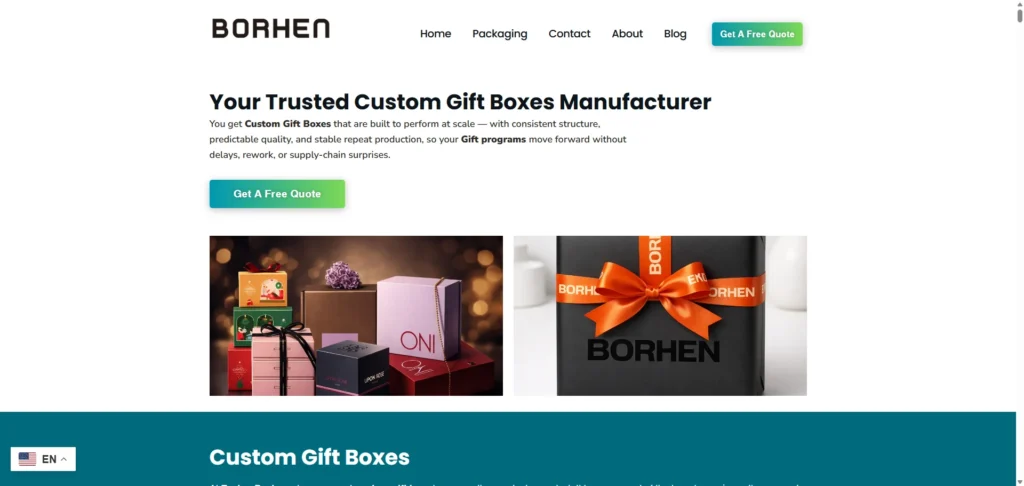
When I look at BorhenPack as a custom gift boxes manufacturer, especially at this stage where the brand is still building its narrative, I don’t see a limitation—I see a strategic opportunity. By studying the strengths of leading players in the market, I can clearly position BorhenPack not as a follower, but as a new-generation packaging partner that combines flexibility, customization depth, and global supply efficiency. What matters to me is not how long a company has existed, but how well it understands the evolving needs of modern brands. From my perspective, BorhenPack is designed to serve exactly those needs: helping brands move faster, design smarter, and scale more confidently with their packaging.
A New-Generation Packaging Partner Inspired by the Best of the Industry
When I analyze top custom gift box manufacturers, I notice that each of them excels in a specific area. Some are strong in low MOQ and accessibility, others in design engineering, and others in supply chain efficiency. What I find compelling about BorhenPack is the opportunity to integrate all of these strengths into a single, cohesive model.
I see BorhenPack as a company that is not restricted by legacy systems. Instead, it can adopt a more flexible and modern approach, combining the ease of digital-first ordering, the depth of full customization, and the reliability of export-oriented manufacturing. For me, this creates a more balanced and future-ready partner, one that aligns with how brands actually operate today rather than how the industry worked ten years ago.
Built for Customization That Goes Beyond Surface-Level Design
In my experience, many manufacturers claim to offer customization, but what they really provide is limited variation within predefined templates. What I expect from a true custom gift box manufacturer is the ability to design packaging from the inside out.
With BorhenPack, I position it as a partner that understands customization as a system rather than a feature. This includes structural design, material selection, printing techniques, finishing options, and internal inserts that are tailored specifically to the product. I am not just choosing a box style—I am building a packaging solution that protects, presents, and enhances the product experience.
This level of customization is what allows brands to stand out in competitive markets, especially when packaging becomes part of the product’s perceived value.
A Flexible Approach That Supports Both Startups and Scaling Brands
One of the biggest challenges I often face when sourcing packaging is finding a partner that can support both early-stage flexibility and long-term scalability. Many suppliers are either optimized for large-volume production or small-batch customization, but rarely both.
What I see in BorhenPack is a model that can bridge this gap. I can start with smaller quantities to test new concepts, refine the packaging based on real market feedback, and then scale production without needing to switch suppliers or redesign the entire structure.
This flexibility is incredibly valuable because it allows me to reduce risk during the early stages while maintaining consistency as the business grows. It gives me control over both experimentation and expansion, which is essential in today’s fast-moving markets.
A Process That Turns Ideas Into Reliable Production Outcomes
From my perspective, the difference between a good supplier and a great partner lies in how well they execute. Ideas are easy; consistent execution is not.
What I value in BorhenPack’s positioning is the emphasis on a clear, structured process. From initial concept discussions to design validation, sampling, and final production, each step is designed to ensure that what I envision is what I actually receive. This reduces the need for repeated revisions and minimizes the risk of misalignment between design and production.
I am not just sending files and hoping for the best. I am working within a guided process that is built to deliver predictable and repeatable results. That level of reliability is critical when managing multiple product lines or seasonal launches.
Cost Efficiency Through Smart Design and Supply Chain Thinking
Cost is always part of the equation, but I have learned that the lowest price rarely delivers the best outcome. What I look for instead is cost efficiency—where design, materials, and production methods are optimized to deliver maximum value.
BorhenPack can be positioned as a partner that approaches cost from a strategic perspective. By simplifying structures where possible, selecting the right materials for the intended use, and optimizing production workflows, it becomes possible to achieve premium-looking packaging without unnecessary expense.
For me, this means I can maintain a strong brand image while still protecting my margins. It is not about cutting costs blindly, but about making smarter decisions that align with both branding and business goals.
Global Supply Capability That Supports Modern Brand Expansion
As brands become more global, packaging suppliers must also operate with an international mindset. I need to know that my packaging can be produced, shipped, and delivered reliably across different markets.
BorhenPack’s positioning as a China-based manufacturer with export capabilities allows me to leverage cost advantages while still maintaining global reach. With the right logistics coordination and production planning, I can ensure that packaging arrives on time and meets the requirements of different regions.
This gives me confidence that packaging will not become a bottleneck as the business expands. Instead, it becomes a stable and scalable component of the overall supply chain.
Why I Choose BorhenPack for Custom Gift Boxes
When I bring all of these factors together, the reason I would choose BorhenPack becomes very clear. I am not just looking for a company that can produce custom gift boxes. I am looking for a partner that understands how packaging fits into the broader business strategy.
BorhenPack offers a combination of flexibility, customization depth, structured execution, and global supply capability that aligns with how modern brands operate. I can move from idea to production faster, adapt to changing market needs, and scale without losing consistency or control.
From my perspective as a sourcing manager, this is exactly what I need. I am not buying packaging as a product—I am building packaging as a system that supports my brand’s growth. And BorhenPack is positioned to be the kind of partner that can make that system work effectively over time.
Pakfactory
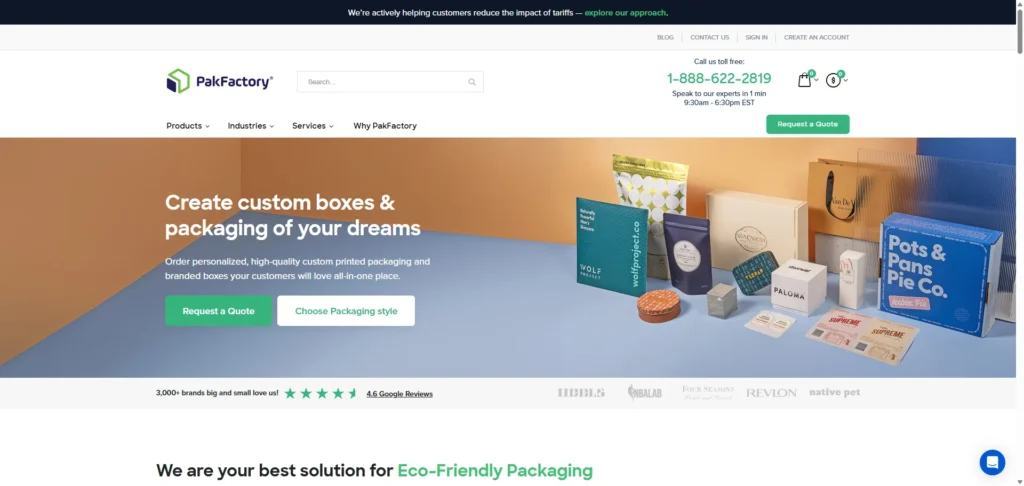
When I take a deeper look at PakFactory, I don’t simply categorize it as a custom gift box manufacturer—I see it as a company that is actively redefining how brands interact with the packaging supply chain. What stands out to me immediately is their ambition to become a global packaging platform, not just a production service. This distinction is important, because it reflects a shift from transactional manufacturing to a more integrated, service-driven model. In my experience, many brands struggle with fragmented sourcing processes where design, sampling, production, and logistics are handled by different vendors. PakFactory positions itself as the solution to this problem by consolidating everything into one ecosystem, which fundamentally simplifies how packaging is developed and delivered.
From my perspective, this kind of positioning is especially valuable for brands that do not have in-house packaging expertise. Instead of navigating technical complexities alone, they can rely on a structured system that guides them from concept to execution. This creates a more predictable and efficient workflow, which is something I always prioritize when evaluating a potential packaging partner.
Global Manufacturing Network and Supply Chain Advantage
As I analyze their infrastructure, I find that PakFactory’s global manufacturing network is one of its most strategically important assets. With access to more than 50 certified facilities worldwide, they are not constrained by the limitations of a single factory. Instead, they operate through a distributed production model that allows them to optimize each project based on its specific requirements.
In practical terms, this means that when I am sourcing custom gift boxes, I am not limited to a fixed set of capabilities or cost structures. PakFactory can allocate production to facilities that are best suited for the job, whether the priority is advanced printing techniques, structural complexity, or cost efficiency. I also see this as a critical advantage in managing external factors such as tariffs, regional cost differences, and shipping challenges. By having a flexible supply chain, they are better positioned to adapt to changing global conditions, which ultimately benefits the brands they serve.
360 Degree Packaging Solution for Gift Boxes
What I find particularly compelling is their 360-degree packaging solution, which integrates every stage of the packaging process into a single, coordinated system. When I think about the typical packaging workflow, it often involves multiple transitions between design teams, prototyping vendors, manufacturers, and logistics providers. Each of these transitions introduces potential inefficiencies and risks.
PakFactory addresses this by offering a fully managed process that includes consultation, structural design, prototyping, production, logistics, and ongoing optimization. From my perspective, this creates a much smoother and more reliable experience. It allows brands to move from initial concept to finished product without the usual friction associated with coordinating multiple parties. For custom gift boxes, where precision and presentation are critical, this level of integration ensures that the final product aligns closely with the original vision.
Custom Gift Box Expertise and Design Flexibility
When I evaluate PakFactory’s capabilities in custom gift box production, I see a strong emphasis on flexibility and creative execution. They offer a wide range of packaging formats, including rigid boxes, folding cartons, corrugated solutions, and fully customized gift sets that incorporate inserts, branded materials, and additional packaging elements. What stands out to me is not just the variety, but the depth of customization available.
From my perspective, this level of flexibility allows brands to create packaging that goes beyond functionality and becomes an extension of their identity. The availability of premium materials, advanced printing techniques, and specialized finishes such as soft-touch coatings and spot UV enables a high degree of personalization. In the context of gift packaging, where the unboxing experience plays a significant role in customer perception, this ability to create visually and tactilely engaging designs becomes a key differentiator. I also appreciate that their system supports both simple and highly complex projects, making them suitable for brands at different stages of growth.
Sustainability and Long Term Brand Alignment
As sustainability continues to shape purchasing decisions, I consider it essential to work with packaging partners that align with these expectations. PakFactory demonstrates a clear commitment to environmentally responsible practices through the use of certified materials, eco-friendly production methods, and initiatives aimed at reducing environmental impact. This includes the use of FSC-certified materials and programs that contribute to reforestation efforts.
From my perspective, this commitment goes beyond compliance and reflects a broader understanding of market trends. Brands today are expected to demonstrate transparency and responsibility in their supply chains, and packaging plays a visible role in that narrative. By partnering with a supplier that already integrates sustainability into its operations, brands can more easily meet these expectations while strengthening their own positioning in the market.
Why Sourcing Managers Choose PakFactory for Custom Gift Boxes
When I place myself in the role of a sourcing manager responsible for selecting a custom gift box supplier, I recognize that the decision is influenced by a combination of operational efficiency, cost control, and long-term reliability. One of the most persistent challenges I face is managing multiple suppliers across different stages of the packaging process. Each additional vendor introduces complexity, increases the likelihood of delays, and makes it more difficult to maintain consistent quality.
What makes PakFactory particularly appealing in this context is their ability to consolidate the entire process into a single platform. By integrating design, prototyping, manufacturing, and logistics, they eliminate many of the inefficiencies associated with traditional sourcing models. This allows me to manage fewer variables and focus on achieving the desired outcome rather than coordinating between different parties.
I also see significant value in their scalability. Gift box requirements can vary widely depending on product launches, seasonal demand, or marketing campaigns. PakFactory’s global supply chain enables them to adjust production volumes without compromising quality or requiring a change in supplier. This continuity is critical for maintaining consistency in brand presentation and operational planning.
Cost efficiency is another factor that I consider carefully, and PakFactory’s network-based model allows them to optimize production and logistics in a way that balances cost and quality. This is particularly important in competitive markets where packaging must enhance brand value without significantly increasing overall expenses.
Finally, what gives me confidence in choosing PakFactory is their understanding of packaging as a strategic component of the customer experience. Custom gift boxes are not simply protective structures; they are a key touchpoint that influences how a brand is perceived. PakFactory’s focus on design, customization, and finishing details ensures that packaging contributes meaningfully to that experience. From my perspective, this combination of efficiency, flexibility, and brand alignment makes them a highly compelling partner for sourcing managers looking for reliable custom gift box solutions.
Paper Mart
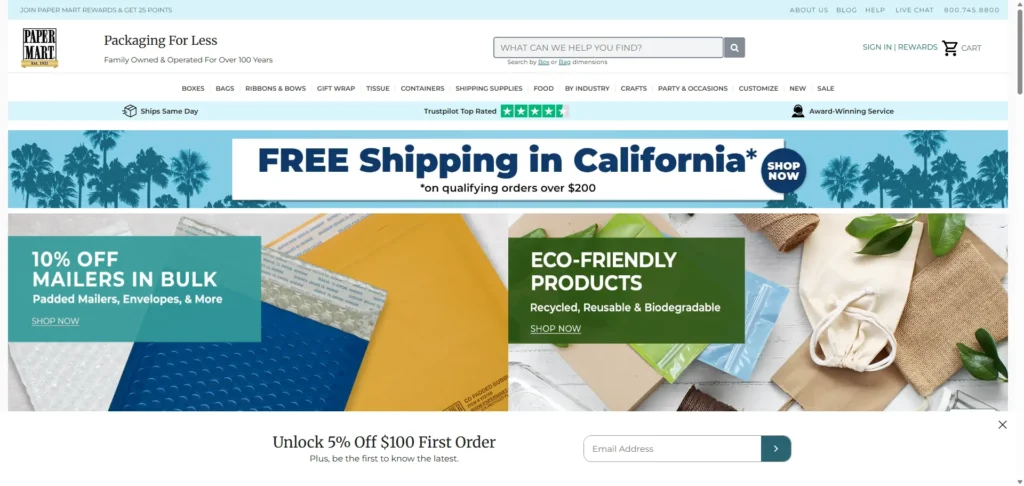
When I take a closer and more critical look at Paper Mart, I don’t approach it as a typical custom gift box manufacturer, but rather as a highly mature and strategically positioned packaging supply platform that has evolved over more than a century. What immediately stands out to me is the depth of its history, dating back to 1921, and how that legacy translates into operational confidence. In an industry where reliability is often uncertain and supplier consistency can vary significantly, I see Paper Mart as a company that has built its foundation on long-term trust, scalability, and supply stability.
From my perspective, Paper Mart’s identity is rooted in being a “complete packaging destination.” This is not simply about offering a wide range of products, but about creating an environment where buyers can solve multiple packaging needs within a single ecosystem. I find this particularly valuable because packaging sourcing is rarely isolated to one product. When I am working on a gift box project, I am also thinking about tissue paper, ribbons, inserts, and overall presentation. Paper Mart’s ability to bring all these elements together in one place reflects a deep understanding of how packaging functions in real business scenarios.
Product Range and Gift Box Offering
As I explore their catalog in more detail, I begin to appreciate the sheer scale and granularity of their product offering. With more than 20,000 items available, Paper Mart has built an inventory that covers almost every conceivable packaging need, from industrial shipping supplies to highly decorative gift packaging. What stands out to me most is how their gift box category is not treated as a single product line, but as a layered system of options that address different use cases.
I notice that their gift box selection includes everything from basic tuck-top boxes designed for efficiency, to premium two-piece rigid boxes, magnetic closure boxes, embossed finishes, and specialty designs tailored for jewelry, apparel, and food packaging. This diversity allows me to approach packaging not as a limitation, but as a flexible toolkit. If I am working on a premium product line, I can select more refined structures and finishes. If I am managing a high-volume campaign, I can shift toward more cost-effective options without leaving the same supplier ecosystem. This adaptability is something I find extremely practical when balancing brand presentation with operational constraints.
Operational Efficiency and Inventory Advantage
When I evaluate Paper Mart’s operational model, I see a company that has optimized itself around one core principle: immediate availability. Unlike traditional manufacturers that require lead times for production, Paper Mart operates with a fully stocked inventory that enables rapid fulfillment. In many cases, they can ship orders the same day, which fundamentally changes how I think about packaging procurement.
From my perspective, this capability addresses one of the most overlooked challenges in sourcing, which is unpredictability. Business timelines are rarely static. Product launches shift, marketing campaigns accelerate, and demand spikes unexpectedly. In these situations, waiting weeks for custom production is not always viable. Paper Mart’s inventory-driven model provides a level of responsiveness that allows me to adapt quickly without compromising on packaging availability. I also recognize that their bulk pricing structure further enhances this advantage, enabling me to secure cost efficiencies while maintaining flexibility in ordering.
Customization Approach and Practical Flexibility
When I consider Paper Mart’s approach to customization, I see a model that prioritizes speed and practicality over deep engineering complexity. Instead of offering fully bespoke packaging solutions that require extensive development cycles, they provide a wide spectrum of pre-designed options that can be combined and adapted to meet different branding needs. This includes variations in materials, finishes, colors, and structural formats, which together create a flexible yet efficient customization framework.
From my perspective, this approach aligns well with the realities of many businesses. Not every project requires a fully custom solution, and in many cases, the ability to quickly select and adapt existing designs is more valuable than starting from scratch. By combining ready-made boxes with branded elements such as tissue paper, ribbons, and inserts, I can still achieve a cohesive and visually appealing packaging experience. This balance between customization and efficiency is something I find particularly useful when managing multiple product lines or working within tight timelines.
Reliability, Experience, and Market Trust
One of the most compelling aspects of Paper Mart, in my view, is the level of trust that comes from its long-standing presence in the industry. Operating for over 100 years is not just a milestone; it is an indication of sustained performance, adaptability, and customer satisfaction. In an industry where supplier reliability can directly impact business operations, this kind of track record carries significant weight.
I also notice that their emphasis on customer service, inventory availability, and fast shipping reinforces this sense of reliability. Their ability to consistently deliver products across a wide range of categories suggests a high level of operational discipline. From my perspective, this translates into a supplier that I can depend on not just for individual orders, but as part of a long-term sourcing strategy. This consistency is particularly important when packaging plays a critical role in brand presentation and customer experience.
Why Sourcing Managers Choose Paper Mart for Custom Gift Boxes
When I place myself in the role of a sourcing manager evaluating suppliers for custom gift boxes, I recognize that the decision is often influenced by practical considerations rather than ideal scenarios. While fully custom packaging offers maximum control, it also introduces complexity, longer lead times, and higher costs. In many situations, what I need is a solution that balances quality, speed, and cost efficiency. This is where Paper Mart becomes particularly relevant.
What stands out to me first is the immediacy of their offering. The ability to access a wide range of gift boxes that are ready to ship allows me to respond quickly to business needs without waiting for production cycles. This is especially valuable in time-sensitive scenarios such as seasonal promotions, holiday campaigns, or rapid product rollouts. I can secure packaging solutions that meet my requirements without compromising on timing.
I also see strong value in their pricing model. With competitive rates and bulk discounts, Paper Mart enables me to manage costs effectively while maintaining a consistent level of quality. This is critical in environments where margins are closely monitored and packaging must deliver both functional and aesthetic value. Their extensive inventory also allows me to standardize packaging across different products, which contributes to operational efficiency and brand consistency.
Another factor that influences my decision is the simplicity of their sourcing process. Their platform is designed to be intuitive and accessible, allowing me to browse, compare, and order products with minimal friction. This reduces the time and effort required to manage packaging procurement and allows me to focus on higher-level strategic tasks.
Finally, I appreciate the role that Paper Mart plays as a dependable and scalable partner. While they may not offer the depth of customization found in specialized manufacturers, they excel in delivering consistent, accessible, and efficient solutions. From my perspective, this makes them an ideal choice for sourcing managers who need reliable gift box options that can be deployed quickly, adapted easily, and integrated seamlessly into ongoing business operations.
Ibex Packaging
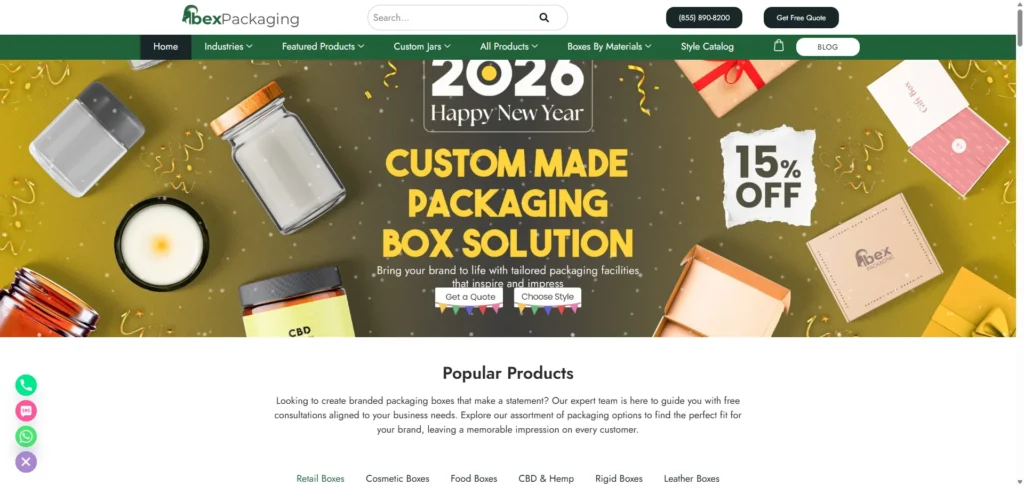
When I take a deeper and more critical look at Ibex Packaging, I begin to see a company that is not simply competing on products, but rather on removing friction from the entire packaging sourcing experience. From my perspective, what defines Ibex Packaging is not just its ability to manufacture custom gift boxes, but its deliberate effort to simplify what is often a complex and time-consuming process for brands. I see a supplier that has clearly studied the pain points of modern businesses, especially startups and mid-sized brands, and has built its entire service model around speed, affordability, and guided execution.
What resonates with me most is their positioning as a partner for “smart startups and creative enterprises.” This is not accidental language. It reflects a strategic decision to focus on brands that are growing, experimenting, and competing in fast-moving markets. In these environments, packaging is no longer just a protective layer—it is a marketing tool, a brand signal, and often the first physical interaction a customer has with a product. Ibex Packaging understands this dynamic, and from my perspective, they are trying to bridge the gap between high-end packaging expectations and real-world budget and timeline constraints.
Product Capabilities and Custom Gift Box Solutions
As I explore their custom gift box capabilities in more detail, I begin to appreciate how their offering is structured to provide both creative freedom and operational practicality. Their range spans multiple structural formats, including rigid boxes for luxury positioning, corrugated boxes for durability and shipping, kraft boxes for sustainability-driven brands, and folding cartons for cost-efficient scalability. This breadth allows me to approach packaging decisions strategically, aligning the structure of the box with the product’s positioning, price point, and distribution model.
What stands out even more to me is the depth of customization they provide. When I evaluate options such as foil stamping, embossing, debossing, spot UV, custom inserts, and window cut-outs, I see a system that enables brands to translate their identity directly into physical packaging. In the context of gift boxes, this level of detail is not optional—it is essential. The texture of the material, the sharpness of the print, and the precision of the structure all contribute to how the product is perceived. From my perspective, Ibex Packaging gives me the tools to control these variables in a way that feels intentional and brand-driven, rather than generic or standardized.
I also notice their emphasis on material selection, which I find particularly important. The availability of cardboard, kraft, corrugated, and rigid materials allows me to balance aesthetics with functionality. If I am working with a delicate or high-value product, I can prioritize rigid structures for protection and presentation. If I am focused on sustainability or cost efficiency, kraft and corrugated options provide viable alternatives. This flexibility ensures that packaging decisions are not isolated, but integrated into broader product and brand strategies.
Cost Efficiency and Strategic Accessibility
One of the most compelling aspects of Ibex Packaging, from my point of view, is how aggressively they position themselves on cost without diminishing perceived value. Their claim of offering significantly lower pricing compared to the general market immediately signals a clear value proposition, but what interests me more is how they sustain this positioning while still offering meaningful customization.
In my experience, cost is often the biggest constraint in packaging decisions. Brands want premium-looking gift boxes, but they are frequently forced to compromise due to budget limitations. What Ibex Packaging appears to do is redefine that trade-off. By optimizing production processes and standardizing certain elements, they create a framework where customization remains accessible rather than exclusive. This allows me to design packaging that feels elevated and brand-aligned without exceeding financial boundaries.
I also see this as particularly valuable for brands in growth phases. When product volumes are uncertain and demand fluctuates, committing to high-cost packaging can introduce unnecessary risk. Ibex Packaging’s pricing structure allows me to remain flexible, test different approaches, and scale gradually. From my perspective, this transforms packaging from a fixed cost into a more dynamic and strategic investment.
Speed, Responsiveness, and Global Fulfillment
As I analyze their operational model, I find that speed is not just an advantage for Ibex Packaging—it is a core component of their value proposition. Their ability to deliver custom packaging within a relatively short timeframe fundamentally changes how I think about sourcing. In many traditional scenarios, custom packaging requires long lead times that can delay product launches or limit responsiveness to market changes.
With Ibex Packaging, I see a system designed to minimize those delays. Their streamlined process, which includes instant quoting, digital proofs, and 3D mockups, reduces the time spent on back-and-forth communication and accelerates decision-making. From my perspective, this is not just about convenience, but about maintaining momentum in a competitive market. When I can move from concept to production quickly, I gain a significant advantage in execution.
Their global shipping capabilities further reinforce this advantage. The ability to deliver to a wide range of countries ensures that I am not limited by geography when selecting a supplier. Whether I am operating in North America, Europe, or other regions, I can rely on a consistent sourcing experience. This level of accessibility is particularly important in today’s globalized supply chains, where flexibility and reach are essential.
Quality Control and Production Precision
When I look beyond surface-level claims and examine their quality control process, I begin to see a structured and methodical approach to production. Their workflow includes multiple validation stages, from design proofing and color accuracy checks to structural testing and final prototyping. This tells me that they are not simply focused on delivering visually appealing packaging, but are equally committed to ensuring functional reliability.
From my perspective, this is critical in the context of custom gift boxes. Packaging must do more than look good—it must protect the product, maintain its shape, and deliver a consistent experience across units. Ibex Packaging’s attention to stock adjustments, endurance testing, and structural validation suggests a level of discipline that reduces the risk of defects or inconsistencies.
I also appreciate their focus on precision in areas such as sizing and color reproduction. In branded packaging, even minor deviations can impact how a product is perceived. Their use of digital systems to ensure color accuracy and their emphasis on detailed finishing processes give me confidence that the final output will align closely with the original design intent.
Why Sourcing Managers Choose Ibex Packaging for Custom Gift Boxes
When I place myself in the role of a sourcing manager, I find that Ibex Packaging addresses a very specific set of needs that are often difficult to satisfy simultaneously. The first is accessibility. Their ability to offer custom packaging with relatively low minimum order quantities and competitive pricing allows me to execute projects without overcommitting resources. This is particularly important when launching new products or testing new markets, where flexibility is essential.
The second factor is speed. In my experience, delays in packaging can create a cascade of challenges across the entire supply chain. Ibex Packaging’s ability to deliver within a short and predictable timeframe allows me to maintain control over project timelines and respond quickly to changing conditions. This responsiveness becomes a strategic advantage in fast-paced industries where timing can directly influence success.
The third element that stands out to me is the level of support they provide. Having access to dedicated experts who can guide me through material selection, structural design, and finishing options reduces the complexity of decision-making. It also ensures that I am not navigating the process alone, which is particularly valuable when managing multiple projects or working under tight deadlines.
Ultimately, I see Ibex Packaging as a partner that enables me to achieve a balance between cost, speed, and quality. They allow me to create packaging that enhances brand perception while remaining aligned with operational realities. From my perspective, this balance is what makes them a compelling and practical choice for sourcing managers who need to deliver both efficiency and impact in custom gift box projects.
Madovar Packaging
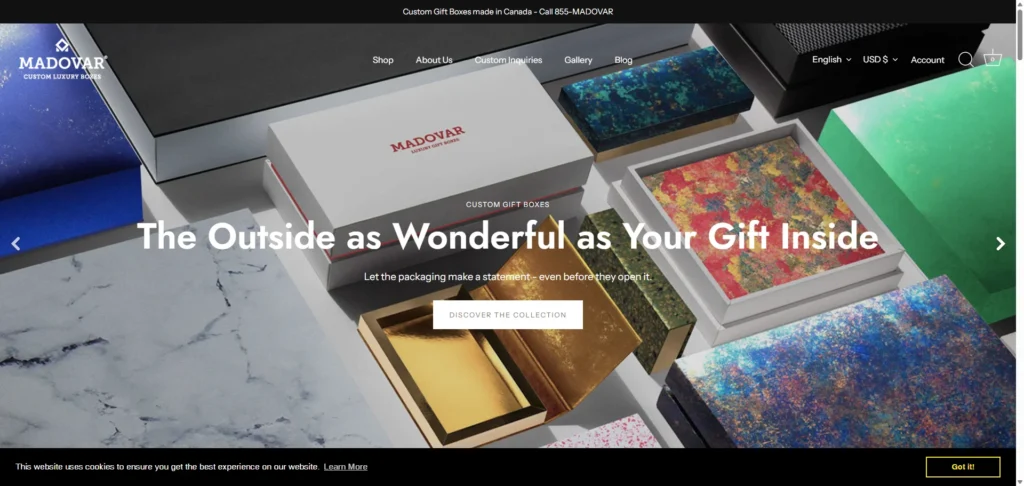
When I take a truly in-depth look at Madovar Packaging, I begin to see a company that is not trying to compete in the traditional sense of the packaging industry, where scale, speed, and price dominate decision-making. Instead, I see a manufacturer that has deliberately chosen to operate in a more refined space, where packaging is treated as a strategic extension of the product itself. From my perspective, Madovar is not selling boxes; it is shaping how products are perceived the moment they are encountered.
What stands out to me immediately is their identity as a Montréal-based, design-and-manufacture integrated company. This local production model signals something very important to me as a sourcing professional: control. In an industry where production is often fragmented across multiple regions, having design, engineering, and manufacturing under one roof creates a level of consistency that is difficult to replicate. I see this as a key differentiator, especially for brands that cannot afford variability in quality or execution.
I also notice how their messaging consistently revolves around craftsmanship, collaboration, and precision. This tells me that Madovar is not designed for transactional relationships, but for deeper partnerships. From my point of view, this kind of positioning naturally attracts brands that are not just looking for packaging, but for a solution that can elevate their entire product presentation.
Custom Gift Box Design Philosophy
As I explore their design philosophy further, I realize that Madovar approaches packaging in a fundamentally different way compared to many other suppliers. Instead of starting with standard templates or predefined box styles, they begin with the product itself. This may seem like a subtle difference, but in reality, it completely changes the outcome of the packaging.
When I bring a product into the conversation, Madovar’s process focuses on understanding its dimensions, weight, fragility, and intended customer experience. From there, they build both the exterior and interior of the box to match those requirements. I find this particularly valuable because it eliminates the compromises that often occur when trying to fit a product into a generic packaging structure.
What I appreciate even more is their equal emphasis on exterior branding and interior engineering. The exterior is designed to communicate the brand’s identity, whether through minimalistic elegance, bold visual storytelling, or refined luxury finishes. At the same time, the interior is engineered with precision, ensuring that the product is securely held, properly displayed, and protected throughout its journey. From my perspective, this holistic approach transforms packaging into a complete experience rather than a simple container.
Manufacturing Control and North American Advantage
When I evaluate their manufacturing model in detail, I begin to see how their decision to produce locally in Montréal directly impacts quality, communication, and reliability. By maintaining production within a controlled environment, Madovar is able to oversee every stage of the process, from prototyping to final assembly. This level of oversight significantly reduces the risk of inconsistencies, which is something I have often encountered when working with suppliers that rely on distributed manufacturing networks.
From my point of view, this localized approach also simplifies collaboration. Time zone alignment, easier communication, and the ability to conduct real-time discussions all contribute to a more efficient workflow. I no longer need to account for delays caused by geographic distance or miscommunication, which can be critical when working on complex or time-sensitive projects.
I also recognize the logistical advantages for North American brands. With operations integrated across Canada and the United States, and the ability to leverage regional trade agreements, Madovar offers a more streamlined sourcing experience. This reduces not only shipping time but also administrative complexity, allowing me to focus more on strategic decisions rather than operational challenges.
Craftsmanship, Materials, and Structural Precision
As I go deeper into their product offering, I begin to fully appreciate the level of craftsmanship that defines Madovar’s packaging. Their focus on rigid boxes, magnetic closures, sleeve designs, and other premium structures reflects a commitment to creating packaging that feels substantial, refined, and intentionally designed. These are not boxes that simply serve a function; they are designed to communicate value before the product is even revealed.
What stands out to me most is their approach to materials. They do not select materials based on trends or cost alone, but on performance, durability, and finish. This means that every decision, from the thickness of the board to the texture of the surface, is made with both aesthetics and functionality in mind. From my perspective, this level of attention ensures that the packaging not only looks premium but also performs reliably under real-world conditions.
I also notice their focus on structural precision. The way a box opens, the way a lid aligns, the way an insert holds a product in place—these details may seem small, but they define the overall experience. Madovar’s ability to control these elements gives me confidence that the final product will feel cohesive and well-executed, rather than improvised or inconsistent.
Collaborative Process and Design Intelligence
One of the aspects I find most compelling about Madovar is their collaborative approach to packaging development. They do not expect clients to arrive with fully defined specifications. Instead, they position themselves as a partner that helps shape the solution from the ground up. This is particularly important because packaging design often involves a level of technical complexity that is not immediately obvious.
From my perspective, their process is built around reducing uncertainty. They guide clients through decisions related to structure, materials, finishes, and dimensions, ensuring that each choice is informed by both design intent and practical considerations. This not only improves the quality of the final product but also minimizes the risk of costly revisions or production errors.
I also appreciate their use of prototyping and sampling as part of the process. Being able to physically evaluate a design before committing to full production allows me to validate every detail, from fit to finish. This step is critical when aiming for a high level of precision, as it ensures that the final result aligns exactly with expectations.
Why Sourcing Managers Choose Madovar Packaging for Custom Gift Boxes
When I step into the role of a sourcing manager, I see Madovar as a highly intentional choice for projects where quality, precision, and brand impact are non-negotiable. The first reason I would choose to work with them is the level of control they offer. Their integrated design and manufacturing process gives me confidence that every aspect of the packaging will be executed exactly as planned.
The second factor that stands out to me is their ability to translate brand identity into a physical experience. In premium markets, packaging is often the first point of contact between the product and the customer. Madovar’s design-driven approach allows me to create gift boxes that not only protect the product but also communicate its value in a tangible and immediate way.
I also value the clarity and support they provide throughout the process. Their guidance reduces complexity and ensures that decisions are made with confidence, even in projects that involve intricate design or structural requirements. This is particularly important when managing high-stakes launches or working with products that require a high level of presentation.
Ultimately, I see Madovar as a partner for brands that are willing to invest in excellence. They may not be the fastest or the most cost-driven option, but they deliver a level of craftsmanship, attention to detail, and design intelligence that is difficult to match. From my perspective, this makes them an ideal choice for sourcing managers who are focused on creating a packaging experience that truly elevates the product and strengthens the brand.
BoxUp
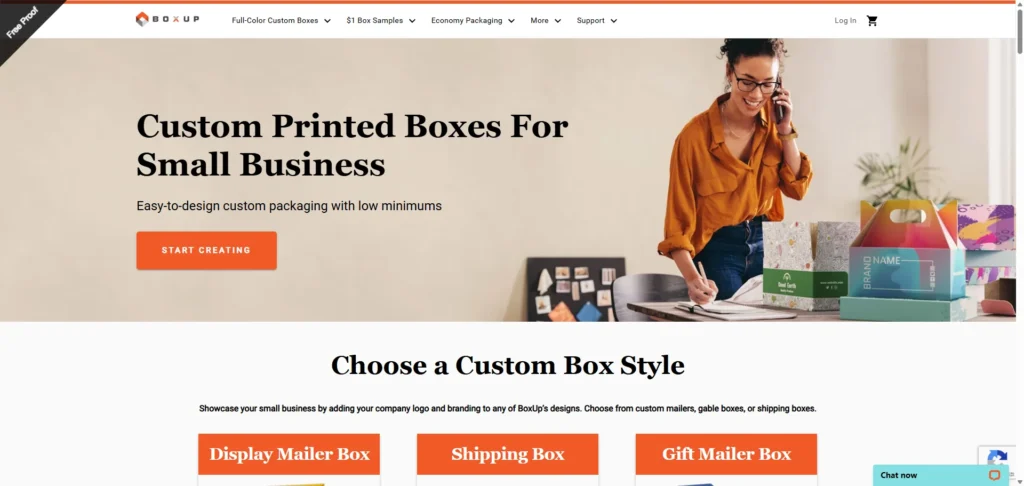
When I take a more strategic and experience-driven view of BoxUp, I begin to see a company that is not simply participating in the custom packaging industry, but actively redefining how access to packaging should work for modern brands. From my perspective, BoxUp is built around a very clear understanding of a problem that many growing businesses face: traditional packaging suppliers are often too rigid, too slow, and too expensive for brands that are still evolving.
What I find particularly compelling is how BoxUp bridges the gap between professional packaging and accessibility. Instead of positioning itself as a complex manufacturing partner, it presents itself as a tool—almost like a platform—that enables brands to take control of their packaging decisions. This subtle shift in positioning changes everything. I am no longer just a buyer negotiating with a supplier; I become an active participant in the creation process.
I also notice that BoxUp’s roots in traditional box manufacturing, combined with its transition into a digital-first model, give it a unique advantage. It understands the technical realities of packaging production while delivering a simplified, user-friendly experience. From my point of view, this combination allows it to serve both the practical and creative needs of modern businesses in a way that feels both efficient and empowering.
Product Capabilities and Custom Gift Box Solutions
As I examine their product offering more closely, I begin to appreciate how intentionally BoxUp has structured its solutions. Rather than offering unlimited structural customization, which often introduces complexity and cost, they focus on refining a set of proven, high-demand box styles. These include mailer boxes, shipping boxes, gift mailers, display boxes, and gable boxes—formats that I know are widely used across e-commerce, retail, and promotional packaging.
From my perspective, this approach is highly strategic. By standardizing structures while allowing deep customization in printing and branding, BoxUp creates a balance between efficiency and creative freedom. I can still achieve a visually distinctive and brand-aligned result, but without the delays and uncertainties that often come with fully bespoke engineering.
What stands out to me even more is the ability to design both the interior and exterior of the box. In today’s market, packaging is not just about protection; it is about storytelling. The moment a customer opens a box has become a critical touchpoint, especially for direct-to-consumer brands. With BoxUp, I can design that experience intentionally, ensuring that every surface of the packaging contributes to how the brand is perceived.
I also recognize the value of their extended product ecosystem. The availability of custom tape, poly mailers, labels, and other packaging accessories allows me to build a complete packaging identity from a single supplier. This level of integration simplifies procurement and ensures that every element of the packaging system feels cohesive and consistent.
Digital Design Experience and Creative Control
When I fully immerse myself in BoxUp’s digital design experience, I begin to understand why it is such a defining part of their value proposition. Traditional packaging workflows often involve multiple layers of communication, revisions, and dependencies. In contrast, BoxUp places the creative process directly in my hands.
From my perspective, this creates a fundamentally different dynamic. I am no longer waiting for updates or approvals; I am actively shaping the outcome in real time. The ability to use templates, upload artwork, and preview designs instantly allows me to move quickly from idea to execution. This immediacy not only saves time but also encourages experimentation, which is essential when trying to create packaging that stands out.
What I find particularly impactful is how this system democratizes design. Even without a professional design background, I can create packaging that looks polished and intentional. At the same time, the platform does not limit more advanced users, as it supports detailed design workflows and external tools like Adobe Illustrator or Canva. This flexibility ensures that the platform adapts to different levels of expertise rather than forcing users into a single approach.
Speed, Flexibility, and Iterative Decision-Making
As I evaluate BoxUp’s operational model, I begin to see how deeply it aligns with the realities of modern business. The absence of minimum order quantities is not just a convenience; it fundamentally changes how I approach packaging strategy. Instead of committing to large volumes upfront, I can test, refine, and scale my packaging decisions over time.
From my perspective, this creates a much more agile and responsive workflow. I can launch a new product with a small batch of packaging, gather feedback, and make adjustments before committing to larger production runs. This reduces risk and allows me to make decisions based on real-world data rather than assumptions.
I also see their sampling process as a critical part of this iterative approach. The ability to order a single custom-printed sample and evaluate it physically gives me a level of confidence that is difficult to achieve through digital previews alone. I can assess the fit, the print quality, and the overall feel of the packaging before moving forward, which minimizes the chances of costly mistakes.
Their fast turnaround times further reinforce this flexibility. In situations where timing is critical, such as product launches or seasonal campaigns, the ability to receive packaging quickly allows me to maintain momentum and execute strategies without delay. This responsiveness is something I consider highly valuable in a competitive market.
Material Quality and Real-World Performance
When I shift my focus to the materials and technical aspects of BoxUp’s packaging, I begin to see how they have optimized for both performance and visual impact. Their use of 200# corrugated cardboard provides a strong and reliable structure that can withstand the demands of shipping and handling. At the same time, the choice of white-coated surfaces enhances print quality, allowing colors to appear vibrant and sharp.
From my perspective, this balance is essential. Packaging must perform in real-world conditions while still delivering a strong visual impression. The use of UV-cured CMYK printing ensures that designs remain durable and resistant to wear, which is particularly important for packages that travel through multiple touchpoints before reaching the customer.
I also appreciate their commitment to sustainability. By using materials that include recycled content and are fully recyclable, BoxUp aligns with the growing expectations of environmentally conscious consumers. This allows me to incorporate sustainability into my packaging strategy without compromising on quality or design.
Why Sourcing Managers Choose BoxUp for Custom Gift Boxes
When I place myself fully in the mindset of a sourcing manager, I begin to understand why BoxUp becomes such a compelling option in certain scenarios. The first reason is flexibility. The ability to order in small quantities, test designs, and adapt quickly allows me to manage uncertainty and respond to changing market conditions with confidence.
The second factor that stands out to me is control. BoxUp’s digital platform gives me direct access to the design and ordering process, reducing dependency on external teams and streamlining decision-making. This level of control is particularly valuable when managing multiple projects or working under tight deadlines.
I also recognize the importance of speed. In many cases, packaging is directly tied to revenue-generating activities, and delays can have significant consequences. BoxUp’s fast production and shipping capabilities allow me to align packaging timelines with business needs, ensuring that operations run smoothly.
Ultimately, I see BoxUp as a solution that prioritizes efficiency without sacrificing impact. While it may not offer the same level of bespoke structural engineering as more traditional manufacturers, it excels in delivering high-quality, visually compelling packaging in a way that is fast, flexible, and easy to manage. From my perspective, this makes it an ideal partner for sourcing managers who need to balance creativity, cost, and speed in their custom gift box strategies.
Custom Apparel Packaging Cost Overview
Whenever I begin discussing custom apparel packaging with brand founders, sourcing managers, or product teams, one topic always appears very early in the conversation: cost. At first glance, a packaging box may seem like a straightforward item with a simple price, but from my experience working with packaging projects, the reality is far more nuanced. The cost of custom apparel boxes is influenced by a combination of design decisions, production techniques, material choices, and logistical considerations. Each of these elements contributes to the final price in ways that are not always immediately obvious to someone sourcing packaging for the first time.
What I have learned over the years is that understanding packaging cost is less about searching for the lowest price and more about understanding how different variables interact. When apparel brands understand the underlying cost structure behind their packaging, they can make decisions that maintain visual quality while also controlling operational expenses. In many cases, small adjustments in structure, materials, printing, or order quantities can significantly influence the overall budget without compromising the brand experience.
How Box Structure Shapes the Foundation of Packaging Cost
The first factor I always examine when estimating the cost of custom apparel packaging is the structural design of the box. Structure is not simply a visual choice; it determines how the packaging is engineered, how it is manufactured, and how efficiently it can be produced at scale. From my perspective, the structure of a box is often the starting point that influences almost every other cost component.
For many apparel brands, folding carton structures provide a practical balance between visual presentation and manufacturing efficiency. These boxes are typically made from paperboard materials that are die-cut, folded, and glued using automated production lines. Because the process is highly standardized, folding cartons can be produced relatively quickly and cost-effectively. This makes them ideal for packaging products such as shirts, accessories, scarves, and lightweight garments.
However, when brands move toward premium packaging structures, the production process becomes more complex. Rigid boxes, drawer-style boxes, magnetic closure boxes, and specialty gift packaging require additional craftsmanship during manufacturing. These structures often involve thicker board materials, manual assembly, and more precise finishing work. I have noticed that while these premium structures significantly enhance the perceived value of a product, they also introduce higher production costs because the manufacturing process becomes more labor-intensive.
From my perspective, choosing the right box structure involves balancing aesthetic goals with operational practicality. A well-designed structure should elevate the product while still allowing efficient manufacturing and shipping.
IMH Packaging
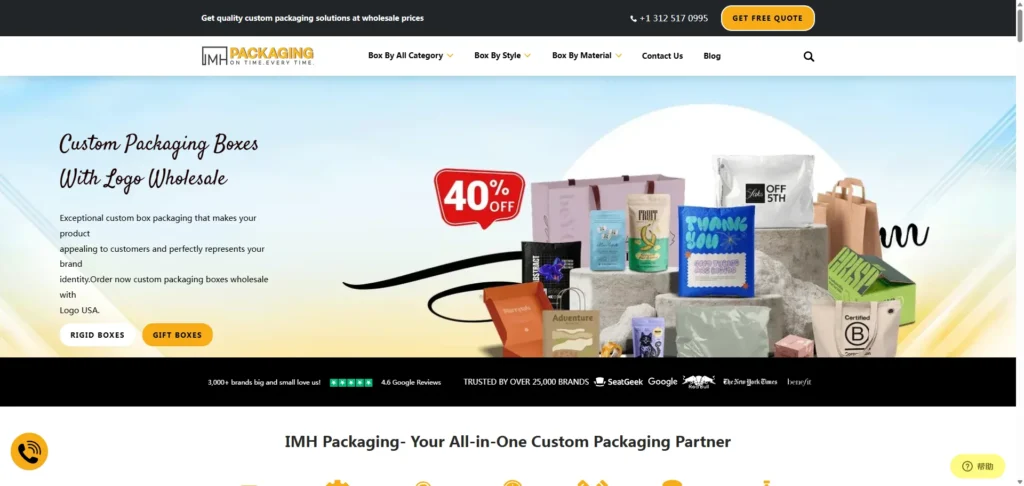
When I take a deeper and more critical look at IMH Packaging, I begin to see a manufacturer that is not only focused on producing custom boxes, but on reducing the friction that typically exists between a brand’s vision and the final packaging outcome. From my perspective, IMH Packaging positions itself very deliberately as an “all-in-one” partner, and that positioning is not just marketing language. It reflects a service structure where design, production, customization, and delivery are all integrated into a single workflow that is meant to feel simple from the buyer’s side.
What I find particularly interesting is how IMH Packaging speaks directly to businesses that are trying to build identity rather than just fulfill packaging requirements. In many cases, packaging suppliers focus on technical capabilities first and branding second. Here, I see the opposite approach. IMH Packaging consistently frames packaging as a tool for brand recognition, customer experience, and emotional engagement. That tells me they understand that for many businesses, especially in gift-related categories, packaging is often the first physical interaction a customer has with the brand. From my point of view, that awareness alone already elevates them beyond a purely transactional supplier.
I also notice how strongly they emphasize accessibility. Free design support, free delivery, no die or plate charges, and competitive pricing all signal that they are trying to remove the typical barriers that prevent brands from investing in custom packaging. This makes IMH Packaging feel less like a high-threshold manufacturing partner and more like a scalable solution that can support both early-stage brands and more established businesses.
Product Breadth and Depth in Custom Gift Boxes
As I dive into their product offering, I start to appreciate just how extensive their custom gift box capabilities are. IMH Packaging does not treat gift boxes as a single standardized product category. Instead, they approach it as a diverse ecosystem of packaging solutions tailored to different use cases, industries, and emotional contexts. I see rigid gift boxes, collapsible magnetic boxes, jewelry packaging, clothing gift boxes, holiday-themed packaging, wedding gift boxes, food gift boxes, and even highly specific formats like ornament boxes and favor boxes.
From my perspective, this level of variety is not accidental. It reflects a clear understanding that gift packaging is highly situational. A luxury jewelry brand does not need the same box structure as a bakery, and a corporate gifting program does not follow the same logic as a retail product launch. By offering this range, IMH Packaging positions itself as a supplier that can adapt to different scenarios rather than forcing clients into a limited set of options.
What I find particularly valuable here is the ability to maintain consistency across different packaging types. If I were managing multiple product categories or seasonal campaigns, I could rely on IMH Packaging to deliver different box formats while still maintaining a unified brand language. That reduces operational complexity and ensures that every packaging touchpoint feels intentional and connected.
Design Support and Translating Brand Vision into Reality
When I focus on their design capabilities, I begin to see one of the strongest aspects of IMH Packaging’s offering. Many brands struggle not because they lack ideas, but because they lack the technical expertise to translate those ideas into production-ready packaging. IMH Packaging addresses this gap directly by offering free design support and hands-on guidance throughout the process.
From my perspective, this is where they create real value. I am not required to arrive with a perfect dieline, a finalized artwork file, or a complete understanding of materials and finishes. Instead, I can bring a concept, a reference, or even just a general direction, and rely on their team to help refine it into something that works in the real world. This reduces both the learning curve and the risk of costly mistakes.
I also see how this support becomes even more important in gift packaging. A gift box is not just about fitting a product inside. It is about creating a moment. The choice of color, the placement of the logo, the texture of the material, and the way the box opens all contribute to how the recipient perceives the brand. IMH Packaging’s emphasis on helping clients from concept to execution suggests that they are actively involved in shaping that experience, not just producing it.
Production Process and End-to-End Execution
When I analyze their production workflow, I see a process that is intentionally structured to feel clear and manageable. The sequence of selecting a box style, preparing artwork, reviewing proofs, confirming production, and receiving delivery creates a predictable path from idea to finished product. From my perspective, this predictability is extremely valuable because it reduces uncertainty and helps keep projects on track.
What stands out to me is how IMH Packaging combines this structured process with continuous support. At each stage, there is an opportunity for feedback, adjustment, and validation. This is particularly important in custom packaging because small errors in design or sizing can lead to significant issues in production. By incorporating proofing and review steps, they create a safety net that helps ensure the final result aligns with expectations.
I also appreciate how they emphasize speed without sacrificing control. Fast turnaround times are important, but only if the process remains reliable. IMH Packaging appears to balance these two factors by maintaining a workflow that is both efficient and collaborative. From my point of view, this makes them a practical choice for projects where timing is critical but quality cannot be compromised.
Material Selection, Structural Integrity, and Premium Finishing
When I evaluate the physical qualities of their packaging, I see a strong focus on both durability and presentation. IMH Packaging highlights the use of sturdy materials, tailored sizing, and structural precision, which tells me they understand that a gift box must perform under real-world conditions. It needs to protect the product during handling and transportation while maintaining its shape and visual appeal.
At the same time, I notice a clear emphasis on finishing techniques and visual detail. Elements such as lamination, UV effects, embossing, inserts, and vibrant printing are not treated as optional extras, but as integral parts of the packaging experience. From my perspective, this is critical because the perceived value of a gift box is often determined by these details. A well-finished box immediately communicates quality, care, and attention to detail, which directly influences how the product inside is perceived.
I also find their approach to material flexibility important. By offering different substrates such as cardboard, kraft, and rigid materials, they allow brands to choose the right balance between cost, durability, and visual impact. This flexibility makes it easier to align packaging decisions with both brand positioning and budget constraints.
Pricing Strategy and Accessibility for Growing Brands
When I consider IMH Packaging’s pricing strategy, I see a company that is intentionally trying to make custom packaging more accessible. Their focus on wholesale pricing, free services, and no hidden charges creates a sense of transparency that is often missing in the packaging industry. From my perspective, this is particularly important for businesses that are cautious about investing in custom packaging due to cost concerns.
I also think their pricing model aligns well with the realities of gift packaging. Many gift box projects are tied to specific events, campaigns, or seasons, which means they must deliver strong visual impact without exceeding budget limits. IMH Packaging’s approach allows brands to achieve a premium look while still maintaining financial control. This balance between affordability and perceived value is one of the key reasons I see them appealing to a wide range of buyers.
Customer Experience and Operational Reliability
As I reflect on the customer experience aspect, I notice that IMH Packaging places a strong emphasis on responsiveness and communication. Feedback from clients consistently highlights quick replies, efficient revisions, and reliable service. From my perspective, this is not just a service benefit but a critical factor in successful packaging projects.
Custom packaging involves multiple steps, and each step requires coordination. Delays in communication can quickly lead to delays in production, which can impact product launches or marketing campaigns. IMH Packaging’s focus on responsiveness suggests that they understand the importance of maintaining momentum throughout the process.
I also see how their service model contributes to trust. By providing guidance, handling revisions efficiently, and delivering on time, they reduce the level of uncertainty that buyers typically experience. In gift packaging, where deadlines are often fixed and tied to specific occasions, this reliability becomes even more valuable.
Why I Would Choose IMH Packaging as a Sourcing Manager for Custom Gift Boxes
When I place myself fully in the role of a sourcing manager, I find that IMH Packaging offers a combination of qualities that are difficult to find in a single supplier. The first is versatility. Their wide range of gift box options allows me to handle different product categories, campaigns, and occasions without constantly searching for new vendors. This simplifies sourcing and creates consistency across projects.
The second is support. The availability of design assistance and continuous guidance means I do not need to solve every technical detail on my own. I can focus on the strategic aspects of the project while relying on the supplier to handle execution details. This reduces internal workload and speeds up decision-making.
The third is cost efficiency. IMH Packaging’s pricing model allows me to achieve high-quality packaging without exceeding budget constraints. This is particularly important when managing multiple projects or working within strict financial limits.
Finally, I see IMH Packaging as a partner that understands the role of packaging in brand building. They recognize that a gift box is not just a container but a communication tool that shapes customer perception and experience. From my perspective, this alignment between packaging and brand strategy is what ultimately makes them a compelling choice for sourcing managers who want to create meaningful and memorable packaging solutions.
Packlane
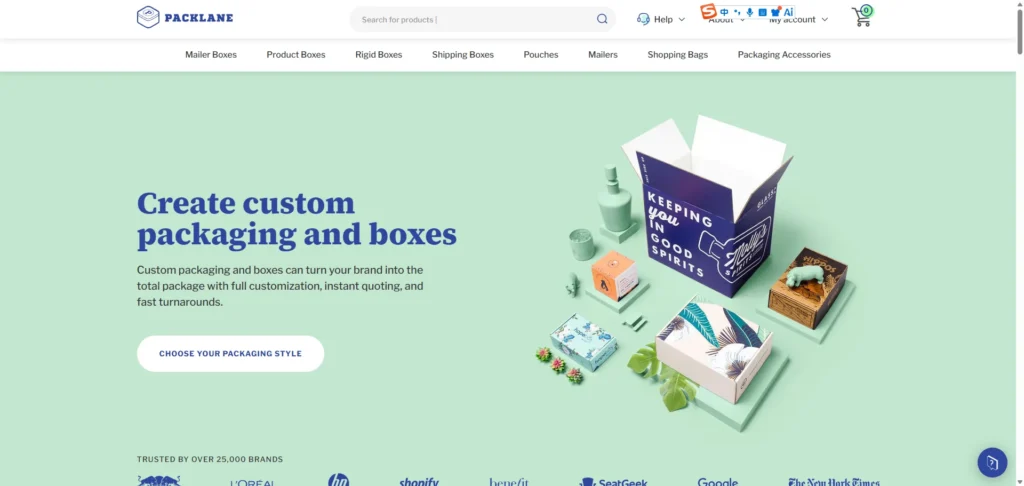
When I take a step back and evaluate Packlane through the lens of a sourcing professional who has worked with multiple packaging suppliers, I begin to see a company that is not simply participating in the custom packaging industry, but actively redefining how it operates. What stands out to me immediately is how Packlane bridges the gap between creativity and execution. In many traditional manufacturing environments, I often find myself navigating fragmented processes where design, pricing, and production are disconnected. With Packlane, however, I experience a unified system where these elements are tightly integrated, allowing me to move from concept to production with a level of clarity and control that feels both modern and efficient.
A Technology-Driven Packaging Ecosystem
As I explore Packlane more deeply, I begin to understand that its true strength lies in its technology-driven ecosystem. The platform is built around a digital-first philosophy that places control directly in my hands. Instead of submitting inquiries and waiting for responses, I can actively participate in the creation process through their 3D design interface.
From my perspective, this transforms the entire sourcing experience. I am no longer dependent on external interpretation of my requirements. I can visualize my custom gift boxes in real time, adjust structural dimensions, experiment with branding elements, and immediately see how each decision shapes the final product. This level of interaction creates a sense of confidence because I am not guessing outcomes; I am actively shaping them. It also reduces the communication gap that often leads to misunderstandings in traditional workflows.
What I find particularly valuable is how this system accommodates both simplicity and complexity. Whether I am working with a basic logo placement or a fully developed packaging concept created in professional design software, Packlane provides the flexibility to support both approaches. This adaptability makes the platform accessible without compromising its capability.
Redefining Custom Gift Boxes Through Structural Simplicity
When I examine Packlane’s approach to product offerings, I initially notice a relatively focused selection of box types. However, as I analyze this further, I realize that this simplicity is intentional and strategic. Rather than overwhelming users with countless variations, Packlane provides core structural formats that can be extensively customized to serve multiple purposes, including high-end gift packaging.
From my perspective, this approach allows me to think beyond predefined categories. A mailer box can evolve into a premium gift box with carefully designed interior printing and structural enhancements. A product box can become a luxury presentation piece through the use of refined finishes and precise branding. This flexibility gives me the ability to create packaging solutions that are tailored to specific customer experiences rather than being constrained by standard definitions.
I also appreciate how this structure aligns with modern commerce. Many brands today operate across multiple channels, including e-commerce, retail, and direct gifting. Packlane’s adaptable box formats allow me to maintain consistency across these channels while still optimizing each packaging solution for its intended use.
Real-Time Pricing as a Strategic Decision Tool
One of the most transformative aspects of working with Packlane, in my experience, is the real-time pricing capability. In traditional sourcing environments, pricing is often a delayed and uncertain process, requiring multiple iterations before reaching clarity. With Packlane, pricing becomes an integral part of the design process rather than a separate step.
As I design my custom gift boxes, I can immediately see how changes in size, material, print coverage, and quantity affect the overall cost. This allows me to make informed decisions on the spot, balancing aesthetic goals with budget constraints. Instead of redesigning after receiving a quote, I can optimize my design as I go, which significantly reduces inefficiencies.
From my perspective, this level of transparency not only saves time but also improves strategic planning. I can test different scenarios, compare cost structures, and align my packaging decisions with broader business objectives. This transforms pricing from a reactive element into a proactive tool that supports better outcomes.
Speed Without Compromising Precision
When I consider the operational capabilities of Packlane, I see a system that prioritizes speed while maintaining a strong emphasis on accuracy. The relatively fast turnaround times are complemented by structured processes such as digital proofing and prepress validation. This ensures that while production moves quickly, it does not bypass critical quality checks.
I find this balance particularly important because custom gift packaging often plays a central role in product launches, seasonal campaigns, and promotional events. Delays in packaging can disrupt entire timelines. With Packlane, I feel confident that I can meet tight deadlines without sacrificing the integrity of the final product.
The prepress review process also adds an additional layer of assurance. Knowing that my designs are checked for technical accuracy before production begins reduces the risk of costly errors. From my perspective, this combination of speed and reliability is one of the key reasons why Packlane stands out in a competitive market.
Material Integrity and Sustainable Responsibility
As I evaluate the materials used by Packlane, I notice a deliberate effort to align performance with sustainability. Their focus on corrugated and paper-based materials with high recycled content reflects a forward-thinking approach that resonates with current market expectations.
From my perspective, sustainability is no longer a secondary consideration. It is a core requirement for many brands, especially those targeting environmentally conscious consumers. Packlane’s ability to provide eco-friendly materials without compromising structural strength or print quality allows me to meet these expectations while maintaining a premium brand image.
I also recognize the importance of material integrity in gift packaging. A gift box must do more than look appealing; it must protect its contents and maintain its form throughout the entire customer journey. Packlane’s emphasis on durable construction ensures that the packaging performs reliably while still delivering a visually compelling experience.
Scalability and Long-Term Partnership Potential
When I think about scalability, I see Packlane as a partner that can evolve alongside a brand’s growth. The availability of low minimum order quantities allows me to experiment with new packaging concepts or test market responses without significant upfront investment. At the same time, the ability to scale production without limitations ensures that I can meet increasing demand as the business expands.
From my perspective, this flexibility is essential in today’s dynamic market environment. It allows me to adopt an iterative approach to packaging strategy, where decisions are informed by real-world performance rather than assumptions. I can refine designs, optimize costs, and scale successful concepts with confidence.
This scalability also simplifies supplier management. Instead of constantly searching for new manufacturers as order volumes change, I can rely on Packlane as a consistent partner throughout different stages of growth. This continuity reduces complexity and strengthens operational efficiency.
Why I Would Choose Packlane as a Sourcing Manager for Custom Gift Boxes
When I fully immerse myself in the role of a sourcing manager, I find that Packlane offers a combination of attributes that align closely with the demands of modern packaging projects. The first reason I would choose them is the level of control they provide through their digital platform. Being able to design, visualize, and price packaging in real time allows me to manage projects with precision and confidence.
The second reason is efficiency. The streamlined workflow reduces the time required to move from concept to production, enabling faster execution and quicker response to market opportunities. This is particularly valuable in competitive industries where timing can directly influence success.
The third reason is adaptability. Packlane’s flexible product structures and scalable order quantities allow me to address a wide range of packaging needs without relying on multiple suppliers. This creates consistency and simplifies the sourcing process.
Finally, I see Packlane as a partner that understands the strategic importance of packaging. They recognize that a custom gift box is not just a functional component, but a key element of brand storytelling and customer experience. From my perspective, this alignment between operational efficiency and brand impact is what ultimately makes Packlane a compelling choice for sourcing managers who are looking to create meaningful, high-quality custom gift packaging.
Splash Packaging
When I take a deeper and more critical look at Splash Packaging, I begin to understand that it represents a very specific and highly practical philosophy within the packaging industry. While many suppliers position themselves around customization, innovation, or large-scale manufacturing, Splash Packaging focuses on solving one of the most immediate and operationally critical challenges that I often face as a sourcing manager, which is how to secure high-quality, visually appealing packaging without delays, uncertainty, or excessive complexity. From my perspective, this is not a limitation of their model, but rather a deliberate strength.
I see Splash Packaging as a bridge between speed and presentation. It allows me to maintain a professional and premium brand image while operating within real-world constraints such as tight deadlines, fluctuating demand, and budget sensitivity. This balance is not easy to achieve, and it is exactly where Splash Packaging becomes strategically valuable.
A Ready-to-Deploy Packaging Infrastructure
As I analyze their operational structure, I begin to appreciate how intentionally Splash Packaging has built its infrastructure around immediacy. Their model is centered on stocking a large inventory of packaging products that are ready to ship at any moment. This means that instead of initiating a production cycle, I am accessing an already prepared solution.
From my experience, this changes the way I think about packaging procurement. I am no longer planning solely around production timelines, but instead around availability and deployment. If I am preparing for a seasonal campaign, a sudden retail opportunity, or a last-minute promotional event, I can move forward without the typical delays associated with custom manufacturing.
I also find that this model reduces operational friction. There is no need to manage multiple iterations, approve complex production samples, or wait for manufacturing updates. The process becomes more about selection and execution rather than coordination and oversight. For me, this creates a more efficient workflow and allows me to allocate time and resources to other strategic priorities.
Thoughtfully Curated Gift Box Solutions for Real Use Cases
When I explore Splash Packaging’s product catalog in detail, I begin to notice that it is not simply extensive, but intentionally curated. Each category of gift boxes appears to be designed with a specific business scenario in mind. I see magnetic lid gift boxes that are clearly positioned for premium gifting experiences, jewelry boxes that emphasize protection and elegance, kraft boxes that align with natural and eco-conscious branding, and bakery boxes that balance functionality with presentation.
From my perspective, this level of curation simplifies decision-making significantly. Instead of starting from a blank canvas and defining every specification, I can select from solutions that are already aligned with my intended use case. This allows me to move faster while still ensuring that the packaging fits the context of the product and the expectations of the customer.
I also notice how these products maintain a consistent visual standard. Even though they are in-stock items, they incorporate finishes, textures, and structural details that elevate their appearance. This is particularly important because it allows me to deliver a cohesive and polished brand experience without investing in full customization.
Creating Perceived Value Through Design and Material Choices
When I evaluate Splash Packaging’s approach to design and materials, I begin to see how they create a strong sense of perceived value. Packaging is not only about protecting a product, but also about shaping how that product is perceived. Splash Packaging achieves this by offering materials and finishes that feel intentional and refined, even within a standardized product range.
From my perspective, elements such as black linen textures, matte finishes, kraft materials, and ribbon details contribute significantly to the overall impression of quality. These details allow me to present products in a way that feels premium and thoughtful, which is especially important in gift-related contexts where presentation plays a central role in the customer experience.
I also appreciate how these design choices are balanced with practicality. The boxes are not overly complex or fragile, which means they can withstand handling, storage, and transportation without compromising their appearance. This balance between aesthetics and durability is essential for maintaining consistency across the entire customer journey.
Cost Efficiency Without Compromising Brand Image
When I consider the financial aspect of sourcing, I find Splash Packaging’s value proposition particularly compelling. Their pricing strategy is designed to be accessible while still delivering a high level of visual and material quality. From my perspective, this allows me to achieve a strong return on investment in packaging without exceeding budget constraints.
I often face the challenge of maintaining brand standards while managing costs, especially when dealing with large volumes or multiple product lines. Splash Packaging provides a solution where I do not have to choose between affordability and presentation. Instead, I can achieve both simultaneously.
This becomes even more important when scaling operations. As order volumes increase, maintaining cost efficiency becomes critical. Splash Packaging’s wholesale pricing and bulk availability allow me to manage expenses effectively while ensuring that packaging remains consistent and professional across all touchpoints.
Integrating Sustainability Into Everyday Packaging Decisions
As sustainability continues to influence purchasing behavior and brand positioning, I find Splash Packaging’s approach both practical and forward-thinking. Many of their products are made from recycled materials and are fully recyclable, which allows me to incorporate environmentally responsible choices into my packaging strategy without additional complexity.
From my perspective, this integration is key. Instead of treating sustainability as a separate initiative, Splash Packaging embeds it into their standard offering. This makes it easier for me to align packaging decisions with broader brand values and market expectations.
I also recognize that sustainability is not only about materials, but also about perception. Using eco-friendly packaging sends a clear message to customers about a brand’s commitment to responsible practices. Splash Packaging enables me to communicate this message effectively while maintaining the visual and functional quality of the packaging.
Simplifying Procurement and Enhancing Operational Consistency
When I reflect on the procurement process, I realize how much efficiency can be gained when complexity is removed. Splash Packaging’s model is designed to simplify every step, from product selection to order fulfillment.
From my perspective, this simplicity is one of their greatest strengths. I can quickly identify the packaging I need, place an order, and receive it without navigating complicated customization processes or extended communication cycles. This is particularly valuable when managing multiple projects or responding to urgent requirements.
I also see how this model supports consistency across different business units. By using standardized, in-stock products, I can ensure that packaging remains uniform across stores, campaigns, or product lines. This consistency reinforces brand identity while reducing the need for constant adjustments and oversight.
Why I Would Choose Splash Packaging as a Sourcing Manager for Custom Gift Boxes
When I fully step into the role of a sourcing manager, I find that Splash Packaging offers a set of advantages that are highly aligned with real-world operational needs. The first reason I would choose them is their ability to deliver immediate solutions. In situations where time is limited or demand is unpredictable, having access to ready-to-ship gift boxes allows me to maintain momentum without delays.
The second reason is their balance between cost and quality. Splash Packaging enables me to manage budgets effectively while still delivering packaging that meets both aesthetic and functional expectations. This is essential for maintaining brand standards at scale.
The third reason is operational efficiency. The straightforward procurement process reduces the time and effort required to manage packaging orders, allowing me to focus on strategic priorities rather than logistical details.
Finally, I see Splash Packaging as a partner that understands the practical realities of business. They recognize that packaging decisions are often driven by time, cost, and availability, not just design ambition. From my perspective, this makes them an indispensable option for sourcing managers who need reliable, efficient, and visually effective gift box solutions that can be deployed quickly and consistently.
American Retail Supply
When I take a closer look at American Retail Supply, I don’t see just another packaging supplier—I see a company that has quietly built one of the most comprehensive retail support ecosystems in the United States. Established with a clear mission to serve retailers at every operational level, their approach to packaging is deeply rooted in practicality, consistency, and long-term reliability. As I analyze their positioning in the custom gift box space, I realize that their strength lies not in flashy innovation, but in their ability to solve everyday problems that brands face when scaling packaging operations.
From my perspective, this becomes incredibly valuable in a market where many suppliers focus heavily on design but overlook execution. American Retail Supply understands that packaging is not just about appearance—it is about availability, efficiency, and the ability to support a business consistently over time. That understanding shapes everything they do, from product design to logistics, and it is exactly why they continue to remain relevant across decades of retail evolution.
A Deep Understanding of Retail Packaging Realities
As I explore their product philosophy, I begin to appreciate how deeply American Retail Supply understands the realities of running a retail business. Their gift boxes are not designed in isolation; they are part of a larger system that includes display, storage, transportation, and final presentation. This holistic thinking is something I rarely see executed this clearly.
When I consider how packaging is actually used in a retail environment, I think about staff assembling boxes quickly during busy hours, limited storage space in backrooms, and the need for packaging that works across multiple product categories. American Retail Supply addresses all of these challenges through practical design decisions such as foldable structures, standardized sizing, and durable materials that can handle frequent handling.
What stands out to me is that they do not try to overcomplicate the product. Instead, they focus on creating packaging that works reliably every single day. This consistency is something I value highly, especially when managing large volumes or multiple store locations.
Product System That Goes Beyond Just Gift Boxes
The more I analyze their offering, the more I realize that American Retail Supply is not just selling gift boxes—they are offering a complete packaging system. Their catalog includes not only various styles of gift boxes, but also complementary products such as tissue paper, ribbons, shopping bags, labels, and even store display solutions.
From my perspective, this creates a significant strategic advantage. Instead of sourcing different packaging components from multiple vendors, I can build a unified packaging experience through a single supplier. This not only simplifies procurement but also ensures visual consistency across all customer touchpoints.
I also notice how their product range supports different levels of brand positioning. Whether I am working on a budget-friendly retail concept or a more premium presentation, I can find solutions that align with the brand’s identity without needing to redesign the entire packaging strategy. This flexibility allows me to adapt quickly to market changes while maintaining operational stability.
Efficiency and Speed as a Competitive Advantage
One of the most compelling reasons I would consider American Retail Supply is their emphasis on speed and reliability. In my experience, packaging delays can create serious bottlenecks in operations, especially during peak seasons or product launches. Their ability to ship orders quickly, often on the same day, directly addresses this challenge.
As I think about the implications of this, I realize that it fundamentally changes how I manage inventory. Instead of holding large amounts of safety stock, I can rely on their consistent fulfillment capabilities to replenish packaging as needed. This reduces storage costs and improves cash flow, which are critical factors for growing brands.
Their regional distribution capabilities further enhance this advantage. With established delivery systems across multiple locations, they provide a level of logistical predictability that allows me to plan with confidence. In a supply chain environment where uncertainty is often the norm, this kind of reliability becomes a powerful differentiator.
Practical Customization That Balances Cost and Branding
While American Retail Supply is primarily known for its in-stock solutions, I find their approach to customization particularly practical. Instead of pushing brands toward fully bespoke packaging, they offer the flexibility to enhance standard products with branding elements such as logos, labels, and decorative finishes.
From my perspective, this approach strikes an ideal balance between cost and brand identity. Fully custom packaging can be expensive and time-consuming, especially for businesses that are still testing products or entering new markets. By starting with adaptable base designs, I can achieve a professional look without the risks associated with complex production processes.
I also see this as a scalable strategy. As the brand grows and demand becomes more predictable, it becomes easier to transition into more advanced customization. American Retail Supply provides a foundation that supports this progression, allowing me to evolve my packaging without disrupting existing operations.
A Service Culture That Prioritizes Long-Term Relationships
What truly sets American Retail Supply apart in my analysis is their commitment to customer service. Their philosophy of focusing on customer satisfaction is not just a slogan—it is embedded in their operations and company culture. Every interaction is designed to ensure that the client feels supported, whether it is through quick responses, clear communication, or reliable delivery.
From my experience, this kind of service culture has a direct impact on the success of long-term partnerships. It reduces friction, builds trust, and creates a sense of reliability that goes beyond the product itself. When I work with a supplier that consistently delivers on promises, it allows me to focus more on growing the business rather than managing operational risks.
I also appreciate the human aspect of their service model. The emphasis on real customer support, rather than purely automated systems, creates a more responsive and adaptable experience. This is particularly important when dealing with custom requests or unexpected challenges.
Why I Would Choose American Retail Supply for Custom Gift Boxes
When I bring all of these insights together, I see American Retail Supply as a highly dependable partner for sourcing custom gift boxes, especially for brands that prioritize operational efficiency and consistency. The first reason I would choose them is their ability to provide a complete packaging ecosystem, allowing me to streamline procurement and maintain a cohesive brand experience.
The second reason is their focus on practicality. Their products are designed to function seamlessly within real retail environments, which helps reduce complexity and improve day-to-day operations.
The third reason is their speed and reliability. Their strong distribution network and commitment to timely delivery give me confidence that packaging will never become a bottleneck in my business.
Finally, I value their balanced approach to customization. They allow me to build a strong brand presence without overcomplicating the production process, which is essential for sustainable growth.
From my perspective, American Retail Supply is not just a packaging vendor—it is a long-term operational partner that helps me deliver consistent, high-quality packaging experiences while maintaining efficiency and control at every stage of the business.
Glee Packaging
When I take a deeper, more critical look at Glee Packaging, I don’t just see a manufacturer operating out of China—I see a highly structured packaging partner that understands how packaging connects product, brand, and supply chain into one unified system. Over the years, I’ve analyzed many suppliers in the custom gift box space, and what often separates average vendors from truly valuable partners is their ability to think beyond production. Glee Packaging clearly operates with that broader mindset.
From my perspective, what makes them particularly interesting is how they bridge two worlds that are often disconnected: creative brand-driven packaging and industrial-scale manufacturing efficiency. They are not simply producing luxury gift boxes; they are engineering packaging that performs across logistics, marketing, and customer experience simultaneously. That combination is exactly what I look for when building packaging strategies for brands that want to scale globally without losing their premium positioning.
A Business Model Built Around Solving Real Packaging Challenges
As I study how Glee Packaging positions itself, I begin to understand that their core strength lies in problem-solving rather than product selling. They explicitly invite brands to bring complex packaging challenges, which tells me they are comfortable operating in scenarios where requirements are unclear, evolving, or technically demanding.
In my experience, this is where most suppliers struggle. Many manufacturers are efficient when given exact specifications, but far fewer can help define the right solution from the beginning. Glee Packaging takes the time to understand the product itself, the weight, fragility, display requirements, and even the emotional positioning of the brand. This allows them to recommend structures, materials, and finishes that are not only visually appealing but also functionally correct.
I find this especially valuable when working with products like cosmetics, jewelry, or premium gifts, where packaging must protect delicate items while simultaneously enhancing perceived value. Instead of forcing me to adapt my product to a standard box, they adapt the packaging to fit the product perfectly.
From Concept to Reality Through an Integrated Development Process
What stands out to me most is how Glee Packaging manages the transition from idea to final product. Their process is not fragmented; it is fully integrated. I can start with a rough concept, move into structural design, validate through sampling, and then scale into full production—all within the same ecosystem.
From my perspective, this reduces a tremendous amount of complexity. In many projects, I have seen delays and inconsistencies arise because design, prototyping, and manufacturing are handled by different parties. Here, everything is aligned under one system, which ensures that what I approve in the sample stage is exactly what I receive in mass production.
I also appreciate their emphasis on rapid sampling. Being able to physically evaluate a box before committing to large quantities allows me to test not only aesthetics but also usability. I can assess how the box opens, how the product fits, and how the entire experience feels in the hands of a customer. This level of validation is essential for making confident decisions.
Manufacturing Depth That Supports Both Scale and Precision
As I go deeper into their manufacturing capabilities, I begin to see the true scale of what Glee Packaging offers. Their production is not just about volume—it is about controlled precision at scale. With advanced printing technologies and experienced engineering teams, they ensure that every detail, from color consistency to structural integrity, is maintained across large production runs.
From my perspective, this is critical for brands that operate across multiple markets. When I place a large order, I need to know that the first box and the ten-thousandth box will look and perform exactly the same. Any inconsistency can weaken brand perception and create operational issues.
I am also particularly impressed by their attention to physical performance. Packaging is often judged by its appearance, but in reality, it must survive transportation, stacking, and handling. Their use of standardized testing methods ensures that boxes are not only beautiful but also durable enough to protect products under real shipping conditions. This combination of strength and elegance is something I always prioritize.
Customization That Translates Brand Identity Into Physical Form
As I analyze their customization capabilities more closely, I start to see how Glee Packaging enables true brand differentiation. They do not limit customization to surface-level printing. Instead, they offer a wide range of structural and finishing options that allow me to design packaging as a fully immersive brand experience.
I can choose rigid boxes for a premium feel, folding cartons for efficiency, or magnetic closure boxes for a more luxurious unboxing moment. Beyond structure, I can incorporate elements such as embossing, foil stamping, soft-touch lamination, and window cutouts to create layers of visual and tactile interest.
From my perspective, this is where packaging becomes powerful. It is no longer just a container; it becomes part of the product itself. The way a box feels, the way it opens, and the way it presents the product all contribute to how customers perceive value. Glee Packaging gives me the flexibility to control these details with a high degree of precision.
Sustainability as a Practical and Scalable Strategy
Another dimension that I find increasingly important is sustainability, and Glee Packaging approaches it in a way that feels both practical and scalable. They use FSC-certified materials and environmentally responsible processes, ensuring that packaging meets modern environmental standards without sacrificing performance.
From my perspective, this is essential for brands that want to position themselves responsibly in global markets. Consumers are paying closer attention to packaging materials, and regulatory requirements are becoming stricter. Working with a supplier that already integrates sustainability into its operations allows me to stay ahead of these trends.
What I particularly appreciate is that their sustainable approach does not feel like a compromise. The materials still deliver strength, print quality, and visual appeal. This balance between environmental responsibility and product performance is something I consider a key indicator of a mature and forward-thinking manufacturer.
A Relationship-Driven Approach That Builds Long-Term Value
Beyond products and processes, what truly shapes my perception of Glee Packaging is their focus on relationships. They emphasize dedicated account management and long-term collaboration, which tells me they are not interested in one-off transactions.
From my experience, this approach creates a much stronger foundation for success. Packaging is not static; it evolves with the brand. Having a partner who understands my business, anticipates my needs, and continuously improves solutions over time is far more valuable than simply finding the lowest price.
I also value their emphasis on confidentiality. In industries where product launches and design innovations are sensitive, knowing that my ideas and specifications are protected gives me additional confidence in the partnership.
Why I Would Choose Glee Packaging for Custom Gift Boxes
When I bring all of these insights together, I see Glee Packaging as a partner that aligns closely with the needs of modern brands operating in competitive, global markets. The first reason I would choose them is their ability to translate complex ideas into practical, manufacturable packaging solutions. This reduces uncertainty and ensures that projects move forward efficiently.
The second reason is their integrated process, which allows me to move from concept to production without losing control over quality or consistency. This level of alignment is critical for maintaining brand integrity.
The third reason is their manufacturing depth, which combines advanced technology with rigorous quality control to deliver reliable results at scale.
The fourth reason is their customization capability, which enables me to create packaging that truly reflects brand identity and enhances customer experience.
The fifth reason is their commitment to sustainability, which supports both environmental goals and long-term business positioning.
Finally, I value their relationship-driven approach. They operate not just as a supplier, but as a partner invested in the success of my brand.
From my perspective, Glee Packaging represents a rare combination of creativity, technical expertise, and operational reliability. They are not just helping me produce custom gift boxes—they are helping me build a packaging strategy that supports growth, differentiation, and long-term brand value.
Noissue
When I evaluate Noissue as a custom gift box manufacturer, I don’t see it as a traditional supplier—I see it as a platform that has redefined how modern brands approach packaging. In a market where speed, sustainability, and brand storytelling are becoming inseparable, Noissue positions itself right at the intersection of these needs. What stands out to me immediately is how it simplifies complexity. Instead of navigating fragmented supply chains, long email threads, and unclear pricing structures, I can operate within a system that is transparent, responsive, and built for decision-making in real time. For any sourcing manager who values efficiency and control, this shift alone is incredibly meaningful.
A Platform That Turns Packaging into a Scalable System
From my perspective, the biggest difference with Noissue is that it doesn’t behave like a conventional factory—it behaves like a scalable infrastructure for packaging. I can approach custom gift boxes not as isolated SKUs, but as part of a broader packaging system that evolves with my brand.
What I find particularly valuable is how this changes my mindset. Instead of committing to large, risky production runs, I can test designs, launch limited collections, and refine packaging based on real customer feedback. This flexibility allows me to stay aligned with market trends without overcommitting resources. In fast-moving industries like DTC, beauty, apparel, or gifting, this kind of adaptability is not just useful—it is essential.
Low Minimum Orders That Unlock Strategic Flexibility
One of the first things I notice when working with Noissue is how accessible their minimum order quantities are. This is not just a convenience feature—it fundamentally changes how I manage risk and innovation.
When I don’t have to commit to high MOQs, I gain the freedom to experiment. I can launch seasonal packaging, test new branding directions, or support smaller product drops without worrying about excess inventory. This is especially important when I am managing multiple SKUs or entering new markets where demand is still uncertain.
From my experience, low minimums are not just about cost—they are about agility. They allow me to make smarter decisions, faster, and with less exposure to operational risk.
A Digital Design Experience That Feels Intuitive and Immediate
What truly differentiates Noissue in my eyes is the way it brings the design process into a digital environment. Instead of relying on static proofs or back-and-forth communication, I can actively participate in shaping my packaging in real time.
I can visualize how my custom gift boxes will look, adjust elements like colors, layouts, and print areas, and understand the impact of those changes instantly. This level of control gives me confidence in my decisions. I am not guessing—I am building with clarity.
This also shortens the development cycle dramatically. What used to take weeks of coordination can now be done in a fraction of the time, allowing me to move from concept to production without unnecessary delays.
Sustainability Built Into Every Layer of the Process
When I think about Noissue, sustainability is not an afterthought—it is embedded into the entire system. From recyclable and compostable materials to soy-based inks and eco-conscious production practices, every decision seems aligned with reducing environmental impact.
For me, this matters on multiple levels. It allows me to meet the growing expectations of environmentally conscious consumers while also aligning with broader corporate sustainability goals. But beyond compliance or branding, it gives me confidence that my packaging choices are responsible by design.
I also see value in how Noissue communicates this clearly. Sustainability is not hidden in technical specifications—it is presented as a core part of the product offering, making it easier for me to integrate into my brand narrative.
A Connected Packaging Ecosystem Beyond Just Gift Boxes
Another reason I see Noissue as a strong partner is the way it extends beyond custom gift boxes into a full packaging ecosystem. I am not limited to a single product category. Instead, I can build a complete packaging experience that includes tissue paper, tape, mailers, and even QR-enabled smart packaging solutions.
This creates a level of consistency that is difficult to achieve when working with multiple suppliers. Every element of my packaging can be aligned in terms of design, material, and messaging.
From my experience, this consistency is what transforms packaging from functional to memorable. When every detail feels intentional, customers notice. It reinforces brand identity and creates a stronger emotional connection with the product.
Smart Packaging and Digital Integration as a Competitive Edge
What I find particularly forward-thinking about Noissue is its approach to bridging physical packaging with digital experiences. Through features like QR-enabled packaging, I can connect offline interactions with online engagement.
This opens up new possibilities for storytelling, marketing, and customer retention. A simple gift box can become a gateway to brand content, loyalty programs, or personalized experiences.
From my perspective, this is where packaging is heading. It is no longer just about protection or presentation—it is about interaction. Noissue understands this shift and provides tools that allow me to stay ahead of it.
Global Accessibility with Reliable Turnaround
As someone who values operational efficiency, I pay close attention to logistics and delivery timelines. Noissue’s ability to support global shipping while maintaining reliable turnaround times is a major advantage.
I can manage orders across different regions without needing to coordinate multiple suppliers. Whether I am shipping to the United States, Europe, or other markets, I can maintain consistency in both product quality and delivery expectations.
This simplifies my supply chain and reduces the complexity that often comes with international sourcing. It allows me to focus more on strategy and less on operational troubleshooting.
A Brand-First Approach That Elevates Customer Experience
What resonates with me most is how Noissue approaches packaging as an extension of the brand experience. Every custom gift box is not just a container—it is an opportunity to communicate identity, values, and creativity.
I can design packaging that reflects my brand’s personality, whether that means minimalistic elegance, bold visual storytelling, or eco-conscious messaging. This flexibility allows me to create packaging that feels authentic rather than generic.
In my experience, this has a direct impact on customer perception. A well-designed package enhances the unboxing experience, increases perceived value, and encourages repeat engagement.
Why I Would Choose Noissue for Custom Gift Boxes
When I bring all of these elements together, the reason I would choose Noissue becomes clear. It offers me a level of control, flexibility, and strategic value that goes far beyond traditional packaging manufacturing.
I am not just placing an order—I am building a system that supports my brand’s growth. I can move faster, experiment more freely, and maintain consistency across every touchpoint. At the same time, I can align my packaging with sustainability goals and emerging digital trends.
For me as a sourcing manager, this combination is incredibly powerful. It reduces operational friction while increasing creative and strategic possibilities. Choosing Noissue means choosing a partner that understands where packaging is today—and where it is going next.
Best Custom Gift Box Manufacturers by Use Case (Editor’s Picks)
When I evaluate custom gift box manufacturers, I do not begin by asking which company is the biggest or the most well-known. Instead, I start with a much more practical question: what does the brand actually need right now, and what will it need six months or one year from now. In my experience, packaging decisions are never isolated. They sit at the intersection of branding, cost control, operational efficiency, and customer experience, and the wrong choice at this stage often creates hidden problems later in production, logistics, and even marketing performance.
Over time, I have learned that the most effective way to select a manufacturer is to view them through specific use cases rather than general rankings. A supplier that excels in flexibility may outperform others for startups but fail to meet the precision requirements of a luxury brand. Likewise, a manufacturer optimized for high-volume production may not provide the responsiveness needed for early-stage experimentation. This is why I approach this analysis from a strategic lens, aligning manufacturer strengths with real business scenarios rather than abstract criteria.
Best for Startups Low MOQ and Flexible Production
When I work with startups, I immediately recognize that packaging is not a fixed system but an evolving experiment. At this stage, the brand is still testing product-market fit, refining its positioning, and learning how customers respond to different visual and structural elements. Because of this uncertainty, I place a very high value on manufacturers that offer low minimum order quantities and flexible production capabilities.
I have seen many founders make the mistake of committing to large production volumes too early, often because they are attracted by lower unit costs. However, what they do not realize is that packaging mistakes become extremely expensive when locked into high quantities. A design that looks good in concept may fail in real-world use, whether due to poor unboxing experience, weak structural integrity, or simply not resonating with the target audience. By working with a manufacturer that allows smaller runs, I can test multiple variations, gather feedback, and iterate quickly without carrying unnecessary inventory risk.
Flexibility also extends beyond quantity. I look for partners who are willing to adapt structures, materials, and printing approaches based on evolving needs. For example, I may start with a simple folding carton to validate the concept, then gradually move toward more complex structures such as magnetic rigid boxes once the brand has proven demand. A good startup-focused manufacturer understands this progression and supports it rather than forcing a one-size-fits-all solution.
Another factor I consider is communication speed and clarity. Startups move quickly, and delays in sampling or unclear feedback loops can slow down the entire business. I value manufacturers who can translate ideas into prototypes efficiently and provide actionable input rather than generic responses. In my experience, the best partners for startups act almost like an extension of the team, helping to reduce uncertainty and accelerate decision-making.
Best for Luxury Brands Premium Materials and Finishes
When I shift my focus to luxury brands, the entire evaluation framework changes. In this segment, packaging is no longer just a functional necessity. It becomes a core part of the product experience and often serves as the first physical touchpoint between the brand and the customer. Because of this, I pay close attention to the manufacturer’s ability to deliver not just quality, but consistency and emotional impact.
Material selection is one of the first areas I analyze in depth. Luxury packaging often relies on rigid board structures, specialty papers, and advanced finishing techniques that create a sense of weight, texture, and refinement. However, what matters to me is not just the availability of these options, but how well the manufacturer executes them. Poorly applied foil stamping, inconsistent embossing, or slight variations in color can significantly reduce the perceived value of the product. I look for manufacturers with proven expertise in high-end production and strict quality control systems that ensure every unit meets the same standard.
I also consider how well the manufacturer understands brand storytelling. Luxury packaging is not only about aesthetics but about conveying identity, heritage, and positioning. The best partners are those who can interpret a brand’s vision and translate it into structural and visual elements that feel cohesive and intentional. They contribute ideas on how to enhance the unboxing experience, whether through layered structures, hidden compartments, or subtle design details that create a sense of discovery.
Consistency across batches is another critical factor. Luxury brands often operate on a global scale, and packaging must remain uniform regardless of production volume or location. I evaluate whether the manufacturer has the systems and discipline required to maintain this consistency over time. In my experience, reliability in execution is what ultimately defines a true luxury packaging partner.
Best for E commerce Brands Fast Turnaround and Scalable Production
When I work with e-commerce brands, I approach packaging from a systems perspective. Unlike traditional retail, where packaging primarily serves a display function, e-commerce packaging must perform across multiple stages, including fulfillment, shipping, and customer interaction. This creates a unique set of requirements that influence how I evaluate manufacturers.
Turnaround time is one of the most important factors. E-commerce businesses often operate on tight timelines, especially during product launches, seasonal campaigns, or inventory restocking cycles. I need a manufacturer that can deliver within predictable timeframes and maintain that consistency even as order volumes fluctuate. Delays in packaging production can disrupt the entire supply chain, leading to lost sales and operational inefficiencies.
Scalability is equally important. Many e-commerce brands experience rapid growth, and the manufacturer must be able to scale production without compromising quality or extending lead times. I look for partners with strong production capacity, efficient workflows, and the ability to manage both small and large orders seamlessly. This ensures that the packaging system can support the brand’s growth rather than becoming a bottleneck.
I also evaluate how packaging performs during transit. E-commerce packaging must balance durability and presentation. It needs to protect the product from damage while still delivering a memorable unboxing experience. I pay attention to structural design, material strength, and how efficiently the packaging integrates with shipping processes. Small optimizations in packaging design can lead to significant savings in logistics costs and improvements in customer satisfaction.
From my perspective, the best manufacturers for e-commerce brands are those who understand that packaging is part of a larger operational ecosystem. They design solutions that not only look good but also function effectively within real-world distribution systems.
Best for Sustainable Packaging Eco Friendly and FSC Certified
Sustainability has become a key consideration in how I evaluate packaging manufacturers, but I approach it with a focus on authenticity and practicality. Many companies claim to offer eco-friendly solutions, but the real value lies in how these solutions are implemented across the entire supply chain.
I begin by examining certifications such as FSC, as they provide a baseline level of credibility. However, I do not stop there. I look deeper into material sourcing, production processes, and how waste is managed. I want to understand whether the manufacturer’s sustainability practices are integrated into their operations or simply added as a marketing feature.
Another aspect I consider is how sustainability aligns with business objectives. Eco-friendly packaging should not come at the expense of performance or cost efficiency. I evaluate whether the manufacturer can provide solutions that maintain structural integrity, visual appeal, and scalability while reducing environmental impact. This balance is critical for brands that want to adopt sustainable practices without compromising their competitiveness.
I also value manufacturers who take a consultative approach to sustainability. The best partners are those who help me navigate trade-offs, recommend better materials, and identify opportunities to reduce environmental impact throughout the packaging lifecycle. They understand that sustainability is not a one-time decision but an ongoing process that evolves with the brand.
When I look across these different use cases, one principle consistently guides my decision-making. There is no single best custom gift box manufacturer for every situation. The right choice depends entirely on how well the manufacturer’s strengths align with the specific needs of the business at a given stage of growth.
By approaching this decision through use cases, I am able to move beyond generic comparisons and focus on practical alignment. I can identify partners who support experimentation for startups, deliver precision for luxury brands, enable efficiency for e-commerce businesses, and provide meaningful sustainability solutions.
In my experience, this approach leads to better outcomes not only in packaging quality but also in overall business performance. The right manufacturer becomes more than a supplier. They become a strategic partner who contributes to how the brand evolves, scales, and connects with its customers over time.
How to Choose the Right Custom Gift Box Manufacturer
When I choose a custom gift box manufacturer, I never see it as a simple procurement decision. I see it as one of the most underestimated strategic choices a brand can make. Over the years, I’ve worked with brands at different stages, from early startups testing their first product to established companies scaling across multiple markets, and I’ve consistently noticed one thing: the right packaging partner doesn’t just produce boxes, it shapes how a brand grows.
In 2026, packaging is no longer just about protection or presentation. It sits at the intersection of branding, customer experience, logistics efficiency, and cost control. That means choosing a manufacturer requires a deeper level of thinking. I don’t just ask what they can produce. I ask how they think, how they operate, and how well they can adapt as the business evolves.
Define Your Packaging Needs and Budget
The first step I always take is to slow down and define my actual needs with precision. I’ve learned that most mistakes happen before any supplier conversation even begins. If I don’t fully understand what I need, I can’t expect any manufacturer to give me the right solution.
I start by asking myself how the packaging will function in the real world. Is this box meant to create a memorable unboxing experience for a DTC customer, or is it primarily designed for retail display on a shelf? Will it be shipped individually, stacked in bulk, or used for seasonal gifting campaigns? Each of these scenarios leads to completely different structural and material decisions.
Then I move into brand positioning. If the product is positioned as premium, the packaging must communicate that instantly through weight, texture, and visual detail. If the product is more price-sensitive, I need to focus on efficiency without making the packaging feel cheap. I always remind myself that packaging is often the first physical interaction a customer has with a brand, and that moment needs to feel intentional.
When it comes to budget, I avoid thinking in terms of cost alone. I think in terms of value. I’ve seen brands damage their perception by underinvesting in packaging, and I’ve also seen brands strain their margins by overdesigning something that didn’t translate into higher conversion or retention. My goal is always to find a level of investment where packaging enhances the product without becoming a financial burden.
Understand MOQ and Scalability
MOQ is one of the most practical constraints in packaging, but I’ve learned that it should never be viewed in isolation. I always connect MOQ to how the business is expected to grow over the next six to twelve months.
If I am working with a new brand or a new product line, I prioritize flexibility. I want the ability to test different designs, adjust structures, and respond quickly to customer feedback. A manufacturer that allows low MOQs is not just offering convenience, it is enabling strategic learning. It allows me to move faster, make better decisions, and avoid locking into packaging that may not perform well in the market.
At the same time, I am always thinking ahead. Growth can happen faster than expected, especially in e-commerce. I’ve seen brands go from small test orders to large-scale demand in a very short time. If the manufacturer cannot scale production smoothly, it creates bottlenecks that affect inventory, delivery, and ultimately revenue.
I also evaluate how the manufacturer handles transitions between different volume levels. I look for consistency in quality, clarity in pricing, and stability in lead times as order sizes increase. A strong manufacturing partner is one that grows with the brand without forcing constant adjustments or supplier changes.
Evaluate Printing Quality and Materials
This is the area where I become extremely detail-oriented, because this is where brand perception is actually formed. Customers may not understand technical specifications, but they immediately notice how packaging looks and feels.
I always request physical samples whenever possible. Digital mockups can be helpful, but they rarely capture the true texture, color accuracy, or finishing quality of the final product. When I hold a sample, I pay attention to how the material feels, how the edges are constructed, and how the print interacts with light. These small details often reveal the true capability of a manufacturer.
I evaluate printing techniques carefully. I look at how well colors match brand guidelines, how sharp fine details appear, and whether finishes such as foil stamping, embossing, or coatings are applied consistently. In premium packaging, these elements are not optional, they are essential to delivering the expected experience.
Material selection is equally important, and I always think in terms of trade-offs. A thicker board may improve durability and perceived value, but it also increases cost and shipping weight. A lighter material may improve efficiency, but it must still meet quality expectations. I work closely with manufacturers who can explain these trade-offs clearly and recommend solutions that balance design, function, and cost.
Consider Lead Time and Shipping Logistics
Lead time is something I treat as a core part of the decision-making process, because it directly affects how the business operates. Packaging is not an isolated component, it is tied to product launches, marketing campaigns, and inventory planning.
I always ask for realistic timelines and try to understand how those timelines are managed internally. I want to know how the manufacturer handles production scheduling, how they deal with peak demand periods, and how they communicate delays if they occur. Reliability is more important to me than speed alone, because consistency allows for better planning.
Shipping logistics is another layer I take seriously, especially when working across borders. I consider transit times, shipping methods, and how packaging dimensions affect freight costs. Over time, I have realized that packaging design decisions can significantly influence logistics efficiency. A slight adjustment in box size or structure can reduce shipping volume and lower costs at scale.
I also think about risk management. Delays at customs, disruptions in shipping routes, or unexpected production issues can all impact timelines. The manufacturers I trust most are those who communicate proactively and provide solutions rather than excuses when challenges arise.
Check Certifications and Sustainability Standards
Sustainability is no longer optional, and I approach it as both a responsibility and a strategic consideration. I start by looking at certifications such as FSC, but I don’t stop there. Certifications are important, but they are only part of the story.
I try to understand how sustainability is integrated into the manufacturer’s overall process. This includes how materials are sourced, how waste is managed, and whether eco-friendly options are practical at scale. I look for transparency, because it tells me whether sustainability is a genuine priority or just a marketing message.
I also consider how sustainability aligns with the brand’s identity. For some brands, it is a core value that needs to be clearly communicated through packaging. In these cases, I work with manufacturers who can help translate that value into tangible design choices, such as material selection, printing methods, and messaging elements.
What I value most are manufacturers who act as partners in this process. They don’t just provide options, they provide guidance. They help me understand the impact of different choices and support decisions that balance environmental responsibility with business practicality.
Frequently Asked Questions About Custom Gift Box Manufacturers
When I look back at the dozens of packaging projects I have been involved in, I realize that most decisions are not driven by creativity alone, but by uncertainty. Founders and sourcing managers are not just asking about boxes, they are trying to understand risk, cost structure, supply chain reliability, and whether their packaging decisions will hold up when their brand begins to scale.
In my experience, the most valuable part of working with a custom gift box manufacturer is not the production itself, but the clarity that comes before it. The right questions, when answered properly, can prevent costly mistakes, reduce delays, and align packaging with real business outcomes. That is why I do not treat these frequently asked questions as simple answers, but as entry points into how packaging actually works in the real world. What I want to do here is break each question down from a practical, operational perspective, so that every answer connects directly to how packaging behaves across design, manufacturing, and logistics.
What Is the Typical MOQ for Custom Gift Boxes
When I discuss MOQ with clients, I always notice that many expect a universal number, something simple and fixed. But the reality I have seen across factories is that MOQ is a reflection of how production systems are structured, not a marketing number.
Every custom gift box begins long before production starts. Materials must be sourced in bulk, printing plates must be prepared, die-cut molds must be created, and machines must be calibrated. These setup processes create a base cost that does not change whether you produce 100 boxes or 1,000 boxes. This is why manufacturers naturally set a minimum quantity, because below a certain threshold, production becomes inefficient and financially unsustainable.
In most of the projects I have handled, I have found that around 500 units is a realistic entry point for custom gift boxes, especially for rigid structures. However, I have also seen situations where MOQ drops significantly when using simpler structures or digital printing, and other cases where MOQ increases when luxury finishes such as foil stamping, embossing, or magnetic closures are involved.
What I always tell brands is that MOQ should not be viewed as a limitation, but as a signal. It tells you how your packaging design interacts with manufacturing reality. If your MOQ feels too high, it usually means your design is too complex for your current stage. In those situations, I often recommend simplifying the structure or starting with a more scalable format, then evolving into more premium packaging as the business grows.
How Long Does Production Usually Take
Production timelines are one of the areas where I see the biggest gap between expectation and reality. Many people think of production as a single step, but from what I have experienced, it is actually a chain of dependent processes, and any delay in one step can affect the entire timeline.
When I map out a typical custom gift box project, I always break it into stages. The first stage is sampling, where the concept becomes a physical prototype. This stage is where most adjustments happen, whether it is structural fit, color accuracy, or finishing details. Depending on complexity, this usually takes about a week, but I have seen it extend longer when multiple revisions are needed.
The second stage is pre-production preparation. This is where materials are confirmed, printing files are finalized, and production schedules are locked in. This stage is often invisible to clients, but it is critical because any mistake here will carry into mass production.
The third stage is mass production itself. This is where efficiency matters most, but it is also where quality control becomes essential. A well-run factory can complete production within two to three weeks, but this depends heavily on order volume and seasonal demand.
What I always emphasize, and what many people underestimate, is the impact of logistics. Shipping is not just transportation, it is part of the production timeline. Whether it is sea freight, air freight, or local delivery, each option changes the total lead time significantly. From my perspective, the most successful packaging projects are not the fastest ones, but the ones where every stage is anticipated and planned with realistic buffers.
Can I Customize Size, Material, and Printing
Customization is often the reason brands choose custom packaging in the first place, but I have learned that true customization is not about having unlimited options, it is about making the right choices within manufacturing constraints.
In almost every project I have worked on, I have had the flexibility to adjust dimensions, materials, and printing techniques. This allows packaging to align perfectly with the product, whether it is creating a snug fit to prevent movement during shipping or selecting materials that enhance the perceived value of the product.
However, what I have also learned is that every layer of customization adds complexity. A simple folding carton can move quickly through automated production lines, while a rigid gift box with multiple finishes often requires manual assembly, which increases both cost and production time.
This is why I always approach customization with intention. I ask myself what each element is meant to achieve. Is the goal to create a premium unboxing experience, to protect a fragile product, or to reduce shipping costs through structural efficiency. When customization is tied to a clear objective, it becomes a strategic tool rather than an unnecessary expense.
In my experience, the most effective packaging designs are not the most complex ones, but the ones where every detail serves a purpose and contributes to the overall performance of the packaging.
Are Eco Friendly Packaging Options Available
Sustainability is no longer a secondary consideration in packaging, it has become a central expectation from both consumers and brands. Over time, I have seen this shift influence not only material choices, but also how packaging systems are designed as a whole.
From a practical standpoint, eco-friendly options are widely accessible. Many manufacturers now offer FSC-certified paper, recycled materials, and water-based inks. These materials allow brands to align with environmental standards while maintaining production efficiency.
However, I always approach sustainability from a systems perspective. A box made from recycled material is only part of the equation. If that box fails during shipping and the product is damaged, the environmental cost becomes even higher.
What I have found most effective is integrating sustainability into the design phase. This includes optimizing box size to reduce material usage, selecting structures that eliminate unnecessary components, and designing packaging that can be easily recycled after use.
Sustainability, in my experience, is not about choosing a single eco-friendly material. It is about designing packaging that performs efficiently across its entire lifecycle, from production to delivery to disposal.
Should I Choose a Local or Overseas Manufacturer
This is one of the most strategic decisions I encounter, and I have seen how it can shape not only cost, but also the overall efficiency of a brand’s supply chain.
When I work with local manufacturers, I notice clear advantages in communication speed and turnaround time. It is easier to coordinate changes, resolve issues quickly, and manage smaller production runs. This can be particularly valuable for brands that are still testing their products or require rapid iteration.
On the other hand, overseas manufacturers often bring a different set of strengths. They typically have more advanced production infrastructure, broader material options, and greater experience with complex packaging structures. In many of the projects I have managed, overseas suppliers have provided better cost efficiency and scalability, especially for larger production volumes.
However, working with overseas manufacturers requires a higher level of planning. Communication must be precise, timelines must account for shipping, and quality control must be clearly defined from the beginning.
What I have learned is that the choice is not about which option is better, but about which option aligns with the brand’s current needs. For early-stage flexibility, local suppliers can reduce risk. For long-term scaling and cost optimization, overseas manufacturers often provide greater value. The key is to match the manufacturing strategy with the business strategy.
When I step back and look at the custom gift box manufacturing landscape in 2026, what stands out to me is not just the variety of suppliers available, but the clear differences in how they serve brands at different stages. There is no single “best” manufacturer for everyone. What I have consistently seen is that the right choice depends on how well a manufacturer aligns with a brand’s current needs, whether that is flexibility, cost efficiency, premium presentation, or scalable production.
From my experience, the brands that succeed are the ones that treat packaging as part of their business system rather than a one-time purchase. They think about how packaging will evolve as order volumes grow, how it will perform across logistics and distribution, and how it will consistently represent the brand across different markets. A good manufacturer can produce boxes, but the right manufacturer can support that entire process with stability and clarity.
As I analyzed these top manufacturers, I paid close attention to how they balance customization, production capability, and operational reliability. Some are strong in rapid iteration and low MOQ, making them suitable for early-stage brands. Others excel in high-end finishes and structural precision, which is critical for luxury positioning. There are also manufacturers built for scale, where efficiency and consistency become the priority. Understanding these distinctions is what allows a brand to make a decision that will hold up not just today, but as it grows.
At the same time, I have found that many brands face a common challenge. They either over-invest in complex packaging too early, or they choose suppliers that cannot support them once they begin to scale. This is exactly where having the right manufacturing partner makes a difference. The goal is not just to produce a box, but to build a packaging system that can adapt with the business.
This is also the philosophy we follow at BorhenPack. When I work on custom gift box projects, I focus on helping brands start at a practical level and scale with confidence. I look at structure, materials, MOQ, and production strategy as a complete system, ensuring that packaging is not only visually strong, but also operationally reliable and cost-effective over time. Whether the need is a low MOQ entry point, a premium rigid box, or a scalable solution for growing demand, I approach each project with the goal of creating long-term value rather than short-term output.
If you are planning your next custom gift box project and want a partner who understands both the design side and the production reality, I would recommend starting a conversation with us at BorhenPack. I am always open to discussing your packaging goals, exploring the right structure and materials, and helping you build a solution that fits where your brand is today and where it is going next.