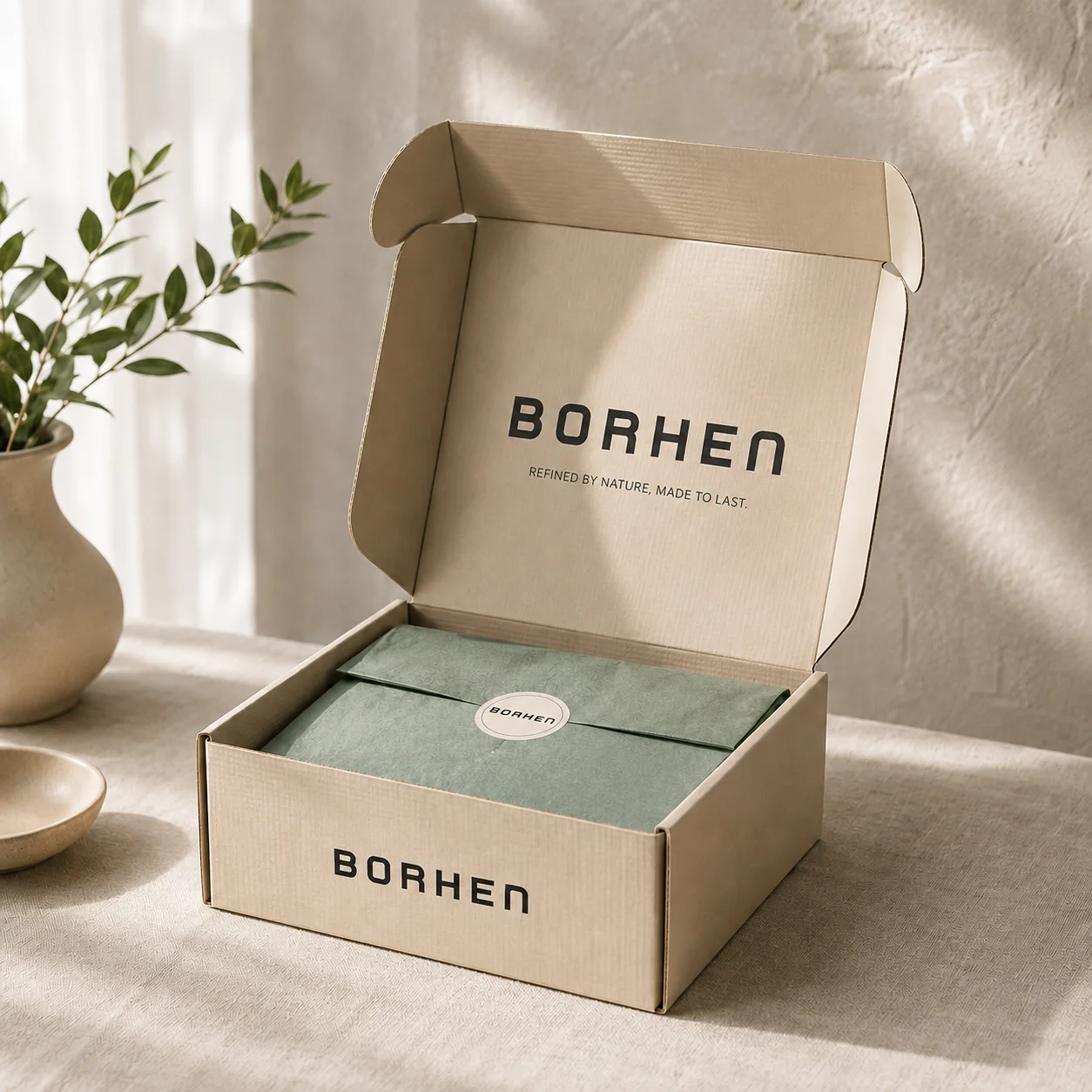
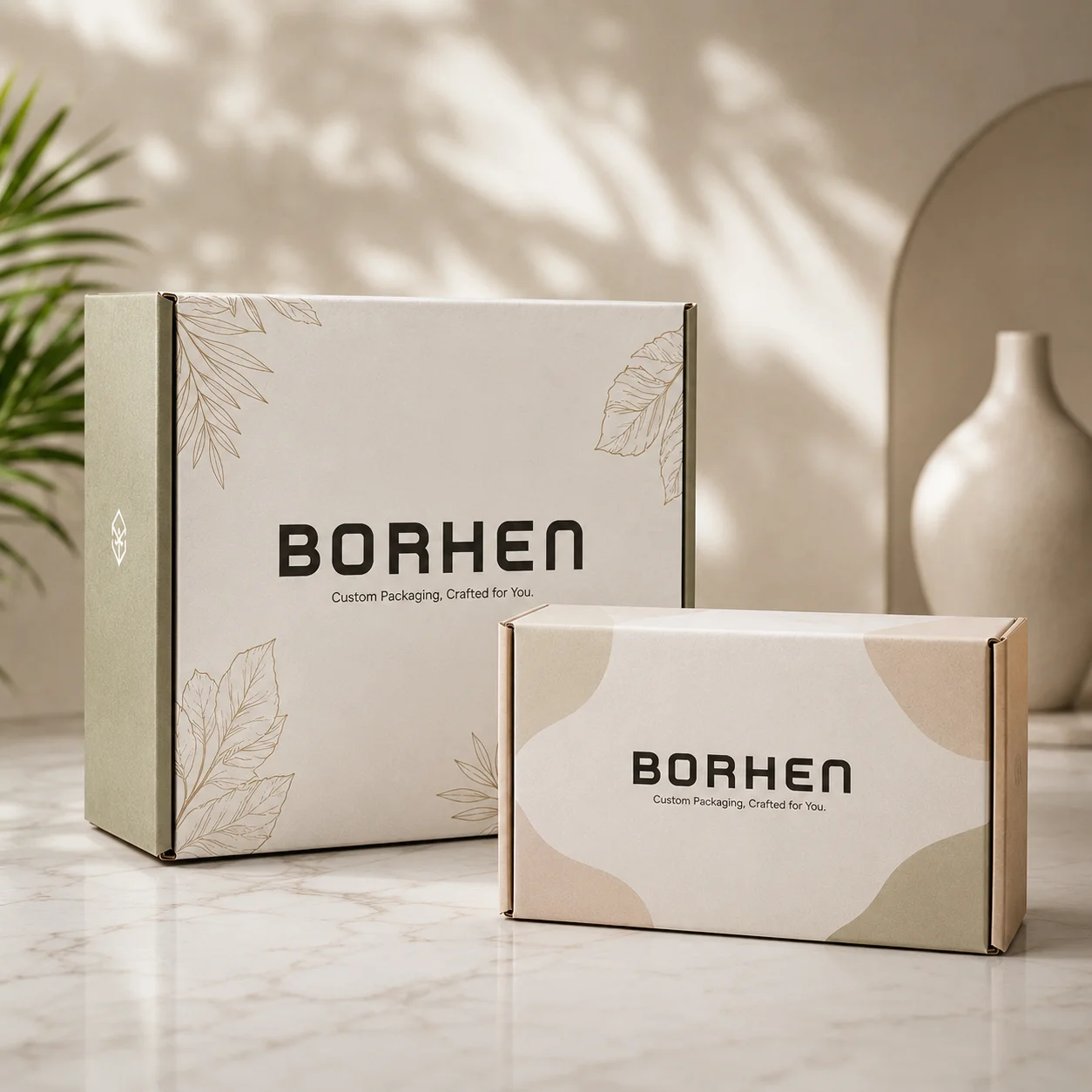
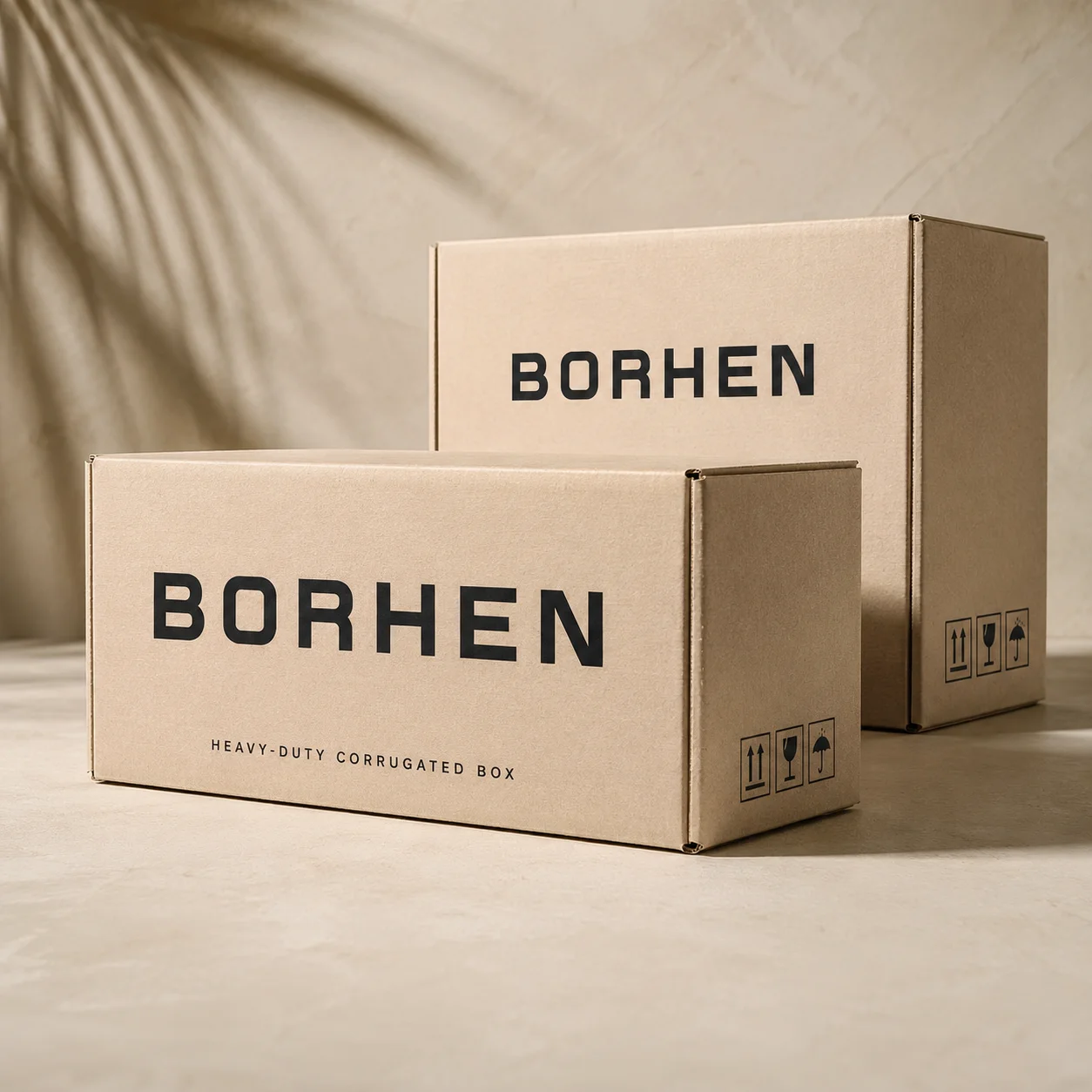
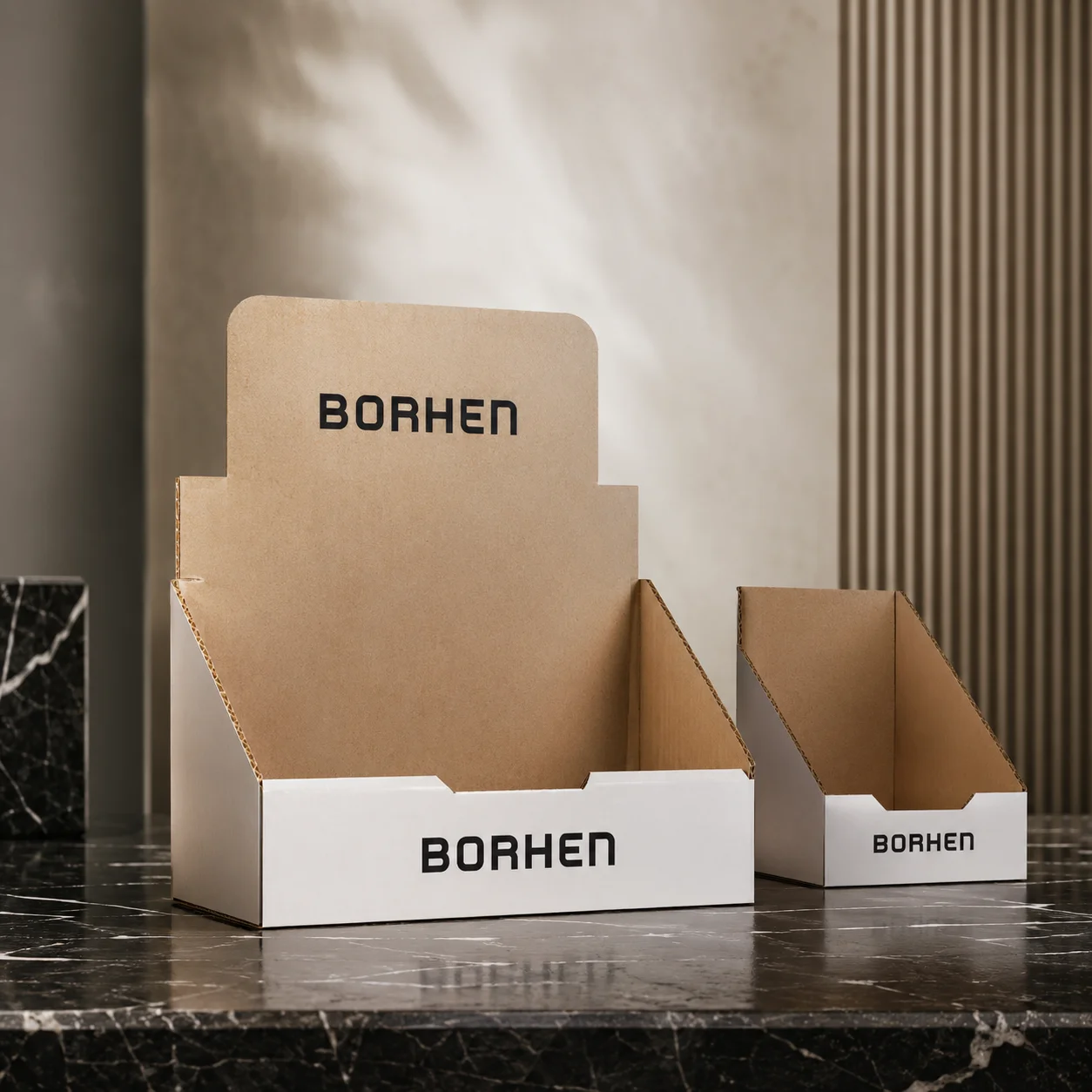
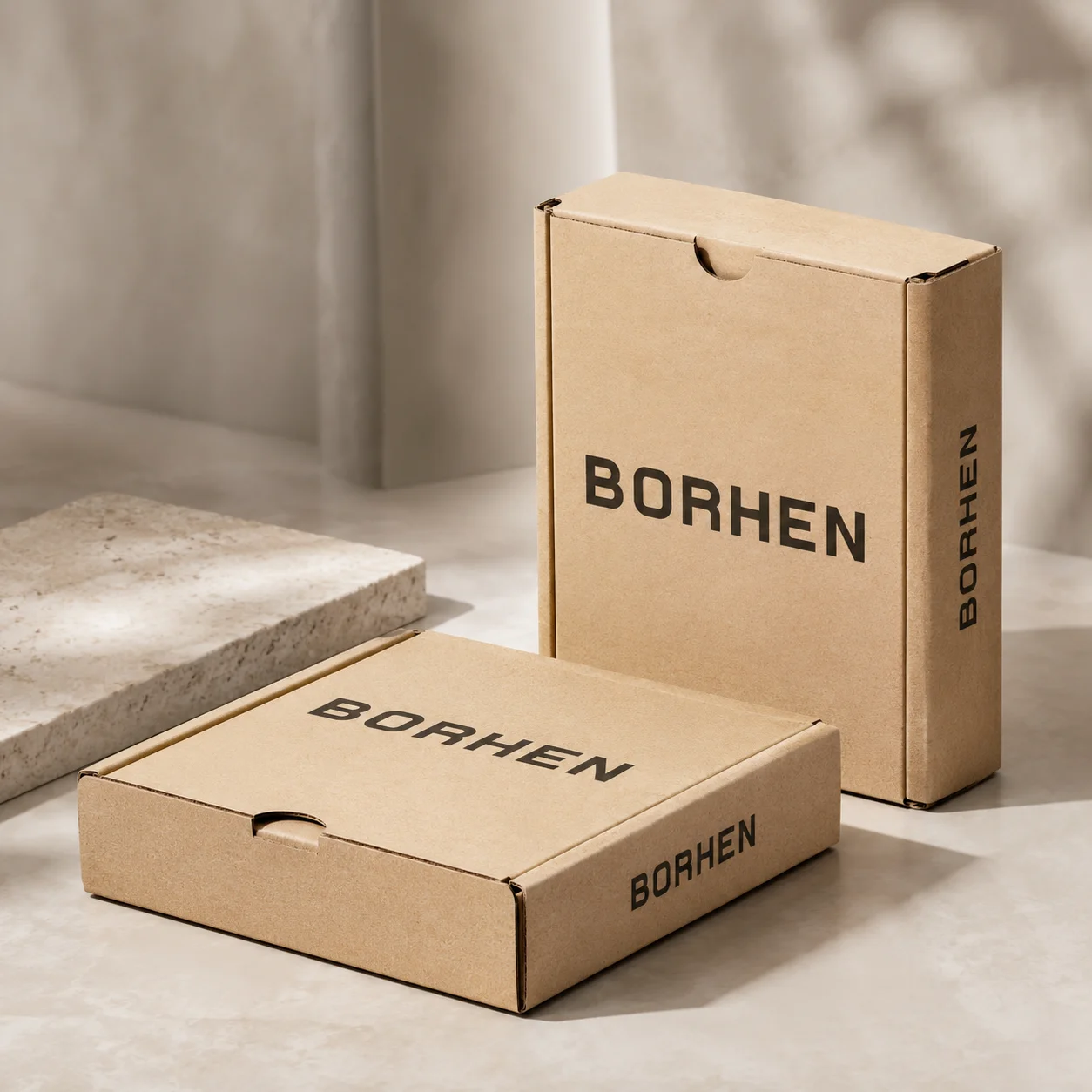
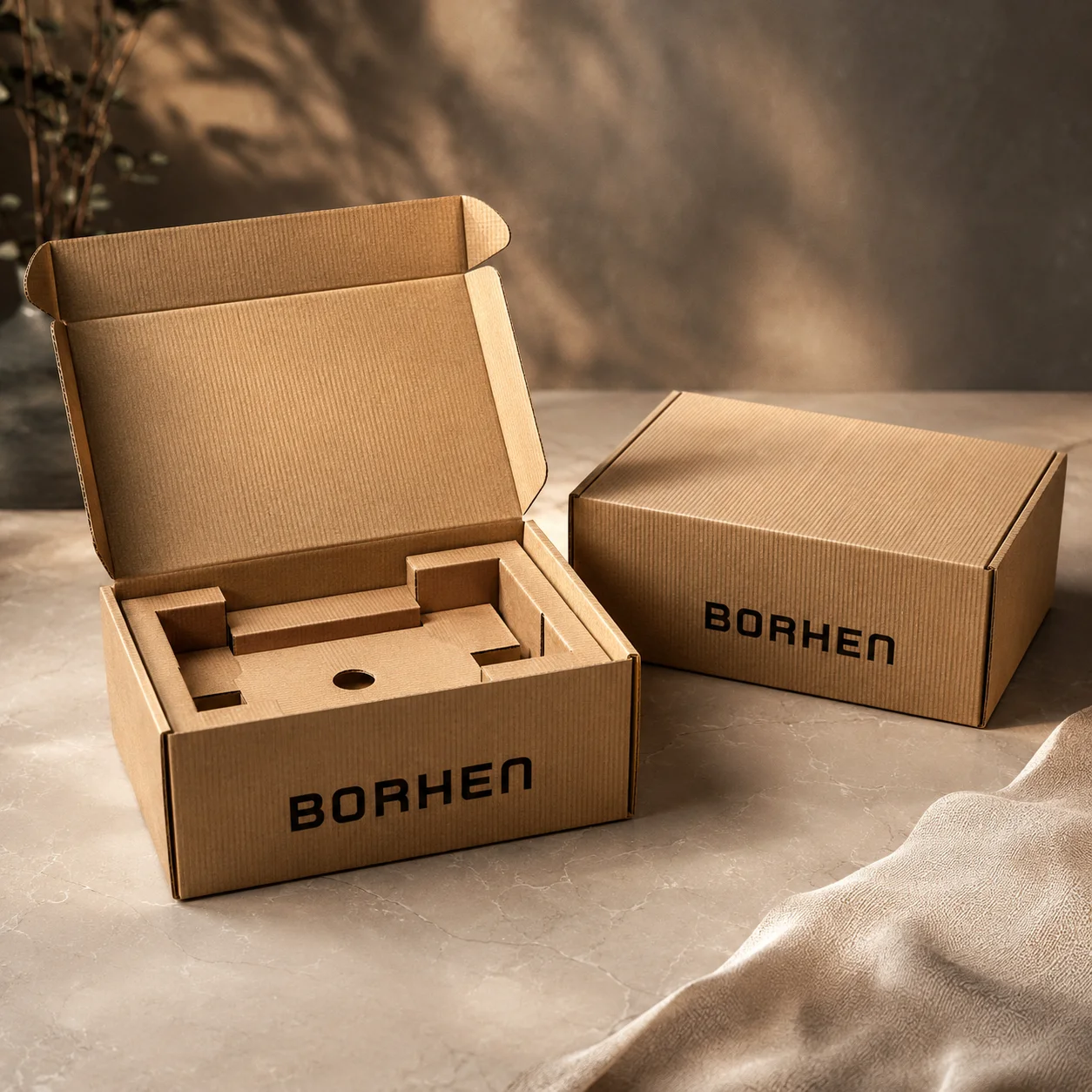
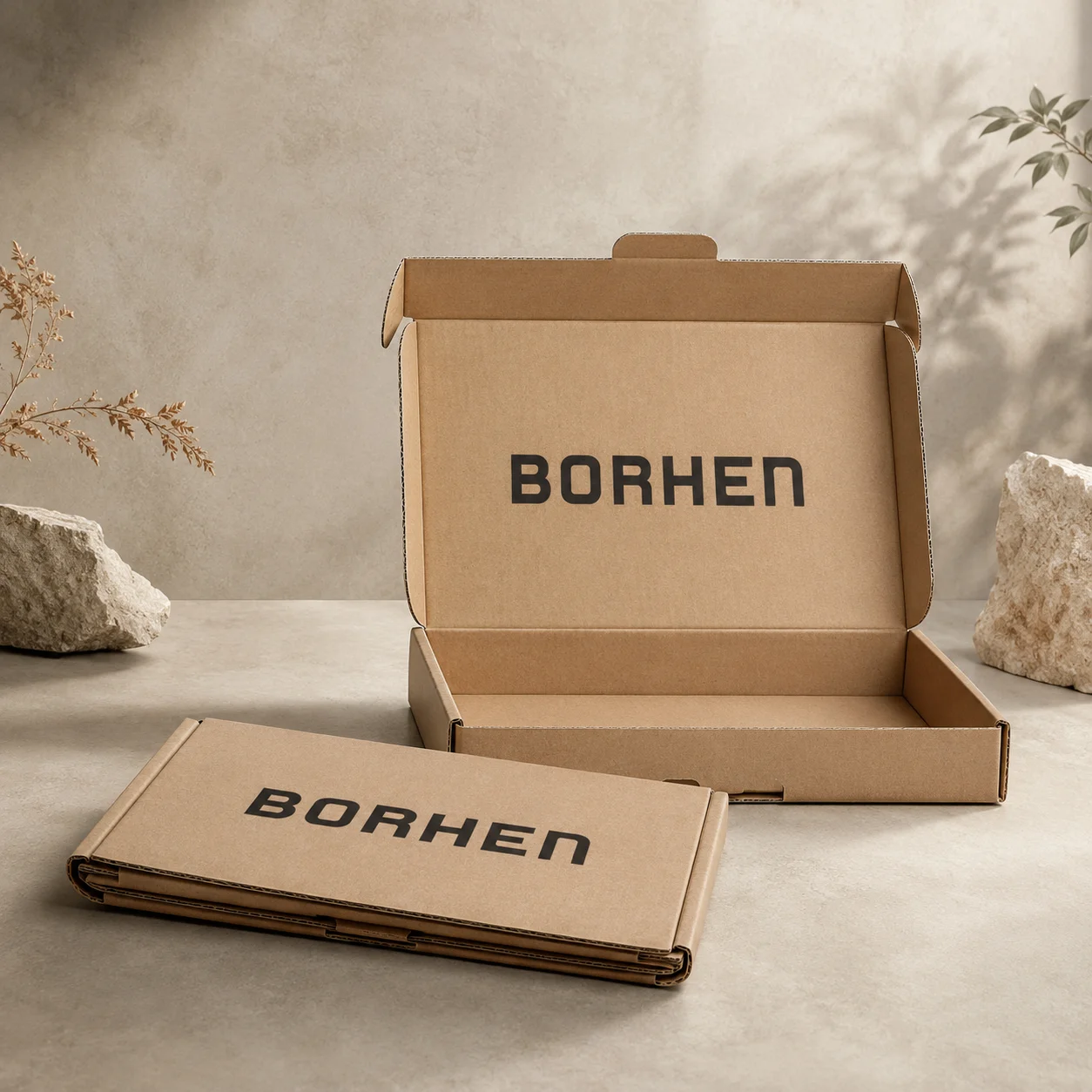
Your Trusted Custom Corrugated Packaging Boxes Manufacturer

You get custom corrugated packaging boxes built for product protection, e-commerce fulfillment, export shipping, printed brand presentation, and stable repeat production — so your packaging projects move from sample approval to bulk orders with less damage, fewer delays, and better supply consistency.

Custom Corrugated Packaging Boxes for Product Protection and Efficient Shipping

At BorhenPack, we know a custom corrugated packaging box is not just an outer shipping carton. It is often the packaging format a brand, importer, distributor, or e-commerce business relies on when products need to travel safely, pack efficiently, and arrive in good condition. The board strength, flute type, box structure, printing method, insert design, and packing method all influence whether the final packaging can protect the product, support fulfillment operations, control shipping risks, and remain consistent across repeat orders.
 
We work with brands, procurement teams, importers, distributors, and growing e-commerce businesses that need corrugated packaging boxes for real business conditions. Some customers need corrugated mailer boxes for direct-to-customer delivery and branded unboxing. Others need custom printed corrugated shipping boxes, heavy-duty corrugated boxes, die-cut corrugated boxes, display boxes, or corrugated boxes with inserts for retail distribution, export shipping, product protection, warehouse handling, or long-term supply programs. In every case, the packaging needs to balance protection, structure, cost, printing, assembly efficiency, shipping performance, and repeat order consistency.
 
As your custom corrugated packaging box manufacturing partner in China, we help turn packaging requirements into solutions that can be sampled, produced, shipped, and reordered with greater confidence. We support decisions around corrugated board, flute type, box size, dieline structure, printing method, inserts, packing method, and export shipping protection, so the approved sample can become a practical standard for bulk production. Whether you are developing e-commerce mailer boxes, printed shipping cartons, heavy-duty corrugated boxes, or protective packaging for multi-SKU programs, our goal is to help your packaging fit the product properly, protect shipments, work in real operations, and remain consistent across repeat orders.

Corrugated Shipping Boxes

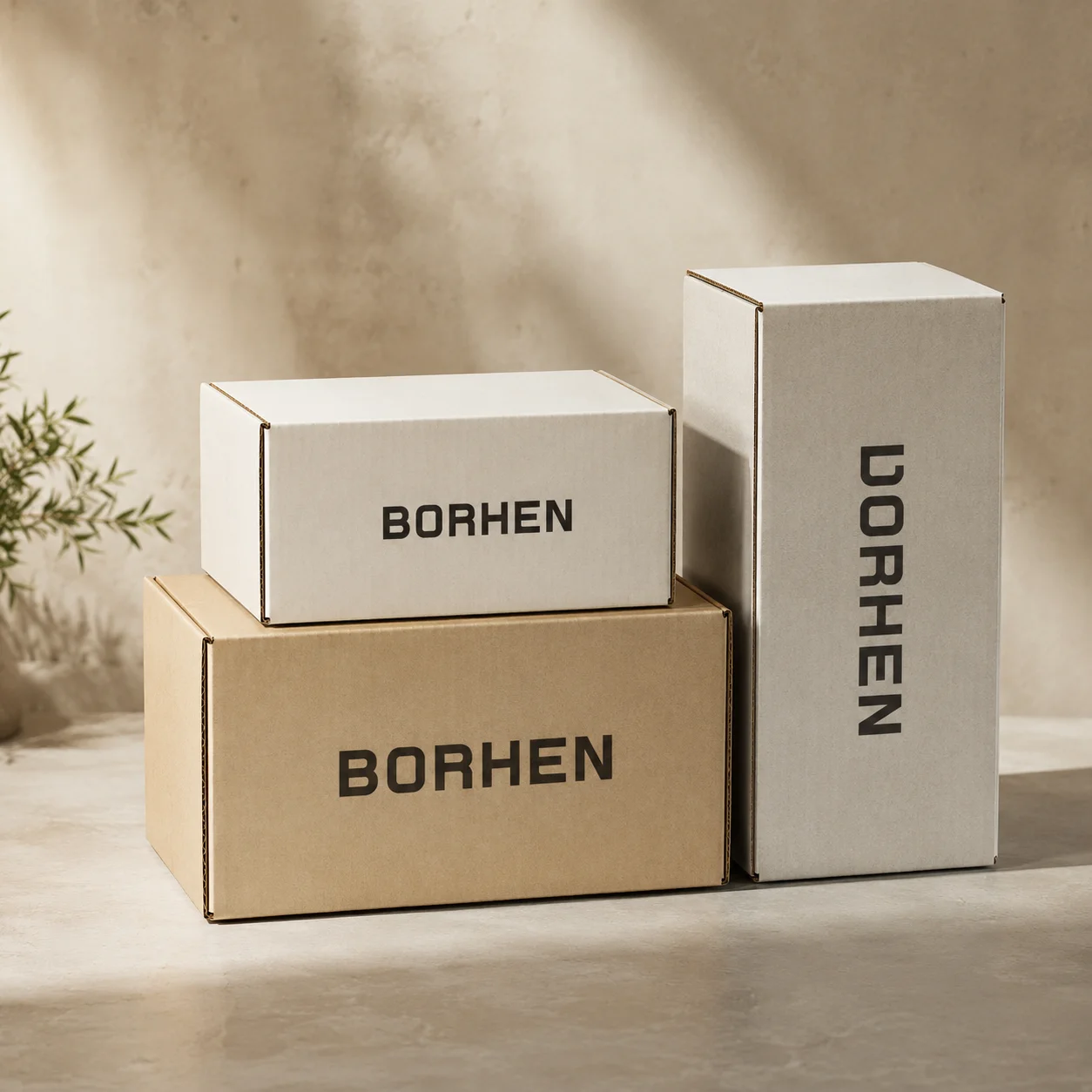
Corrugated Mailer Boxes

Custom Printed Corrugated Boxes

Heavy-Duty Corrugated Boxes

Corrugated Display Boxes

Die-Cut Corrugated Boxes

Corrugated Boxes with Inserts

Flat-Pack Corrugated Boxes

Build Corrugated Packaging Boxes That Protect Products — Not Just Hold Them

At BorhenPack, we believe custom corrugated packaging boxes are more than basic cartons used to contain products. They influence how safely your products move through warehouses, fulfillment centers, export shipping routes, retail distribution channels, and last-mile delivery. The strength of the corrugated board, the flute type, the accuracy of the dieline, the fit of the insert, the printing method, and the final packing method all affect whether a corrugated box can protect the product, support efficient handling, reduce shipping risks, and remain reliable for real business use.
 
We work with brands, procurement teams, importers, distributors, and growing e-commerce businesses that need corrugated packaging boxes to perform beyond the first sample. Some customers need corrugated mailer boxes that support direct-to-customer shipping and branded unboxing. Others need custom printed corrugated shipping boxes, heavy-duty corrugated boxes, die-cut corrugated boxes, display boxes, or corrugated boxes with inserts that support product protection, retail distribution, warehouse handling, export shipping, and long-term repeat orders. For us, a successful corrugated box is not only about whether it looks clean in a photo. It must also work in packing, stacking, shipping, fulfillment, and future reorders.
 
As your custom corrugated packaging box manufacturing partner in China, we help turn packaging requirements into structures that can be sampled, produced, shipped, and reordered with greater confidence. We review corrugated board selection, flute type, box structure, dieline accuracy, product fit, insert design, artwork placement, printing method, glue control, and export packing needs before production decisions are finalized. Our goal is to help your custom corrugated boxes protect your products, reduce shipping damage, support efficient fulfillment, improve brand presentation, and remain consistent across bulk production and repeat orders.
Our Most Requested Corrugated Packaging Box Options
1️⃣ Corrugated Mailer Boxes
Corrugated mailer boxes are often chosen by e-commerce brands, DTC businesses, subscription box sellers, and online retailers that need packaging for direct-to-customer delivery. They are designed to be easy to assemble, protective during shipping, and suitable for branded printing or a cleaner unboxing experience. The value of a corrugated mailer box is not only in how it looks when opened, but also in how well the board strength, box structure, locking method, printing layout, and product fit work together to support fulfillment efficiency and repeat shipping programs.
2️⃣ Custom Printed Corrugated Shipping Boxes
Custom printed corrugated shipping boxes are suitable for brands, importers, distributors, and procurement teams that need stronger shipping cartons with clear brand visibility. They can be used for bulk shipping, warehouse handling, retail distribution, product launches, and multi-SKU supply programs. Printing can help make the packaging more professional, but the structure still needs to remain practical for packing, stacking, and transportation. We help review board selection, flute type, printing method, artwork placement, and carton strength so your printed corrugated boxes can balance brand presentation with real shipping performance.
3️⃣ Heavy-Duty Corrugated Boxes
Heavy-duty corrugated boxes are designed for products that need stronger protection during storage, handling, export shipping, and long-distance transportation. They are commonly used for heavier products, fragile items, multi-piece sets, industrial products, and shipments that may experience stacking pressure or rough handling. The performance of a heavy-duty corrugated box depends on board grade, flute type, wall structure, box size, glue strength, and packing method. We help review these details so the packaging can reduce product movement, improve compression resistance, and protect shipments through real supply chain conditions.
4️⃣ Corrugated Boxes with Inserts
Corrugated boxes with inserts are useful when product fit, internal protection, and presentation all matter. Inserts can help hold products in position, reduce movement during shipping, separate multiple items, and create a more organized opening experience. They are commonly used for electronics accessories, cosmetics sets, glass bottles, gift sets, sample kits, and fragile products. Depending on the product and shipping requirements, we can help review corrugated dividers, paperboard inserts, molded pulp inserts, honeycomb paper supports, or custom compartments to balance protection, cost, sustainability, assembly efficiency, and production feasibility.
Practical Customization, MOQ, and Scalability for Corrugated Packaging Projects
At BorhenPack, we design custom corrugated packaging projects to be realistic from the beginning and scalable as your business grows. Corrugated boxes may look simple from the outside, but box size, board strength, flute type, wall structure, printing method, dieline complexity, insert design, packing method, and order quantity can all influence MOQ, unit cost, sampling time, and bulk production stability. A standard corrugated shipping box, a printed mailer box, a heavy-duty export carton, and a corrugated box with inserts may require very different production planning.
 
Many custom corrugated packaging box projects can start with practical quantities depending on the structure, size, board type, printing requirements, and packing needs. Standard shipping boxes may offer more flexible starting options, while custom printed corrugated mailer boxes, full-color laminated corrugated boxes, retail display boxes, heavy-duty double-wall boxes, die-cut structures, or corrugated boxes with custom inserts may require higher quantities to support stable production and cost efficiency. We communicate these requirements clearly during project planning, so you can understand what is realistic before moving into sampling or bulk production.
 
Every corrugated packaging project can include box structure review, board and flute guidance, dieline coordination, artwork checking, printing recommendations, sample development, bulk production control, quality inspection, export packing, and repeat order support. Our goal is to help you create custom corrugated packaging boxes that fit the product properly, protect shipments, support efficient fulfillment, control unnecessary shipping risks, and remain consistent when your packaging needs scale from a launch order to long-term repeat production.

More Than Just a Corrugated Box Manufacturer

At BorhenPack, we do not treat corrugated boxes as a one-time packaging order. We see them as part of a broader packaging and supply chain program that may support e-commerce fulfillment, retail distribution, export shipping, warehouse operations, distributor supply, and repeat orders across different markets. Once a corrugated box moves beyond the first sample, details such as board strength, flute selection, dieline accuracy, printing consistency, insert fit, packing method, and dependable lead times become just as important as the initial design.
 
That is why we focus on how custom corrugated packaging boxes actually perform in production, packing, storage, shipping, and repeat ordering — not only how they look in a sample photo. From corrugated mailer boxes and custom printed corrugated shipping boxes to heavy-duty corrugated boxes, display boxes, die-cut structures, and corrugated boxes with inserts, we help review the structure, board, printing, inserts, and export packing method before bulk production begins, so your packaging can move forward with fewer delays, fewer misunderstandings, and better long-term consistency.

✅ Structure Planning Based on Product and Shipping Needs

We help review the product size, weight, fragility, packing direction, shipping route, warehouse handling, and fulfillment process before the corrugated box structure is finalized. A reliable corrugated box should not only fit the product; it should protect the product, assemble efficiently, stack properly, reduce unnecessary movement, and remain practical for packing, shipping, storage, and repeat production.

✅ Board and Flute Guidance for Protection and Cost Control

Corrugated packaging performance depends heavily on the right combination of board strength, flute type, wall structure, paper surface, and box design. We help guide decisions around single-wall board, double-wall board, E-flute, B-flute, C-flute, BC-flute, kraft board, white board, and FSC-certified paper options based on your product weight, protection needs, printing goals, shipping risk, MOQ, budget, and production feasibility.

✅ Sample-to-Bulk Consistency for Corrugated Packaging

For brands, importers, distributors, and procurement teams, the approved sample should become a stable production standard. We pay close attention to box dimensions, board quality, flute direction, printing accuracy, dieline tolerance, creasing performance, glue strength, insert alignment, and packing method, helping your custom corrugated boxes stay consistent from sample approval to bulk production and future repeat orders.

✅ Export-Ready Packing for Global Supply

Our custom corrugated packaging boxes are developed with international shipping and global supply needs in mind. From flat packing and outer carton strength to stacking efficiency, palletizing, moisture protection, transit stability, and export coordination, we focus on packaging that can travel safely through global supply chains while supporting efficient warehouse handling and long-term supply from China.

Corrugated Packaging Boxes Built for Real Business Operations — Not Just Sample Approval

When you work with BorhenPack, you are not only choosing a corrugated box manufacturer. You are partnering with a team that understands how corrugated packaging performs after the sample is approved — during warehouse handling, packing, stacking, e-commerce fulfillment, retail distribution, export shipping, last-mile delivery, and repeat production. A corrugated box may look simple in a prototype, but its real value depends on whether the board strength, flute type, box structure, printing, inserts, glue control, and packing method can remain reliable in daily business operations.
 
We support brands, procurement teams, importers, distributors, and growing e-commerce businesses that need custom corrugated packaging boxes to balance product protection with real operational performance. Some clients need corrugated mailer boxes that support direct-to-customer delivery and branded unboxing. Others need custom printed corrugated shipping boxes, heavy-duty corrugated boxes, die-cut boxes, display boxes, flat-pack corrugated boxes, or corrugated boxes with inserts that can protect products, improve fulfillment efficiency, support retail distribution, and remain consistent across repeat orders.
🧱 Built for Product Protection
We approach every corrugated packaging project by first understanding the product itself — its size, weight, shape, fragility, packing direction, and shipping environment. This allows us to review box dimensions, board strength, flute type, wall structure, insert design, and packing method based on real usage conditions. If there is a way to reduce internal movement, improve compression resistance, strengthen corner protection, or simplify packing, we explain it clearly before sampling and bulk production.
 
📦 Built for E-commerce Fulfillment
Corrugated packaging is often used in fast-moving fulfillment environments where speed, protection, and consistency all matter. Mailer boxes, shipping cartons, and branded corrugated boxes need to assemble efficiently, fit products properly, and move smoothly through warehouse and delivery systems. We help review box structure, closure method, locking style, packing flow, product fit, and shipping carton efficiency so your packaging supports real e-commerce fulfillment instead of slowing it down.
 
⚙️ Built for Production Stability
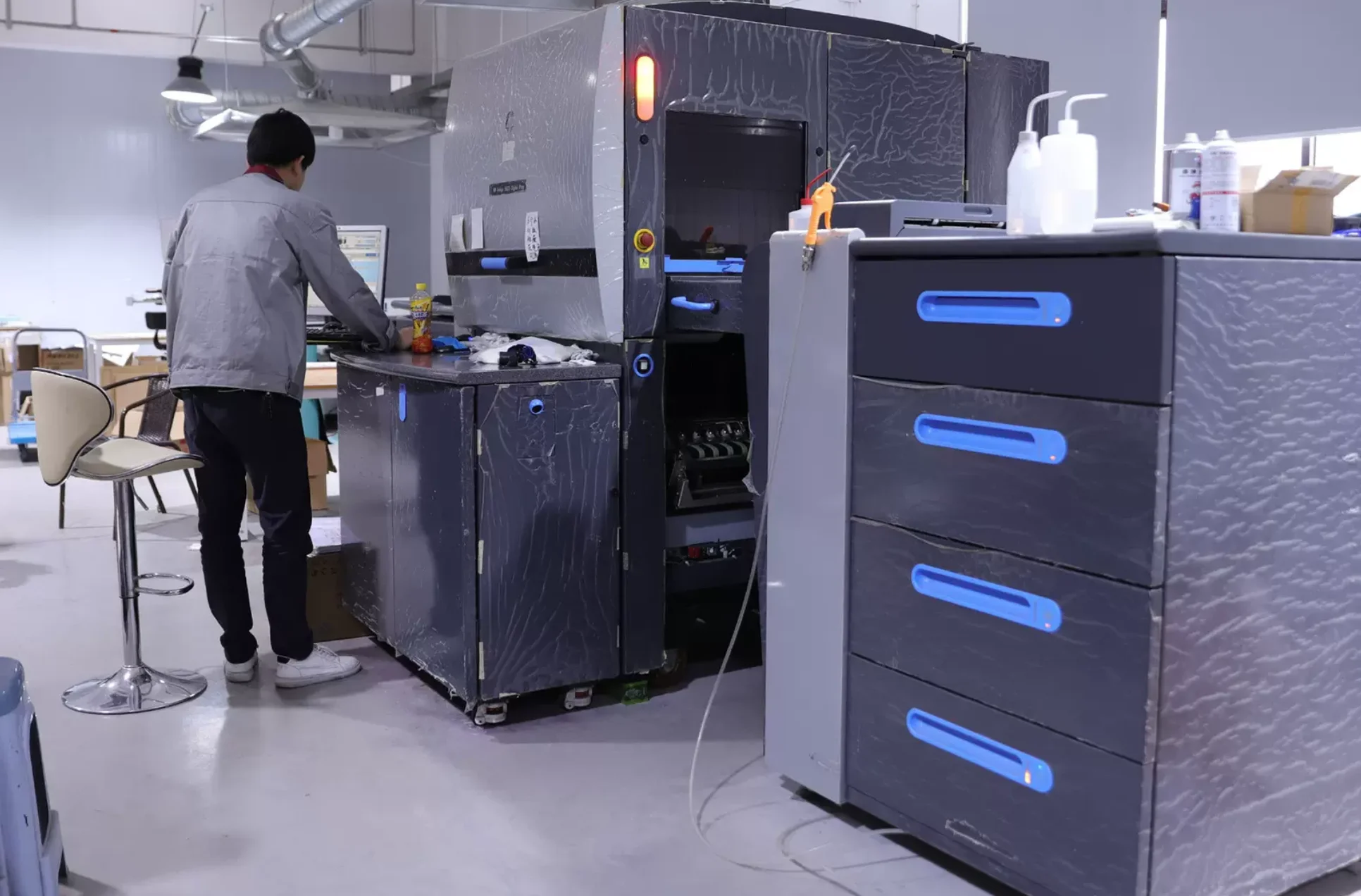
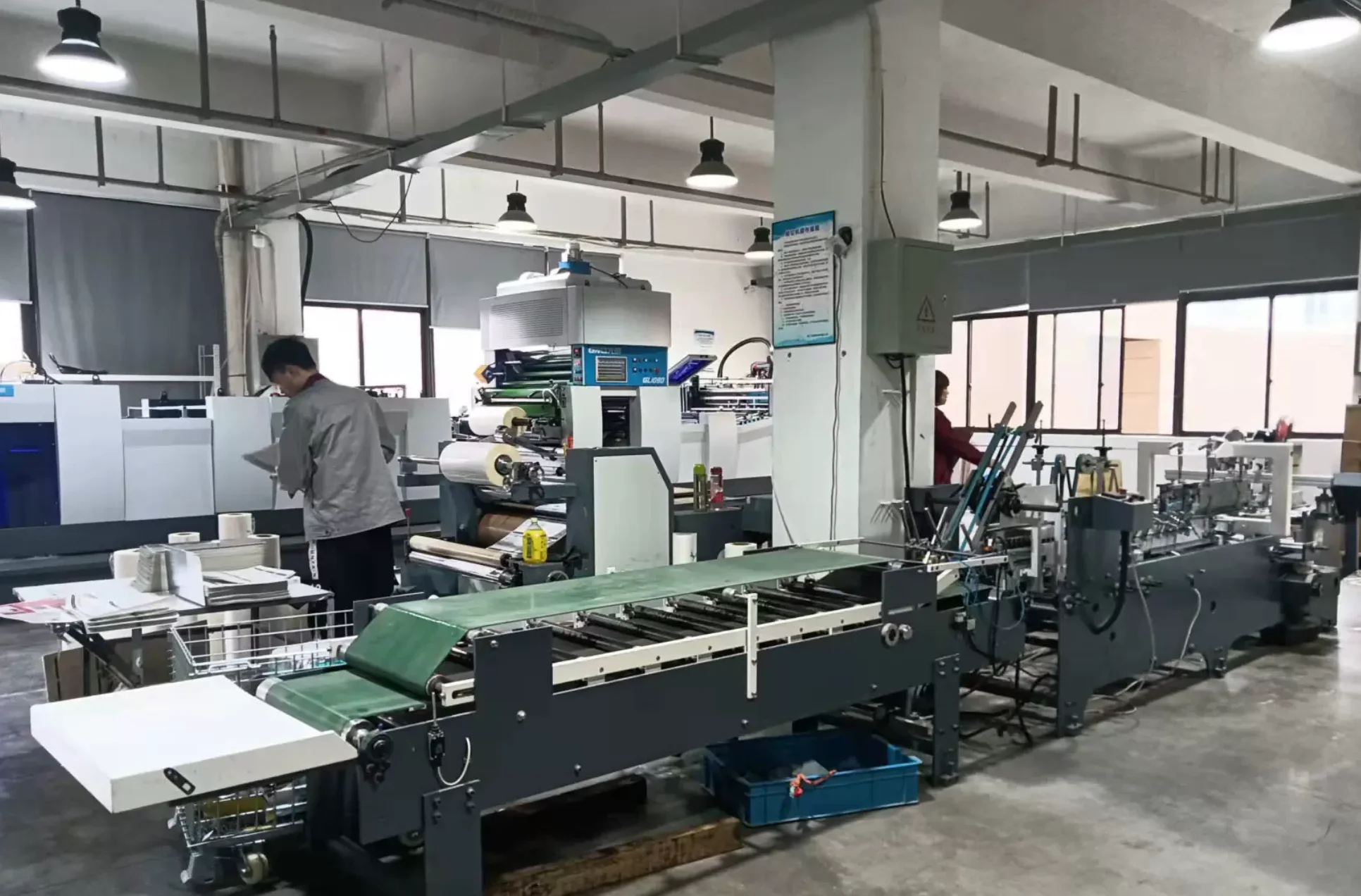
Corrugated box manufacturing involves multiple production steps, including paper preparation, corrugating, printing, laminating when required, die-cutting, creasing, slotting, gluing, folding, insert production, and final inspection. Small differences in board quality, flute direction, cutting accuracy, crease depth, or glue control can affect the final result. Our workflow focuses on confirming key details early, reducing avoidable changes, and helping the approved sample become a practical production standard.
 
🌿 Built for FSC and Paper-Based Packaging Goals
Many brands, retailers, and procurement teams are looking for paper-based packaging that supports sustainability goals without sacrificing shipping performance. We can help review FSC-certified corrugated paper options, recyclable corrugated structures, kraft board, white board, molded pulp inserts, paperboard dividers, and other paper-based internal support options. The goal is to balance responsible material choices with product protection, cost control, printing needs, and real production feasibility.
 
🚚 Built for Export Shipping and Repeat Orders
Custom corrugated packaging boxes are often used for international retail, e-commerce, and distribution programs. That means the packaging must not only look clean and professional, but also travel safely through global supply chains. We consider flat packing, inner packing, outer carton strength, stacking efficiency, palletizing, moisture protection, transit stability, and export coordination, helping your corrugated boxes arrive in good condition and support long-term supply needs from China.

Corrugated Board, Printing, Structures, and Inserts for Custom Corrugated Boxes

A successful custom corrugated packaging box depends on how board strength, flute type, box structure, printing method, inserts, and packing requirements work together. Choosing a stronger corrugated board, a finer flute, a kraft surface, a white surface, a printed design, or a custom insert may improve protection, presentation, or fulfillment efficiency, but each choice can also affect MOQ, cost, sampling time, production stability, packing method, and repeat order consistency. At BorhenPack, we help customers review these options from both a packaging performance and manufacturing feasibility perspective.

Corrugated Board and Flute OptionsCorrugated Board and Flute Options

Corrugated board is the foundation of product protection, shipping performance, printing quality, and packing efficiency. Different board types and flute structures create different levels of strength, cushioning, surface smoothness, and stacking performance. A mailer box for e-commerce delivery may need a different board direction from a heavy-duty export carton, while a full-color printed corrugated box may require a smoother surface for better print results. We help review board and flute options based on product weight, shipping conditions, printing needs, cost targets, and repeat order plans.
Single-Wall Corrugated Board

Single-Wall Corrugated Board

Double-Wall Corrugated Board

Double-Wall Corrugated Board

E-Flute Corrugated Board

E-Flute Corrugated Board

B-Flute Corrugated Board

B-Flute Corrugated Board

C-Flute Corrugated Board

C-Flute Corrugated Board

BC-Flute Corrugated Board

BC-Flute Corrugated Board

Kraft Corrugated Board

Kraft Corrugated Board

White Corrugated Board

White Corrugated Board

FSC-Certified Corrugated Paper Options

FSC-Certified Corrugated Paper Options

Printing Options for Corrugated Boxes

Printing can turn a basic corrugated box into a more professional and brand-ready packaging solution. Logo printing, product information, handling marks, full-color graphics, inside printing, and outside printing can all support brand presentation and operational clarity. However, printing should be planned carefully because different methods affect color accuracy, surface quality, MOQ, production time, and cost. We help review whether flexographic printing, offset laminated printing, digital sample printing, or other printing approaches are suitable for your corrugated packaging project.
Flexographic Printing

Flexographic Printing

Offset Laminated Printingrinting

Offset Laminated Printing

Digital Sample Printing

Digital Sample Printing

Logo Printing

Logo Printing

Full-Color Printing

Full-Color Printing

Inside Printing

Inside Printing

Outside Printing

Outside Printing

Handling Mark Printing

Handling Mark Printing

Corrugated Box Structures

Different corrugated box structures create different levels of protection, assembly efficiency, warehouse convenience, shipping performance, and customer experience. Mailer boxes are useful for e-commerce delivery, shipping boxes are practical for bulk transport, display boxes support retail presentation, and heavy-duty structures help protect larger or more fragile products during export shipping. We help customers choose a structure based on product fit, board strength, fulfillment process, printing needs, shipping conditions, and repeat order plans.
Corrugated Mailer Boxes

Corrugated Mailer Boxes

Corrugated Shipping Boxes

Corrugated Shipping Boxes

Die-Cut Corrugated Boxes

Die-Cut Corrugated Boxes

Corrugated Display Boxes

Corrugated Display Boxes

Roll End Corrugated Boxes

Roll End Corrugated Boxes

Tuck Top Corrugated Boxes

Tuck Top Corrugated Boxes

Heavy-Duty Corrugated Boxes

Heavy-Duty Corrugated Boxes

Flat-Pack Corrugated Boxes

Flat-Pack Corrugated Boxes

Corrugated Inserts and Internal Support

The inside of a corrugated box is just as important as the outside when product protection matters. Inserts help keep products in position, reduce movement during shipping, separate multiple items, improve product presentation, and create a more organized opening experience. The right insert material depends on the product’s weight, fragility, shape, sustainability goals, shipping method, and desired presentation effect. We can help review corrugated dividers, paperboard inserts, molded pulp inserts, honeycomb paper supports, cardboard partitions, and custom compartments.
Corrugated Dividers

Corrugated Dividers

Paperboard Inserts

Paperboard Inserts

Molded Pulp Inserts

Molded Pulp Inserts

Honeycomb Paper Inserts

Honeycomb Paper Inserts

Cardboard Partitions

Cardboard Partitions

Custom Compartments

Custom Compartments

Protective Inner Supports

Protective Inner Supports

Product Fit Inserts

Product Fit Inserts

Choosing Options Based on Real Project Needs

We do not recommend corrugated board, printing methods, structures, or inserts only because they look stronger or more impressive. We review how each choice affects the full packaging project, including product fit, shipping protection, brand presentation, target market, MOQ, budget, sampling, production feasibility, warehouse handling, export packing, and long-term repeat orders. This helps your custom corrugated boxes protect products, work efficiently in fulfillment, ship safely, and remain consistent as your packaging program grows.

How We Develop Custom Corrugated Packaging Boxes

At BorhenPack, we follow a clear development process to help your custom corrugated packaging boxes move from project idea to approved sample, bulk production, inspection, and export delivery with fewer misunderstandings and better production consistency. From board and flute selection to dieline review, printing, inserts, quality inspection, and export packing, our goal is to make each corrugated packaging project practical, protective, and scalable for real business use.

① Project Requirement Review

We review your product size, weight, fragility, quantity, sales channel, shipping method, target market, delivery needs, and reference packaging to understand the real project requirements before quoting.

② Board and Flute Recommendation

We review your product size, weight, fragility, quantity, sales channel, shipping method, target market, delivery needs, and reference packaging to understand the real project requirements before quoting.

③ Structure and Dieline Review

We check the box structure, dieline, folding direction, locking method, glue area, product fit, insert space, and assembly flow before sampling to reduce structure-related production issues.

④ Printing and Artwork Review

We review artwork placement, logo position, color requirements, printing method, handling marks, inside or outside printing needs, and production layers before sampling to help reduce file-related printing issues.

⑤ Sample Development

We create samples so you can confirm the real box size, board strength, flute performance, structure, product fit, assembly experience, printing effect, insert fit, and shipping protection before bulk production.

⑥ Sample Approval and Production Standard Confirmation

Once the sample is approved, we confirm the key details as the production standard, including board type, flute type, box dimensions, dieline, printing method, insert structure, packing method, and quality requirements.

⑦ Bulk Production

We manage paper preparation, printing, laminating when required, die-cutting, creasing, slotting, gluing, folding, insert production, and final box forming based on the approved production standard.

⑧ Quality Inspection and Export Packing Coordination

We arrange suitable flat packing, outer cartons, stacking methods, palletizing, moisture protection, and shipping coordination to help your corrugated boxes travel safely through international supply chains.

FAQs About Custom Corrugated Packaging Boxes

For your convenience, we’ve gathered the most commonly asked questions about our custom corrugated packaging boxes. If you have a product sample, dieline, artwork, shipping requirement, or reference packaging, we can review it based on your product protection, printing, fulfillment, export shipping, and repeat order needs.
1. What types of custom corrugated packaging boxes can you manufacture?
We manufacture a wide range of custom corrugated packaging boxes, including corrugated shipping boxes, corrugated mailer boxes, custom printed corrugated boxes, heavy-duty corrugated boxes, die-cut corrugated boxes, corrugated display boxes, flat-pack corrugated boxes, and corrugated boxes with inserts. These structures are commonly used for e-commerce fulfillment, retail distribution, product protection, subscription packaging, warehouse handling, and export shipping.
If you already have a reference box, product sample, artwork, or dieline, we can review it from a production and shipping perspective and help turn the idea into a more practical corrugated packaging solution.
Yes. We often help customers choose the right corrugated box structure before sampling. We review your product size, weight, fragility, packing direction, sales channel, fulfillment process, shipping route, target market, budget, and branding needs before giving a recommendation.
For some projects, corrugated mailer boxes may be suitable for direct-to-customer delivery and branded unboxing. For others, custom printed shipping boxes, heavy-duty corrugated boxes, display boxes, die-cut structures, flat-pack boxes, or corrugated boxes with inserts may be more practical for product protection, packing efficiency, export shipping, and repeat production.
MOQ for custom corrugated boxes depends on the box size, board type, flute type, printing method, structure, inserts, packing method, and total order quantity. Standard corrugated shipping boxes may have more flexible starting options, while custom printed mailer boxes, full-color laminated corrugated boxes, display boxes, heavy-duty double-wall boxes, or boxes with custom inserts may require higher quantities for stable production and cost efficiency.
We explain the MOQ clearly before sampling, so you can understand what is realistic for your project and choose a starting quantity that supports both production quality and future scalability.
Yes. We can support custom printed corrugated boxes with logo printing, brand graphics, product information, handling marks, inside printing, outside printing, and full-color printed effects depending on the project. Printed corrugated boxes are often used for e-commerce packaging, retail distribution, subscription boxes, branded shipping cartons, and product launch packaging.
The right printing method depends on your design, quantity, board surface, color requirements, and budget. We can help review whether flexographic printing, offset laminated printing, digital sample printing, or another production method is more suitable for your corrugated packaging project.
Common flute options may include E-flute, B-flute, C-flute, and BC-flute, depending on the product and shipping requirements. E-flute is often used for printed mailer boxes or retail-style corrugated packaging because it has a finer surface and can support cleaner printing results. B-flute and C-flute are commonly used for stronger shipping boxes and general corrugated packaging.
For heavier products, fragile items, or export shipping, double-wall structures such as BC-flute may be considered. We help recommend flute type based on product weight, protection needs, printing effect, box size, shipping risk, and cost target.
Common flute options may include E-flute, B-flute, C-flute, and BC-flute, depending on the product and shipping requirements. E-flute is often used for printed mailer boxes or retail-style corrugated packaging because it has a finer surface and can support cleaner printing results. B-flute and C-flute are commonly used for stronger shipping boxes and general corrugated packaging.
For heavier products, fragile items, or export shipping, double-wall structures such as BC-flute may be considered. We help recommend flute type based on product weight, protection needs, printing effect, box size, shipping risk, and cost target.
Yes. Corrugated boxes are widely used for e-commerce shipping because they can combine product protection, packing efficiency, and branded presentation. Corrugated mailer boxes are suitable for direct-to-customer delivery, while stronger corrugated shipping cartons can be used for bulk fulfillment, warehouse distribution, or multi-SKU shipping programs.
For fragile or high-value products, inserts, dividers, or internal supports can be added to reduce movement during transit. We help review box structure, board strength, closure method, packing flow, and shipping carton efficiency so your corrugated packaging works well in real fulfillment operations.
Yes. Inserts and dividers are often important when products need to stay in position, avoid collision, separate multiple items, or present neatly when the package is opened. We can help develop corrugated boxes with corrugated dividers, paperboard inserts, molded pulp inserts, honeycomb paper supports, cardboard partitions, or custom compartments depending on your product and shipping needs.
The right insert design depends on product size, weight, fragility, shape, sustainability goals, shipping method, assembly efficiency, and budget. We review the insert together with the outer corrugated box structure so both parts work properly as one packaging system.
Yes. BorhenPack can support FSC-certified paper options for corrugated packaging projects when required. FSC paper options can be useful for brands, retailers, importers, and procurement teams that need more responsible paper-based packaging for markets such as Europe, North America, Australia, and other regions where sustainability expectations are important.
We also help customers balance sustainability with board strength, printing effect, MOQ, cost, product protection, and production stability. A responsible corrugated packaging solution still needs to perform well during packing, storage, shipping, and repeat production.
Yes. Corrugated boxes are commonly used for international shipping, but the structure must be planned properly. We review box size, board strength, flute type, wall structure, product weight, insert stability, outer packing, stacking method, palletizing needs, moisture protection, and shipping route before recommending a solution.
For brands, importers, distributors, and procurement teams shipping to the United States, Europe, Australia, the Middle East, or other markets, our goal is to help reduce shipping damage, protect the product, improve packing efficiency, and keep corrugated packaging stable through global supply chains.
Yes. Corrugated boxes are commonly used for international shipping, but the structure must be planned properly. We review box size, board strength, flute type, wall structure, product weight, insert stability, outer packing, stacking method, palletizing needs, moisture protection, and shipping route before recommending a solution.
For brands, importers, distributors, and procurement teams shipping to the United States, Europe, Australia, the Middle East, or other markets, our goal is to help reduce shipping damage, protect the product, improve packing efficiency, and keep corrugated packaging stable through global supply chains.
Sampling time depends on the corrugated box structure, board selection, flute type, printing method, insert complexity, and sample testing requirements. A simple corrugated shipping box may be faster to sample, while printed mailer boxes, full-color laminated boxes, display boxes, heavy-duty boxes, or corrugated boxes with inserts may require more preparation.
Bulk production time depends on order quantity, printing requirements, structure complexity, and production schedule after sample approval. If you have a launch date, retail schedule, seasonal campaign, or distributor delivery deadline, we recommend sharing it early so we can review the timeline more realistically.
We treat the approved sample as the production standard. Before bulk production, we confirm key details such as board type, flute type, box dimensions, dieline, printing method, color reference, insert layout, glue area, packing method, and quality expectations.
During production, we pay attention to board quality, flute condition, die-cutting accuracy, creasing performance, printing consistency, glue strength, insert fit, folding performance, and final packing. This helps your custom corrugated boxes stay more consistent from sample approval to bulk production and future repeat orders.
Yes, custom corrugated boxes can help reduce shipping damage when the structure is designed around the real product and shipping environment. The box size, board strength, flute type, wall structure, insert design, closure method, and packing method all affect how well the packaging protects the product during handling, stacking, transportation, and last-mile delivery.
We review your product size, weight, fragility, shipping route, and packing process before recommending a corrugated packaging direction. The goal is not only to make the box stronger, but to make it fit the product properly, reduce internal movement, and support safer shipping performance.

Who We Work With And Why They Choose Borhen Pack

We work with buyers who need custom corrugated packaging boxes that do more than hold products. Our customers usually manage e-commerce fulfillment, export shipping, warehouse operations, retail distribution, multi-SKU packaging programs, distributor supply, or repeat orders across different markets. They need a corrugated box manufacturer in China that can support board selection, flute recommendation, structure planning, printing control, sample approval, bulk production, export packing, and long-term supply consistency.

For Product Managers and Procurement Teams

You need corrugated packaging that can move from sample approval to bulk production without unnecessary delays, rework, shipping damage, or quality surprises. For mature brands, details such as board strength, flute type, box dimensions, printing consistency, insert fit, glue strength, and repeat order stability matter as much as the first sample.
We help turn corrugated packaging requirements into production-ready specifications, with clearer decisions around box structure, board selection, flute direction, printing method, MOQ, sampling, quality inspection, and export packing.
 
Why it works: fewer unclear details, fewer sample-to-bulk surprises, and more predictable corrugated box production across future orders.

For Importers and Distributors

You manage supply across multiple customers, SKUs, markets, or sales channels. Packaging inconsistency can create downstream complaints, shipping damage, delivery issues, and extra coordination work. You need corrugated boxes that can be produced with stable specifications and shipped reliably for international supply.
We help support repeatable corrugated box structures, controlled board quality, custom printed shipping boxes, export-ready packing, and scalable production for long-term packaging programs.
 
Why it works: more consistent specifications, smoother reorder management, and stronger support for multi-market corrugated packaging supply.

For Retail and Multi-SKU Brands

You need corrugated packaging that supports product protection, retail distribution, warehouse storage, and consistent brand presentation across different product lines. Whether you need custom printed corrugated boxes, display boxes, shipping cartons, mailer boxes, or heavy-duty packaging, the structure needs to fit both the product and your supply chain.
We help review corrugated box structure, printing layout, board strength, SKU variation, packing method, and repeat order standards so your packaging can stay consistent across different products, markets, and reorder cycles.
 
Why it works: your corrugated packaging becomes easier to manage across multiple SKUs, retail channels, warehouse flows, and long-term supply programs.

For E-commerce and DTC Brands

You need packaging that protects products during delivery while still creating a clean and professional customer experience. Corrugated mailer boxes, printed shipping boxes, and corrugated boxes with inserts can help improve product protection, branded unboxing, fulfillment efficiency, and repeat shipping performance.
We help review box size, board strength, closure method, locking style, printing layout, insert design, packing flow, and shipping carton efficiency so your packaging works for real e-commerce operations.
 
Why it works: fewer damaged shipments, smoother packing operations, better delivery presentation, and packaging that can scale from launch orders to repeat fulfillment.

For Packaging Designers and Agencies

You may already have a strong corrugated packaging concept, but the challenge is turning that design into a box that can actually be produced consistently. Printed mailer boxes, die-cut structures, corrugated display boxes, inserts, dividers, and special opening formats all need to be checked from a manufacturing perspective.
We help review dielines, artwork placement, printing method, board selection, flute type, insert structure, assembly flow, and production feasibility before sampling and bulk production.
 
Why it works: design ideas become more production-ready, reducing communication gaps between creative concept, sample development, and final corrugated box manufacturing.

Borhen Pack in Numbers

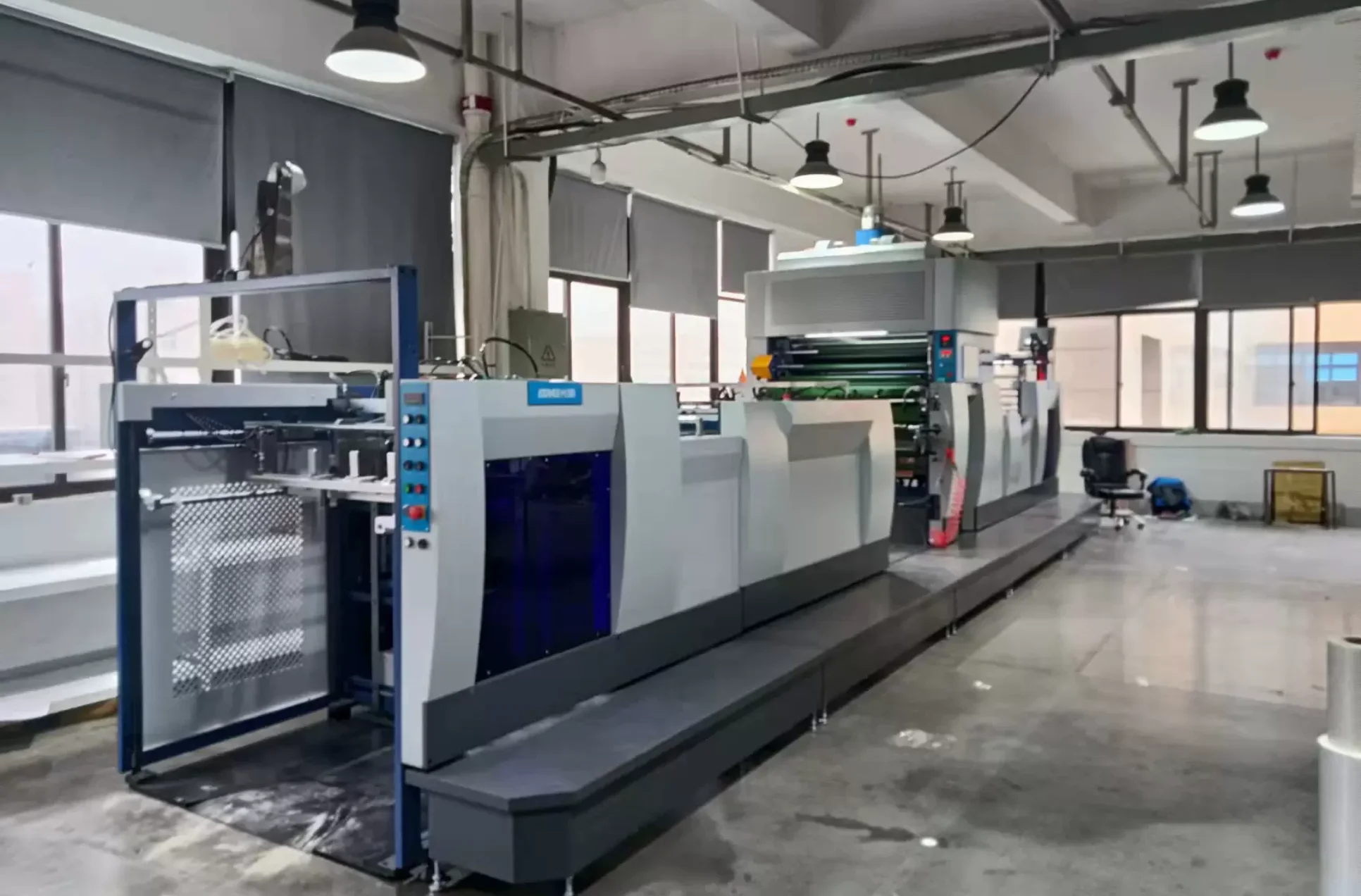
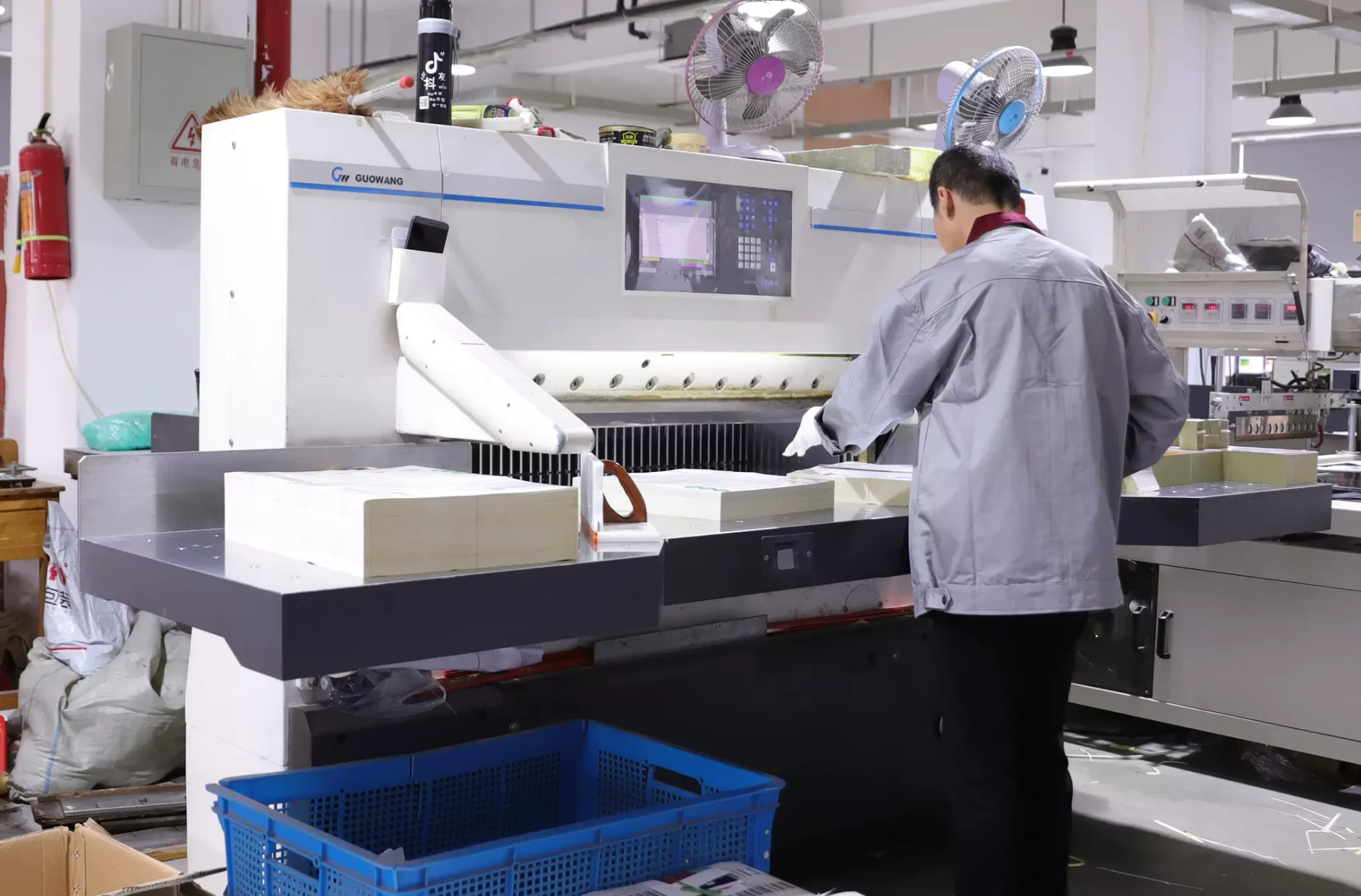
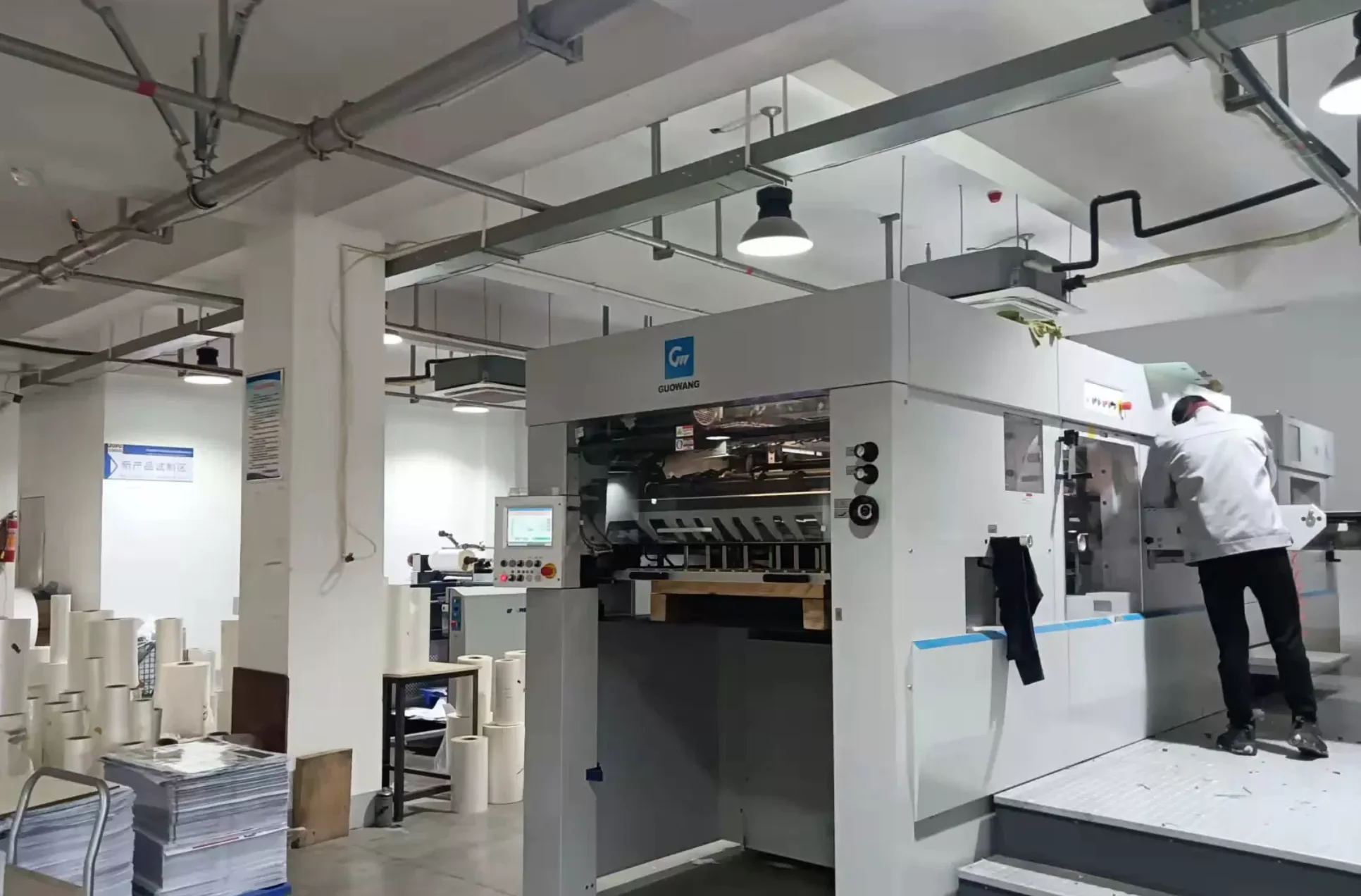
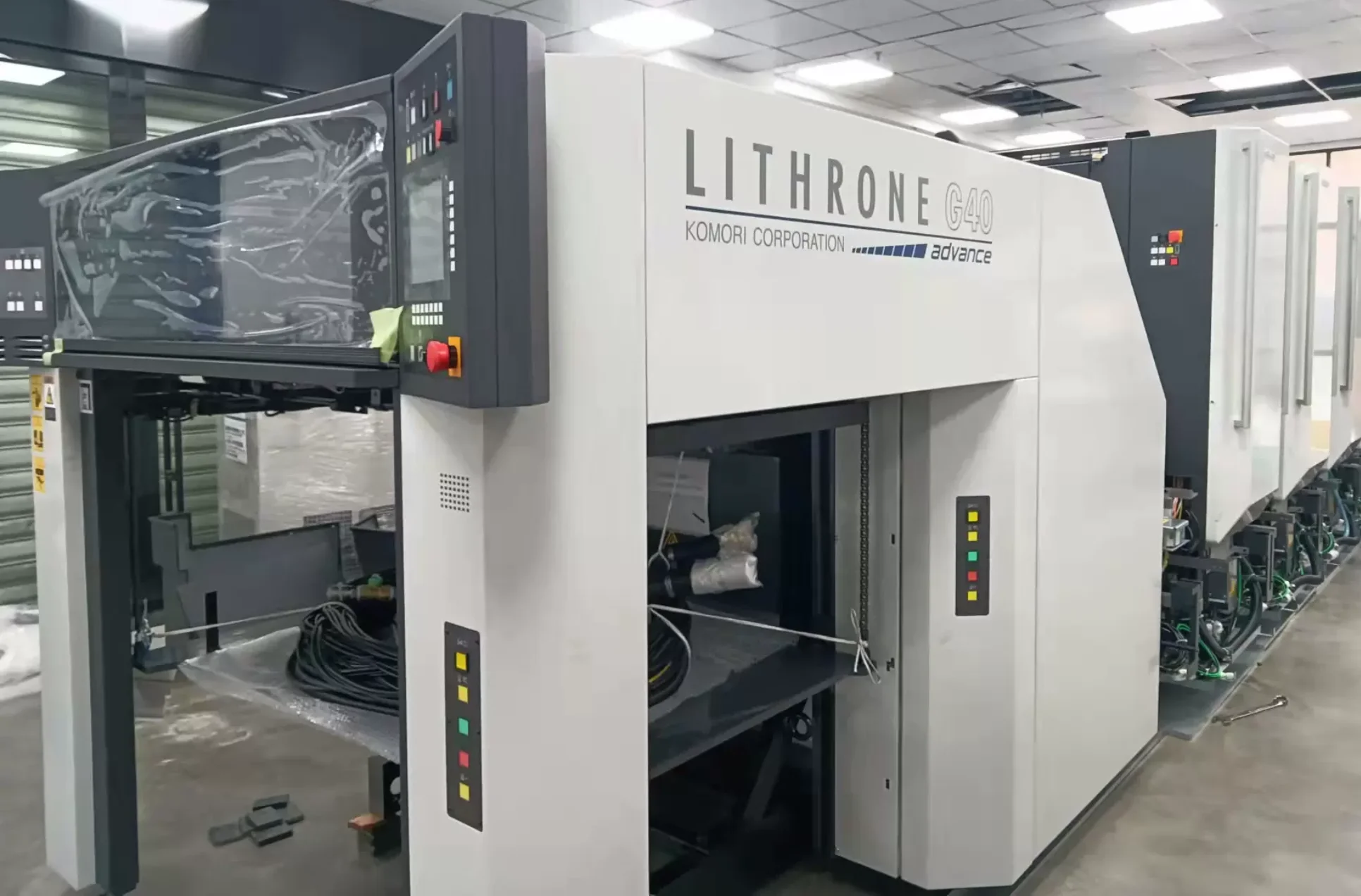
25,000㎡ Production Facility

Supports stable capacity planning and multi-line production

100+ Advanced Machines

Ensures precision and efficiency across different packaging types

400+ Skilled Workers

Maintains consistent execution across large-volume orders

Dedicated QC System

Controls quality from sampling to mass production

Multi-Line Production Setup

Reduces delays and improves delivery reliability

Repeat Order Control System

Ensures consistency across multiple production cycles

Material & Color Standards

Helps maintain uniform output across batches

Structured Workflow Process

Minimizes errors and improves production efficiency

So your production stays stable — even as your order volume grows.

Your Ultimate Guide to Custom Corrugated Packaging Boxes

If you are developing custom corrugated packaging boxes for your products, you are not only choosing a shipping box. You are making decisions that affect product protection, e-commerce fulfillment, warehouse efficiency, export shipping, printed brand presentation, production cost, MOQ, and long-term repeat order consistency.
 
At Borhen Pack, we work with brands, procurement teams, importers, distributors, e-commerce businesses, retail brands, and packaging designers who need corrugated boxes that fit the product, protect shipments, work in production, and remain reliable across future orders. This guide helps you understand how to choose the right corrugated box structure, board, flute type, printing method, inserts, and manufacturing partner before moving into sampling and bulk production.

Table of Contents

What Are Custom Corrugated Packaging Boxes?

Custom corrugated packaging boxes are paper-based packaging structures designed around a product’s real protection, shipping, storage, fulfillment, branding, and repeat-order needs. When I look at custom corrugated packaging boxes from a B2B packaging perspective, I do not see them as ordinary cartons that simply hold products. I see them as part of a business system. They influence whether a product arrives safely, whether warehouse teams can pack efficiently, whether a brand looks professional when the customer receives the parcel, and whether future orders can be produced with the same structure, strength, and appearance.
 
Understanding Custom Corrugated Packaging Boxes from a B2B Perspective
When I explain custom corrugated packaging boxes to brands, procurement teams, importers, distributors, and e-commerce businesses, I usually begin with one important point: a corrugated box should be designed around the real journey of the product. A product may be packed at a factory, stored in a warehouse, loaded into outer cartons, stacked on pallets, shipped internationally, handled by carriers, delivered to a retailer, or sent directly to an end customer. During that journey, the packaging is not just a container. It becomes the structure that protects the product, controls movement, supports stacking, carries printed information, and helps the shipment remain organized.
This is why I do not define custom corrugated boxes only by size or printing. A box becomes truly custom when its dimensions, board strength, flute type, structure, printing method, insert design, and packing method are planned around the product and the business model. A lightweight skincare product sold online does not need the same corrugated structure as a heavy home goods item shipped through an importer. A subscription box that needs a clean branded unboxing experience has different requirements from a bulk shipping carton used for warehouse distribution. From my perspective, custom corrugated packaging boxes should always connect product protection with real operational use.
 
Why Corrugated Packaging Boxes Are More Than Ordinary Shipping Cartons
Many people think of corrugated packaging boxes as standard shipping cartons, but I see a clear difference between a basic carton and a custom corrugated packaging solution. A standard carton may be selected because it is close to the product size, but that does not mean it is the right packaging. If the internal space is too large, the product may move during transportation. If the board is too weak, the box may crush under stacking pressure. If the folding structure is inconvenient, packing teams may lose time during fulfillment. If the printing is unclear, warehouse teams may have difficulty identifying products or SKUs.
A custom corrugated packaging box is developed with these practical issues in mind. The box should fit the product closely enough to reduce movement, but not so tightly that packing becomes difficult or pressure damages the item. The board should be strong enough for shipping conditions, but not unnecessarily heavy if the product does not require it. The structure should be practical for assembly, sealing, stacking, and handling. The printing should support both brand presentation and operational clarity. In my experience, this is where custom corrugated packaging creates real value: it helps businesses avoid hidden costs caused by damage, inefficient packing, oversized boxes, unclear specifications, or inconsistent repeat orders.
 
The Structural Foundation of Corrugated Board
The most important technical foundation of a corrugated packaging box is the corrugated board itself. I pay close attention to board selection because it affects almost everything that happens later. Corrugated board is usually made with a fluted paper layer placed between liner papers. That fluted middle layer creates cushioning, compression resistance, and structural support while keeping the packaging relatively lightweight. This is why corrugated packaging is widely used for shipping, e-commerce delivery, export cartons, retail distribution, and protective product packaging.
Different board choices create different packaging performance. A finer flute may create a smoother surface for printing and a cleaner appearance for mailer boxes or retail-style corrugated packaging. A stronger flute or double-wall board may be more suitable for heavier products, fragile items, or export shipping conditions. Kraft board may create a natural and practical look, while white board may support a cleaner printed presentation. FSC-certified corrugated paper options may be important for brands selling into markets where responsible paper sourcing matters. I always consider board selection as a balance between protection, cost, printing quality, shipping method, and long-term supply consistency.
 
How Flute Type Influences Protection, Printing, and Cost
Flute type is one of the details that many buyers may not think about at first, but it can strongly influence the final packaging result. When I review a custom corrugated box project, I look at whether the selected flute supports the product weight, box size, printing requirement, and shipping route. The flute affects cushioning, surface smoothness, stacking strength, and the overall hand-feel of the box.
For example, a fine flute such as E-flute is often useful when the packaging needs a cleaner surface for printing or a more compact structure for e-commerce mailer boxes. B-flute and C-flute are often considered for shipping boxes because they can provide practical strength and cushioning for general product protection. For heavier products or export shipping, double-wall structures such as BC-flute may be considered when the packaging needs stronger compression resistance and better stacking performance. I do not treat flute selection as a fixed formula. I prefer to evaluate it based on the product, the shipping environment, the printing expectation, and the cost target, because choosing a flute that is too weak can create damage risk, while choosing one that is unnecessarily strong can increase cost and shipping volume.
 
How Product Size, Weight, and Fragility Shape the Box Design
Whenever I begin reviewing a custom corrugated packaging project, I start with the product itself. The product’s size determines the internal dimensions of the box, but the process does not stop there. I also look at the product’s weight, shape, surface material, fragility, center of gravity, and how it should be positioned inside the packaging. These details influence whether the box needs a simple structure, reinforced board, internal dividers, molded pulp support, honeycomb paper inserts, or custom compartments.
A fragile glass bottle, for example, needs a different packaging approach from a lightweight textile product. A multi-piece electronics accessory kit needs a different internal layout from a single retail item. A product with sharp edges, glossy surfaces, or delicate finishes may require additional protection against scratching or internal movement. In my experience, many packaging problems happen when a box is designed only around external size rather than the full product condition. A better corrugated box is designed around product fit, movement control, packing speed, handling pressure, and shipping risk.
 
Corrugated Packaging Boxes for Product Protection
Product protection is one of the strongest reasons businesses choose custom corrugated packaging boxes. A well-designed corrugated box should help the product survive handling, stacking, vibration, compression, and delivery conditions. Protection does not come only from using thicker board. It comes from the relationship between the box size, board strength, flute type, structure, insert design, closure method, and packing standard.
I often see product damage caused not by the absence of packaging, but by packaging that was not designed around the product’s real movement. If a product shifts inside the box, it may hit the side walls repeatedly during transit. If multiple items are placed together without dividers, they may collide with each other. If the box is too weak for stacking, the top pressure may deform the package and damage the product inside. If the packing method is inconsistent, one shipment may arrive safely while the next shipment creates complaints. Custom corrugated packaging helps reduce these risks by creating a more controlled protective system around the product.
 
Corrugated Packaging Boxes for E-commerce Fulfillment
For e-commerce and DTC brands, corrugated packaging boxes have a special role because the box often becomes the customer’s first physical contact with the brand. A customer may discover the product through a website, an online marketplace, a TikTok video, or a social media advertisement, but the packaging is often the first thing they touch. If the box arrives damaged, feels weak, or looks careless, the customer may question the product before even opening it. If the corrugated mailer box arrives clean, opens smoothly, and presents the product clearly, the delivery feels more professional.
At the same time, I always remind e-commerce businesses that packaging must work behind the scenes as well. A corrugated mailer box should be easy for warehouse teams to assemble. It should not require too many manual steps. It should fit the product properly and avoid excessive filler. It should move smoothly through fulfillment and carrier handling. It should support repeat shipping without unexpected structure changes. A box that looks attractive but slows down packing operations can create hidden labor costs. A box that looks branded but does not protect the product can create returns and negative reviews. For e-commerce packaging, I believe the best corrugated boxes balance protection, speed, brand presentation, and scalability.
 
Corrugated Packaging Boxes for Warehousing and Multi-SKU Management
For brands, importers, and distributors managing multiple SKUs, corrugated packaging boxes also support warehouse organization. Packaging is not only about what the end customer sees. It also affects how products are stored, counted, stacked, identified, picked, packed, and shipped. When a business manages several product sizes or markets, box consistency becomes very important. If box dimensions change unexpectedly, warehouse space planning may become less efficient. If printing or marks are unclear, sorting may become slower. If board strength varies between orders, stacking performance may become unpredictable.
I often see mature buyers care deeply about repeatable specifications because packaging variation creates operational friction. A consistent corrugated packaging system can help teams manage SKUs more clearly, reduce unnecessary handling, improve storage planning, and make repeat orders easier to control. This is especially important for importers and distributors who may supply different customers or markets using similar packaging standards. In these cases, custom corrugated packaging becomes part of the supply system, not just a product container.
 
Corrugated Packaging Boxes for Export Shipping
Export shipping places higher demands on corrugated packaging because products often travel through long and complex logistics routes. A shipment may be stacked in a warehouse, loaded into containers, exposed to humidity changes, moved through ports, transferred between carriers, and handled multiple times before reaching the destination. In these conditions, a box must be more than visually acceptable. It must be structurally reliable.
When I evaluate corrugated boxes for export shipping, I consider board strength, flute type, wall structure, box dimensions, inner packing, outer carton method, stacking direction, palletizing, moisture risk, and transit time. A box that works for domestic delivery may not automatically work for international distribution. For heavy products or fragile products, the packaging may need stronger board or internal support. For products shipped in large quantities, the box must also fit efficiently into outer cartons or pallets to reduce wasted space and improve logistics efficiency. A reliable corrugated box manufacturer should help buyers think through these details before bulk production begins.
 
The Role of Printing in Custom Corrugated Packaging Boxes
Printing on corrugated packaging boxes has both branding and operational value. I see custom printed corrugated boxes used for logos, brand patterns, product names, shipping marks, handling instructions, SKU identification, barcodes, and retail information. For e-commerce brands, printed packaging can make the delivery feel more intentional. For distributors and warehouses, printed information can improve handling and identification. For retail programs, printed corrugated packaging can support shelf presentation, promotional displays, or product launches.
However, printing on corrugated board should be planned carefully. The final result depends on the board surface, flute type, artwork design, printing method, color requirement, and production quantity. Flexographic printing may be practical for simple logos, marks, and large-volume shipping boxes. Offset laminated printing may be more suitable when the brand needs sharper graphics, stronger color presentation, or a more retail-ready appearance. Digital printing may be useful for sampling or short-run visual confirmation in some projects. From my perspective, printing should not be treated as decoration only. It should support brand recognition, operational clarity, and production stability.
 
Why Inserts and Internal Support Matter
The inside of a corrugated box can be just as important as the outside. I often tell customers that a strong outer box does not automatically protect the product if the product is free to move inside. Internal movement is one of the most common causes of damage during shipping. When the product moves, it can collide with the box wall, hit another product, or become scratched, dented, or broken during vibration and impact.
This is where inserts and dividers become valuable. Corrugated dividers can separate multiple items. Paperboard inserts can create clean product positioning. Molded pulp inserts can support a more paper-based protection direction. Honeycomb paper supports can provide cushioning and structural support for certain products. Custom compartments can keep product sets organized and improve the opening experience. When I review inserts, I do not choose them only based on appearance. I consider the product weight, fragility, shape, sustainability goals, assembly process, shipping method, and cost. The best result usually comes when the outer corrugated box and the internal support are designed together as one packaging system.
 
Custom Corrugated Boxes as a Branding Tool
Although corrugated packaging is often associated with shipping and protection, I believe it can also support brand presentation when it is planned correctly. This is especially true for e-commerce, subscription boxes, retail distribution, and product launch packaging. A well-printed corrugated mailer box can create a more professional delivery experience. A custom printed shipping box can make a brand feel more organized and recognizable. A corrugated display box can help products appear more prepared for retail environments.
That said, I do not think every corrugated box needs to look overly decorative. The right level of branding depends on the product, sales channel, budget, and customer expectation. Sometimes a clean one-color logo is enough. Sometimes inside printing can create a better unboxing moment. Sometimes full-color laminated printing is worth considering for retail-style corrugated packaging. The important point is that branding should support the packaging purpose. It should not create unnecessary cost, slow down production, or reduce shipping performance.
 
Custom Corrugated Boxes as a Scalable Packaging Solution
For B2B buyers, packaging needs often change as the business grows. A brand may start with one product and later expand into multiple SKUs. An e-commerce seller may begin with smaller order quantities and later move into repeat fulfillment. An importer may need stable box specifications across different customers. A distributor may need packaging that can be reordered with consistent size, board, printing, and packing method. This is why I see custom corrugated boxes as scalable packaging solutions rather than one-time purchases.
When the first project is planned carefully, future orders become easier. The approved sample can become the production reference. The board type, flute, dimensions, printing method, dieline, inserts, and packing standards can be documented. This makes repeat production more predictable and reduces the risk of unexpected variation. For mature brands and procurement teams, this repeatability is often as important as the first order. A reliable corrugated packaging program should support growth instead of forcing the buyer to solve the same packaging problems again and again.
 
What Makes a Corrugated Packaging Box Truly Custom
A corrugated packaging box is not truly custom just because it has a printed logo. In my view, a truly custom corrugated packaging box is designed around the product, the sales channel, the shipping condition, the packing process, the brand requirement, and the future order plan. It should answer practical questions before production begins. Does the box fit the product correctly? Does the board match the weight and shipping risk? Does the flute support both protection and printing? Does the structure assemble efficiently? Does the insert reduce movement? Does the packing method support export or warehouse handling? Can the same packaging be produced again with stable specifications?
When these questions are answered, the packaging becomes more than a box. It becomes a planned solution. It can reduce damage, improve packing efficiency, support a better customer experience, help warehouse teams work more smoothly, and make future reorders more predictable. This is the difference between buying generic cartons and developing custom corrugated packaging boxes with a professional corrugated box manufacturer.
 
Why the Right Corrugated Box Manufacturer Matters
Choosing the right corrugated box manufacturer matters because the final packaging depends on many connected decisions. A supplier who only asks for size and quantity may miss important details about product weight, shipping risk, flute selection, internal protection, printing requirements, or export packing. I believe a reliable manufacturer should help buyers review the project before production, not only after problems appear.
For international buyers sourcing from China, this is especially important. Distance can make communication slower if specifications are unclear. A strong manufacturing partner should help clarify board options, structure feasibility, dieline details, printing method, sample standards, bulk production control, quality inspection, and packing requirements. The goal is not only to produce boxes. The goal is to reduce uncertainty from sample approval to bulk production and repeat orders. This is why I always view a good corrugated box manufacturer as part of the packaging decision-making process.
 
Final Thoughts on Custom Corrugated Packaging Boxes
When I define custom corrugated packaging boxes, I define them as engineered paper-based packaging solutions built for protection, shipping, fulfillment, branding, storage, export, and repeat production. They may look simple from the outside, but the decisions behind them can strongly influence product safety, logistics efficiency, customer experience, and supply consistency.
For B2B buyers, the right custom corrugated boxes can help reduce shipping damage, improve warehouse handling, support e-commerce fulfillment, strengthen brand presentation, and make future orders easier to manage. That is why I believe corrugated packaging should never be treated as an afterthought. A well-developed corrugated box should fit the product properly, protect it through real transportation conditions, work efficiently in daily operations, and remain consistent as the business grows.

Why B2B Buyers Choose Corrugated Packaging for Product Protection and Shipping

B2B buyers choose corrugated packaging because packaging has a direct influence on product safety, delivery quality, warehouse efficiency, customer satisfaction, and long-term supply stability. When I look at corrugated packaging from a professional sourcing and manufacturing perspective, I do not see it as a low-value shipping material. I see it as one of the most practical packaging systems for businesses that need products to move safely through warehouses, fulfillment centers, distributors, retailers, export routes, and last-mile delivery networks. For mature brands, importers, distributors, procurement teams, and e-commerce businesses, the decision to use corrugated packaging is usually not driven by appearance alone. It is driven by the need to reduce shipping damage, improve handling efficiency, control logistics risks, and make packaging more predictable across repeat orders.
 
Corrugated Packaging Helps B2B Buyers Reduce Real Supply Chain Risk
When I speak about corrugated packaging with B2B buyers, I always like to begin with risk. A buyer is rarely just asking for a box. In most cases, they are trying to prevent a series of problems that can happen after the product leaves the factory. A product can be well made, correctly priced, and ready for sale, but if it arrives damaged, crushed, poorly presented, or difficult to handle, the packaging failure can affect the entire business process. It can create replacement costs, customer complaints, delayed product launches, refund pressure, distributor disputes, and a loss of confidence in the supplier.
This is why corrugated packaging remains one of the most widely used choices for product protection packaging. A properly developed corrugated box helps create a buffer between the product and the unpredictable conditions of transportation. It can absorb certain levels of pressure, reduce impact, support stacking, and keep products more stable during handling. From my perspective, the value of corrugated packaging is not only in the material itself. Its real value comes from how the board strength, flute type, structure, insert design, and packing method work together to reduce uncertainty throughout the supply chain.
 
Product Protection Is the Foundation of Corrugated Packaging Value
Product protection is usually the first and most important reason B2B buyers choose corrugated packaging. A corrugated box is built with a fluted paper structure that gives the packaging cushioning and compression resistance while keeping it relatively lightweight. This makes corrugated shipping boxes useful for many product categories, especially when items need to pass through multiple handling stages before reaching a warehouse, retailer, distributor, or final customer.
However, I do not believe product protection should be reduced to one simple idea such as “use a stronger box.” A stronger box may help, but a box can still fail if the product does not fit correctly, if the internal space is too large, if the flute type is not suitable, or if the packing method allows the product to move during transit. I often see protection problems caused by a mismatch between the product and the packaging structure. A good corrugated packaging solution should protect the product through fit, structure, cushioning, stacking strength, and movement control. That is why I always evaluate corrugated packaging as a complete protective system, not just as an outer carton.
 
Shipping Protection Becomes More Important When Products Travel Through Multiple Handling Points
Shipping protection matters because most products do not travel in a straight and gentle path. A product may be packed in one location, stored temporarily, moved by forklift, loaded into a truck, stacked on a pallet, transferred to a freight forwarder, shipped by sea or air, handled at customs, moved into a distribution center, and later delivered to a retailer or end customer. Each stage creates the possibility of compression, vibration, impact, moisture exposure, stacking pressure, or rough handling.
In this kind of environment, corrugated packaging needs to be designed for the real shipping route. A box used for local delivery may not need the same structure as export shipping packaging. A product sold through e-commerce fulfillment may need a mailer-style structure that protects the item and still creates a clean customer experience. A product shipped in bulk to distributors may need stronger corrugated shipping boxes that can withstand stacking and warehouse movement. When I evaluate shipping protection, I always ask how far the product will travel, how many times it may be handled, how it will be stacked, and what kind of damage risk the product may face along the way.
 
Board Strength Influences Whether Packaging Can Survive Real Handling
Board strength is one of the first details I consider when reviewing corrugated packaging for product protection and shipping. The board must match the product’s size, weight, fragility, packing quantity, stacking method, and transportation route. If the board is too weak, the box may bend, collapse, or lose shape during shipping. If the board is much stronger than necessary, the packaging may become more expensive, heavier, and less efficient for storage and freight.
This balance is especially important for B2B buyers because packaging cost and logistics cost are connected. A procurement team may want strong protection, but it also needs cost control across thousands of units. An importer may want a reliable export carton, but it also needs efficient pallet loading and container utilization. An e-commerce brand may need packaging that protects products during delivery without making each shipment too heavy or oversized. In my experience, board strength should be selected through practical evaluation, not guesswork. The right board is the one that supports the product and the shipping environment without creating unnecessary cost.
 
Flute Type Changes the Way a Corrugated Box Performs
Flute type is one of the technical details that can quietly influence the success of a corrugated packaging project. The flute is the wavy paper layer inside the corrugated board, and it affects cushioning, compression resistance, surface smoothness, printing quality, box thickness, and overall packaging performance. When I review a custom corrugated box, I do not treat the flute as a minor specification. I see it as one of the key decisions that determines whether the packaging is suitable for its purpose.
A finer flute can be useful when the box needs a cleaner surface for printing or a more compact structure for e-commerce fulfillment packaging. This is why finer flute structures are often considered for printed mailer boxes or retail-style corrugated packaging. A stronger flute may be more suitable for corrugated shipping boxes that need better cushioning and stacking performance. For heavier products or export shipping packaging, a double-wall structure may be needed to improve compression resistance. I always prefer to choose flute type based on the product, shipping conditions, printing expectations, and budget, because the wrong flute can create either protection weakness or unnecessary packaging cost.
 
Box Structure Determines How the Product Is Packed, Handled, and Delivered
The structure of a corrugated box has a major influence on how the product performs in real operations. Two boxes can use similar corrugated board but behave very differently depending on the structure. A corrugated mailer box, a standard shipping carton, a die-cut corrugated box, a corrugated display box, and a heavy-duty export box each solve a different business problem. This is why I never see box structure as only a design choice. I see it as a practical decision that affects packing speed, product fit, shipping protection, storage efficiency, and customer experience.
For example, a corrugated mailer box may be the right choice for a DTC brand because it can be assembled efficiently, protect the product during delivery, and create a more branded unboxing moment. A regular corrugated shipping box may be more suitable for bulk transport, warehouse storage, and distributor shipments. A die-cut corrugated box may be useful when the product needs a more specific fit or a custom opening method. A heavy-duty corrugated box may be necessary when the product is heavier, fragile, or exposed to longer shipping routes. In my view, the right structure is the one that supports the entire product journey, not only the first impression.
 
Insert Design Helps Prevent Internal Movement and Collision
One of the most common causes of shipping damage is internal movement. Even if the outer corrugated box is strong, the product can still be damaged if it moves inside the box during handling, vibration, or impact. This is especially important for fragile items, glass bottles, electronics accessories, cosmetics sets, sample kits, gift sets, and multi-piece products. When products are not held in the correct position, they may collide with each other, hit the box wall, scratch the surface, or shift into a weaker area of the packaging.
This is where insert design becomes very important. Corrugated dividers, paperboard inserts, molded pulp inserts, honeycomb paper supports, and custom compartments can help hold products in place and reduce collision during shipping. I usually evaluate the insert together with the outer corrugated box because these two parts must work as one packaging system. A strong box with a weak insert may still fail. A good insert can improve product protection, make the package easier to organize, and create a cleaner opening experience without necessarily making the packaging overly complex. For B2B buyers, this can reduce damage rates and improve consistency across repeated shipments.
 
Corrugated Packaging Supports Warehouse Handling and Storage Efficiency
B2B buyers also choose corrugated packaging because packaging affects warehouse efficiency. In a warehouse, boxes are not only stored; they are received, counted, stacked, picked, moved, packed, labeled, and shipped. If the box dimensions are inconsistent, if the structure is difficult to fold, if the printing is unclear, or if the packaging cannot withstand stacking, warehouse teams may lose time and make more errors. These small inefficiencies can become expensive when the business is managing large quantities or multiple SKUs.
I often see mature buyers care about packaging consistency because it helps warehouse teams work more predictably. Consistent corrugated shipping boxes can make storage planning easier. Clear printing can help identify SKUs, product categories, handling instructions, or destination markets. A well-planned box structure can reduce assembly time and improve packing flow. From my perspective, good corrugated packaging does not only protect products in transit. It also supports the daily rhythm of warehouse operations, which is a major reason B2B buyers treat packaging as part of their supply chain strategy.
 
Stacking Performance Matters for Distribution and Bulk Shipping
Stacking performance is another important reason B2B buyers choose corrugated packaging carefully. During warehousing, palletizing, container loading, and retail distribution, boxes are often stacked under pressure for extended periods. If the packaging cannot maintain its shape, the products inside may become damaged, the pallet may become unstable, or the shipment may be more difficult to handle.
When I think about stacking performance, I do not only ask whether one box feels strong when held by hand. I think about how many boxes will be stacked together, how long they may remain stacked, how the weight is distributed, whether the contents create pressure points, and whether the outer packaging can remain stable during movement. Board strength, flute type, box dimensions, product weight, inner packing, and palletizing method all influence the result. A good corrugated box should perform as part of a larger shipping unit, not only as an individual package.
 
E-commerce Fulfillment Packaging Must Work for Both the Warehouse and the Customer
For e-commerce businesses, corrugated packaging has to satisfy two different audiences at the same time. It must work for the warehouse team that packs orders quickly, and it must work for the customer who receives and opens the package. If the box is slow to fold, difficult to close, or requires too much filler, it can reduce fulfillment efficiency. If the box is weak, oversized, or poorly presented, it can create delivery damage or a poor customer experience.
This is why e-commerce fulfillment packaging needs a careful balance of protection, assembly speed, brand presentation, and shipping efficiency. A corrugated mailer box should be practical for packing teams and still look clean when it reaches the customer. A printed shipping box should support brand recognition without sacrificing structural strength. A box with inserts should protect the product without creating unnecessary packing complexity. In my experience, the best e-commerce corrugated packaging is not the most decorative box. It is the box that protects the product, packs efficiently, ships reliably, and makes the customer feel the brand is professional.
 
Export Shipping Packaging Requires Stronger Planning from the Beginning
Export shipping packaging requires more careful planning because international logistics are longer and less predictable than local delivery. Products may be loaded into containers, stacked under pressure, exposed to humidity changes, moved through ports, handled by multiple logistics providers, and stored before final distribution. A box that works well for a domestic shipment may not automatically perform well in export shipping.
When I review export shipping packaging, I pay close attention to board strength, flute type, wall structure, inner support, master carton planning, palletizing, moisture protection, stacking direction, and container loading. I also consider whether the packaging will be shipped flat or pre-assembled, because that affects freight volume and handling efficiency. For importers and distributors, this planning matters because packaging failure during export can create expensive problems after the goods have already traveled far from the factory. I always believe export packaging should be designed before bulk production begins, not corrected after damage complaints appear.
 
Corrugated Packaging Helps Control Logistics Costs When Designed Properly
Corrugated packaging can help control logistics costs, but only when the design is practical. Packaging size, weight, board strength, stacking efficiency, and carton utilization all affect freight cost. A box that is too large may increase dimensional weight and waste space in outer cartons, pallets, or containers. A box that is too heavy may increase shipping cost. A box that does not stack efficiently may create unnecessary storage and transportation waste.
I often encourage B2B buyers to think about packaging cost and logistics cost together. The lowest unit price is not always the best choice if the packaging leads to damage, poor stacking, excessive filler, or inefficient container loading. At the same time, over-engineering the box can also increase cost without adding meaningful value. The best corrugated packaging solution usually finds the practical middle point. It protects the product, supports shipping, fits the operational process, and avoids unnecessary material or freight waste.
 
Corrugated Packaging Can Strengthen Brand Delivery Without Losing Function
Although corrugated packaging is usually chosen for product protection and shipping protection, it can also strengthen brand delivery. This is especially true for e-commerce fulfillment packaging, subscription boxes, custom printed corrugated boxes, and retail-ready corrugated packaging. A clean printed box can make the delivery feel more professional. A branded mailer box can make the unboxing experience more intentional. A printed shipping carton can help the brand look organized during distribution.
However, I believe brand presentation should never weaken the core function of corrugated packaging. The box still needs to protect the product, assemble efficiently, stack properly, and ship safely. Printing should support both appearance and operations. It can include logos, handling marks, product information, SKU references, channel identifiers, or inside graphics. When branding and function are balanced correctly, corrugated packaging can protect the product while also strengthening the customer’s impression of the business.
 
Repeat Order Consistency Is Essential for Mature B2B Buyers
For mature brands, importers, distributors, and procurement teams, repeat order consistency is a major reason to choose a reliable corrugated packaging supplier. A first sample may look good, but the real test begins when the same packaging needs to be produced again and again. If the board strength changes, if the flute type is inconsistent, if the box dimensions shift, if the printing varies, or if the glue strength changes, the buyer may face operational and quality problems.
This is why I always treat the approved sample as more than a visual reference. It should become the production standard. The board type, flute type, box size, dieline, printing method, insert structure, packing method, and quality expectations should be clearly confirmed. When these details are controlled, future orders become easier to manage. For B2B buyers, stable repeat production reduces communication work, prevents surprise variations, and helps packaging become a predictable part of the supply chain.
 
Corrugated Packaging Supports Scalable Business Growth
Corrugated packaging is also attractive to B2B buyers because it can support growth. A small e-commerce brand may begin with corrugated mailer boxes for one product and later expand into multiple SKUs. An importer may begin with one packaging size and later need a family of corrugated shipping boxes for different product lines. A distributor may need stable packaging specifications that can be used across several customers or markets. A retail brand may need packaging that works for warehouse storage, display, distribution, and direct delivery.
This scalability makes corrugated packaging practical for businesses that expect change. The board can be upgraded, the flute type can be adjusted, the printing can become more refined, inserts can be added, and specifications can be standardized for repeat production. From my perspective, this is one of the strongest business reasons to choose custom corrugated packaging. It can support the first order, but it can also grow with the business when the packaging is planned correctly from the beginning.
 
Choosing Corrugated Packaging Is Really a Business Decision
When I look at why B2B buyers choose corrugated packaging, I see a decision that goes far beyond material selection. The buyer is deciding how the product will be protected, how efficiently it will be packed, how safely it will move, how professionally it will arrive, and how consistently the same packaging can be reordered. That makes corrugated packaging a business decision, not just a purchasing detail.
A good corrugated box can reduce shipping damage, improve warehouse handling, support e-commerce fulfillment, control logistics cost, strengthen brand presentation, and make repeat orders more predictable. A poorly chosen box can create damage, delays, wasted space, higher freight cost, and customer dissatisfaction. This is why I always encourage B2B buyers to evaluate corrugated packaging through the full product journey. The right box should work from the packing table to the warehouse, from the warehouse to the shipping route, and from the shipping route to the final customer.
 
Final Thoughts on Why B2B Buyers Choose Corrugated Packaging
When I think about why B2B buyers choose corrugated packaging for product protection and shipping, I see one clear pattern: they need packaging that performs in the real world. They need packaging that can protect products, support efficient fulfillment, handle stacking pressure, move through export routes, reduce damage risk, control shipping cost, and remain consistent across repeat orders.
The true value of corrugated packaging comes from how board strength, flute type, box structure, insert design, printing method, and packing method work together. A good corrugated packaging solution should not only hold the product. It should help the product travel safely, support business operations, and protect the buyer’s reputation. For brands, importers, distributors, procurement teams, and e-commerce businesses, this reliability is often the real reason corrugated packaging becomes the preferred choice for product protection and shipping.

Common Types of Custom Corrugated Packaging Boxes

Custom corrugated packaging boxes can look simple from the outside, but in real B2B packaging projects, each box type serves a very different purpose. When I review corrugated packaging for a brand, importer, distributor, procurement team, or e-commerce seller, I never choose a structure only because it is common or visually familiar. I first think about the product journey. I want to understand how the product will be packed, how much protection it needs, how it will move through warehouses and shipping routes, whether it will be opened by a retail buyer or an end customer, and whether the same packaging needs to be reordered consistently in the future.
This is why I see corrugated shipping boxes, corrugated mailer boxes, custom printed corrugated boxes, heavy-duty corrugated boxes, corrugated display boxes, die-cut corrugated boxes, corrugated boxes with inserts, and flat-pack corrugated boxes as different packaging solutions rather than simple product names. They may all use corrugated board, but they answer different business needs. Some are built for bulk transportation. Some are designed for e-commerce delivery. Some support retail display. Some protect fragile products with internal structures. Some reduce warehouse and shipping volume before assembly. Understanding these differences helps B2B buyers choose packaging that protects products, supports operations, controls cost, and remains scalable across repeat orders.
 
Corrugated Shipping Boxes
Corrugated shipping boxes are usually the first type of corrugated packaging most B2B buyers think about because they are widely used for transportation, storage, and distribution. When I look at corrugated shipping boxes, I see them as the practical foundation of many packaging programs. They are used by brands, importers, distributors, wholesalers, manufacturers, and procurement teams that need products to move safely from one business point to another. Their value is not only that they can contain products. Their real value is that they help products survive handling, stacking, loading, transportation, warehousing, and delivery.
In a good corrugated shipping box project, I always start by looking at the product weight, product size, shipping distance, stacking requirements, and warehouse handling conditions. A box used for light retail items may not need the same board strength as a box used for heavier products or long-distance export shipping. If the box is oversized, the product may move inside and require extra filling material. If the board is too weak, the box may crush under stacking pressure. If the box is too strong for the actual product need, the buyer may pay unnecessary material and freight costs. This is why corrugated shipping boxes should be designed with a practical balance between protection, cost, and logistics efficiency.
For importers and distributors, corrugated shipping boxes are especially important because the packaging often passes through several different handling stages before reaching the final destination. A shipment may be stored in a supplier warehouse, packed into export cartons, loaded onto pallets, placed in a container, unloaded at a port, moved into a distribution warehouse, and then shipped again to retailers or downstream customers. In this process, the box must remain stable enough to protect the product and predictable enough for repeated handling. I often see shipping boxes become part of the buyer’s supply chain standard, especially when the same product line is reordered regularly.
Another detail I pay attention to is how the shipping box supports identification and workflow. A plain corrugated shipping box may be enough for simple bulk transport, but many B2B buyers benefit from printed handling marks, SKU information, product codes, carton quantities, or destination indicators. These details may seem small, but they can help warehouse teams reduce sorting mistakes and improve handling speed. In my view, a well-designed corrugated shipping box should protect the product physically and support the operation practically.
 
Corrugated Mailer Boxes
Corrugated mailer boxes are closely connected to e-commerce, DTC brands, subscription products, influencer kits, and direct-to-customer delivery. When I review a corrugated mailer box, I do not only think about shipping protection. I also think about the customer’s first physical experience with the brand. For many online businesses, the mailer box is the first thing the customer touches after seeing the product online. That makes the packaging part of the brand experience, even if its first job is still to protect the product during delivery.
A corrugated mailer box needs to satisfy two different sides of the business at the same time. On the fulfillment side, it should be easy to fold, quick to assemble, secure to close, and efficient to pack. If a mailer box looks attractive but requires too many manual steps, it can slow down warehouse teams and increase labor cost. On the customer side, it should arrive clean, open smoothly, and present the product in an organized way. If the box arrives crushed, feels weak, or opens awkwardly, the customer may question the quality of the product before using it.
I often see corrugated mailer boxes used for cosmetics, apparel accessories, wellness products, small electronics, subscription boxes, stationery, gift sets, and branded e-commerce products. The structure usually includes self-locking flaps or roll-end designs that can reduce the need for excessive tape. Depending on the product, the box may also include inside printing, paperboard inserts, product cards, or protective compartments. The goal is not to make the mailer box overly complicated. The goal is to create a packaging experience that is protective, efficient, and aligned with the brand’s customer promise.
From a sourcing perspective, corrugated mailer boxes also need realistic production planning. The board surface, flute type, printing method, size, and order quantity can all affect cost and MOQ. A simple kraft mailer box with one-color logo printing may be easier to produce than a full-color printed mailer box with inside printing and a custom insert. When I help evaluate a mailer box project, I always try to balance visual presentation with fulfillment efficiency and repeat-order stability. A good mailer box should not only work for the first product launch. It should also be practical when order volume increases.
 
Custom Printed Corrugated Boxes
Custom printed corrugated boxes are chosen when the packaging needs to communicate brand identity, product information, handling instructions, or channel-specific details. I never see printing on corrugated boxes as decoration only. In B2B packaging, printing often plays two roles at the same time. It helps the brand look more professional to customers, retailers, or distributors, and it helps internal teams identify, sort, handle, and manage products more efficiently.
For e-commerce brands, printed corrugated boxes can improve the delivery experience. A logo, brand pattern, inside message, or clean printed layout can make the package feel more intentional. For retail brands, printed corrugated boxes may support product launches, promotional campaigns, or display-ready presentation. For importers and distributors, printing may be more functional. It may include SKU numbers, product names, carton contents, handling marks, market information, or shipping symbols. In these cases, printing helps reduce confusion and supports operational clarity.
The printing method matters a lot in custom printed corrugated packaging. Flexographic printing is often practical for simple logos, shipping marks, and larger-volume production where cost efficiency matters. Offset laminated printing may be more suitable when the packaging needs sharper graphics, full-color images, or a more retail-ready surface. Digital printing may be useful for samples, mockups, or short-run visual confirmation, depending on the project. I usually recommend choosing the printing method based on the expected visual result, order quantity, board surface, color requirement, and budget rather than choosing based only on appearance.
One detail I always pay attention to is the relationship between printing quality and corrugated board structure. A rougher surface or larger flute may not produce the same sharpness as a smoother board or laminated surface. If the brand expects high-quality graphics, this needs to be considered before artwork is finalized. If the packaging is mainly for shipping, simple and clear printing may be more cost-effective. Good printed corrugated packaging should match the real purpose of the box. It should make the brand or operation clearer without creating unnecessary cost or production risk.
 
Heavy-Duty Corrugated Boxes
Heavy-duty corrugated boxes are used when the product, shipping route, or storage condition requires stronger protection than a standard corrugated box can provide. When I review heavy-duty packaging, I usually think about pressure, weight, rough handling, export shipping, long-distance transportation, and product fragility. These boxes are often used for heavier goods, industrial products, home goods, glass items, multi-piece sets, electronics components, and products that need stronger resistance during storage and transport.
A heavy-duty corrugated box is not simply a thicker version of a regular box. It should be engineered around the stress the packaging will face. I look at board grade, flute type, wall structure, box size, closure method, glue strength, stacking direction, and internal support. A double-wall board may be necessary when the product is heavy or when cartons need to be stacked for long periods. Stronger flutes may help improve compression resistance. Reinforced corners or internal supports may be useful when the product creates pressure points inside the box. The right solution depends on the product and shipping conditions, not on a single standard.
For export shipping, heavy-duty corrugated boxes can be especially valuable. Products may travel through ports, containers, warehouses, and distribution routes before reaching the buyer. The packaging may experience stacking, vibration, moisture changes, and repeated handling. In these cases, under-designed packaging can lead to costly damage claims or product replacement. I often remind customers that the cost of better packaging should be compared with the possible cost of damaged goods, delayed deliveries, and customer complaints. Heavy-duty corrugated boxes are not always necessary, but when the product or route demands it, they can protect both the shipment and the buyer’s business reputation.
Another important point is that heavy-duty packaging still needs cost control. Overbuilding the box may increase material cost, storage volume, and freight weight. A professional corrugated box manufacturer should help the buyer find the correct protection level rather than simply recommend the strongest option. In my view, the best heavy-duty corrugated box is not the heaviest box. It is the box that provides the right strength for the product, the route, and the repeat-order plan.
 
Corrugated Display Boxes
Corrugated display boxes are designed for packaging that must also support retail presentation. When I think about corrugated display boxes, I see them as a bridge between logistics and merchandising. They need to protect the product during transportation, but once they arrive at the store, they may also help present the product to shoppers. This makes them different from ordinary shipping cartons because they must perform before and after the product reaches the retail environment.
These boxes are often used for product launches, retail promotions, counter displays, supermarket displays, seasonal campaigns, and point-of-sale presentation. A display box may include printed graphics, tear-away panels, open-front structures, product compartments, or reinforced bases. The design needs to consider how the product will be seen, how many units will be placed inside, how retail staff will set it up, and whether the display can remain stable after repeated customer interaction.
The challenge with corrugated display boxes is balancing presentation with shipping reality. A display box that looks attractive but cannot survive transport may fail before it reaches the store. A box that is strong but difficult to assemble may frustrate retail teams. A display that does not hold products neatly may reduce visual impact. I usually review display box projects by thinking about the full sequence: how it is produced, how it is packed, how it is shipped, how it is opened, how it is placed, and how it supports the sale. This is why corrugated display packaging should be developed as both a structural packaging solution and a merchandising tool.
For B2B buyers, display boxes can also help standardize promotional execution across markets. If a distributor supplies multiple retail locations, consistent display packaging can reduce setup variation and make the campaign easier to manage. Clear printing, stable structure, and practical assembly can make the difference between a display that supports sales and a display that creates operational headaches. In my view, a strong corrugated display box should not only look good in a rendering. It should work in real retail conditions.
 
Die-Cut Corrugated Boxes
Die-cut corrugated boxes are custom structures created through specific cutting, creasing, locking, and folding patterns. I usually consider die-cut boxes when a standard carton cannot fully solve the product’s needs. The product may have a special shape, require a specific opening method, need better internal positioning, or benefit from a structure that improves assembly and presentation. Die-cut corrugated packaging gives more flexibility than regular box formats, but it also requires more careful planning.
The dieline is the heart of a die-cut corrugated box. It determines how the board will be cut, folded, locked, glued, assembled, and used. If the dieline is not accurate, the box may be difficult to assemble, the product may not fit properly, the locking points may not hold, or the structure may become unstable during shipping. I always review folding direction, glue area, locking method, product clearance, insert space, and board thickness before sampling. A die-cut box may look simple after it is assembled, but the technical decisions behind it are important.
Die-cut corrugated boxes are useful for e-commerce packaging, promotional kits, product samples, retail packs, subscription packaging, and products that need a more customized fit. They can create a cleaner customer experience and reduce the need for excessive filler if designed correctly. However, more customized structure also means the buyer should think carefully about MOQ, tooling, assembly speed, packing workflow, and repeat production. I see die-cut corrugated boxes as very valuable when the structure solves a real packaging problem, not when it is made complex only for appearance.
For packaging designers and agencies, die-cut boxes are often attractive because they allow more creative structural ideas. But from a manufacturing perspective, creativity needs to be matched with feasibility. The structure should be beautiful enough to support the brand but simple enough to produce consistently. It should create a good experience but not slow down packing teams. This balance is where strong manufacturing review becomes important.
 
Corrugated Boxes with Inserts
Corrugated boxes with inserts are used when the inside of the package matters as much as the outside. When I review packaging for fragile products, multi-piece sets, electronics accessories, cosmetics, glass bottles, samples, or gift kits, I often look first at whether the product can move inside the box. Internal movement is one of the most common causes of damage. A strong outer box may still fail if the product shifts, collides, tilts, or rubs against other items during shipping.
Inserts help control that internal space. Corrugated dividers can separate multiple items. Paperboard inserts can create clean positioning. Molded pulp inserts can support a paper-based protection direction. Honeycomb paper supports may provide cushioning and structural support in certain applications. Custom compartments can organize product sets and make the opening experience more orderly. The right insert depends on product weight, fragility, shape, surface sensitivity, sustainability goals, packing process, and cost target.
I always prefer to evaluate inserts together with the outer box. If the insert is too loose, it will not protect the product. If it is too tight, it may make packing difficult or create pressure on the product. If it is too complicated, it may slow down assembly and increase labor cost. If it uses the wrong material, it may not match the brand’s sustainability direction or protection requirement. A good corrugated box with inserts should reduce product movement, improve product organization, and support safer shipping without making the packaging unnecessarily difficult to produce or use.
For B2B buyers, boxes with inserts are often used in higher-value packaging projects because product damage is more expensive and presentation matters more. Electronics, cosmetics sets, sample kits, glass products, and gift sets often need this extra internal structure. In my view, inserts are not just accessories. They are part of the protective engineering of the package.
 
Flat-Pack Corrugated Boxes
Flat-pack corrugated boxes are designed to save space before the box is assembled. I often see flat-pack structures used by importers, distributors, e-commerce businesses, and brands that need to manage packaging inventory efficiently. When boxes can be shipped and stored flat, they take up less warehouse space and can reduce unnecessary logistics volume before they are used for packing.
The value of flat-pack corrugated boxes becomes more obvious as order volume increases. Fully assembled boxes can consume a lot of space during storage and shipping. Flat-packed boxes can be stacked more efficiently, stored more neatly, and moved more easily before final assembly. This can help businesses that need to keep packaging inventory on hand without filling warehouse space too quickly. For international buyers, flat-pack delivery can also help reduce shipping volume compared with pre-assembled packaging.
However, flat-pack packaging still needs careful design. A box that saves space but takes too long to assemble may create labor problems. A structure that folds easily but becomes weak after assembly may not protect the product properly. A locking method that looks clever but confuses packing workers may slow down fulfillment. When I review flat-pack corrugated boxes, I always consider folding accuracy, assembly sequence, locking method, crease quality, worker handling, and final box strength. The goal is to save storage and shipping space without creating new problems during packing.
Flat-pack corrugated boxes are especially useful when buyers need scalable packaging supply. They can support bulk storage, repeat orders, and more efficient distribution of empty packaging. In my view, they are a practical option when warehouse efficiency matters as much as packaging protection.
 
How I Choose Between Different Corrugated Box Types
When I help customers choose between different corrugated box types, I always begin with the real business situation. I want to know what the product is, how fragile it is, how heavy it is, how it will be sold, how it will be packed, how far it will travel, how it will be stored, whether it needs printing, whether it needs inserts, and whether the customer plans to reorder the same packaging later. These answers usually make the correct structure much clearer.
A corrugated shipping box may be the best option for bulk transport and distributor supply. A corrugated mailer box may be better for e-commerce and direct-to-customer delivery. A custom printed corrugated box may be necessary when branding, product identification, or retail communication matters. A heavy-duty corrugated box may be safer for export shipping or heavier products. A corrugated display box may support retail presentation and promotional campaigns. A die-cut corrugated box may solve a special product fit or opening requirement. A corrugated box with inserts may be necessary for fragile or multi-piece products. A flat-pack corrugated box may help reduce storage and shipping volume.
I do not believe there is one best corrugated box type for every project. The best choice depends on the product journey. If the packaging works beautifully in one stage but fails in another, the structure is not truly successful. A box should work in production, packing, storage, shipping, delivery, and repeat ordering. That is the standard I use when thinking about custom corrugated packaging.
 
Why Understanding Box Types Helps B2B Buyers Make Better Packaging Decisions
Understanding the common types of custom corrugated packaging boxes helps B2B buyers avoid costly mismatches. A buyer may choose a mailer box because it looks good, but if the product is too heavy or fragile, the structure may not provide enough protection. A buyer may choose a heavy-duty box because it feels safe, but if the product is lightweight and the shipping route is simple, the extra material may create unnecessary cost. A buyer may ignore inserts because the outer box looks strong, but internal movement may still damage the product.
This is why I encourage buyers to think about corrugated box types as solutions to specific business problems. Each structure has a reason to exist. Shipping boxes support transportation. Mailer boxes support e-commerce delivery. Printed boxes support branding and operations. Heavy-duty boxes support demanding protection needs. Display boxes support retail selling. Die-cut boxes support customized structure. Boxes with inserts support internal protection. Flat-pack boxes support storage efficiency. When buyers understand these differences, they can make packaging decisions with more confidence.
For procurement teams, this understanding can also improve communication with suppliers. Instead of asking only for “a corrugated box,” the buyer can explain whether the priority is product protection, shipping strength, printing quality, warehouse efficiency, retail display, internal support, or repeat order stability. This makes the quotation and sampling process more accurate from the beginning.
 
Final Thoughts on Common Types of Custom Corrugated Packaging Boxes
When I think about the common types of custom corrugated packaging boxes, I see a complete toolkit for different B2B packaging needs. Corrugated shipping boxes protect products during bulk transport and distribution. Corrugated mailer boxes support e-commerce fulfillment and customer-facing delivery. Custom printed corrugated boxes combine brand communication with operational clarity. Heavy-duty corrugated boxes provide stronger protection for demanding shipping conditions. Corrugated display boxes support retail presentation and promotional selling. Die-cut corrugated boxes solve specific structure and fit challenges. Corrugated boxes with inserts reduce internal movement and improve product organization. Flat-pack corrugated boxes support storage and logistics efficiency before assembly.
For B2B buyers, the most important lesson is that box type should never be chosen in isolation. The right choice should come from the product’s size, weight, fragility, sales channel, shipping route, warehouse process, branding needs, and repeat order plan. A reliable corrugated box manufacturer should help connect these details before production begins. That is how custom corrugated packaging boxes become more than containers. They become practical packaging solutions that support product protection, shipping performance, fulfillment efficiency, retail execution, and long-term business growth.

How to Choose the Right Corrugated Box Structure for Your Product

Choosing the right corrugated box structure is one of the most important decisions in a custom corrugated packaging project because the structure affects far more than the outside shape of the box. It influences how the product fits, how safely it travels, how quickly warehouse teams can pack it, how much space the packaging uses, how the customer opens it, how well it supports branding, and how consistently the same packaging can be produced again. When I review a corrugated packaging project, I do not treat the structure as a style choice. I treat it as a practical packaging decision that connects product protection, shipping performance, packing efficiency, cost control, and long-term repeat order stability.
 
Start with the Product Before Choosing the Box Structure
Before I recommend any corrugated box structure, I always begin with the product itself. This may sound simple, but it is one of the most important steps in packaging structure design. The product is the reason the packaging exists, so the box should be developed around the product instead of forcing the product into a standard structure. I want to understand the product’s length, width, height, weight, shape, surface material, fragility, center of gravity, and how it should be positioned inside the box. These details help me understand whether the packaging should be a regular shipping carton, a corrugated mailer box structure, a die-cut corrugated box, a box with inserts, a flat-pack structure, or a heavier-duty shipping solution.
In many B2B projects, packaging problems start when the box type is chosen too early. A buyer may like the appearance of a mailer box, but the product may be too heavy or too tall for that structure. Another buyer may request a standard shipping box, but the product may need a more controlled opening experience or internal protection. A die-cut corrugated box may look more customized, but if the product is simple and the order volume is high, a more standard structure may be more practical. From my perspective, the right corrugated box structure should always begin with the product’s real physical needs, not with a visual preference or a catalog example.
 
Understand the Product’s Full Journey
When I review a custom box structure, I do not only think about the moment when the product is placed inside the box. I think about the entire journey that follows. The product may be packed by workers at a factory, stored in a warehouse, loaded into master cartons, stacked on pallets, moved through export shipping, handled by distributors, placed on retail shelves, or delivered directly to an end customer. Each stage places different demands on the corrugated packaging.
A structure that works well for local delivery may not be strong enough for export shipping. A box that looks clean for e-commerce delivery may not be efficient enough for fast warehouse fulfillment. A package that fits the product well in a sample room may still fail if it is stacked under pressure for several weeks. This is why I always think about where the product is going, how it will be handled, and how many times the packaging may be moved before it reaches its final destination. A good corrugated box structure should support the full product journey, not only the first packing step.
 
Consider Product Size and Internal Fit
Product size is one of the first technical details that affects corrugated box structure. A box should provide enough space for the product to fit safely, but it should not create unnecessary empty space. If the internal space is too large, the product may move during transportation, which can lead to scratches, dents, broken parts, or damaged surfaces. It may also require additional filler materials, which increases packing time, material cost, and waste. If the internal space is too tight, the product may be difficult to pack, difficult to remove, or exposed to pressure when the box is closed.
When I think about internal fit, I look beyond basic product dimensions. I consider how the product should sit inside the box, whether it needs to be placed flat or upright, whether it has accessories, whether it needs a divider, whether there should be space for instructions or cards, and whether the customer should see the product immediately when opening the package. For e-commerce and retail packaging, internal presentation can be important. For export shipping packaging, stability and movement control may matter more. A well-developed custom box structure should match both the physical product and the way the product needs to be handled.
 
Match the Structure to Product Weight
Product weight has a direct impact on corrugated box structure. A lightweight product may work well with a simple corrugated mailer box or a standard shipping carton, while a heavier product may require stronger board, a more secure bottom, a reinforced structure, or a double-wall corrugated board. If the box structure is not suitable for the product weight, the packaging may bend, open, crush, or lose shape during handling and shipping.
I also look at how the weight behaves inside the box. Some products distribute weight evenly, while others create pressure in one area. A heavy product with a small base may create stress points that require additional internal support. A long product may need a structure that prevents bending. A multi-piece set may need separate compartments so the weight does not shift during transportation. In my experience, selecting the right corrugated box structure means understanding not only how heavy the product is, but also how that weight moves, rests, and creates pressure inside the package.
 
Review Product Fragility and Damage Risk
Fragility is one of the clearest reasons to invest more attention in packaging structure design. A fragile product does not simply need a box around it. It needs a structure that reduces impact, controls movement, protects weak points, and supports safe handling through real shipping conditions. Glass bottles, ceramics, electronic accessories, cosmetics sets, sample kits, candles, delicate retail products, and items with sensitive surfaces all require more careful structure decisions.
When I evaluate a fragile product, I look at how it may fail during transportation. It may crack under pressure, scratch against the box wall, collide with another item, shift during vibration, or break if dropped. These risks cannot always be solved by using thicker corrugated board alone. Sometimes the more important solution is a better insert, a tighter internal layout, a divider, a molded pulp support, or a honeycomb paper structure. I usually treat the outer corrugated box and the inner support as one complete protection system. If the product is fragile, the custom box structure should be designed to protect the product from movement as much as from outside pressure.
 
Choose the Structure Based on the Shipping Method
The shipping method is one of the most important factors in choosing a corrugated box structure. A product shipped directly to an e-commerce customer faces different conditions from a product shipped in bulk to a distributor. A product delivered locally may not need the same protection as a product shipped internationally. A box that works for warehouse-to-store distribution may not be suitable for last-mile parcel delivery, where packages may be sorted, dropped, stacked, and handled more unpredictably.
When I review shipping conditions, I think about whether the product will travel by courier, truck, sea freight, air freight, pallet shipment, or container loading. For e-commerce fulfillment, a corrugated mailer box structure may be useful because it can protect the product while creating a clean customer-facing opening experience. For bulk distribution, a regular corrugated shipping carton may be more practical. For export shipping, heavier-duty structures, stronger board, better stacking strength, and inner support may be necessary. I believe a box structure should always follow the shipping route because logistics conditions can completely change what “good packaging” means.
 
Think About Packing Direction and Product Orientation
Packing direction is an often-overlooked detail, but it can strongly affect both protection and presentation. Some products should be packed horizontally to reduce pressure. Some products should stand upright because of their shape, label direction, or risk of leakage. Some products need to be opened in a specific orientation so the customer sees the product clearly. Some products have a front side that should face upward when the box is opened. These details influence the box structure, insert design, opening method, and internal space.
I often see customer-facing packaging benefit from careful product orientation. A corrugated mailer box can make a product feel more organized when the customer opens it. A die-cut corrugated box can guide the product into a specific position. A box with inserts can create a cleaner presentation for multi-piece sets. For B2B shipping cartons, presentation may be less important, but packing direction still matters because it affects stacking, loading, and product stability. In my view, the best corrugated box structure should make sense for both the packing team and the person who receives the product.
 
Evaluate How the Box Will Be Assembled
A corrugated box structure may look good in a design file, but it still has to be assembled in real operations. This is especially important for e-commerce brands, distributors, and high-volume buyers. If the box takes too long to fold, requires confusing steps, needs too much tape, or depends on delicate locking points, the packaging may slow down packing operations. When order volume grows, a few extra seconds per box can become a significant labor cost.
When I evaluate assembly, I think about how easily a worker can understand the folding sequence, whether the creases are clear, whether the locking tabs work smoothly, whether the box holds its shape after assembly, and whether the packing process can be repeated consistently. A flat-pack corrugated box can save storage space, but it should still be easy to assemble. A die-cut corrugated box can create a better product fit, but it should not create confusion during packing. A practical custom box structure should look good after assembly and also feel logical before assembly.
 
Consider E-commerce Fulfillment Efficiency
For e-commerce and DTC brands, fulfillment efficiency can be just as important as product protection. The packaging must support fast packing, secure closure, consistent labeling, and safe delivery. A box that is beautiful but slow to assemble can create problems in daily fulfillment. A box that protects the product but requires too much filler may increase labor and material costs. A box that closes poorly may create delivery risk.
When I review a corrugated mailer box structure for e-commerce, I think about the entire packing flow. I look at how quickly the box can be folded, how easily the product can be placed inside, whether the insert is simple to load, whether the closure is secure, whether the shipping label has a clear placement area, and whether the customer can open the package without frustration. E-commerce packaging needs to satisfy both warehouse teams and end customers. In my experience, the best e-commerce corrugated box structure is not always the most complex one. It is the one that protects well, packs quickly, ships reliably, and creates a clean brand impression.
 
Evaluate Warehouse Storage and Packaging Inventory
Warehouse storage is another factor that can influence corrugated box structure. Empty packaging takes up space before it is used, and that space has a cost. Fully assembled boxes can occupy significant warehouse volume, while flat-pack corrugated boxes can often be stored more efficiently. For companies managing high packaging volume, repeated orders, or multiple SKUs, storage efficiency can make a real operational difference.
When I think about warehouse storage, I look at how the packaging will arrive, whether it will be stored flat or assembled, how much space it will require, how quickly it will be used, and whether the packing team has enough room to assemble it efficiently. A flat-pack structure may reduce storage and inbound freight volume, but it must still be strong after assembly and easy enough for workers to use. A pre-assembled structure may save packing time, but it may consume more storage space. The right structure depends on the buyer’s warehouse reality, not only the product itself.
 
Decide Whether a Standard Structure or Die-Cut Corrugated Box Is Better
Standard corrugated box structures are often practical when the product is simple, the shipping requirement is straightforward, and cost efficiency is important. They can be easier to quote, easier to produce, and easier to repeat. For many brands, importers, and distributors, a standard corrugated shipping box is still the most reliable option for bulk transport and warehouse handling.
Die-cut corrugated boxes are more useful when the product needs a special fit, a custom opening method, a better unboxing experience, or a more controlled structure. Die-cut corrugated boxes can support e-commerce packaging, product kits, retail packaging, promotional sets, and products that do not fit well in standard cartons. However, I always review die-cut structures carefully because the dieline controls the entire box behavior. Folding direction, locking points, glue areas, board thickness, insert space, and product clearance all need to work together. A die-cut structure should solve a real packaging challenge. If it only adds complexity without improving protection, presentation, or efficiency, it may not be the best choice.
 
Plan Inserts and Internal Support Early
If the product needs inserts or internal support, I prefer to plan them early instead of adding them after the outer box is already decided. Inserts affect the internal size, box height, product position, packing sequence, and material use. If the outer box is designed first and the insert is added later, the final package may become too tight, too large, or inconvenient to assemble.
When I review insert design, I think about the product’s fragility, shape, weight, surface sensitivity, and movement risk. A glass bottle may need molded pulp or paperboard support. A cosmetics set may need compartments that keep each item in position. An electronics kit may need separate spaces for cables, manuals, and accessories. A fragile retail product may need a structure that keeps it away from the box walls. Good internal support should reduce movement and improve protection without making packing overly slow or expensive. The insert and the corrugated box structure should function together as one packaging system.
 
Balance Branding with Structural Performance
Branding matters, especially for e-commerce packaging, retail packaging, and subscription boxes, but branding should never weaken the basic function of the box. A custom printed corrugated box can make a package look professional and recognizable, but the box still needs to protect the product, assemble efficiently, stack properly, and ship safely. I often see buyers focus on artwork and printing before the structure is confirmed, but I believe structure should come first.
The board surface, flute type, printing method, and box structure all affect the final branded result. A smoother surface may support cleaner printing. A stronger board may be better for shipping but may not always create the sharpest visual effect. A simple logo may be enough for a shipping carton, while full-color printing may be more suitable for customer-facing mailer boxes or retail display packaging. I try to balance brand effect with production reality because packaging should look aligned with the brand while still performing in the supply chain.
 
Think About Retail Display and Opening Experience
If the product is sold in retail or used in a promotional program, the corrugated box structure may need to support display as well as shipping. A corrugated display box may need tear-away panels, open-front presentation, compartments, printed graphics, or a structure that can be easily set up by retail staff. In this case, I think about how the box will arrive at the store, how it will be opened, how the product will be presented, and whether the structure will stay stable during display.
Opening experience also matters for DTC and subscription packaging. A customer-facing corrugated mailer box may need to open cleanly and present the product in a specific way. If the box is difficult to open, feels messy, or causes the product to shift, the customer experience becomes weaker. A good structure should match the sales channel. Retail display packaging should support visibility. E-commerce packaging should support unboxing. Shipping cartons should support protection and handling. Each channel creates different structural priorities.
 
Consider Export Shipping Before Finalizing the Structure
For international buyers, export shipping requirements should be considered before the corrugated box structure is finalized. Export packaging often faces longer transit times, container loading, pallet stacking, humidity changes, port handling, and multiple logistics transfers. A structure that works for local delivery may not be strong enough for international transportation.
When I review a structure for export shipping, I think about board strength, flute type, wall structure, carton size, stacking method, palletization, outer carton planning, and moisture exposure. I also consider whether the corrugated boxes themselves will be shipped flat or assembled, because this affects freight volume and packing method. If the final product box is part of a larger export packing system, the individual box must work with master cartons, pallets, and container loading. Export packaging should be planned as a system, not as a single box.
 
Consider Repeat Orders Before Approving the Structure
For B2B buyers, the first order is rarely the only order that matters. If the product sells well, the same corrugated box structure may need to be produced again and again. This is why I always think about repeat order consistency before approving a structure. A box that is too complicated, too dependent on special materials, or difficult to assemble consistently may create problems in future production.
The approved sample should become a practical production standard. The board type, flute type, box dimensions, dieline, insert layout, printing method, glue area, closure method, and packing standard should be clearly confirmed. If these details are not documented, future orders may vary in size, fit, strength, or appearance. For mature brands, importers, distributors, and procurement teams, this stability is extremely valuable. A good corrugated box structure should not only work for the first order. It should remain realistic and consistent for future repeat production.
 
Avoid Choosing a Corrugated Box Structure Only by Price
Price matters in every packaging project, but choosing the box structure only by the lowest price can create hidden costs. A cheaper structure may require more filler material, slow down packing, increase product damage, waste shipping space, or create customer complaints. On the other hand, an overly complex structure may increase tooling, production, and assembly cost without adding enough practical value.
I prefer to evaluate cost through the full packaging journey. A better-fitting box may reduce filler material. A stronger structure may reduce product replacement costs. A flat-pack design may save storage space. A simpler structure may improve packing speed. A well-planned insert may reduce damage for fragile products. The right structure is not always the cheapest or the most expensive. It is the structure that creates the best balance between protection, efficiency, cost, brand experience, and scalability.
 
Work with a Manufacturer Who Reviews Structure Before Production
A reliable corrugated box manufacturer should help review the structure before production begins. This matters especially for international buyers because correcting a structural problem after sampling or bulk production can be slow and expensive. If the structure is not reviewed carefully, the buyer may later face product fit issues, assembly problems, printing misalignment, weak closure, insufficient strength, or shipping damage.
When I think about good manufacturing support, I believe the supplier should review product size, product weight, board selection, flute type, dieline accuracy, folding method, glue area, insert needs, printing position, packing method, and export shipping conditions. This kind of review is where a manufacturer adds real value beyond simply producing boxes. A good manufacturer should not only ask what box the buyer wants. A good manufacturer should help the buyer understand whether the chosen corrugated box structure is suitable for real production, real shipping, and long-term repeat orders.
 
Final Thoughts on Choosing the Right Corrugated Box Structure
Choosing the right corrugated box structure is about matching packaging to the product’s real business journey. The best structure should fit the product, protect it during shipping, support efficient packing, work in storage, represent the brand properly, and remain consistent across repeat orders. It should solve real operational problems instead of only looking good in a sample.
When I help customers think through corrugated packaging, I always return to one principle: structure should serve both the product and the business. A corrugated mailer box structure may be ideal for e-commerce fulfillment. A standard shipping carton may be better for bulk distribution. A die-cut corrugated box may solve a special product fit challenge. A box with inserts may be necessary for fragile or multi-piece products. A flat-pack structure may support storage efficiency. The right choice depends on product size, weight, fragility, shipping method, opening experience, warehouse space, packing efficiency, export requirements, branding needs, and long-term supply plans. When these factors are reviewed carefully, custom corrugated packaging becomes more than a box. It becomes a practical packaging solution that supports product protection, shipping performance, operational efficiency, and business growth.

Understanding Corrugated Board, Flute Types, and Strength Requirements

Understanding corrugated board, flute types, and strength requirements is one of the most important parts of developing custom corrugated packaging boxes. When I review a corrugated packaging project, I do not only look at the visible box shape, the printed surface, or the outer dimensions. I look at the material structure behind the box because corrugated board decides how the package behaves in real business conditions. It affects whether the box can protect the product, whether it can resist stacking pressure, whether it can absorb vibration, whether it can support clean printing, whether it can be folded and assembled efficiently, and whether future orders can remain consistent.
For B2B buyers, this topic matters because corrugated board is not just a technical material choice. It is connected to product safety, shipping cost, warehouse handling, customer satisfaction, export shipping performance, and repeat order stability. A box may look acceptable in a photo, but if the board or flute type is not suitable, the packaging may collapse, crush, print poorly, or fail during transportation. That is why I always treat corrugated board selection as one of the earliest and most important decisions in a corrugated packaging project.
 
What Corrugated Board Really Means in Packaging
Corrugated board is the layered paper material that gives corrugated packaging its strength, cushioning, and shipping performance. In simple terms, it is usually made with liner paper on the outside and a fluted paper layer in the middle. That fluted layer creates the wave-like structure inside the board, and this structure gives the material its ability to resist pressure, absorb impact, and stay lightweight compared with many heavier packaging materials.
When I explain corrugated board to B2B buyers, I usually avoid treating it as a generic “paper material.” It is much more than that. The liner paper, flute height, flute spacing, board thickness, paper quality, and wall structure all influence how the final box performs. A corrugated shipping box for export may need stronger board and better compression resistance. A corrugated mailer box for e-commerce may need a cleaner surface and a more compact structure. A corrugated display box may need both structural stability and printable surface quality. This is why I always look at corrugated board as the foundation of the entire packaging system.
 
Why Corrugated Board Selection Matters for B2B Buyers
Corrugated board selection matters because the wrong board can create problems that are much more expensive than the packaging itself. If the board is too weak, the box may deform during stacking, lose shape during handling, or fail during transportation. If the board is too strong for the actual product need, the buyer may pay unnecessary material costs and increase freight volume. In B2B packaging, the goal is not simply to choose the strongest material. The goal is to choose the board that fits the product, shipping route, storage condition, printing requirement, and long-term order plan.
From my experience, mature buyers care about this balance because packaging cost is connected to many other business costs. A weak box can lead to product damage, returns, replacements, customer complaints, and distributor dissatisfaction. An overbuilt box can increase unit cost, warehouse space, shipping weight, and container volume. A suitable corrugated board should protect the product without creating unnecessary waste. This is why I always prefer to evaluate board selection through the full product journey rather than only through the price of one box.
 
Understanding Corrugated Flute Types
Corrugated flute types refer to the height, shape, and spacing of the wavy paper layer inside the corrugated board. This may sound like a small technical detail, but it can strongly affect packaging performance. The flute influences cushioning, compression resistance, folding behavior, surface smoothness, printing quality, box thickness, and the overall strength of the finished package. When I review a corrugated packaging project, flute type is never an afterthought.
Different corrugated flute types are suitable for different packaging goals. A finer flute may be useful when the box needs a smoother printing surface, a cleaner appearance, or a more compact structure. A medium flute may be practical for general corrugated shipping boxes because it can balance protection, cost, and production efficiency. A larger or double-wall flute combination may be needed when the product is heavy, fragile, or shipped through demanding export routes. I always connect flute selection with the product’s real business conditions, because flute type affects how the box performs long after the sample is approved.
 
E-Flute Corrugated Board for Printing and E-commerce Packaging
E-flute corrugated board is often used when the packaging needs a cleaner surface, a thinner profile, and better printability. When I work on corrugated mailer boxes, subscription boxes, retail-style corrugated packaging, or custom printed corrugated boxes, I often consider E-flute because it can create a more refined appearance while still providing practical protection for many lightweight or moderately weighted products.
What makes E-flute valuable is its relatively fine flute structure. Because the flute is smaller and more compact, the board surface can appear smoother than larger flute types. This can help logos, brand graphics, and full-surface printing look cleaner. For e-commerce brands, this matters because the box may be customer-facing. A well-designed E-flute corrugated mailer box can support branded unboxing, direct-to-customer delivery, and a more professional presentation. However, I never choose E-flute only for appearance. If the product is heavy, fragile, or exposed to rough shipping conditions, I still need to evaluate whether the structure, board grade, or internal support can provide enough protection.
 
B-Flute Corrugated Board for Practical Strength and Versatility
B-flute corrugated board is often a practical choice when a box needs a balance of strength, cushioning, folding performance, and cost control. I usually consider B-flute for general corrugated shipping boxes, product packaging, retail-ready corrugated packaging, and projects where the product needs stronger protection than a very fine flute can provide, but does not require a heavy double-wall structure.
The reason I like B-flute in many B2B projects is its versatility. It can support a wide range of packaging needs, especially when the box needs to pass through warehouse handling, moderate stacking, and normal distribution routes. It can also support practical printing depending on the liner surface and printing method. For importers, distributors, and procurement teams, B-flute can be a sensible option when they need dependable packaging performance without increasing thickness or cost too much. I often see it as a middle-ground choice that works well when the project needs both protection and production efficiency.
 
C-Flute Corrugated Board for Cushioning and Shipping Protection
C-flute corrugated board is commonly considered when cushioning and shipping protection are important. Compared with finer flute structures, C-flute generally provides more thickness and cushioning space, which can help the box absorb pressure and protect products during handling, transportation, and storage. When I think about C-flute, I often think about corrugated shipping boxes that need to perform in real logistics conditions rather than only look clean on a customer-facing surface.
C-flute can be useful for general shipping cartons, bulk transport, warehouse distribution, and products that need more protective support. It may not always provide the smoothest printing surface compared with finer flute options, but it can offer practical protection when the packaging’s main purpose is transportation. I usually consider C-flute when product safety, stacking stability, and cushioning matter more than refined surface appearance. For many B2B buyers, this type of board can be a strong choice when they need reliable shipping performance and reasonable cost control.
 
BC-Flute Corrugated Board for Heavy-Duty and Export Shipping
BC-flute corrugated board is a double-wall structure that combines two flute layers to create stronger packaging performance. I usually consider BC-flute when the product is heavy, fragile, large, or shipped through long-distance export routes. Because it uses two flute layers, it can provide better compression resistance, stronger stacking performance, and more protective structure than many single-wall boards.
For export shipping packaging, BC-flute can be especially valuable. International shipments often go through long transit times, container loading, port handling, warehouse transfers, pallet stacking, and multiple logistics stages. These conditions can place more pressure on the packaging than local delivery. A BC-flute corrugated box can help improve shipping protection in these demanding situations, but I still evaluate it carefully. Stronger board also increases thickness, material use, and sometimes shipping volume. I usually recommend BC-flute when the product’s weight, fragility, shipping route, or stacking requirement truly justifies the added strength.
 
Single-Wall Corrugated Board and When It Makes Sense
Single-wall corrugated board has one fluted layer between two liner papers. It is widely used because it provides a practical balance of protection, weight, cost, and production efficiency. Many corrugated mailer boxes, shipping cartons, printed corrugated boxes, and product packaging structures use single-wall corrugated board when the product does not require extreme strength.
When I recommend single-wall corrugated board, I usually look at whether the product is light to moderate in weight, whether the shipping route is manageable, and whether the box structure can provide enough support. Single-wall board can be easy to fold, efficient to produce, and cost-effective for many B2B packaging projects. It is also suitable for many e-commerce and retail packaging formats when paired with the right flute type and printing method. However, single-wall board still needs careful evaluation. If the product is fragile, heavy, or exported through demanding routes, the packaging may need stronger board, improved structure, or better internal support.
 
Double-Wall Corrugated Board and When Extra Strength Is Needed
Double-wall corrugated board uses two fluted layers with additional liner paper to create a stronger and thicker structure. I usually consider double-wall board when the product needs stronger compression resistance, better stacking performance, or improved shipping protection. It is often used for heavy-duty corrugated boxes, export cartons, large products, fragile items, industrial products, and shipments that may face rougher handling.
The advantage of double-wall corrugated board is strength, but I do not recommend it automatically for every project. It increases material use, thickness, storage volume, and sometimes freight cost. If the product does not need that level of protection, double-wall board may be unnecessary. But when the product does require it, the added strength can prevent much larger problems such as crushed boxes, damaged goods, unstable pallets, distributor complaints, and replacement costs. In my view, double-wall board should be chosen when the real shipping and handling conditions demand it, not simply because stronger sounds better.
 
How Board Strength Affects Compression and Stacking
Board strength has a direct influence on how well a corrugated box performs under compression and stacking pressure. In warehouses, trucks, containers, and distribution centers, boxes are often stacked on top of each other. If the board strength is not suitable, lower boxes may deform, collapse, or transfer pressure to the products inside. This is especially important for export shipping, bulk distribution, and storage-heavy supply chains.
When I evaluate compression performance, I do not only look at the board grade. I also look at box dimensions, product weight, internal support, stacking direction, pallet layout, and how much empty space is inside the box. A tall box can behave differently from a shallow box. A box with too much empty space may collapse more easily. A product with uneven weight distribution may create pressure points. Good corrugated packaging design needs the board and box structure to work together under real stacking conditions. This is why I always treat compression resistance as a system-level issue, not just a material number.
 
How Flute Type Affects Cushioning and Impact Protection
Flute type affects how well corrugated packaging can cushion products against vibration, pressure, and impact. The fluted layer creates air space and resilience inside the board, which helps the box absorb certain handling stresses. Larger flute structures may provide more cushioning volume, while finer flute structures may provide a smoother surface and more compact appearance. Both can be useful, depending on the project.
For fragile products, cushioning can be just as important as stacking strength. A box may resist compression, but if the product moves inside and receives repeated impact, damage can still occur. This is why I always review flute type together with internal support. Sometimes the best solution is a stronger board. Sometimes the better solution is a better insert. Sometimes the box simply needs less empty space. Product protection usually comes from the relationship between flute, structure, insert design, and packing method rather than from one specification alone.
 
How Corrugated Board Influences Printing Surface and Brand Presentation
Corrugated board also affects the final printing result. A smoother board surface usually supports cleaner graphics, sharper logos, and more controlled color presentation. This is why E-flute corrugated board is often considered for custom printed corrugated boxes, e-commerce mailer boxes, subscription boxes, and retail-style packaging. When the box is customer-facing, surface quality becomes more important because the packaging contributes to the brand experience.
At the same time, printing expectations should match the board and printing method. Flexographic printing can be practical for simple logos, shipping marks, handling symbols, and cost-efficient volume production. Offset laminated printing can provide a cleaner and more refined printed appearance when the project needs stronger visual impact. The liner paper, flute type, artwork coverage, printing method, and quantity all influence the final result. I always prefer to confirm board and printing direction together because a good printed corrugated box should balance appearance, cost, production feasibility, and repeat order consistency.
 
How Board and Flute Choices Affect Packaging Cost
Board and flute choices directly affect packaging cost. Stronger board, double-wall structures, higher-grade liner paper, smoother surfaces, and more demanding print requirements can all increase unit cost. However, choosing a board that is too weak can create hidden costs through product damage, returns, replacements, customer complaints, and delayed deliveries. For B2B buyers, the cheapest box is not always the most economical packaging solution.
I prefer to evaluate cost through the full business impact. A lower-cost board may be suitable for lightweight products with low shipping risk. A stronger board may be a better investment for fragile goods, export shipments, or heavy products. A smoother surface may be worthwhile for a customer-facing printed mailer box. A simple kraft corrugated board may be enough for bulk shipping cartons. The goal is not to choose the cheapest board or the strongest board. The goal is to choose the board that delivers the right level of protection, printing quality, shipping efficiency, and long-term consistency.
 
Matching Corrugated Board to E-Commerce Packaging
E-commerce packaging often needs to balance protection, presentation, packing speed, and shipping cost. When I review corrugated board for e-commerce mailer boxes, I think about how the package will look when it reaches the customer, how well it will protect the product during last-mile delivery, how easily the fulfillment team can assemble it, and how consistently it can be produced for repeat orders.
E-flute corrugated board is often a strong option for e-commerce packaging because it can create a cleaner printed surface and a compact box structure. However, not every e-commerce product has the same needs. A lightweight accessory may work well with a thinner board, while a fragile item may need stronger structure or internal support. A subscription box may need inside printing and a better opening experience, while a replacement part may only need practical protection. I always match the board to the product, the fulfillment workflow, and the customer experience, because e-commerce packaging has to work both in the warehouse and at the customer’s doorstep.
 
Matching Corrugated Board to Export Shipping Packaging
Export shipping packaging requires more careful board selection because the logistics route is longer and less predictable. Products may be stacked in containers, moved through ports, stored in warehouses, exposed to humidity changes, and handled multiple times before reaching the final destination. A board that performs well for local delivery may not be suitable for export shipping.
When I review corrugated board for export packaging, I look at product weight, box size, stacking pressure, palletizing method, transit time, container loading, and inner support. B-flute, C-flute, BC-flute, or double-wall corrugated board may be considered depending on the product and shipping risk. However, board strength is only one part of the solution. A heavy product may need stronger board, but it may also need better internal support. A fragile product may need cushioning and movement control more than extra thickness. A reliable export packaging solution comes from the right combination of board, flute, box structure, inserts, and packing method.
 
Matching Corrugated Board to Retail and Display Packaging
Retail and display packaging needs a different balance because the packaging must protect the product during transportation and then present it clearly in a selling environment. A corrugated display box needs enough board strength to stand properly, enough surface quality to support printing, and enough structural accuracy to hold products neatly during retail use.
When I review board choice for display packaging, I think about the product weight, display height, printed graphics, shelf presence, setup process, and transportation route before the display reaches the store. A board that is too weak may bend or collapse during display. A board that is too rough may not support the desired printed effect. A board that is too strong may become unnecessarily costly or difficult to fold. The right board for retail display should support both visual presentation and real handling conditions.
 
Why Board Selection Should Be Confirmed Before Sampling
I prefer to confirm board direction before sampling because the board affects the entire packaging result. Once the sample is made, the buyer will judge size, strength, folding performance, printing effect, insert fit, and overall feel based on that board. If the board changes after sample approval, the box may fold differently, print differently, stack differently, or fit the product differently.
For B2B buyers, this matters because the approved sample should become the production standard. If the board type, flute type, liner surface, and strength level are not clearly confirmed, bulk production may not match expectations. This is especially important for repeat orders. A reliable corrugated box manufacturer should help confirm board specifications early so the project can move from sample approval to bulk production with fewer surprises.
 
Why Repeat Order Consistency Depends on Board Control
Repeat order consistency depends heavily on board control. If board strength changes between orders, the packaging may perform differently. If the flute type changes, the box thickness, folding behavior, and stacking performance may change. If the liner paper changes, the printing result may look different. These changes may appear small, but they can create real problems for mature brands, importers, distributors, and procurement teams.
This is why I see board consistency as an important part of long-term packaging supply. The approved sample should clearly define the board direction. Future orders should follow the same specifications as closely as possible. If material availability changes, the buyer should understand the impact before production begins. For serious B2B packaging programs, stable board control protects product quality, shipping performance, brand presentation, and buyer confidence.
 
How I Choose the Right Corrugated Board and Flute Type
When I choose the right corrugated board and flute type, I do not use one fixed rule. I start with the product, then review the shipping route, protection requirement, printing expectation, warehouse process, packing method, order quantity, and cost target. A lightweight e-commerce product may need a different board from a heavy export item. A retail display box may need a different surface from a bulk shipping carton. A fragile product may need a different combination of board and inserts from a durable product.
In my experience, the best board choice is the one that fits the complete packaging purpose. E-flute corrugated board may be suitable for printed mailer boxes and customer-facing e-commerce packaging. B-flute or C-flute may be suitable for many corrugated shipping boxes and general packaging needs. BC-flute or double-wall corrugated board may be more suitable for heavier products, stronger stacking requirements, and export shipping packaging. The final decision should balance protection, printing, cost, production feasibility, and repeat order consistency.
 
Final Thoughts on Corrugated Board, Flute Types, and Strength Requirements
Understanding corrugated board, flute types, and strength requirements helps B2B buyers make better packaging decisions. The board is not only a material. It is the structural foundation that affects product protection, printing quality, compression resistance, cushioning, shipping performance, cost, and repeat production stability. If the board and flute are chosen correctly, the packaging can support the product through real business conditions. If they are chosen poorly, even a good-looking box may fail during handling, shipping, storage, or repeat production.
When I review custom corrugated packaging boxes, I always look at how board, flute, structure, insert, printing method, and packing method work together. A strong packaging solution does not come from one specification alone. It comes from the right combination of materials and structure for the product’s real journey. For brands, importers, distributors, procurement teams, and e-commerce businesses, understanding these details makes it easier to choose packaging that protects products, supports operations, controls cost, and remains reliable across repeat orders.

Custom Printed Corrugated Boxes for Brand Presentation and Operational Clarity

Custom printed corrugated boxes are often described as branded packaging, but I think that definition is too limited. In real B2B packaging projects, printing is not only about making a corrugated box look better. It is also about helping the box communicate clearly throughout the supply chain. A printed corrugated box can carry a brand identity, product information, handling instructions, SKU references, shipping marks, market labels, and customer-facing messages. When printing is planned well, it helps a package become easier to recognize, easier to sort, easier to handle, and more consistent across repeat orders. This is why I see custom printed corrugated boxes as a combination of brand presentation and operational clarity, not simply as paper boxes with graphics on the surface.
 
Custom Printed Corrugated Boxes Are More Than a Visual Upgrade
When I review custom printed corrugated boxes for a B2B buyer, I do not start by asking how colorful the box should be. I start by asking what the printed packaging needs to do. Some printed corrugated boxes need to create a better customer experience for e-commerce delivery. Some need to help warehouse teams identify products faster. Some need to carry handling marks for export shipping. Some need to separate product lines, SKUs, regions, or distribution channels. Some need to make the brand look more professional when the package reaches a retailer, distributor, or final customer.
This is why I believe printing should be treated as part of the packaging function. A plain corrugated box may protect the product, but a well-planned printed corrugated box can protect the product and communicate important information at the same time. For brands, this may mean stronger recognition. For importers, it may mean easier carton management. For distributors, it may mean clearer sorting and receiving. For e-commerce businesses, it may mean a more professional delivery experience. The most valuable printed corrugated packaging is not the one with the most ink coverage. It is the one where the print serves a clear business purpose.
 
Why Printed Corrugated Packaging Matters for Brand Presentation
Brand presentation matters because packaging is often the first physical proof of how organized and professional a company is. In e-commerce and DTC sales, the customer may never visit a store or speak to a salesperson. The package arriving at the door becomes part of the brand experience. If the box is plain, weak, poorly printed, or inconsistent, the customer may unconsciously connect that feeling with the product inside. If the box is clean, structured, and printed with care, it can make the product feel more reliable before the customer even opens it.
I do not think every brand needs a highly decorative corrugated box. Sometimes simple logo printed corrugated boxes are more effective than complicated graphics. A clean logo on kraft board can feel natural and practical. A white corrugated mailer with precise logo placement can feel modern and premium without being excessive. A full-color corrugated box can be powerful when the packaging is used for retail, subscription programs, product launch kits, or promotional campaigns. The level of printing should match the product value, the customer expectation, the sales channel, and the role of the package. Good brand presentation is not about adding more design. It is about using the right amount of visual identity in the right place.
 
Printing Helps Customers Recognize the Brand Faster
One of the simplest values of printed corrugated packaging is recognition. A box with a clear logo, consistent color direction, or recognizable graphic style can help customers connect the package with the brand immediately. For e-commerce brands, this can turn an ordinary delivery into a more intentional branded moment. For retail and distributor supply, printed packaging can make cartons look more organized and easier to identify in storage or receiving areas.
When I plan logo printed corrugated boxes, I pay close attention to placement. A logo should not be placed where shipping labels, tape, folds, or pallet wrapping will cover it. It should not sit too close to a crease where distortion may happen after folding. It should be sized according to the box, not simply copied from a flat artwork file. A small box may need a simple and balanced logo, while a larger shipping carton may need a more visible mark. In my experience, good logo placement makes the packaging feel deliberate, while poor placement makes even a good brand look careless.
 
Printed Shipping Boxes Improve Warehouse Communication
Printed shipping boxes are useful because they help people understand what a carton contains before opening it. In a warehouse, cartons are received, counted, stacked, moved, picked, packed, scanned, and shipped. If all boxes look the same, warehouse teams may need to spend extra time checking contents. That may not seem like a big issue for one order, but when a business manages many SKUs or repeated shipments, small delays and mistakes can create real operational cost.
This is why I see printed shipping boxes as part of warehouse communication. A box can include product names, SKU numbers, carton quantities, size references, destination marks, batch codes, or handling instructions. These details make the packaging more useful in daily operations. For importers and distributors, this can reduce sorting errors and improve receiving efficiency. For brands with multiple product lines, it can help teams separate cartons quickly. For export shipments, it can make carton identification clearer during logistics and customs handling. In many B2B projects, practical printing is just as valuable as decorative printing.
 
Printing Supports Multi-SKU Packaging Management
Multi-SKU management is one of the strongest reasons to use custom printed corrugated boxes. When a company manages different product sizes, colors, models, regions, or product versions, packaging can easily become confusing if the outer cartons are not clearly marked. I often see this problem with growing brands and distributors. As product lines expand, boxes begin to look similar from the outside, and warehouse teams need to open cartons or check labels repeatedly to confirm what is inside.
Printed corrugated packaging can help create a more organized system. It can show product categories, SKU codes, model names, quantity information, color references, market versions, or product line identifiers. This does not always require complex design. In many cases, a clean and consistent information layout is more useful than a highly decorative graphic. I usually recommend thinking of printed packaging as a visual language for the business. Once that language is consistent, teams can recognize products faster, manage inventory more clearly, and reduce mistakes during repeat orders.
 
Printing Helps Separate Different Sales Channels
Different sales channels often need different packaging communication. A product sold through e-commerce may need a customer-facing mailer box with stronger brand presentation. A product shipped to a distributor may need printed shipping boxes with clear carton information and handling marks. A product prepared for retail may need stronger visual graphics or display-ready printing. A product shipped for a seasonal campaign may need temporary promotional artwork. If the same packaging design is forced across every channel, it may not serve any channel particularly well.
When I review printed corrugated boxes for channel differentiation, I think about who will see the box and what they need from it. An end customer may need a clean unboxing experience. A warehouse worker may need readable SKU information. A distributor may need carton markings that support receiving and sorting. A retailer may need packaging that looks ready for shelf or display use. This is why printed packaging should be planned according to the sales channel. The box should communicate the right message to the right person at the right stage of the product journey.
 
Printing Can Support Handling Marks and Shipping Safety
Handling marks are not always visually exciting, but they can be very important in B2B shipping. Fragile symbols, orientation arrows, stacking limits, carton numbers, product codes, and handling instructions can help logistics teams treat packages more appropriately. Of course, printing a fragile mark does not guarantee perfect handling, but it does create a clearer instruction and reduces ambiguity in the supply chain.
When I plan handling marks on printed shipping boxes, I think about visibility and placement. The mark should be readable after the box is sealed, stacked, labeled, or palletized. If the mark is placed too low, too close to a fold, or in an area covered by tape, it may lose its function. For export shipping packaging, this becomes even more important because cartons may be handled by many different parties. A clear printed mark can help reduce confusion during loading, unloading, sorting, and receiving. In my view, operational printing should be designed for real handling conditions, not only for a clean artwork layout.
 
Flexographic Printing for Practical Corrugated Packaging
Flexographic printing is one of the most common printing methods for corrugated packaging because it is practical for many shipping boxes, logo printed cartons, export cartons, and large-volume packaging projects. When I think about flexographic printing, I usually connect it with simple logos, one-color or limited-color designs, handling marks, product information, and cost-efficient repeat production.
The strength of flexographic printing is that it can be efficient and scalable. It is often suitable when the buyer needs clear printing rather than highly detailed photographic graphics. For many B2B buyers, this is exactly what they need. A printed shipping box may only need a logo, product code, carton mark, or basic brand pattern. In those cases, flexographic printing can provide a practical balance between clarity, cost, and production efficiency. However, I also explain that flexographic printing has visual limits. Very fine details, complex gradients, and high-resolution images may not perform as well as they would with offset laminated printing. The artwork should be designed for the method, not simply transferred from a digital brand file.
 
Offset Laminated Printing for Stronger Visual Impact
Offset laminated printing is often used when custom printed corrugated boxes need sharper graphics, richer colors, and a more refined surface. In this process, the printed sheet is usually produced separately and then laminated onto the corrugated board. I often consider offset laminated printing for retail-ready corrugated boxes, full-color corrugated boxes, subscription packaging, product launch kits, promotional packaging, and customer-facing e-commerce mailer boxes.
The advantage of offset laminated printing is visual quality. It can support more detailed artwork, stronger color performance, and a cleaner surface effect than many forms of direct corrugated printing. However, I do not recommend it automatically for every project. It usually involves more production steps, more material preparation, potentially higher MOQ, and more cost. For a simple export carton, this may be unnecessary. For a premium e-commerce kit or retail campaign, it may be exactly what the brand needs. I usually recommend offset laminated printing when the printed box is part of the customer-facing brand experience and when the visual result can create real business value.
 
Full-Color Corrugated Boxes and When They Are Worth It
Full-color corrugated boxes can be very effective when the package is meant to be seen, opened, photographed, displayed, or remembered. They are often useful for product launches, retail displays, subscription boxes, influencer kits, promotional packaging, seasonal campaigns, and e-commerce deliveries where the brand wants to create a stronger impression. A full-color corrugated box can tell a story, show product imagery, create visual excitement, and make the delivery feel more complete.
At the same time, full-color printing should be used with purpose. If the box is mainly used as an outer shipping carton that will be covered with labels, tape, pallet wrap, or freight marks, full-color graphics may not provide enough value. Large areas of color also require more careful control because color variation, ink coverage, and surface quality become more visible. I prefer to evaluate full-color printing based on the role of the box. If the package is customer-facing or retail-facing, the investment may be justified. If the box is mainly functional, a simpler print may be smarter and more cost-effective.
 
Inside Printing for a Better Unboxing Experience
Inside printing is often valuable for corrugated mailer boxes because it allows the outside of the package to remain practical for shipping while the inside creates a more personal brand moment. When the customer opens the box, the printed interior can reveal a message, pattern, instruction, product story, or brand statement. I like inside printing when it feels intentional because it can create a memorable experience without making the outside of the shipping box too busy.
However, inside printing needs careful planning. The artwork should appear where the customer can actually see it after opening. It should not be hidden by the product, inserts, tissue paper, or packing material. The design should also respect fold lines, locking tabs, and assembly direction. I have seen inside printing lose much of its value because the artwork was placed in areas that became covered or distorted. When inside printing is planned together with the corrugated mailer box structure, it can strengthen the customer experience in a clean and practical way.
 
Outside Printing for Branding and Logistics Visibility
Outside printing is the most visible type of printing on corrugated packaging because it appears during storage, shipping, delivery, and sometimes retail display. It may include logos, brand patterns, product details, handling marks, barcodes, carton information, or promotional graphics. When I review outside printing, I always think about how the package will look after it is folded, sealed, labeled, stacked, and handled.
A design that looks good on a flat dieline may not work as well once the box becomes three-dimensional. A logo may cross a fold line. A graphic may be hidden by a shipping label. A handling mark may be covered by tape. A large color area may be scratched during transport. This is why outside printing should be designed around real use. For shipping boxes, clarity and placement often matter more than decoration. For retail or customer-facing packaging, visual impact matters more, but it still needs to survive handling. Good outside printing should respect both design and logistics.
 
Board Surface Has a Direct Impact on Print Quality
The surface of the corrugated board has a major influence on the final printed result. Kraft board creates a natural and practical appearance, but colors printed on kraft may appear warmer, darker, or less bright. White liner can support cleaner logo visibility and stronger contrast. A laminated printed sheet can create a smoother and more refined surface for detailed graphics. The flute type also matters because a finer flute can often provide a smoother appearance, while a larger flute may create a more textured surface.
When I review a printed corrugated packaging project, I always connect the print expectation with the board surface. A brand that wants natural, minimal packaging may be happy with black logo printing on kraft corrugated board. A brand that needs clean e-commerce presentation may prefer white board with simple printing. A retail project with full-color graphics may need offset laminated printing. The material choice should support the intended print result. If the board and printing method do not match, even good artwork may not produce the expected appearance.
 
Color Accuracy Needs Realistic Planning
Color accuracy is one of the most common concerns in custom printed corrugated boxes. Many brands have specific color systems, but colors can change depending on material, printing method, ink coverage, lighting, and production conditions. A color printed on kraft corrugated board may not match the same color printed on white paper. A flexographic print may not look the same as an offset laminated print. A large solid color area may show variation more clearly than a small logo.
When I manage expectations around color, I prefer to confirm references early. Pantone references, CMYK artwork, printed proofs, physical samples, and approved production samples all help create a clearer standard. I also explain that the approved sample should become the main reference for bulk production and repeat orders. Color consistency is not only a design issue. It is a production control issue. The more clearly the color standard is confirmed before production, the fewer misunderstandings are likely to happen later.
 
Printing Can Affect MOQ and Cost More Than Buyers Expect
Printing decisions often affect MOQ, cost, and production planning more than buyers initially expect. A simple one-color logo print is usually more straightforward than a full-color laminated design. Inside printing and outside printing together may add complexity. Large ink coverage may require more careful color control. Offset laminated printing may involve additional material preparation and production steps. Custom printing plates, sample proofing, and artwork revisions can also influence timeline and cost.
I usually encourage buyers to connect printing ambition with business stage. A startup testing a new product may not need the most advanced full-color box in the first order. A mature brand preparing a retail launch may need stronger print quality because the packaging directly affects customer perception. A distributor managing repeated shipments may value clear operational printing more than decorative graphics. There is no single correct level of printing for every project. The right choice depends on order quantity, brand role, channel, budget, and repeat order expectations.
 
Printing Should Support Packaging Structure, Not Fight Against It
One mistake I often notice is when artwork is designed without enough attention to the box structure. Corrugated boxes fold, lock, glue, crease, and sometimes carry shipping labels or tape. If the artwork ignores these physical details, the final printed box may not look as intended. A graphic may break across a fold line. A logo may sit too close to a crease. A pattern may not align after assembly. A message may appear upside down after opening. These problems usually happen when the design is treated as a flat image rather than a three-dimensional package.
I always prefer to review artwork together with the dieline. The printing layout should consider fold lines, glue areas, locking tabs, insert placement, tape zones, label placement, and customer viewing angles. This does not reduce creativity. It makes creativity more realistic. A well-designed printed corrugated box should look good after it is assembled, packed, shipped, and opened, not only when the artwork is viewed on a screen.
 
Printed Corrugated Boxes for Export and International Markets
For export projects, printed corrugated boxes can support logistics communication and international distribution management. A box may need shipping marks, carton numbers, destination details, product identification, handling symbols, language variations, or customer-specific references. These printed details can help reduce confusion when goods pass through freight forwarders, customs, warehouses, distributors, and retail channels.
When I plan printing for export shipping packaging, I think carefully about readability and placement. The printed information should remain visible after cartons are stacked, wrapped, labeled, or palletized. If shipping marks are covered by pallet wrap or placed on the wrong panel, they may not help the logistics team. If destination information is unclear, cartons may be sorted incorrectly. For international B2B packaging, printing should support movement and control. It is not only a branding decision; it is part of the export process.
 
Repeat Order Consistency Is Critical for Printed Packaging
Repeat order consistency is especially important for custom printed corrugated boxes because printing differences are easy to notice. A small shift in logo position, color tone, ink coverage, artwork alignment, or board surface can make the packaging feel inconsistent. For mature brands, importers, distributors, and procurement teams, these differences may create concerns about quality control and supplier reliability.
This is why I treat the approved printed sample as a production standard. Before bulk production, the artwork, color reference, board surface, flute type, printing method, logo position, and packing standard should be confirmed clearly. For repeat orders, these details should be followed as closely as possible. If the material or printing method needs to change, the buyer should understand the possible impact before production. Printed packaging is part of brand identity, so consistency matters more than many people realize.
 
Avoid Over-Designing Printed Corrugated Packaging
Printed corrugated packaging should be attractive when needed, but I do not believe it should be over-designed. Too many colors, large solid areas, complex patterns, or unnecessary print positions can increase cost and production difficulty without improving the customer experience. In some cases, a simpler print can feel more professional and more practical.
I often ask buyers what the printing is supposed to achieve. If the goal is brand recognition, a clean logo may be enough. If the goal is warehouse clarity, readable information is more important than decorative graphics. If the goal is retail impact, stronger visual design may be justified. If the goal is export handling, marks and identification matter most. The best printed corrugated box is not always the most visually complex. It is the one that communicates clearly and supports the real use of the packaging.
 
How I Approach a Custom Printed Corrugated Box Project
When I approach a custom printed corrugated box project, I begin by identifying the role of the box. I want to know whether the packaging is for e-commerce fulfillment, retail presentation, distributor supply, export shipping, warehouse storage, product launch, or repeat replenishment. Once I understand that role, I review the product, box structure, board surface, flute type, artwork style, printing method, order quantity, and repeat order plan.
This process helps me decide whether the project needs logo printed corrugated boxes, printed shipping boxes, flexographic printing, offset laminated printing, full-color corrugated boxes, inside printing, outside printing, or a simpler marking system. I believe printing should always be connected to purpose. If the purpose is clear, the print design becomes easier to plan. If the purpose is unclear, printing can easily become decorative cost without real value.
 
Final Thoughts on Custom Printed Corrugated Boxes
Custom printed corrugated boxes can create strong value when printing is planned as both brand communication and operational support. They can make a package more recognizable, help customers feel the brand more clearly, support warehouse sorting, improve SKU management, communicate handling requirements, and make repeat packaging programs easier to control. This is why I see printed corrugated packaging as much more than a visual upgrade.
For B2B buyers, the best printed corrugated box is not always the most colorful or expensive. It is the box where printing, board surface, flute type, structure, artwork, and business purpose work together. Whether the project needs custom printed corrugated boxes, logo printed corrugated boxes, printed shipping boxes, flexographic printing, offset laminated printing, or full-color corrugated boxes, the printing should support protection, handling, branding, cost control, and repeat order consistency. When these details are planned carefully, printed corrugated packaging becomes more professional, more useful, and more scalable across real business operations.

Corrugated Inserts, Dividers, and Internal Protection Options

Corrugated inserts, dividers, and internal protection options are where a custom corrugated packaging project often moves from a simple shipping box into a more complete product protection system. When I review corrugated packaging for B2B buyers, I never judge the package only by the outer box. I always look inside the box, because many shipping problems begin with what happens after the product is placed inside. If the product moves, tilts, collides, rubs, or receives pressure in the wrong area, even a strong corrugated box may not protect it properly. This is why corrugated boxes with inserts are often used for higher-value packaging projects, especially for electronics accessories, cosmetics sets, glass bottles, gift sets, sample kits, fragile products, and multi-piece product lines.
For me, an insert is not just an extra piece of paper placed inside the box. It is a structural decision. It controls product movement, separates items, improves presentation, supports packing efficiency, and helps the package arrive closer to the way it was designed. A well-planned insert can reduce product damage, make the opening experience cleaner, and help a brand or procurement team create more consistent packaging across repeat orders. This is especially important for B2B buyers who are not only concerned about the first sample, but also about how the packaging performs during bulk production, shipping, warehouse handling, and future reorders.
 
Why the Inside of a Corrugated Box Is Just as Important as the Outside
When I evaluate corrugated packaging, I usually separate protection into two layers. The outer corrugated box protects the product from external pressure, stacking, handling, and shipping impact. The internal insert protects the product from moving inside the box. These two layers must work together. If the outer box is strong but the inside is empty or poorly controlled, the product can still be damaged. If the insert is well shaped but the outer box is too weak, the product may still suffer from compression or impact during shipping.
This is why I always pay attention to the inside structure early in the project. Many buyers focus first on box size, board strength, printing, or exterior design, but the product’s real safety often depends on how it is held inside. A bottle may look secure when the sample is placed gently on a table, but it may move during courier handling. A cosmetic set may look organized when packed by hand, but it may shift after vibration during transport. A multi-piece electronics kit may look fine when opened immediately after packing, but accessories may collide with the main product during delivery. In real packaging, the inside of the box decides whether the product stays where it should stay.
 
Why Products Move During Shipping
Products move during shipping because logistics environments are not gentle or predictable. A package may be lifted, dropped, pushed, turned, stacked, compressed, or exposed to repeated vibration. In e-commerce fulfillment, parcels may pass through sorting machines, courier vehicles, delivery vans, and last-mile handling. In export shipping, cartons may be stacked on pallets, loaded into containers, moved through ports, stored in warehouses, and handled by multiple logistics providers. Every step creates a chance for the product inside the box to shift.
I often tell customers that empty space inside a box is not always harmless. Empty space can become movement space. When the product moves, it can hit the box wall, collide with another item, rub against printed surfaces, press against a cap or corner, or create stress in a fragile area. Some damage happens suddenly, but many packaging problems happen through repeated small movements. A product may not break from one impact, but after hours or days of vibration, it may arrive scratched, dented, loosened, or out of position. This is why internal protection matters so much. Corrugated dividers, paperboard inserts, molded pulp inserts, honeycomb paper inserts, custom compartments, and protective inner supports help control movement before it becomes damage.
 
Corrugated Boxes with Inserts for Higher-Value Packaging Projects
Corrugated boxes with inserts are often used when the product requires more than basic containment. In my experience, buyers usually ask for inserts when the product is fragile, expensive, customer-facing, multi-piece, or important to present neatly. This makes insert-based corrugated packaging especially suitable for electronics accessories, cosmetics sets, glass bottles, candles, sample kits, promotional boxes, gift sets, subscription products, and products that need a more controlled opening experience.
What makes these projects more valuable is that the insert solves both functional and visual problems. Functionally, it holds the product in place, reduces internal movement, and separates items that should not touch. Visually, it makes the package feel more organized and intentional when opened. For B2B buyers, this matters because damage and presentation both affect business results. A distributor does not want products arriving loose or damaged. An e-commerce brand does not want customers receiving messy packaging. A procurement team does not want complaints caused by avoidable internal movement. Corrugated boxes with inserts help reduce those risks by turning the inside of the package into a controlled structure.
 
Corrugated Dividers for Separating Multiple Products
Corrugated dividers are one of the most practical internal protection options when several products need to be packed together. I often consider corrugated dividers for bottles, jars, cans, tubes, accessories, sample sets, and products that have similar shapes but should not touch during shipping. Without dividers, items can collide with each other, scratch surfaces, damage labels, dent packaging, or create a messy presentation when the box is opened.
The strength of corrugated dividers is that they provide simple and efficient separation. They divide the inner space into individual sections so each product has its own position. This is useful for both product protection and packing organization. For importers and distributors, corrugated dividers can make bulk packing more stable and easier to repeat. For brands, they can help products arrive more neatly and reduce the chance of internal collision. I often recommend corrugated dividers when products are similar in size and the goal is practical separation rather than complex molded protection.
Corrugated dividers also need to be designed with the product and box size in mind. If the divider slots are too loose, the products may still move. If the divider is too tight, packing workers may struggle to place items efficiently. If the board is too thin, the divider may bend or collapse during shipping. If the divider is too thick, it may take up too much internal space. A good divider should be strong enough to separate products, simple enough to assemble, and accurate enough to repeat during bulk production.
 
Paperboard Inserts for Clean Product Positioning
Paperboard inserts are useful when the packaging needs a clean and organized product layout. I often see paperboard inserts used for cosmetics sets, skincare products, small electronics accessories, sample kits, promotional boxes, and retail-ready packaging. Compared with a basic divider, a paperboard insert can create a more refined internal presentation while still helping hold the product in place.
When I review paperboard inserts, I think about the product’s position, visibility, ease of packing, and ease of removal. The product should sit securely in the insert without feeling forced. If the fit is too loose, the product may move during shipping. If the fit is too tight, workers may pack slowly and customers may find it difficult to remove the product. A good paperboard insert should create a clean product position while keeping the user experience practical.
I also look at the relationship between paperboard inserts and the outer corrugated box. The insert affects internal height, product clearance, closing pressure, and the way the product appears when the box is opened. If the insert is added too late, the outer box may need to be resized. This is why I prefer to review the insert and outer box together during the early structure stage. A well-designed paperboard insert can make the package feel organized and professional without becoming overly complex or expensive.
 
Molded Pulp Inserts for Shaped Paper-Based Protection
Molded pulp inserts are often chosen when the product needs shaped support and the buyer wants a paper-based internal protection option. I usually consider molded pulp when products have curved shapes, fragile parts, or specific contact points that need to be held in place. Bottles, jars, electronics, small devices, beauty products, home goods, and fragile items can all benefit from molded pulp when the shape and protection requirement are suitable.
The value of molded pulp is that it can be shaped around the product more closely than many flat paper inserts. It can reduce movement, cushion certain areas, and support a more sustainable material direction compared with plastic or foam alternatives. For brands that care about paper-based packaging, molded pulp can be a strong choice because it communicates a more responsible packaging direction while still providing practical product support.
However, I do not treat molded pulp as the default solution for every project. It usually requires tooling, sample confirmation, shape testing, and careful tolerance review. The surface texture may also be different from smoother paperboard or plastic trays, so the brand should consider whether that texture fits the desired presentation. Molded pulp can be very effective, but it needs to match the product shape, MOQ, budget, protection target, and production timeline. In my view, it is best used when the product needs formed protection and the project volume supports the development work.
 
Honeycomb Paper Inserts for Stronger Cushioning and Structural Support
Honeycomb paper inserts are useful when the package needs stronger internal cushioning or pressure distribution while staying within a paper-based material direction. The honeycomb structure can provide lightweight support and help absorb certain types of pressure. I often consider honeycomb paper inserts for heavier products, larger items, fragile goods, and export packaging projects where the product needs more stability inside the corrugated box.
When I review honeycomb paper inserts, I think about where pressure needs to be controlled. Some products do not need a fully shaped insert, but they need support at the bottom, sides, corners, or key pressure points. Honeycomb paper can help keep the product away from the outer box wall, reduce direct impact, and support a more stable packing structure. It can be especially useful when the product needs cushioning but the buyer wants to avoid foam-based materials.
Like any internal support option, honeycomb paper needs to be planned carefully. The thickness, cut shape, contact area, and placement all affect performance. If the support does not touch the right areas, it may not solve the problem. If it creates too much pressure, it may damage delicate products. If it is difficult to place during packing, it may slow down operations. A good honeycomb paper insert should solve a specific protection need while remaining practical for bulk packing.
 
Custom Compartments for Product Sets and Kits
Custom compartments are often needed when a box contains multiple products that need to be arranged clearly. I often see this in gift sets, beauty kits, electronics accessory kits, sample boxes, retail bundles, subscription boxes, and promotional packaging. Without compartments, products may move into each other, appear messy when opened, or create inconsistent packing results across different workers and production batches.
When I review custom compartments, I think about both organization and protection. Each product should have a clear position, and the layout should make sense to the person opening the box. A well-planned compartment system can make a product set feel more complete and premium, even when the outer structure is a practical corrugated box. The customer should immediately understand the order of the items and feel that the products were packed intentionally.
At the same time, I always consider packing efficiency. A beautiful compartment layout can fail in production if workers need too much time to place each item or if the structure is too fragile during assembly. Each compartment should guide the product naturally into position. It should hold the product securely, but not require excessive force. For B2B buyers, custom compartments should support a repeatable packing process because the same layout may need to be produced and packed thousands of times.
 
Protective Inner Supports for Fragile and Sensitive Products
Protective inner supports are important when a product has weak points that need extra control. Some products are not fragile in every area, but they may have certain vulnerable parts such as glass surfaces, caps, pumps, corners, screens, handles, labels, coatings, or delicate edges. If these parts receive pressure or impact, the product may be damaged even if the overall box looks strong.
When I review protective inner supports, I try to understand how the product is most likely to fail. Does it break from side pressure? Does it need bottom cushioning? Does the top need clearance? Does the product need to stay away from the box wall? Does the surface scratch easily? Does the cap or pump need to avoid direct pressure? These questions help determine whether the support should hold the product from the bottom, suspend it slightly, separate it from other items, or protect a specific area.
I believe protective inner supports should always be based on the real product, not just a general packaging template. Two products with similar dimensions may need different internal protection because their weak points are different. This is why sampling is important. A sample allows the buyer and manufacturer to check fit, pressure, movement, and packing flow before bulk production begins.
 
Inserts for Electronics Accessories
Electronics accessories often need inserts because they may include several small parts that must stay organized and protected. A package may contain a device, cable, charger, adapter, instruction manual, case, or spare parts. If these items move freely inside the box, they can scratch the main product, press against delicate components, or create a poor opening experience. This is why I usually pay close attention to internal layout when reviewing electronics packaging.
For electronics accessories, the insert should make the package easy to understand. The main product should have a secure and obvious position, while accessories should be separated and arranged logically. Paperboard inserts, corrugated dividers, molded pulp inserts, or custom compartments may all be suitable depending on the product value and protection requirement. I also consider whether the packing team can place each item quickly and consistently. A good electronics insert should protect the product, organize the accessories, and help the customer understand the product set immediately after opening.
In many electronics projects, I also pay attention to surface protection. Products with glossy finishes, screens, coated surfaces, or small metal parts can scratch easily. The insert should reduce rubbing and keep accessories from moving into the main product. A clean internal layout can also make the product feel more reliable, which is important for customer confidence.
 
Inserts for Cosmetics Sets and Beauty Packaging
Cosmetics sets and beauty packaging often need inserts because appearance and protection are equally important. Bottles, jars, tubes, compacts, pumps, and small beauty tools may have different shapes and surface finishes. They may need to stay upright, avoid rubbing, and appear neatly arranged when the customer opens the box. A corrugated box with inserts can help create a more polished presentation while also reducing movement during shipping.
When I review cosmetics packaging, I think about how the product set should feel. A skincare kit should look organized and clean. A sample set should feel easy to understand. A gift set should appear complete and intentional. The insert helps create this impression by giving each product a defined position. It also helps reduce scratches, label damage, cap damage, and bottle movement.
The material choice depends on the brand direction and the product’s risk. Paperboard inserts can create a clean and refined layout. Molded pulp inserts can support a paper-based protection direction. Corrugated dividers can separate similar products efficiently. Custom compartments can create a more structured set presentation. For beauty packaging, I always try to balance protection, appearance, material direction, and packing efficiency because the package needs to work both during shipping and during the customer’s first impression.
 
Inserts for Glass Bottles and Fragile Containers
Glass bottles and fragile containers are among the product types where inserts can make the biggest difference. Glass products can break from impact, vibration, side pressure, or collision with other items. A strong corrugated outer box helps, but it may not be enough if the bottle can move inside. The insert must keep the bottle stable and reduce contact with other hard surfaces.
When I review glass bottle packaging, I look at the bottom support, side clearance, neck stability, cap protection, and spacing between bottles. If multiple bottles are packed together, corrugated dividers may reduce direct contact. If the bottle has a unique shape, molded pulp or shaped paper support may hold it more securely. If the bottle is shipped internationally, both the outer board and the internal protection may need to be stronger.
I also consider the packing method. Bottles should be easy to place into the insert without requiring excessive force. If the fit is too loose, the bottle may still move. If it is too tight, the bottle or label may be damaged during packing or removal. For glass products, the insert should create a balance between secure holding and practical handling.
 
Inserts for Gift Sets and Sample Kits
Gift sets and sample kits often depend on inserts to create order and presentation. These packages usually contain several different items, and the customer expects the contents to look arranged rather than randomly placed. When I review this type of packaging, I think about the opening sequence. I want the customer to see the products clearly, understand the set quickly, and feel that the layout was designed with care.
At the same time, the insert must protect each item during shipping. A beautiful layout is not enough if the products shift during transit. Custom compartments, paperboard inserts, corrugated dividers, and molded pulp inserts can all help create a stable layout depending on the product mix. For sample kits, the insert may need to hold small items neatly. For gift sets, the insert may need to create a more refined presentation. For promotional kits, it may need to balance product visibility and quick packing.
I usually recommend avoiding overly complicated layouts unless they serve a real purpose. The insert should make the set look complete, but it should not slow down packing too much. A good gift set insert should create a positive opening experience while remaining realistic for bulk assembly and repeat orders.
 
Inserts for E-Commerce Fulfillment
E-commerce fulfillment creates special demands for inserts because packaging must be protective, efficient, and repeatable. A package may look excellent in a sample, but if the insert is difficult to load, weak during assembly, or confusing for workers, it may slow down fulfillment. When order volume grows, small inefficiencies can become significant labor costs.
When I review inserts for e-commerce packaging, I think about the packing table. How quickly can the worker place the insert? How easily can the product be loaded? Does the insert hold the product securely without adjustment? Does the box close smoothly? Will the product stay in place during last-mile delivery? These questions matter because e-commerce packaging is used repeatedly and quickly.
A simple paperboard insert may be the best choice if speed is important. A molded pulp insert may be better if the product needs shaped protection. Corrugated dividers may work well for multi-product shipments. Custom compartments may be useful for subscription boxes or product kits. The best insert for e-commerce is the one that protects the product without slowing down the fulfillment process.
 
How Inserts Improve the Opening Experience
Inserts can improve the opening experience by making the product feel organized, stable, and intentionally presented. When a customer opens a box and sees products neatly positioned, the package feels more professional. This matters for cosmetics sets, gift boxes, electronics accessories, sample kits, subscription packaging, and other customer-facing products.
However, I believe the opening experience should be supported by real protection. If the products move during shipping, the carefully designed presentation may be lost before the customer ever sees it. This is why the insert must hold the products securely enough to preserve the intended layout. The goal is not only to make the package look good in a sample photo. The goal is to make the package arrive in a condition that feels consistent with the approved sample.
Inserts can also help create a more intuitive opening process. The customer can see the main product first, then accessories, cards, or supporting items in a logical order. This makes the packaging feel easier to understand and more thoughtful. In my view, good insert design improves both protection and communication.
 
How Inserts Affect MOQ, Cost, and Production Planning
Inserts can affect MOQ, cost, sampling time, and production planning more than some buyers expect. A simple corrugated divider may be relatively easy to produce. A paperboard insert may require cutting, creasing, and folding. A molded pulp insert may require tooling, sample development, and more preparation time. A custom compartment layout may require detailed dieline review and multiple rounds of sample adjustment.
This is why I always connect insert choice with product value and business purpose. If the product is durable and the shipping risk is low, a complex insert may not be necessary. If the product is fragile, expensive, or customer-facing, a better insert can reduce damage and improve presentation enough to justify the cost. The best insert is not always the most expensive option. It is the insert that provides the right level of protection, production feasibility, packing efficiency, and customer experience.
For B2B buyers, the insert should also match future order plans. If the buyer expects repeat production, the insert structure should be stable and easy to reproduce. If the product line may expand, the insert design should be considered with scalability in mind. A highly specialized insert may work well for one product but may not be flexible for future SKUs. These are details worth reviewing before the project moves too far into sampling.
 
How Inserts Affect Packing Efficiency
Packing efficiency is one of the most important practical concerns when using inserts. An insert may look impressive in a sample, but it still has to be assembled, placed, loaded, and packed repeatedly in bulk production. If the insert requires too many steps, collapses during loading, tears easily, or forces workers to adjust products constantly, it can slow down packing and increase labor cost.
When I review insert designs, I try to imagine the worker packing hundreds or thousands of boxes. The insert should guide the product naturally into position. It should be stable enough to hold its shape. It should not require excessive force. It should allow the box to close smoothly. It should work consistently even when different workers are packing the product. A good insert should make the packing process more controlled, not more complicated.
This is especially important for e-commerce and distributor supply, where packing speed and repeatability matter. A structure that is too delicate or complex may not be suitable for fast-moving operations. Sometimes a simpler insert with better packing flow is more valuable than a more visually impressive insert that slows everything down.
 
How Inserts Support Sustainability Goals
Many brands and procurement teams are looking for paper-based internal protection options because they want to reduce plastic materials and align with more responsible packaging expectations. Corrugated dividers, paperboard inserts, molded pulp inserts, honeycomb paper inserts, and other paper-based protective inner supports can all support this direction. These materials can be especially relevant for brands selling into markets where retailers or consumers pay closer attention to packaging choices.
However, I always believe sustainability must be connected to performance. An insert may look environmentally responsible, but it still needs to protect the product, hold its shape, work in production, and survive shipping conditions. If the product arrives damaged because the insert is not strong enough, the overall waste may be worse. A responsible packaging solution should reduce unnecessary materials while still protecting the product properly.
This is why I prefer to review paper-based insert options based on the product’s actual needs. Molded pulp may work well for shaped support. Paperboard may work well for clean presentation. Corrugated dividers may be efficient for separation. Honeycomb paper may support cushioning. The best sustainable direction is the one that balances material responsibility, protection performance, cost, and production feasibility.
 
Why Inserts Should Be Planned Before Sampling
Inserts should be planned before sampling because they affect almost every part of the package. The insert changes the internal dimensions, product position, box height, product clearance, packing sequence, and opening experience. If the outer corrugated box is sampled first and the insert is added later, the final package may become too tight, too loose, too tall, or inefficient to assemble.
When I prepare a sample direction, I prefer to confirm the product layout, insert material, compartment size, product clearance, box height, board strength, and packing method together. This allows the customer to evaluate the full packaging system instead of only the outer box. For B2B buyers, this is important because the sample should represent real production, not only a rough visual idea.
A complete sample helps reveal details that drawings cannot show clearly. The product may be harder to insert than expected. The insert may need more clearance. The box may need a slight height adjustment. The opening experience may feel different when the product is actually inside. These are exactly the kinds of details that should be solved before bulk production begins.
 
How I Choose the Right Internal Protection Option
When I choose the right internal protection option, I begin with the product’s risk profile. I ask whether the product is fragile, heavy, easily scratched, multi-piece, high-value, customer-facing, or shipped through demanding routes. I also consider whether the buyer needs a stronger presentation, faster packing, paper-based materials, lower cost, or better repeat order consistency. These answers help narrow the insert direction.
I do not believe one insert material is best for every product. Corrugated dividers may be excellent for separating similar items. Paperboard inserts may create a clean and organized layout. Molded pulp inserts may provide shaped paper-based support. Honeycomb paper inserts may help with cushioning and structural support. Custom compartments may work well for kits and sets. Protective inner supports may be needed for fragile parts or pressure-sensitive products. The right choice depends on how the product needs to survive shipping and how the package needs to perform in real business conditions.
I also think about production and long-term use. Can the insert be made consistently? Can workers pack it efficiently? Can the product be removed easily? Will the material stay stable across repeat orders? Will the insert support the brand’s sustainability direction? A good internal protection solution should answer these questions clearly before production begins.
 
Final Thoughts on Corrugated Inserts, Dividers, and Internal Protection Options
Corrugated inserts, dividers, and internal protection options are essential when a product needs more than a basic outer box. They help reduce movement, separate multiple items, protect fragile surfaces, improve product organization, and create a cleaner opening experience. For electronics accessories, cosmetics sets, glass bottles, gift sets, sample kits, fragile retail products, and multi-piece packaging, the right internal protection can make the difference between a package that only looks acceptable in a sample and a package that performs reliably during shipping.
When I review corrugated boxes with inserts, I always think about the full packaging system. The outer corrugated box, insert material, product position, packing method, shipping route, sustainability direction, cost target, and repeat order plan should all work together. A good insert should not be treated as decoration or as an optional extra added at the end. It should be designed to protect the product, support packing efficiency, improve presentation, and remain practical for bulk production. For B2B buyers, this is where custom corrugated packaging becomes more valuable because it solves real protection problems while improving the way products are packed, shipped, opened, and reordered.

MOQ, Cost, and Scalability for Custom Corrugated Packaging Projects

MOQ, cost, and scalability are some of the most important questions in any custom corrugated packaging project because they decide whether a packaging idea is only attractive in theory or practical enough for real production. When I discuss custom corrugated boxes MOQ with B2B buyers, I do not like giving a single number without explaining the logic behind it. A corrugated box minimum order quantity is influenced by box size, board type, flute type, printing method, dieline complexity, insert design, packing method, order quantity, and long-term reorder planning. If these factors are not understood clearly, buyers may focus only on the lowest starting quantity and miss the bigger question: whether the packaging can be produced consistently, priced reasonably, packed efficiently, and scaled as the business grows.
From my perspective, a good custom corrugated packaging project should not be planned only for the first order. It should be planned for the full business journey. A new e-commerce brand may need a practical starting quantity for a product launch. A mature brand may need better unit cost and stable repeat production. An importer or distributor may need scalable packaging supply for multiple SKUs and markets. A procurement team may need fewer surprises between sample approval and bulk production. That is why I always connect MOQ, custom corrugated packaging cost, corrugated packaging bulk production, and repeat order planning together. They are not separate decisions. They are part of the same packaging strategy.
 
Why MOQ Is Not Just a Number
When buyers ask about MOQ, they often expect a simple answer, but in custom corrugated packaging, MOQ is rarely only about quantity. It is also about production setup, material preparation, printing arrangement, machine efficiency, sample confirmation, tooling, waste control, and packing workflow. A custom corrugated box is not the same as a stock carton that already exists in a warehouse. Once the buyer needs a custom size, special board, specific flute type, printed design, die-cut structure, inserts, or export packing method, the production process becomes more project-based.
I usually explain MOQ as the minimum quantity needed to make production realistic and stable. If the order is too small, the factory still needs to prepare materials, adjust machines, arrange printing, check dielines, produce samples, and manage quality control, but those setup costs are spread across only a small number of boxes. This makes the unit cost higher and sometimes limits the options available. If the quantity is more practical, the setup work becomes easier to absorb, production becomes more efficient, and the final price per unit often becomes more reasonable. For me, MOQ is not a random threshold. It is part of the relationship between customization, production efficiency, and cost control.
 
Why the Lowest MOQ Is Not Always the Best Choice
I understand why many buyers ask for the lowest MOQ, especially when they are testing a new product, launching a new brand, or entering a new market. Reducing inventory pressure is a real business concern. Nobody wants to order too much packaging before knowing whether the product will sell as expected. However, I also believe that chasing the lowest MOQ can create hidden problems if the packaging project is not planned carefully.
A very low MOQ may limit material choices, reduce printing options, increase unit cost, and make production less efficient. It may also make it harder to test the packaging under realistic bulk production conditions. For example, a buyer may want full-color corrugated boxes, custom inserts, special board, and a die-cut structure, but if the quantity is too low, the cost per box may become unrealistic. In that situation, the smarter decision may be to simplify the first version of the packaging, use a practical printing method, and leave room for upgrades after the product proves itself. I prefer to help buyers find a practical MOQ that protects their budget while still supporting production quality and future scalability.
 
How Box Size Influences MOQ and Cost
Box size is one of the first factors that affects custom corrugated packaging cost. A larger box uses more corrugated board, takes up more production space, increases shipping volume, and may affect storage efficiency. However, size is not only about using more or less material. It also affects sheet layout, cutting efficiency, packing method, palletization, and how well the box fits into outer cartons or containers.
When I review box size, I look at whether the dimensions are truly suitable for the product. If the box is too large, the product may move inside, which can increase the need for filler materials and raise damage risk. The larger size may also increase dimensional weight and waste space in storage or shipping. If the box is too tight, the product may be difficult to pack, and pressure may build around fragile areas. A good box size should protect the product, control internal movement, support efficient board usage, and reduce unnecessary logistics cost. In many projects, cost efficiency begins with correct sizing, not with cheaper material.
 
How Product Fit Affects Packaging Cost
Product fit is closely connected to cost because a poorly fitted box often creates extra expenses that are not visible in the box quotation. If a corrugated box has too much empty space, the buyer may need extra paper filler, bubble wrap, dividers, or cushioning material. That increases material cost and packing time. If the product is not held securely, damage rates may increase. If the box is oversized, shipping cost may rise because of dimensional weight or poor carton utilization.
When I think about product fit, I do not only look at the product’s length, width, and height. I also consider the product’s shape, weak points, accessories, display direction, and whether it needs internal support. A product that fits tightly in one position may still need clearance for easy packing. A fragile product may need extra space for inserts or molded pulp. A multi-piece set may need compartments. In my experience, a well-fitted custom corrugated box can reduce waste, improve packing speed, lower shipping risk, and make the total packaging cost more reasonable over time.
 
How Board Type Affects Pricing and Production Stability
Board type is one of the most important drivers of cost in custom corrugated packaging. Different corrugated boards have different paper quality, liner surface, strength, thickness, and sourcing requirements. A standard kraft corrugated board may be practical for shipping cartons and distributor packaging. A white liner board may be better for custom printed corrugated boxes that need a cleaner appearance. FSC-certified paper options may be required for brands selling into markets where responsible sourcing matters. Stronger board may be necessary for export shipping packaging or heavy-duty corrugated boxes.
When I help buyers choose board type, I always connect material choice with the product and the supply chain. A stronger board can improve protection, but it can also increase cost, thickness, and freight volume. A smoother board can improve printing, but it may not be necessary for packaging that is mainly used as an outer shipping carton. A special board may support branding or sustainability goals, but it may require higher MOQ or longer preparation time. For scalable packaging supply, board type should be practical, available, and repeatable. If the material is difficult to source consistently, future repeat orders may become less predictable.
 
How Flute Type Changes Cost and Performance
Flute type affects both packaging performance and cost. The flute determines board thickness, cushioning, compression resistance, folding behavior, surface smoothness, and printability. E-flute corrugated board is often used for customer-facing mailer boxes and printed corrugated packaging because it offers a finer surface and a more compact structure. B-flute and C-flute are often used for corrugated shipping boxes because they provide practical protection for transportation and warehouse handling. BC-flute or double-wall corrugated board is often considered for heavy-duty packaging, fragile products, and export shipping.
I do not choose flute type only by habit. I choose it by looking at the product weight, shipping route, printing expectations, storage conditions, and cost target. A finer flute may help the box look cleaner and print better, but it may not provide enough strength for a heavy product. A stronger flute may improve protection, but it may also increase material use and shipping volume. The right flute type should support the real product journey. If the buyer wants cost efficiency, the answer is not always to choose the cheapest flute. The answer is to choose the flute that gives enough protection without overbuilding the package.
 
How Printing Method Influences MOQ and Cost
Printing method can change the MOQ and cost of a custom corrugated packaging project more than many buyers expect. A simple one-color logo printed corrugated box is usually easier to produce than a full-color corrugated box with large ink coverage, inside printing, and laminated graphics. Flexographic printing is often practical for shipping marks, simple logos, product information, and cost-efficient corrugated packaging bulk production. Offset laminated printing can create sharper graphics and stronger visual presentation, but it usually involves more production steps, higher setup requirements, and sometimes higher MOQ.
When I review printing choices, I always ask what the printing needs to accomplish. If the box is mainly for warehouse handling or export shipping, clear and simple printing may be enough. If the box is for e-commerce delivery, retail presentation, or a product launch, stronger visual printing may create real brand value. The printing method should match the role of the packaging. If the buyer chooses an expensive print method for a box that will only be used as a transport carton, the added cost may not create enough value. If the buyer chooses printing that is too simple for a customer-facing package, the brand presentation may feel weak. Good printing decisions balance visual effect, cost, MOQ, production stability, and repeat order consistency.
 
How Full-Color Printing Changes the Cost Structure
Full-color corrugated boxes can create strong brand presentation, but they also change the cost structure of the project. Full-color printing often requires more detailed artwork preparation, better surface planning, stronger color control, and more production coordination. If offset laminated printing is used, the printed sheet must be produced and laminated to the corrugated board, which adds materials and processing steps. This can affect MOQ, sampling time, production lead time, and unit price.
I usually recommend full-color printing when the packaging is customer-facing or retail-facing. It can be valuable for subscription boxes, promotional kits, product launch boxes, retail display packaging, and e-commerce mailer boxes where the customer experience matters. But for outer shipping cartons, distributor cartons, or export packaging that will be covered with labels and pallet wrap, full-color printing may not always be necessary. In my view, full-color printing should be used when it supports sales, brand recognition, or customer experience clearly enough to justify the cost.
 
How Dieline Complexity Affects Production Feasibility
Dieline complexity affects MOQ, cost, sampling time, and production reliability. A standard corrugated shipping box is usually easier to produce because the structure is familiar and efficient. A die-cut corrugated box, mailer box with locking tabs, corrugated display box, or box with custom compartments may require more detailed dieline development, tooling, cutting, creasing, folding, gluing, and testing.
When I review a dieline, I pay attention to folding direction, locking method, glue area, crease position, board thickness, product clearance, insert space, and assembly sequence. A beautiful structure in a design file may not work well if it is difficult to fold, slow to assemble, or unstable after packing. Complexity should always have a purpose. If a special dieline improves product fit, protection, retail display, or customer opening experience, it may be worth the cost. If it only makes the box look different without improving performance, it may create unnecessary production risk. For B2B buyers, the best dieline is one that is creative enough to solve the problem but practical enough to scale.
 
How Insert Design Affects MOQ, Cost, and Value
Insert design can significantly affect custom corrugated packaging cost because inserts add material, structure development, assembly steps, and sometimes tooling. Corrugated dividers are often practical and cost-efficient for separating multiple products. Paperboard inserts can create clean product positioning. Molded pulp inserts can provide shaped paper-based protection, but they may require tooling and longer development. Honeycomb paper inserts can provide stronger cushioning or structural support, but they need to be designed around the product’s pressure points. Custom compartments can improve organization, but they also require careful dieline review and production planning.
When I review inserts, I think about product value and damage risk. If the product is durable and low-risk, a complex insert may not be necessary. If the product is fragile, expensive, multi-piece, or customer-facing, a better insert may reduce shipping damage and improve presentation enough to justify the added cost. I also consider packing efficiency. An insert that looks impressive but slows down packing can increase labor cost. A simpler insert that protects well and packs quickly may create better business value. The right insert should protect the product, support the brand, and remain practical for bulk production.
 
How Packing Method Influences the Real Total Cost
Packing method is one of the details that can change the real cost of a corrugated packaging project. A box may be delivered flat to save storage space and shipping volume, or it may be supplied pre-assembled if the structure is complex. Inserts may be shipped separately, pre-folded, pre-placed, or assembled during final packing. Export cartons, palletizing, stacking methods, moisture protection, and container loading can all influence final cost.
When I review packing method, I think beyond the factory quotation. I think about how the buyer will receive the packaging, where it will be stored, how workers will assemble it, how long packing will take, how much space it will use, and how it will be shipped after products are packed inside. A flat-pack corrugated box may reduce freight volume, but if it is difficult to assemble, the labor cost may increase. A pre-assembled box may save packing time, but it may take up much more warehouse space. A good packing method should support both cost efficiency and real operations.
 
Why Unit Price Does Not Show the Full Packaging Cost
I do not like evaluating packaging only by unit price because unit price is only one part of the real cost. A cheaper box may create higher product damage, require more filler materials, slow down packing, increase shipping volume, or cause more customer complaints. A slightly more expensive box may reduce damage, pack faster, protect the brand image, and support smoother repeat orders. In B2B packaging, the cheapest box is not always the most cost-effective solution.
When I evaluate custom corrugated packaging cost, I include material cost, printing cost, tooling, sampling, inserts, packing labor, storage space, shipping volume, damage risk, reorder consistency, and supplier communication. This wider view helps buyers make better decisions. If a better board or insert reduces damage rates, it may save money beyond the box price. If a more efficient structure reduces packing time, it may lower operational cost. If a consistent supplier reduces rework, it may make the entire packaging program easier to manage.
 
How Order Quantity Affects Unit Cost
Order quantity has a direct influence on unit cost because setup work becomes more efficient when the quantity increases. Material preparation, printing setup, machine adjustment, cutting, creasing, gluing, quality control, and packing coordination all require time and resources. When the quantity is low, these costs are spread across fewer boxes. When the quantity is higher, the same setup work supports more units, and the unit price usually becomes more competitive.
However, I do not believe every buyer should place a large order immediately. Quantity should match the business stage. A launch project may need a smaller practical starting order to reduce inventory risk. A mature product line may benefit from larger quantities because demand is more stable. An importer or distributor may need higher volume to support multiple customers or markets. In my view, the best order quantity balances cash flow, inventory control, unit cost, production efficiency, and future reorder planning.
 
Practical MOQ for New Product Launches
For new product launches, I usually recommend a practical MOQ strategy. A new brand may want advanced printing, custom inserts, unique structures, and premium presentation, but the first order also needs to stay realistic. If the product is still being tested, a simpler corrugated mailer box, practical logo printed shipping box, or standard structure with clean branding may be the better starting point.
This does not mean the packaging should look basic or careless. It means the packaging should be designed for the current stage of the business. It should protect the product, support the brand, and allow future upgrades. After the product proves itself, the buyer can improve printing, refine inserts, increase order quantity, or expand into more advanced structures. A practical MOQ for a product launch should reduce risk while still creating packaging that feels professional and production-ready.
 
Cost Efficiency for Mature Brands
Mature brands usually care about cost efficiency in a different way from early-stage buyers. They often have stable sales, repeat orders, multiple SKUs, and clearer demand forecasts. For them, a small difference in unit cost can become meaningful across thousands of boxes. However, mature buyers also know that reducing cost too aggressively can create quality issues, shipping damage, or inconsistency between orders.
When I work with mature packaging programs, I focus on stable specifications. The box size, board type, flute type, printing method, insert design, packing method, and quality expectations should be confirmed clearly. Once these details are stable, cost efficiency can come from suitable order quantities, better material planning, repeat production control, and reduced rework. For mature brands, the best packaging supplier is not only the cheapest supplier. It is the supplier who can keep the packaging consistent while helping the brand control cost over time.
 
Scalability for E-Commerce and DTC Brands
E-commerce and DTC brands often need packaging that can grow with their order volume. A brand may begin with a launch order, then move into repeat fulfillment, subscription programs, influencer campaigns, seasonal packaging, or multiple product variations. If the first packaging structure is not planned with growth in mind, the brand may need to redesign packaging too soon, which creates extra cost and delays.
When I review scalable packaging for e-commerce, I think about fulfillment speed, storage space, packing labor, customer experience, printing consistency, and SKU expansion. A corrugated mailer box should be easy to fold and pack repeatedly. A printed design should be strong enough for the brand but not so complicated that every reorder becomes difficult. An insert should protect the product without slowing down warehouse operations. Scalable e-commerce packaging should work for the first order, but it should also remain practical when order volume increases.
 
Scalability for Importers and Distributors
Importers and distributors often need scalable packaging supply because they manage multiple customers, product lines, shipment schedules, and markets. Their concern is not only whether one box works. They need stable specifications, predictable production, export-ready packing, and smoother reorder management. Packaging inconsistency can create warehouse confusion, customer complaints, and extra coordination work.
When I review corrugated packaging for importers and distributors, I focus on repeatability and supply control. Related product lines may need related box structures. Printed carton information may need to support warehouse identification. Board strength should match export shipping and distribution routes. Packing methods should support palletizing and container loading. For these buyers, scalable packaging supply means fewer surprises and easier long-term cooperation. A stable corrugated packaging program can help them serve their customers more confidently.
 
Repeat Order Planning Should Begin Before the First Order
Repeat order planning should not begin after the first order succeeds. It should begin before the first sample is approved. Many packaging problems happen because the first design looks good, but it is not easy to reproduce, scale, or reorder. The material may be difficult to source. The printing may be too complex for stable repeat production. The insert may be slow to assemble. The structure may work in a sample but create problems in bulk packing.
When I review a project, I think about whether the box can be produced again with the same board, flute, dimensions, printing, insert, and packing method. I also think about whether the buyer may add more SKUs, increase quantity, or change markets later. The approved sample should become a practical production standard, not only a visual reference. If repeat order planning is done early, the buyer can scale more smoothly and avoid redesigning the packaging when the business grows.
 
How Scalable Packaging Supply Supports Business Growth
Scalable packaging supply matters because successful products often become more complex over time. A buyer may start with one product and later add more sizes, colors, kits, bundles, markets, or sales channels. If the packaging system cannot grow with the business, the buyer may face inconsistent materials, unstable pricing, longer lead times, or repeated development work.
A scalable packaging supply should support sample development, corrugated packaging bulk production, quality control, export packing, and repeat orders. It should also allow practical upgrades. A brand may start with simple logo printing and later move into full-color corrugated boxes. It may start with one insert and later adapt the layout for multiple product sizes. It may begin with a practical MOQ and later move into larger production runs. In my view, scalability is not only about producing more boxes. It is about keeping packaging stable as the business becomes more demanding.
 
How I Approach MOQ and Cost Discussions with Buyers
When I discuss MOQ and cost with buyers, I first try to understand the project stage. I want to know whether the packaging is for a new launch, market test, packaging upgrade, repeat order, distributor supply program, or long-term packaging plan. This context changes the recommendation. A launch project may need flexibility. A mature product may need cost efficiency. An export project may need stronger protection. A retail project may need better printing. A multi-SKU program may need consistency.
After I understand the project stage, I review box size, board type, flute type, printing method, dieline complexity, insert design, packing method, and order quantity. These factors explain why one project may have a different MOQ and cost from another. I prefer transparent discussions because they help buyers make realistic decisions before sampling. Clear communication around MOQ and cost helps prevent misunderstandings and creates a smoother path toward bulk production and repeat supply.
 
Why Practical MOQ Creates Better Projects
Practical MOQ creates better projects because it allows the packaging to be developed in a way that matches both production reality and business needs. If MOQ is too low for the desired customization, the buyer may face high unit cost or limited options. If MOQ is too high for the current sales stage, the buyer may carry unnecessary inventory risk. A practical MOQ sits between these two extremes.
In my experience, a practical MOQ should support stable materials, realistic printing, manageable cost, and future scalability. It should allow the buyer to test or launch without making the packaging too weak, too expensive, or too difficult to reorder. This is why I prefer to talk about practical starting quantities rather than only minimum numbers. The right starting point should help the buyer move forward with confidence and still leave room for growth.
 
Final Thoughts on MOQ, Cost, and Scalability
MOQ, cost, and scalability should always be discussed together in custom corrugated packaging projects. A corrugated box minimum order quantity is influenced by box size, board type, flute type, printing method, dieline complexity, insert design, packing method, and order quantity. Custom corrugated packaging cost is influenced not only by the material, but also by setup work, printing preparation, tooling, sampling, inserts, packing labor, storage, shipping volume, damage risk, and repeat order management.
When I help buyers think through custom corrugated boxes MOQ, I focus on practical MOQ, cost efficiency, scalable production, and repeat order planning instead of simply chasing the lowest possible number. A good packaging project should support the first order, but it should also be realistic for corrugated packaging bulk production and future repeat orders. For brands, importers, distributors, procurement teams, and e-commerce businesses, the best corrugated packaging is packaging that protects products, controls cost, supports operations, and grows with the business.

FSC and Sustainable Corrugated Packaging Options

FSC and sustainable corrugated packaging options are becoming a serious consideration for B2B buyers because packaging is no longer judged only by cost, appearance, or basic protection. For many brands, importers, distributors, procurement teams, and e-commerce businesses, packaging now also needs to support responsible material choices, retailer expectations, customer trust, and long-term brand positioning. When I review a custom corrugated packaging project, I do not treat sustainability as a decorative message or a marketing phrase added after the box is designed. I see it as part of the whole packaging decision, connected to board selection, product protection, printing quality, shipping performance, cost control, production feasibility, and repeat order consistency.
For Borhen Pack, FSC-certified corrugated packaging is an important topic because FSC certification can help international buyers feel more confident when sourcing paper-based packaging from China. This is especially valuable for customers selling into Europe, North America, Australia, and other markets where sustainability expectations are stronger. However, I also believe that sustainable corrugated packaging must remain practical. A box may use FSC corrugated paper, kraft board, recyclable corrugated structures, molded pulp inserts, or paper-based inserts, but it still needs to protect the product, print correctly, survive transportation, and remain stable across bulk production and future repeat orders.
 
Why FSC and Sustainable Corrugated Packaging Matter for B2B Buyers
When I talk with B2B buyers about sustainable corrugated packaging, I often find that their motivation is both environmental and commercial. Of course, many brands want to reduce unnecessary plastic, choose more responsible paper materials, and show customers that they care about packaging impact. But for serious buyers, sustainability is also connected to market access, retailer requirements, procurement standards, brand trust, and supplier credibility. A mature brand may need FSC-certified corrugated packaging to support its internal sustainability goals. An importer may need clearer material documentation for customers. A distributor may want packaging that is easier to explain to retail buyers. An e-commerce brand may want its packaging to feel more aligned with modern customer expectations.
This is why FSC and sustainable packaging options should be discussed as part of the business value of the packaging, not only as an environmental preference. In many developed markets, packaging choices can affect how a product is perceived before the customer even uses it. A recyclable corrugated box, a kraft board mailer, a molded pulp insert, or a paper-based internal support can all communicate a more responsible packaging direction. But the packaging still has to perform. If a sustainable package fails during shipping, the product may be damaged, replaced, reshipped, or refunded, which creates more waste and more cost. For me, the real value of sustainable packaging is achieved only when responsibility and performance work together.
 
What FSC-Certified Corrugated Packaging Means in Practice
When I refer to FSC-certified corrugated packaging, I am talking about packaging made with FSC-certified paper options under a controlled certification system. In practical B2B packaging projects, this may apply to corrugated shipping boxes, corrugated mailer boxes, custom printed corrugated boxes, corrugated display boxes, retail packaging, and some paper-based internal protection options, depending on the final material structure and project requirements. For buyers who need FSC corrugated paper, this requirement should be treated as part of the packaging specification from the beginning.
I always prefer to discuss FSC requirements before sampling because FSC paper selection can influence board availability, MOQ, cost, lead time, printing surface, and documentation. If a buyer tells me after sample approval that the project must use FSC-certified paper, the packaging may need to be reviewed again. The board may change, the surface may print differently, the cost may shift, and the production timeline may need adjustment. When FSC is confirmed early, the sample can be developed closer to the real bulk production standard. This helps the buyer avoid unnecessary redesign and makes the path from sample approval to bulk production more stable.
 
Sustainable Packaging Should Still Begin with Product Protection
I believe sustainable packaging must begin with product protection because damaged products create waste, cost, and customer dissatisfaction. A package may look eco-conscious, but if it cannot protect the product through storage, shipping, handling, and delivery, it may not be truly responsible in practice. When a product is damaged, the business may need to produce another unit, use more packaging, arrange another shipment, handle customer service, and absorb extra cost. That result can be worse than using a slightly stronger but well-designed paper-based packaging structure from the beginning.
This is why I never choose sustainable corrugated packaging only by appearance. FSC-certified corrugated paper, recyclable corrugated packaging, molded pulp inserts, paperboard inserts, honeycomb paper supports, and corrugated dividers all need to be matched with the product’s size, weight, fragility, shipping route, and packing method. A lightweight product may work well with a simple recyclable corrugated mailer. A fragile glass bottle may need molded pulp or dividers. A heavier export product may need stronger corrugated board or double-wall protection. The responsible choice is not always the thinnest or simplest material. It is the packaging system that protects the product properly while reducing unnecessary material complexity.
 
FSC Corrugated Paper and Material Selection
FSC corrugated paper can support responsible sourcing goals, but it still needs to be selected according to the actual packaging function. When I review FSC paper options, I look at the box structure, flute type, board strength, liner surface, printing method, shipping route, and product protection needs. A customer-facing mailer box may need a cleaner paper surface for printing, while an export shipping carton may need stronger board performance. A retail display box may need both print quality and structural stability. A bulk distributor carton may need durable kraft board and clear shipping marks.
This is why I do not treat FSC corrugated paper as one single material choice. It can appear in different forms depending on the project. FSC kraft paper can support a natural and practical look. FSC white liner can support cleaner printing and stronger visual contrast. FSC board with stronger specifications may support heavier products or export shipping. The best material choice should satisfy the buyer’s sustainability requirement without weakening the box’s real performance. For B2B buyers, the right FSC material is not only responsible; it also needs to be available, printable, protective, and repeatable.
 
Kraft Board for Natural and Practical Sustainable Packaging
Kraft board is one of the most common directions for sustainable corrugated packaging because it naturally communicates a paper-based, practical, and less over-processed appearance. I often see kraft board used for corrugated shipping boxes, corrugated mailer boxes, e-commerce packaging, distributor cartons, product boxes, and eco-conscious packaging programs. Many brands like kraft because it feels honest, simple, durable, and aligned with recyclable corrugated packaging.
However, I always review kraft board with the final design expectation in mind. Kraft board has a natural brown tone, so printed colors may appear warmer, darker, or more muted than they would on white liner or coated paper. This can be perfect for brands that want minimal printing, black logo marks, simple line graphics, or a natural material feeling. But if the buyer expects bright colors, clean white backgrounds, or high-contrast full-color artwork, kraft board may not deliver the desired result. In my experience, kraft board works best when the brand embraces its natural look instead of trying to force it to behave like a white printed surface.
 
White Board for Cleaner Printing and Brand Presentation
White corrugated board or white liner paper can be a better choice when the packaging needs cleaner printing, stronger logo visibility, and a more polished visual effect. I often consider white board for custom printed corrugated boxes, e-commerce mailer boxes, subscription packaging, retail display boxes, product launch kits, and packaging projects where the customer-facing appearance matters more. Compared with kraft board, white board can make printed graphics appear clearer and colors appear brighter.
At the same time, white board should still be chosen based on the package’s real use. A white corrugated box can look clean and professional, but it may show dirt, scuffs, handling marks, or transit wear more easily than kraft board. If the package is mainly used for warehouse storage, export shipping, or distributor handling, kraft board may be more practical. If the package is part of the customer’s unboxing experience or retail presentation, white board may be worth the additional consideration. I usually decide between kraft and white board by asking whether the packaging is mainly functional, customer-facing, retail-facing, or export-focused.
 
Recyclable Corrugated Packaging Starts with Practical Structure
Recyclable corrugated packaging is not only about choosing paper material. The structure of the packaging also matters. A recyclable corrugated structure should avoid unnecessary mixed materials, overcomplicated components, excessive coatings, or decorative choices that make the packaging harder to manage after use. In many cases, a clean and simple corrugated structure can support sustainability better than a complicated package that looks eco-conscious but uses too many parts.
When I review recyclable corrugated structures, I think about the outer box, internal inserts, dividers, printed areas, closures, and packing method as one complete system. A corrugated mailer box with a paperboard insert may be suitable for an e-commerce product. A corrugated divider may help separate bottles or jars without plastic. A molded pulp insert may provide shaped protection for fragile goods. Honeycomb paper support may help cushion heavier products. The goal is to keep the structure as paper-based and recyclable as possible while still protecting the product. A recyclable package should be easy to understand, practical to produce, and strong enough for real shipping conditions.
 
Paper-Based Packaging as a Practical Sustainability Direction
Paper-based packaging is attractive because it can reduce reliance on plastic trays, foam inserts, and other mixed-material protection. For many B2B buyers, moving toward paper-based packaging can support brand positioning, retailer expectations, and customer confidence. Corrugated board, paperboard inserts, molded pulp inserts, honeycomb paper supports, and corrugated dividers can all contribute to a more paper-based packaging system.
Still, I always review paper-based packaging through the lens of performance. Paper materials can vary widely in strength, thickness, surface quality, cushioning behavior, and folding ability. A paperboard insert may create a clean and organized product layout, but it may not provide enough cushioning for a fragile product. Molded pulp may provide shaped support, but it may require tooling and careful fit testing. Honeycomb paper can provide stronger support, but only if it is placed in the right pressure areas. Paper-based packaging works best when the material choice is made according to the product’s protection needs, not only the brand’s sustainability message.
 
Molded Pulp Inserts for Shaped Paper-Based Protection
Molded pulp inserts are often a strong option when a buyer wants shaped internal protection while staying within a paper-based direction. I often consider molded pulp for glass bottles, jars, beauty products, electronics, small devices, fragile containers, product sets, and packaging projects where the product needs to be held in a specific position. Molded pulp can reduce internal movement, support product shape, and replace certain plastic tray or foam insert solutions.
However, molded pulp is not a casual add-on. It usually requires tooling, sample confirmation, drying control, fit testing, and production planning. The surface texture is also different from smooth paperboard or plastic, so the brand should decide whether the molded pulp appearance matches the product positioning. For natural, eco-conscious, or paper-based brands, the texture can be an advantage. For brands that need a very refined or luxury interior, another insert direction may be more suitable. I recommend molded pulp when the product shape, protection requirement, sustainability goal, order quantity, and budget all support the decision.
 
Paperboard Inserts and Corrugated Dividers for Recyclable Internal Support
Paperboard inserts and corrugated dividers are among the most practical ways to improve internal protection while keeping the package paper-based. Paperboard inserts can hold products in position and create a clean layout. Corrugated dividers can separate multiple items and reduce collision during shipping. I often consider these options for cosmetics sets, sample kits, bottles, jars, electronics accessories, gift sets, and product bundles.
The value of paperboard inserts and corrugated dividers is that they can improve product organization without making the packaging overly complex. But they still need to be designed correctly. If a divider is too loose, products may still collide. If a paperboard insert is too thin, it may bend during handling. If the structure is too complicated, workers may take longer to pack each box. I always review internal paper-based supports together with product size, weight, fragility, packing speed, and shipping route. Sustainable internal protection should be responsible, but it must also be functional and repeatable.
 
Honeycomb Paper Inserts for Cushioning and Pressure Distribution
Honeycomb paper inserts can be useful when a product needs stronger internal cushioning or pressure distribution while still staying within a paper-based packaging direction. The honeycomb structure can provide lightweight support, absorb pressure, and help separate the product from the outer box wall. I often consider honeycomb paper supports for larger products, heavier items, fragile goods, export packaging, or projects where the buyer wants to avoid foam but still needs strong cushioning.
When I review honeycomb paper inserts, I think about where the product is vulnerable. Some products need bottom support. Some need side protection. Some need corner cushioning. Some need pressure distributed across a larger area. Honeycomb paper can be effective when it is placed correctly, but it should not be added randomly. If the support does not touch the right pressure areas, it may not solve the problem. If it creates pressure in the wrong place, it may create a new risk. In sustainable packaging, material choice matters, but design placement matters just as much.
 
Eco-Conscious Packaging Should Balance Material, Protection, and Cost
Eco-conscious packaging should not be designed only around what sounds environmentally friendly. It should balance material choice, product protection, cost, production feasibility, and long-term supply. A buyer may want FSC-certified corrugated packaging, recyclable corrugated packaging, kraft board, molded pulp inserts, paper-based supports, and reduced plastic materials. These are all meaningful directions, but they still need to fit the product and business model.
I always remind customers that a sustainable packaging solution must be scalable. If the material is too expensive, the buyer may not be able to use it across repeat orders. If the structure is too weak, product damage may increase. If the printing surface does not support the brand’s expectations, the package may feel inconsistent with the product value. If the material is difficult to source, future supply may become unstable. The best eco-conscious packaging is usually the option that balances responsible materials with practical protection, realistic cost, and reliable production.
 
Sustainable Printing Considerations for Corrugated Packaging
Printing is an important part of the sustainability discussion because ink coverage, printing method, coatings, laminations, and decorative choices can affect the overall packaging direction. A simple one-color print on kraft board may support a natural and clean appearance. Limited printing on white liner may give the brand clearer visual communication without using excessive ink coverage. Full-color laminated printing can be valuable for retail or promotional packaging, but it should be used only when the visual impact supports a real business goal.
When I review sustainable printing, I first ask what the printing needs to do. If the box is mainly for shipping, clear logo printing, handling marks, and product information may be enough. If the box is customer-facing, stronger brand printing may be justified. If the project is focused on eco-conscious packaging, I usually recommend avoiding unnecessary over-printing, heavy coverage, or decorative finishes that do not add value. A responsible print design should communicate clearly, support the brand, and respect the material direction.
 
Balancing Sustainability with Shipping Performance
Shipping performance is one of the most important tests of sustainable corrugated packaging. A recyclable box still needs to survive handling, stacking, vibration, courier delivery, export transport, and warehouse storage. If the packaging fails during shipping, the sustainability benefit becomes weaker because the damaged product may need to be replaced and reshipped. This is why I always review board strength, flute type, box structure, insert design, and packing method even when sustainability is the buyer’s main concern.
In some projects, a slightly stronger paper-based structure is more responsible than a weak structure that causes damage. For example, a fragile glass product may need molded pulp support or corrugated dividers. A heavier product may need double-wall corrugated board. An export shipment may need stronger outer cartons and better palletizing. Sustainable packaging should be designed to reduce waste, but product damage is also waste. The right solution is the one that protects the product responsibly through the full shipping route.
 
Balancing Sustainability with Printing Quality
Sustainable packaging still needs to look appropriate for the brand. A natural kraft corrugated box with simple logo printing may be perfect for one brand, while another brand may need white board and cleaner graphics to match its market positioning. The key is to choose the printing surface and printing method that support the brand without creating unnecessary complexity.
I always explain that colors behave differently on different paper surfaces. Kraft board creates a warmer, more natural appearance, but it may reduce brightness and contrast. White liner gives stronger clarity and cleaner print results. Offset laminated printing can create a more refined look, but it adds production steps and should be justified by the packaging role. If the buyer wants sustainable packaging and strong brand presentation, the material and printing plan should be reviewed together. Sustainability does not mean the package must look unfinished. It means the design should be responsible, intentional, and suitable for the product.
 
Balancing Sustainability with Cost and MOQ
Sustainable packaging options can influence cost and MOQ because certified materials, special paper sources, molded pulp inserts, and certain recyclable structures may require different procurement and production planning. FSC-certified paper options may have different availability from standard paper. Molded pulp inserts may require tooling. Special paper-based structures may need more sample testing. These factors can affect the project’s starting quantity, lead time, and unit cost.
When I discuss this with buyers, I try to separate necessary sustainability value from unnecessary complexity. FSC corrugated paper may be important for the target market. Kraft board may support both cost control and eco-conscious positioning. Molded pulp may be worth the investment for fragile products that need shaped support. But a packaging concept that is too complicated, too expensive, or too difficult to repeat may not be sustainable from a business perspective. I believe sustainable packaging should be realistic enough to be used consistently, not only impressive in the first presentation.
 
FSC and Sustainable Packaging for European, North American, and Australian Markets
For buyers selling into Europe, North America, and Australia, FSC-certified corrugated packaging and sustainable packaging options can be especially important. These markets often have stronger expectations around paper sourcing, recyclability, plastic reduction, and packaging responsibility. Retailers may ask more questions. Customers may notice packaging choices more quickly. Procurement teams may prefer suppliers who can support certified paper options and clearer material communication.
This is where Borhen Pack’s FSC certification can strengthen buyer confidence. A customer sourcing from China may want assurance that the packaging supplier can support FSC-certified paper options and understand sustainability requirements for international markets. But I also know that these buyers still care about protection, cost, lead time, printing quality, and repeat production. Sustainability is important, but it cannot stand alone. For these markets, the strongest packaging solution is one that combines responsible material selection with reliable manufacturing and stable supply.
 
Sustainability Requirements Should Be Confirmed Before Sampling
Sustainability requirements should be confirmed before sampling because they influence almost every packaging decision. If the buyer needs FSC-certified corrugated packaging, FSC corrugated paper, kraft board, white board, recyclable corrugated structures, molded pulp inserts, paperboard inserts, honeycomb paper supports, or reduced printing coverage, these choices should guide the first sample direction. If the requirements are introduced after sampling, the project may need to be changed and sampled again.
When I prepare a sustainable packaging sample, I prefer to confirm the material direction, board structure, insert type, printing method, cost expectation, MOQ, and documentation needs early. This makes the sample more meaningful because it reflects the real production plan. For B2B buyers, the sample should not only show the shape of the box. It should show the actual material logic and performance direction. This helps reduce misunderstandings before bulk production and makes repeat orders more predictable.
 
Sustainable Packaging and Repeat Order Consistency
Repeat order consistency is very important in sustainable corrugated packaging because paper materials can vary in tone, texture, strength, and print behavior. Kraft paper from different batches may have slight color differences. White liner may vary subtly in brightness. A change in flute type or board grade can affect box thickness and stacking performance. A change in insert material can affect product fit. For mature brands, these differences can matter.
This is why I believe sustainable packaging specifications should be documented carefully. The FSC requirement, board type, liner paper, flute type, insert material, printing method, structure, and packing standard should be confirmed before bulk production. For repeat orders, the manufacturer should follow the approved specifications as closely as possible. If a material adjustment is necessary, the buyer should understand the possible effect before production begins. Sustainability should become part of a controlled packaging system, not a source of unexpected variation.
 
How I Approach FSC and Sustainable Corrugated Packaging Projects
When I approach an FSC or sustainable corrugated packaging project, I first try to understand the buyer’s true reason for choosing that direction. Some buyers need FSC-certified corrugated packaging for retailer requirements. Some want recyclable corrugated packaging to reduce plastic. Some want paper-based packaging to support brand positioning. Some need molded pulp inserts or paperboard inserts because they want internal protection without foam. Some prefer kraft board because it visually communicates a natural packaging identity.
After I understand the purpose, I review the product, shipping route, board strength, flute type, printing requirement, insert design, MOQ, cost target, and repeat order plan. These details help me recommend a direction that is not only sustainable in concept, but also practical in production. I do not believe sustainability should be separated from performance. A successful sustainable corrugated packaging project should protect the product, support the brand, work in manufacturing, fit the budget, and remain consistent across future orders.
 
Final Thoughts on FSC and Sustainable Corrugated Packaging Options
FSC and sustainable corrugated packaging options can create real value when they are designed as part of a complete packaging system. FSC-certified corrugated packaging, FSC corrugated paper, sustainable corrugated packaging, recyclable corrugated packaging, kraft board, white board, molded pulp inserts, paperboard inserts, honeycomb paper supports, and other paper-based packaging options can all help brands move toward more responsible packaging while still supporting product protection and business operations.
When I review sustainable packaging, I always return to balance. The packaging should support responsible material choices, but it should also protect the product, print properly, control cost, work in bulk production, and remain stable for repeat orders. For brands, importers, distributors, procurement teams, and e-commerce businesses, the best eco-conscious packaging is not only packaging that looks sustainable. It is packaging that performs responsibly through the full product journey, from material selection and sampling to warehouse handling, export shipping, customer delivery, and long-term supply.

How to Choose a Reliable Corrugated Box Manufacturer in China

Choosing a reliable corrugated box manufacturer in China is not only about finding a supplier who can make a box at an acceptable price. In my view, it is about finding a packaging partner who can understand the product, review the structure, recommend the right corrugated board, control printing, manage sampling, maintain sample-to-bulk consistency, arrange export-ready packing, and support repeat orders with stable quality. For overseas B2B buyers, especially brands, importers, distributors, procurement teams, and e-commerce businesses, the real risk is not only whether the box can be produced. The real risk is whether the packaging can protect the product, ship safely, look consistent, arrive in good condition, and be reordered without repeated corrections.
A reliable custom corrugated packaging manufacturer should help turn a packaging idea into a production-ready, shipping-ready, and reorder-ready solution. This is the difference between a basic box supplier and a true packaging manufacturing partner. A basic supplier may quote based on size and quantity. A stronger partner will ask about the product, sales channel, shipping route, board strength, flute type, printing method, insert needs, export packing, MOQ, and long-term reorder plan. When I evaluate a corrugated packaging supplier in China, I look for this deeper level of support because it directly affects the buyer’s cost, product safety, communication efficiency, and long-term supply confidence.
 
Start by Looking Beyond the Lowest Price
When buyers search for a corrugated box manufacturer in China, price is often the first point of comparison. I understand this completely because packaging cost affects product margin, shipping budget, resale pricing, and long-term procurement planning. However, I do not believe the lowest price should be the only standard. A low quotation can look attractive at the beginning, but if the supplier does not understand structure, board strength, flute selection, printing control, internal protection, export packing, and repeat order consistency, the buyer may pay much more later through product damage, rework, delayed shipments, unclear communication, and unstable quality.
A reliable supplier should be able to explain the logic behind the quotation. I expect a professional corrugated packaging supplier China to discuss how box size, board type, flute type, printing method, dieline complexity, insert design, packing method, and order quantity affect the final cost. If the quotation is low because the board is weaker, the printing method is simpler, the packing is not export-ready, or the insert is not included, the buyer needs to know that before making a decision. For serious B2B buyers, a transparent quotation is more valuable than a cheap quotation with unclear assumptions.
 
Understand Whether the Supplier Thinks Like a Packaging Partner
A reliable corrugated box manufacturer should not behave only like an order taker. I believe the supplier should think like a packaging partner. This means they should not simply ask for size, quantity, and artwork, then move directly into pricing. They should understand why the box is needed, what product it will hold, how the product will be shipped, whether the package is customer-facing, and whether the buyer plans to reorder the same packaging in the future.
This difference matters because overseas buyers often do not need a factory that only follows instructions. They need a manufacturer who can identify risks before the project moves too far. If the box is too large, the product may move during shipping. If the board is too weak, the carton may collapse during stacking. If the dieline is too complex, packing may become slow. If the printing method does not match the board surface, the final result may disappoint the brand. A true packaging partner should help the buyer avoid these problems early instead of waiting until the sample or bulk order reveals them.
 
Evaluate the Manufacturer’s Structure Recommendation Ability
Structure recommendation is one of the first capabilities I look for when judging a custom corrugated packaging manufacturer. A supplier may be able to produce many types of boxes, but the more important question is whether they can recommend the right corrugated box structure for a specific product. A corrugated mailer box, standard shipping carton, die-cut corrugated box, display box, heavy-duty carton, flat-pack box, or box with inserts can all be useful, but they solve different problems.
When I evaluate a manufacturer, I look at whether they ask about product size, weight, fragility, packing direction, shipping method, sales channel, warehouse handling, and customer experience. A corrugated mailer box may work well for e-commerce delivery, but it may not be suitable for a heavy or fragile product. A die-cut corrugated box may create a better opening experience, but it may also increase tooling cost and assembly complexity. A heavy-duty corrugated box may protect export shipments, but it may be unnecessary for lightweight products. A reliable corrugated box manufacturer should help the buyer choose a structure based on real usage conditions, not only because a style looks popular.
 
Check Whether They Understand Product Fit and Protection
Product fit is one of the most important parts of corrugated packaging, and it reveals whether the supplier understands product protection. A box that is too large may require extra filler and still allow product movement. A box that is too tight may create pressure on the product and make packing difficult. A box that ignores product weight or weak points may look acceptable in a sample but fail during transportation.
I expect a reliable supplier to ask for product dimensions, weight, shape, fragility, and packaging direction before finalizing the structure. If the product is fragile, they should consider internal support, dividers, molded pulp inserts, paperboard inserts, honeycomb paper supports, or custom compartments. If the product is heavy, they should think about board strength, wall structure, bottom support, stacking performance, and export packing. In my view, a good China packaging manufacturer should understand that the box is not only an outer shell. It is a protection system built around the product.
 
Review Their Corrugated Board and Flute Selection Knowledge
Board and flute selection is one of the clearest signs of whether a supplier understands corrugated packaging performance. Corrugated board is not simply paper thickness. It affects compression resistance, cushioning, folding behavior, printing surface, shipping protection, storage performance, and cost. A supplier who cannot explain the difference between E-flute, B-flute, C-flute, BC-flute, single-wall corrugated board, and double-wall corrugated board may not be able to guide the buyer properly.
When I review a supplier’s board knowledge, I want to see whether they connect the material with the product journey. E-flute may be suitable for printed mailer boxes, subscription packaging, and customer-facing e-commerce packaging because it supports a cleaner surface and compact structure. B-flute or C-flute may be suitable for corrugated shipping boxes and general distribution packaging. BC-flute or double-wall corrugated board may be more suitable for heavier products, fragile items, and export shipping packaging. A reliable corrugated box manufacturer should not automatically recommend the cheapest board or the strongest board. They should recommend the board that balances protection, cost, printing quality, and repeat order stability.
 
Check Their Ability to Explain Trade-Offs Clearly
A reliable packaging supplier should be able to explain trade-offs honestly. In packaging, almost every choice affects another part of the project. A stronger board may improve shipping protection, but it may increase cost and thickness. A finer flute may improve printing, but it may not be strong enough for heavier products. Offset laminated printing may create better graphics, but it may increase MOQ and production time. A complex die-cut structure may improve presentation, but it may slow down packing. A molded pulp insert may support paper-based protection, but it may require tooling and sample testing.
I value suppliers who can explain these trade-offs before production. If a manufacturer only agrees to everything without explaining risks, the buyer may feel comfortable at first but face problems later. A reliable corrugated packaging supplier should help the buyer understand what is practical, what is risky, what will increase cost, and what may affect lead time. This kind of clarity is especially important for overseas buyers who cannot visit the factory easily and need to make decisions based on communication and samples.
 
Review Their Printing Control Capability
Printing control is important because custom printed corrugated boxes often need to support both brand presentation and operational clarity. A printed box may carry logos, product names, SKU marks, handling instructions, carton numbers, destination details, or full-color graphics. If the printing is poorly controlled, the packaging may look inconsistent, unclear, or different from the approved sample.
I expect a reliable custom corrugated packaging manufacturer to explain which printing method is suitable for the project. Flexographic printing may be practical for logo printed corrugated boxes, simple shipping marks, product information, and cost-efficient bulk production. Offset laminated printing may be better for full-color corrugated boxes, retail packaging, promotional boxes, and customer-facing mailer boxes that need sharper graphics. The supplier should also review board surface, flute type, artwork placement, color reference, fold lines, tape areas, label areas, and print tolerance. Good printing control begins before printing starts, not after problems appear on the finished box.
 
Look for Strong Artwork and Dieline Review
Artwork and dieline review are essential because many production problems begin in the file stage. A flat dieline may look correct on screen, but the final box must be folded, glued, packed, sealed, stacked, and shipped. If the artwork crosses crease lines awkwardly, if the logo is placed near a fold, if the glue area is not considered, or if the product clearance is too tight, the final packaging may not match the buyer’s expectations.
A reliable corrugated box manufacturer should review the dieline from both a visual and production perspective. They should check folding direction, glue areas, lock positions, bleed, artwork placement, printing layers, product fit, insert space, and assembly logic. If the buyer provides artwork, the supplier should not simply accept it without review. They should identify potential production risks and explain them clearly. This is especially important for die-cut corrugated boxes, corrugated mailer boxes, custom printed boxes, and packaging with inserts.
 
Look for a Clear Sampling Process
A clear sampling process is one of the strongest signs of a reliable corrugated packaging supplier. I see the sample as more than a visual preview. It is the first physical test of box size, board selection, flute type, structure, printing effect, insert fit, packing method, and opening experience. A sample helps the buyer understand whether the packaging idea can become a real production standard.
A reliable corrugated box manufacturer in China should confirm important details before sampling, including product size, board direction, flute type, dieline, printing method, insert layout, and packing requirements. After the sample is completed, the buyer should be able to check product fit, closure performance, insert stability, print position, folding behavior, and assembly practicality. The approved sample should become the reference for bulk production. If the supplier treats sampling casually, the buyer may approve something that cannot be repeated consistently later.
 
Confirm Their Sample-to-Bulk Consistency Control
Sample-to-bulk consistency is one of the biggest concerns for international buyers. A sample may look good, but the real test begins when the order moves into bulk production. If the board changes, the flute type shifts, the dimensions vary, the printing color changes, the glue strength is unstable, or the insert fit becomes loose, the buyer may face problems after the packaging has already been produced.
I believe a reliable corrugated box manufacturer should treat the approved sample as the production standard. The supplier should document the box size, board type, flute type, liner paper, printing method, color reference, dieline, insert structure, glue area, packing method, and quality expectations before bulk production begins. During production, they should control material consistency, cutting accuracy, creasing quality, folding performance, print alignment, glue strength, insert fit, and final packing. For mature brands, importers, and distributors, the ability to repeat the approved sample is often more important than the first sample itself.
 
Evaluate Their Bulk Production Management
Bulk production management matters because corrugated packaging involves many connected production steps. Depending on the project, production may include paper preparation, printing, laminating, die-cutting, slotting, creasing, folding, gluing, insert manufacturing, final forming, inspection, flat packing, outer packing, and export coordination. If one step is poorly controlled, the final box may not perform correctly.
When I evaluate a corrugated packaging supplier, I look at whether they understand how each step affects the next. Board quality affects folding and stacking strength. Flute direction affects structural performance. Printing affects brand presentation and identification. Dieline accuracy affects assembly and product fit. Insert production affects protection and opening experience. Packing method affects export delivery and storage condition. A reliable custom corrugated packaging manufacturer should manage the process as a system, not as disconnected operations.
 
Check Their Quality Inspection Process
Quality inspection is essential because small packaging variations can create large business problems. A box that is slightly wrong in size may not fit the product. A weak crease may make assembly difficult. Poor glue strength may cause the box to open during handling. Inaccurate printing may affect brand presentation or warehouse identification. Weak board may reduce stacking performance. A poorly fitted insert may allow product movement and damage.
When I evaluate quality inspection, I look for practical inspection points. A reliable corrugated box manufacturer should inspect box dimensions, board quality, flute condition, printing accuracy, die-cutting position, creasing performance, folding behavior, glue strength, insert fit, packing condition, and shipment readiness. Inspection should not only happen at the end. Important details should be controlled during material preparation, production, and final packing. For overseas buyers, a clear inspection process helps reduce uncertainty before the goods leave China.
 
Consider Their Export Packing Experience
For international buyers, export packing experience is very important. Finished corrugated boxes may need to travel through long shipping routes before the buyer even uses them. They may be packed flat, placed in outer cartons, stacked on pallets, loaded into containers, moved through ports, stored in warehouses, and handled by freight forwarders. If the finished boxes are not packed properly, they may arrive bent, crushed, damp, dirty, or difficult to use.
A reliable corrugated packaging supplier in China should understand export packing requirements. They should consider flat packing, outer carton strength, palletizing, stacking method, moisture protection, carton labeling, and shipping coordination. If the buyer needs packaging delivered to a freight forwarder, distributor warehouse, fulfillment center, or e-commerce supply chain, the supplier should communicate packing details clearly. I see export packing as part of the packaging solution because it protects the finished boxes before they reach the buyer’s operation.
 
Review Their Communication Efficiency and Technical Clarity
Communication is one of the strongest signals of supplier reliability. For overseas buyers sourcing from China, unclear communication can create wrong samples, incorrect artwork, production delays, MOQ misunderstandings, quality issues, and missed shipping schedules. A supplier may have manufacturing capability, but if they cannot explain details clearly, the buyer may still face uncertainty throughout the project.
When I evaluate communication, I look at whether the manufacturer can explain technical details in a way that is practical and easy to understand. They should clarify what is realistic, what may increase cost, what may affect MOQ, what needs to be confirmed before sampling, and what should be controlled before bulk production. They should not give vague answers or avoid difficult questions. A reliable corrugated box manufacturer should make the buyer feel informed and supported, not confused or pressured.
 
Look for Repeat Order Management Ability
Repeat order management is especially important for mature brands, importers, distributors, and procurement teams. The first order may prove that the supplier can produce the packaging once. Repeat orders prove whether the supplier can keep producing it consistently. If board strength changes, printing color shifts, box dimensions vary, insert fit changes, or packing standards become inconsistent, the buyer may face repeated problems.
I expect a reliable supplier to document approved specifications clearly. The board type, flute type, box size, dieline, artwork, color reference, insert structure, packing method, and quality standards should be recorded and followed. If material availability changes, the supplier should explain the potential impact before production. Long-term packaging supply depends on repeatability. A reliable manufacturer should reduce repeated explanation, repeated correction, and repeated uncertainty for the buyer.
 
Check Whether the Supplier Understands Different Buyer Types
Different B2B buyers have different packaging priorities. A procurement manager may care most about stable quality, cost control, lead time, and repeat order reliability. An e-commerce brand may care about corrugated mailer box structure, fulfillment efficiency, unboxing experience, and customer delivery. An importer or distributor may care about scalable supply, multi-SKU management, export packing, and consistent specifications. A packaging designer or agency may care about dieline feasibility, print effect, and structure execution.
A reliable corrugated packaging supplier should understand these differences instead of giving every buyer the same answer. Some customers need practical corrugated shipping boxes. Some need custom printed corrugated boxes for brand presentation. Some need corrugated boxes with inserts for fragile products. Some need FSC-certified corrugated packaging for sustainability requirements. In my view, a strong supplier adapts their recommendation to the buyer’s real business model and project goal.
 
Evaluate Their Sustainability and FSC Support
Sustainability is becoming more important for international buyers, especially those selling into Europe, North America, Australia, and other markets where responsible paper-based packaging matters. If a buyer needs FSC-certified corrugated packaging, recyclable corrugated structures, kraft board, paperboard inserts, molded pulp inserts, or other eco-conscious packaging options, the supplier should be able to discuss these choices clearly.
Borhen Pack has FSC certification, which can help buyers who need more responsible paper-based packaging options. However, I always believe sustainability must be balanced with protection, printing, cost, MOQ, and production stability. A supplier should not recommend a material only because it sounds environmentally friendly. They should review whether the material can protect the product, print properly, meet order requirements, and remain stable across repeat production. A reliable China packaging manufacturer should help buyers choose sustainable options that are both responsible and practical.
 
Understand Lead Time and Production Planning
Lead time matters because packaging is often connected to product launches, retail schedules, distributor deliveries, seasonal campaigns, and fulfillment timelines. A reliable corrugated box manufacturer should communicate sampling time, material preparation time, printing time, bulk production time, quality inspection time, export packing time, and shipping coordination clearly. If the project involves special paper, full-color printing, molded pulp inserts, complex dielines, or large quantities, the timeline may need more planning.
I prefer realistic lead time communication over overly optimistic promises. A supplier who promises everything too quickly without reviewing project details may create risk later. It is better to understand what needs to be confirmed before sampling, what may affect production, and what should be scheduled early. For B2B buyers, predictable timing is often more valuable than an unrealistic fast promise that may fail when the project becomes more complex.
 
Avoid Choosing a Supplier Only from Product Photos
Product photos can help buyers understand what a supplier has produced, but photos alone cannot prove reliability. A photo shows the finished box, but it does not show whether the supplier reviewed the structure properly, selected the right board, controlled printing, corrected samples, inspected production, packed for export, or managed repeat orders well. Two suppliers may show similar product photos, but their process quality may be completely different.
When I evaluate a corrugated packaging supplier, I look at how they think and communicate. Do they ask about the product? Do they explain board and flute choices? Do they review dielines? Do they identify printing risks? Do they discuss inserts and internal protection? Do they understand export packing? Do they control sample-to-bulk consistency? These process signals often reveal more than photos alone. A reliable supplier should be able to explain the reasoning behind the packaging, not only show the result.
 
Why Stable Capacity Matters
Stable capacity matters because B2B buyers often need packaging aligned with production schedules, product launches, shipping windows, and repeat order cycles. A supplier may be able to produce a small sample order, but if they cannot manage larger quantities, urgent timelines, or repeat programs, the buyer may face delays when the business grows. This is especially important for importers, distributors, and mature brands that need predictable supply.
When I think about capacity, I do not only mean factory size. I also think about production coordination, material sourcing, printing scheduling, quality control, packing arrangement, and communication speed. A reliable supplier should be able to support the buyer’s growth without losing control over details. Stable capacity means the manufacturer can handle production volume while still maintaining structure accuracy, printing consistency, board quality, and packing standards.
 
Why Borhen Pack Is More Than a Corrugated Box Supplier
At Borhen Pack, I position corrugated packaging support as more than simply producing boxes. The goal is to help overseas B2B buyers turn packaging requirements into solutions that can be sampled, produced, shipped, and reordered with greater confidence. That means reviewing the product, structure, board type, flute selection, printing method, inserts, packing method, quality expectations, export needs, sustainability direction, MOQ, and repeat order plan before the project moves too far into production.
For buyers searching for a corrugated box manufacturer in China, this kind of support can reduce uncertainty. A customer may come with a reference box, product sample, artwork, dieline, or rough packaging idea, but the real work is turning that idea into a production-ready packaging standard. I believe Borhen Pack’s value is in helping customers think through practical details that affect real business results, including product protection, shipping performance, printing consistency, cost efficiency, production feasibility, export packing, and long-term supply stability.
 
How I Would Choose a Corrugated Packaging Supplier
If I were choosing a corrugated packaging supplier China for a serious B2B project, I would not make the decision only by price, product photos, or quick replies. I would look for a supplier who understands the full packaging journey. I would want a manufacturer who can review the product, recommend the right corrugated box structure, explain board and flute choices, guide printing methods, develop samples clearly, control bulk production, inspect quality, arrange export packing, and support repeat orders.
I would also look for a supplier who explains trade-offs honestly. Packaging always involves decisions between cost and strength, printing effect and board surface, MOQ and customization, sustainability and protection, structure creativity and production efficiency. A reliable corrugated box manufacturer should help prevent problems before production rather than only respond after problems appear. In my view, the right supplier is not only the one who can make the box. It is the one who can make the packaging project safer, clearer, and more scalable.
 
Final Thoughts on Choosing a Reliable Corrugated Box Manufacturer in China
Choosing a reliable corrugated box manufacturer in China is ultimately about choosing a partner who can reduce risk throughout the packaging project. A good supplier should support structure advice, material and flute selection, printing control, artwork and dieline review, sample development, sample-to-bulk consistency, bulk production management, quality inspection, export packing, communication clarity, sustainability options, stable capacity, and repeat order management. These factors matter because custom corrugated packaging must perform in real business conditions, not only look acceptable in a sample photo.
When I think about the role of Borhen Pack, I see it as helping overseas customers move from packaging ideas to production-ready, shipping-ready, and reorder-ready corrugated packaging solutions. For brands, importers, distributors, procurement teams, and e-commerce businesses, the right China packaging manufacturer should help make packaging more reliable, more practical, and easier to scale. That is the real value of working with a dependable custom corrugated packaging manufacturer: not only receiving boxes, but building a packaging supply system that supports product protection, shipping performance, brand presentation, operational efficiency, and long-term business growth.

Ready to Start Your Custom Packaging Project?

🔒 Borhen Pack takes your privacy seriously. All information is strictly confidential and used only for technical and commercial communication.
Tell us about your product and volume.
We help brands source structured, bulk-ready packaging with clear quotes and timelines.

Request a Quote for
Your Packaging Project

Tell us about your product and estimated volume.
We typically support projects with MOQ 1,000+ units and ongoing production needs.

🔒Your information is kept strictly confidential and used only for project evaluation and communication.