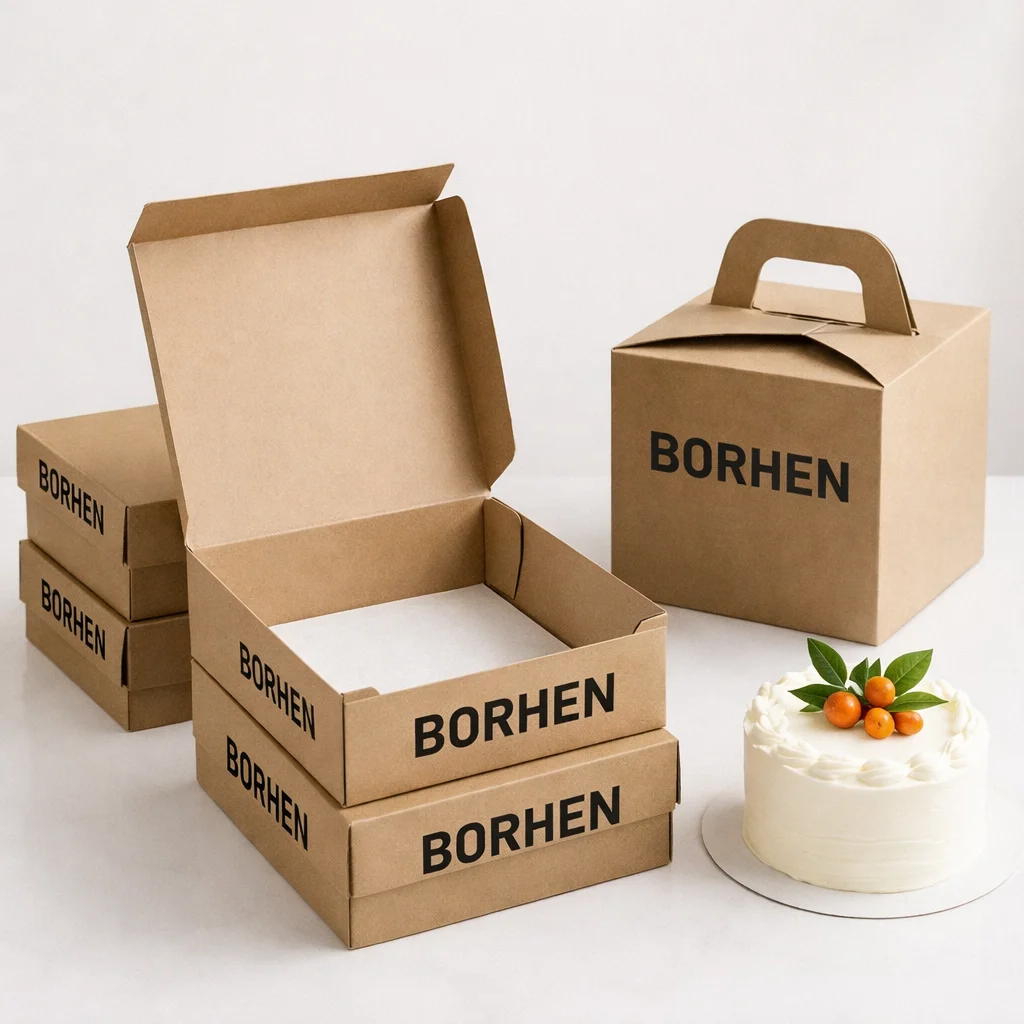
Your Trusted Custom Cake Packaging Boxes Manufacturer

You get custom Custom Cake Packaging Boxes that are built to perform at scale — with consistent structure, predictable quality, and stable repeat production, so your Cake programs move forward without delays, rework, or supply-chain surprises.

Custom Cake Packaging Boxes

At Borhen Pack, we understand that great cake packaging isn’t just about holding a cake — it’s about protecting the product, maintaining presentation, and delivering a consistent brand experience from production to the final handoff. The box strength, the internal fit, grease resistance, ventilation, and how the lid closes all directly affect whether your cakes arrive intact and look the way they should. That’s why we approach custom cake packaging boxes from a practical, production-ready perspective, not just a visual one.
 
We work with cake brands, bakery chains, food packaging distributors, and corporate event suppliers who need packaging that performs reliably at scale. From folding cake boxes for daily retail use, to rigid cake boxes for gifting and events, window boxes for display, and FSC-certified options for regulated markets, we manufacture cake packaging that fits real business scenarios. We study cake sizes, transport conditions, food safety requirements, and order volumes — so the packaging we produce is not only well-designed, but stable, repeatable, and easy to reorder.
 
As your manufacturing partner, we don’t just “print cake boxes.” We help you turn your packaging requirements into a solution that can be produced consistently, shipped efficiently, and scaled without risk. Whether you’re standardizing packaging for multiple bakery locations, managing bulk orders for seasonal campaigns, or sourcing custom cake boxes for export markets, we guide you through materials, structures, inserts, and production details — so your cake packaging protects your products, supports your operations, and grows with your business.

Standard Folding Cake Boxes (Bulk & Chain Use)

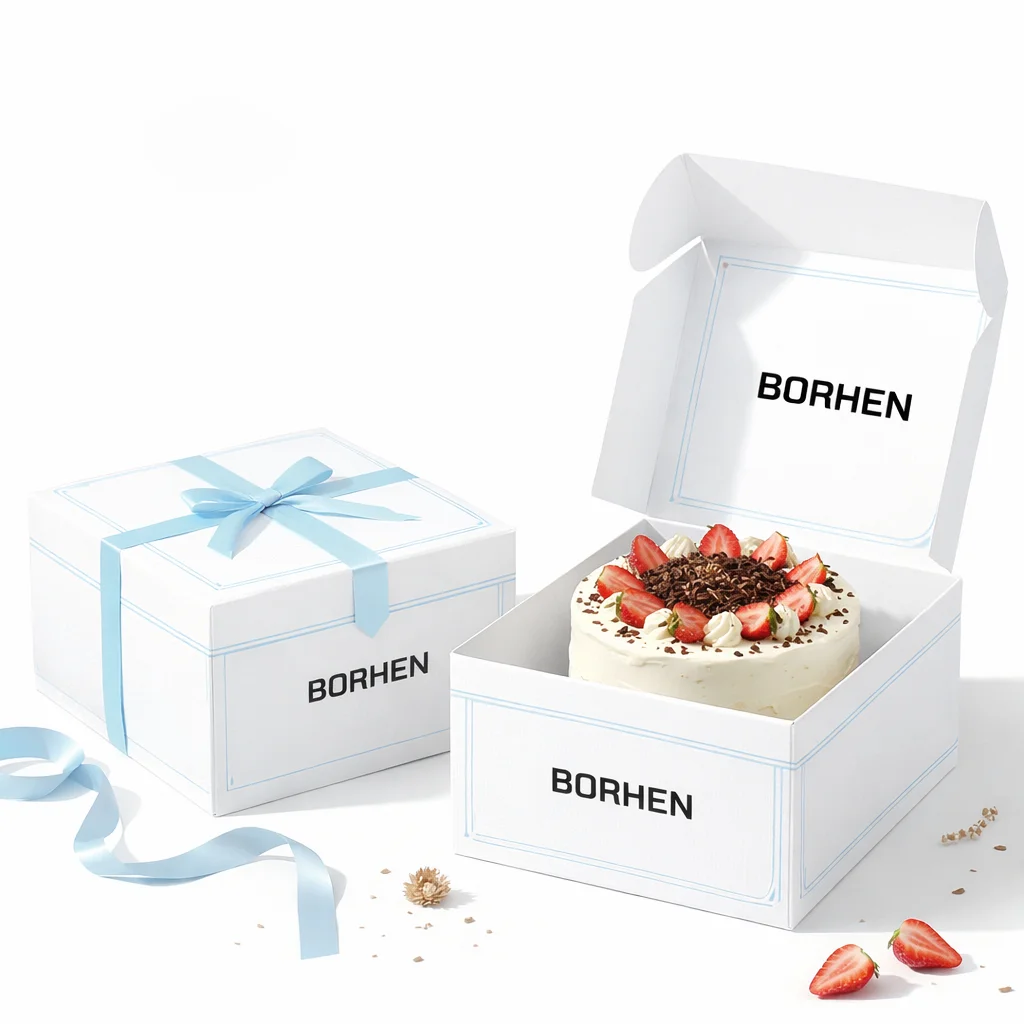
Rigid Cake Boxes for Gifting & Events

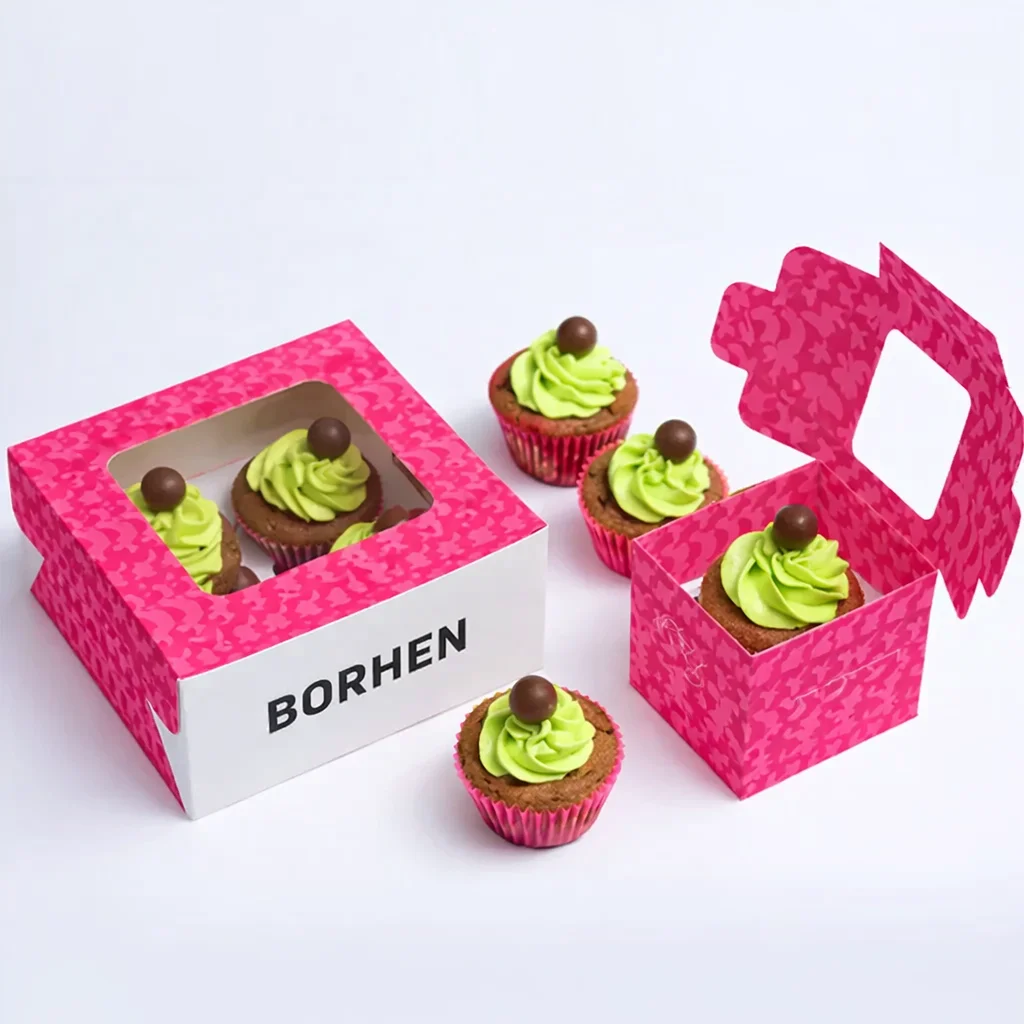
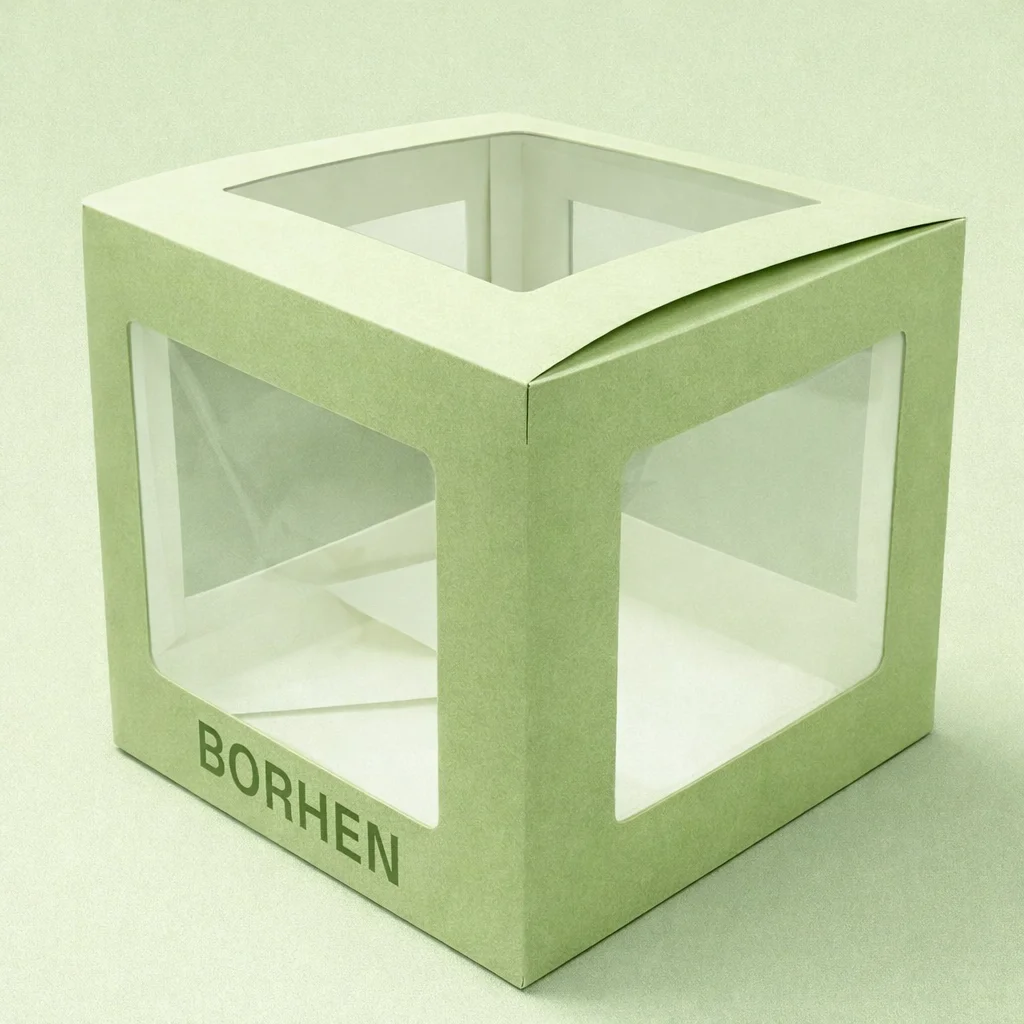
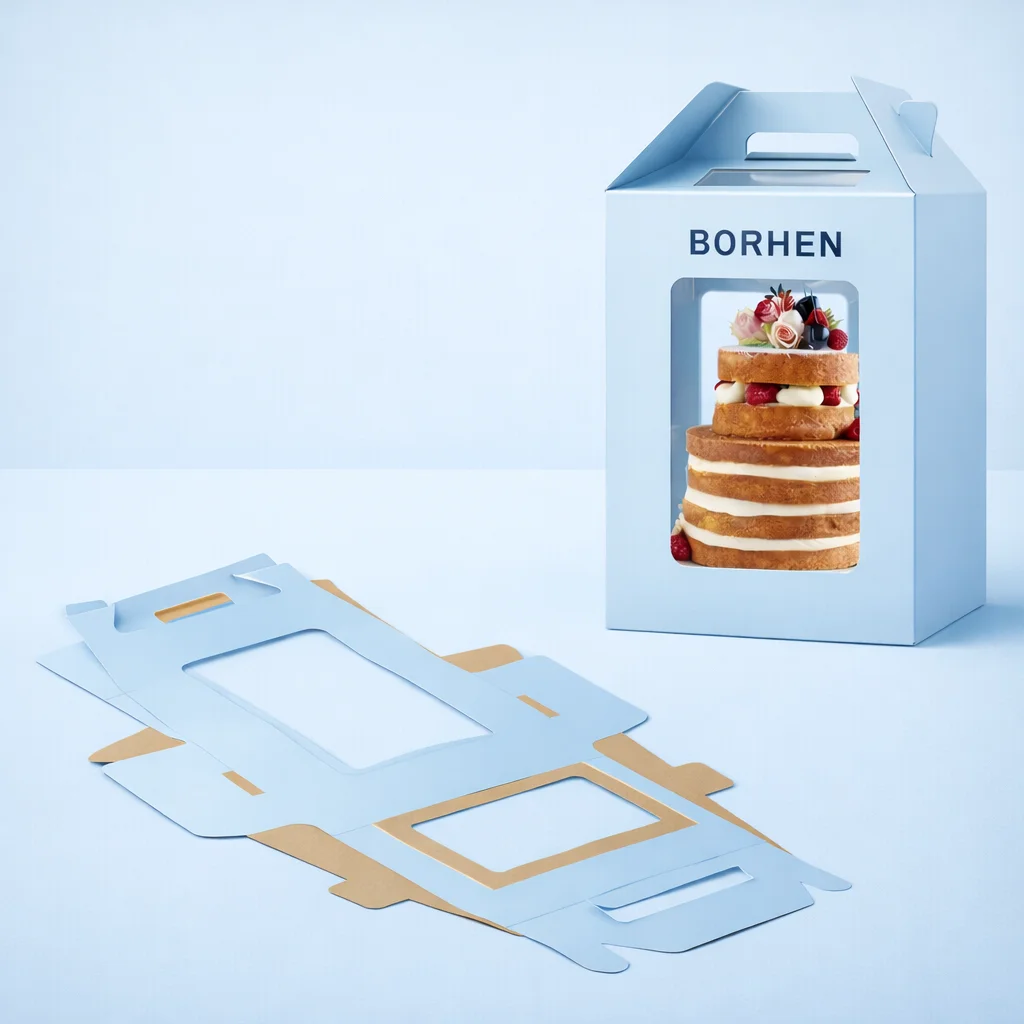
Window Cake Boxes

Custom Size & Shape Cake Boxes

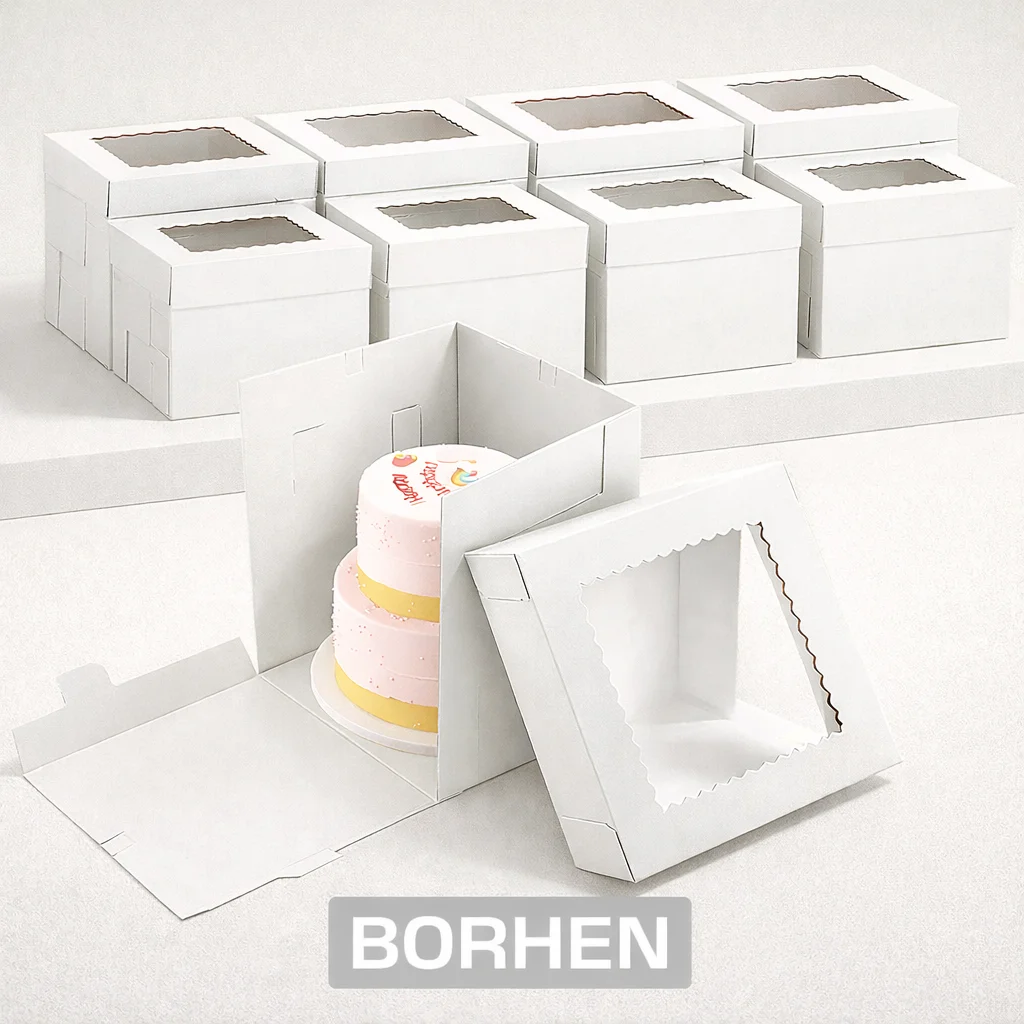
Multi-Tier & Large Cake Packaging

Eco-Friendly & FSC-Certified Cake Packaging

Cake Packaging with Inserts & Protection Systems

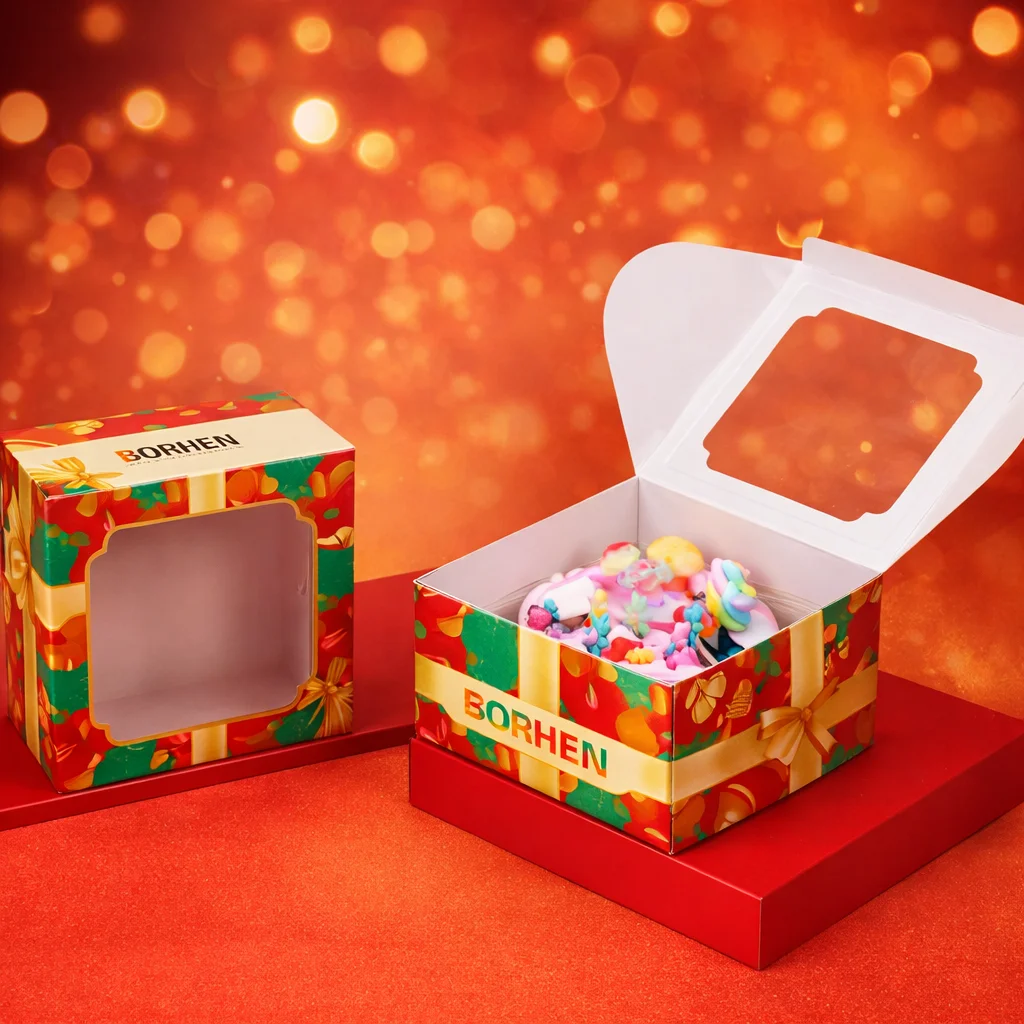
Branded & Printed Cake Packaging (Scale Branding)

Build Custom Cake Packaging Boxes That Supports Your Operations — Not Just Your Cakes

At Borhen Pack, we don’t see custom cake packaging boxes as simple boxes. For bakery brands, distributors, and large-scale cake programs, packaging is part of execution — it directly affects product protection, transport stability, food safety, and how smoothly your daily or seasonal operations run. Box strength, size accuracy, grease resistance, ventilation, insert fit, and repeatability all matter when you’re handling volume, multiple cake sizes, and fixed delivery timelines. That’s why we manufacture custom cake packaging boxes based on real production, logistics, and distribution logic, not just visual ideas.
 
We work with cake brand owners, bakery chains, food packaging distributors, and corporate event suppliers who need packaging that performs consistently across repeat orders. Whether you’re standardizing cake boxes for multiple retail locations, preparing bulk packaging for festive or promotional programs, or supplying cake packaging to overseas markets, we help you turn specifications into packaging that can be produced reliably at scale. Our focus stays on structural stability, size consistency, food-grade materials, and lead-time control — so what’s approved during sampling is exactly what arrives in mass production.
We also make sure your cake packaging is production-ready and export-friendly. From material selection and internal protection to carton strength and packing efficiency, we help reduce transport risk and avoid last-minute adjustments. Whether your cakes are distributed through bakery chains, wholesale channels, or large event projects, our goal is simple: cake packaging that stays stable, repeatable, and easy to reorder as your business grows.
 
Our Most In-Demand Custom Cake Packaging Boxes Types
1️⃣ Standard Folding Cake Boxes (Bulk & Chain Use) Built for daily retail use, efficient storage, and consistent performance across high-volume bakery operations.
2️⃣ Rigid Cake Boxes for Gifting & Events Premium structures designed for corporate gifting, celebrations, and high-value cake presentations.
3️⃣ Window Cake Boxes Display-focused boxes that showcase cakes clearly while maintaining hygiene and structural stability.
4️⃣ Custom Size & Shape Cake Boxes Engineered for non-standard cake dimensions, signature products, and seasonal designs.
5️⃣ Multi-Tier & Large Cake Packaging Reinforced structures developed for wedding cakes, celebration cakes, and large event orders.
6️⃣ Eco-Friendly & FSC-Certified Cake Packaging Food-safe, compliant solutions designed for EU, UK, and sustainability-driven markets.
7️⃣ Cake Packaging with Inserts & Protection Systems Custom inserts and reinforced bases that minimize movement and damage during transport.
8️⃣ Branded & Printed Cake Packaging (Scale Branding) Tailored structures for complex requirements, bundled products, or project-specific programs.
 
MOQ & Customization Options
(Built for Scalable Cake Packaging Programs)
At Borhen Pack, we keep cake packaging projects practical, structured, and scalable.
Production MOQ
Most custom cake packaging boxes starts from 500 pieces, depending on box structure and materials.
Fully Customized Printing & Materials
Custom branding, specialty finishes, and material upgrades typically begin from 500 pieces.
Customization Options Available
  • Box structures: folding cake boxes, rigid boxes, window boxes, reinforced transport boxes
  • Insert solutions: paperboard inserts, molded pulp supports, reinforced bases
  • Branding finishes: hot stamping, embossing, debossing, UV
  • Materials: food-grade paperboard, grease-resistant liners, FSC-certified options
Included Project Support
Every project includes structural recommendations, size fitting guidance, material selection support, sampling coordination, and production consistency checks — so your cake packaging protects your products, stays consistent across orders, and scales smoothly without disrupting your supply chain.

More Than Just a Custom Cake Packaging Boxes Manufacturer

At Borhen Pack, we don’t just manufacture custom cake packaging boxes — we help you keep cake programs running smoothly. For large orders and repeat projects, cake packaging isn’t only about looks. It affects product protection, food safety, transport stability, delivery timelines, and how confidently you can reorder. Every folding cake box, rigid cake box, window box, and protective insert we produce is designed to support stable execution at scale, not just a one-time order.

✅Packaging Built for How Cake Programs Actually Run

We design custom cake packaging boxes based on how cakes are produced, transported, displayed, and delivered in real markets. By working closely with cake brands, bakery chains, food packaging distributors, and event suppliers, we understand the pressure behind large cake programs — multiple cake sizes, daily turnover, fixed schedules, hygiene requirements, and repeat orders. From structures that stack and ship efficiently, to grease-resistant materials, to precise size fitting that prevents movement, we focus on packaging that performs the same way every time. The goal is simple: cake packaging that doesn’t create problems when volume increases.

✅ MOQs That Support Programs, Not Just Trials

We keep cake packaging practical for businesses that need to move forward. Most custom cake packaging boxes projects start from 500 pieces, allowing you to standardize packaging without locking in excessive inventory. As volumes grow, scaling from 500+ pieces with fully customized materials, printing, and finishes is straightforward — without changing suppliers or reworking structures. This makes it easier to support new store openings, seasonal demand, and long-term supply planning without disruption.

✅ Consistency You Can Rely on Across Repeat Orders

For cake packaging, consistency is as important as design.
We manage materials, size tolerances, structural strength, and finishing details so the packaging you approve during sampling is exactly what you receive in every production run. This reduces damage risk, avoids quality disputes, and allows you to reorder with confidence as volumes grow, product ranges expand, or markets change.

✅ Export-Ready Production for Global Cake Distribution

We manufacture custom cake packaging boxes with cross-border distribution in mind.
From board strength and box durability to packing methods and shipping efficiency, we help you avoid common issues that lead to delays, damage, or unexpected costs. Whether your cake packaging is supplied to Europe, the Middle East, or other international markets, our focus stays the same: packaging that travels well, ships efficiently, and arrives exactly as planned.

Build Custom Cake Packaging Boxes That Supports Scale — Not Just Designa

When you work with Borhen Pack, you’re not just choosing a custom cake packaging boxes manufacturer — you’re partnering with a team that understands how packaging impacts large cake programs. For bakery chains, distributors, and procurement teams, the box is never an afterthought. It affects cake protection, food safety, transport stability, delivery efficiency, and how confidently you can reorder. We help turn cake packaging requirements into boxes that are structurally reliable, visually consistent, and ready for real-world distribution. Our focus is simple: keep operations running smoothly, protect the product, and maintain consistency as volumes grow.
 
Whether you’re standardizing cake packaging across multiple sizes, upgrading from generic stock boxes, or preparing packaging for retail, gifting, or seasonal programs, we design every cake box with execution in mind. From folding cake boxes and rigid gift boxes to window designs and custom inserts, our packaging is built to hold cakes securely, close properly, and maintain a clean, professional presentation — the level bakery buyers and partners expect from established brands.
 
🧱 Structures Designed for Real Cake Distribution Conditions
We don’t believe in one-size-fits-all cake packaging.
Every custom cake box starts with how the cake is packed, stacked, transported, displayed, and handed over. We work from proven structures and adapt them to your requirements — adjusting dimensions, lid styles, ventilation, inserts, and materials to reduce movement, prevent damage, and improve packing efficiency.
We guide you through options such as reinforced bases, paperboard or molded pulp supports, grease-resistant liners, and plastic-free alternatives, helping you balance protection, cost control, and presentation. If there’s a smarter way to improve fit, simplify assembly, or strengthen durability, we explain it clearly and help you decide. This practical approach ensures your cake packaging performs reliably across repeat orders — not just the first run.
 
📦 Packaging That Scales With Your Cake Programs
We believe cake packaging should be easy to standardize and simple to scale. Most projects begin from 500 pieces, allowing you to consolidate packaging without overcommitting inventory. As volumes increase, scaling from 500+ pieces with fully customized materials, finishes, colors, and branding is straightforward — without changing suppliers or redesigning structures.
Packaging Notes
  • Standard custom cake packaging boxes: from 500 pcs
  • Fully customized materials, printing, or finishes: typically from 500+ pcs
  • Inserts and protection systems: matched to cake size, weight, and transport needs
We coordinate box structures, inserts, printing, and outer cartons so your cake packaging remains consistent, retail-ready, and easy to reorder across different locations, programs, and timelines.
 
⚙️ A Production Process Built for Reliability
Everything runs through a clear, coordinated workflow — from structure confirmation and sampling to material approval, mass production, and quality checks. We communicate openly, flag potential risks early, and keep timelines realistic. Many clients work with us long-term because we help them avoid common packaging issues that lead to delays, damaged products, or last-minute adjustments. Over time, we become less of a vendor and more of a dependable extension of their supply chain.
 
🌿 Built for Long-Term Cake Programs, Not One-Off Orders
We measure success by how smoothly your cake packaging performs over time.
That’s why we focus on stable structures, repeatable materials, practical MOQs, and production consistency that supports long-term planning. Whether your cakes are supplied to retail chains, wholesale partners, or international markets, we help you build cake packaging that stays consistent, scalable, and dependable.
With Borhen Pack, your custom cake packaging boxes is designed to execute reliably, reorder smoothly, and support growth — not just for one shipment, but for the long run.

Who We Work With (And Why They Choose Us)

We work with scalable buyers who manage multi-SKU programs, multiple markets, or time-sensitive cake launches — and need packaging that stays stable across repeat orders, shipping routes, and changing timelines.

For Regional Distributors & Master Agents

You’re supplying multiple markets and channels — and packaging consistency directly affects your downstream partners.
We help you standardize cake packaging boxes without losing flexibility across SKUs and destinations.

  • Repeatable structures and specs across markets

  • Carton optimization to reduce shipping waste and damage

  • Stable materials and controlled reorders for long-term programs

💡 Why it works: fewer variations, fewer disputes, and smoother multi-country execution.

For Trading Companies & Product Integrators

You coordinate brands, factories, and timelines — often across several SKUs at once.
We make packaging coordination easier by turning requirements into production-ready specs that can scale.

  • Clear dielines, tolerances, and production-friendly artwork checks

  • Insert and structure matching for mixed cake sets and accessories

  • Documentation-ready workflow for export and client approvals

💡 Why it works: less back-and-forth, faster approvals, and fewer “sample vs. mass” surprises.

For Campaign Buyers & License Holders

Your project has a deadline — and packaging delays can kill the whole program.
We focus on proven structures, realistic timelines, and early risk control to protect launch windows.

  • Fast sampling with structured decision checkpoints

  • Controlled materials/finishes to avoid late-stage changes

  • Production planning built for seasonal and promotional timing

💡 Why it works: higher first-time-right execution and fewer last-minute reworks under pressure.

FAQs Custom Cake Packaging Boxes

For your convenience, we’ve gathered the most commonly asked questions about our Custom Cake Packaging Boxes. However, should you have any further queries, please don’t hesitate to reach out to us.
1. What types of custom cake packaging boxes can you manufacture?
We manufacture a full range of custom cake packaging boxes, including folding cake boxes, rigid cake boxes, window boxes, multi-tier cake packaging, large celebration cake boxes, and protective transport boxes. We also design custom bases and inserts to support different cake sizes and weights. Whether you’re supplying daily retail cakes or large event orders, we build packaging that works at scale.
Yes — this is one of the most important parts of our role.
We don’t expect you to be a packaging expert. We help you choose the right structure based on cake size, weight, transport distance, display needs, and cost. Our goal is to make sure the cake stays stable, protected, and presentable from bakery to customer.
Most custom cake packaging boxes projects start from 500 pieces, depending on the structure and materials. For fully customized printing, specialty materials, or premium finishes, the MOQ is usually 500+ pieces. We always explain these numbers clearly and help you choose a practical starting point.
Yes, and many of our long-term clients do exactly that.
We design cake box structures that can scale smoothly, so when you reorder at higher volumes, you don’t need to redesign packaging or change suppliers. This makes it easier to support new store openings, seasonal peaks, or expanded distribution.
Sampling usually takes 2–3 weeks, depending on box structure and materials. Mass production typically takes 20–30 days after sample approval. If you’re working toward a launch date, holiday season, or fixed event timeline, we plan the schedule with you early and keep it realistic.
Yes. We support Pantone color matching and a range of printing and finishing options, including spot UV, embossing, debossing, and hot stamping. All colors and finishes are confirmed during sampling to ensure consistency before mass production begins.
Yes. We use food-grade materials and offer FSC-certified paper, recyclable options, grease-resistant liners, and plastic-free designs. If sustainability or regulatory compliance is important for your market, we help you balance safety, durability, and cost.
Yes. We design cake packaging with transport in mind.
That includes box strength, reinforced bases, internal stability, outer carton packing, and volume efficiency. Whether cakes are delivered locally or shipped internationally, we focus on reducing movement, damage, and handling issues.
Yes. We work with both design agencies and brand owners. If you already have artwork, we review it to ensure it’s suitable for production. If adjustments are needed for dielines, sizing, or printing, we guide you so the final packaging matches your design intent.
Yes. We work with clients worldwide and are familiar with export workflows. We support export-ready packaging, documentation coordination, and international shipping arrangements. Whether you’re a brand owner, distributor, or sourcing agent, we help keep the process clear, stable, and predictable.

Borhen Pack in Numbers

Happy Clients
0 +
Million-dollar Buyers
0 +
Formulation
0 +
Professional Staffs
0 +

Your Ultimate Guide to Custom Cake Packaging Boxes

If you’re planning to develop or upgrade cake packaging for your business—whether it’s for a growing bakery chain, a corporate gifting program, or seasonal production—you’re not just choosing a box. You’re making decisions that affect product safety, logistics efficiency, brand perception, and how confidently your operation can scale. Cake packaging sits at the intersection of food protection, presentation, and execution, and small misjudgments often become expensive once volume increases.
 
We’ve seen cake packaging evolve far beyond simple takeaway boxes. Over the years, we’ve worked with brand owners standardizing packaging across multiple SKUs, importers managing long-distance distribution, corporate and event suppliers operating under fixed deadlines, and sourcing teams balancing cost, consistency, and compliance. In every case, cake packaging proves to be more complex than it appears on the surface. What works for small batches often fails under scale, and what looks good in samples doesn’t always survive real-world handling.
 
This guide is built from what we’ve learned behind the scenes—how cake packaging behaves in real operations, what problems it’s expected to solve at scale, and why structure, materials, and process matter more than most buyers expect. In the sections that follow, we’ll walk through how distribution models change packaging requirements, how to standardize packaging across products and locations, what trends actually matter to B2B buyers in 2026, and how to evaluate packaging decisions with long-term supply in mind. Whether you’re managing daily production or planning high-stakes programs, this guide is designed to help you make packaging choices that hold up in real use, not just on paper.

Table of Contents

What Business Problems Cake Packaging Is Expected to Solve at Scale

When cake production scales, human behavior becomes less predictable, not more disciplined. I’ve seen teams assume that training or SOPs will compensate for packaging weaknesses, but in reality, packaging must compensate for human inconsistency. At scale, cakes are packed by different people, across different shifts, often under time pressure. If a box only works when it is assembled perfectly, it will fail in real operations. One of the core business problems cake packaging must solve is absorbing small mistakes without amplifying them. A forgiving structure, stable base, and tolerant fit protect the business from the reality of imperfect execution.
 
Packaging Must Convert Physical Stability into Operational Confidence
At small volume, teams rely on vigilance to maintain quality. At scale, vigilance is replaced by trust in systems. I’ve watched operations slow down not because packaging was failing, but because teams no longer trusted it. When boxes occasionally collapse, tilt, or arrive damaged, staff begin double-checking, adjusting, and compensating. That hesitation spreads quickly. Packaging at scale must remove doubt. It needs to behave so consistently that teams stop thinking about it. Operational confidence is a business asset, and reliable packaging is one of the fastest ways to build or destroy it.
 
Packaging Must Protect the Product Across Time, Not Just Distance
Most people think about packaging in terms of transport, but at scale, time is often a bigger enemy than distance. I’ve seen cake packaging that survived delivery but failed hours later while sitting in storage, vehicles, or display areas. Grease migration, humidity buildup, and slow material fatigue are rarely visible during short tests. At scale, cakes may wait longer than planned due to delays, scheduling changes, or uneven demand. Packaging must maintain structure, cleanliness, and appearance over extended periods, because time exposure becomes unavoidable as volume increases.
 
Packaging Must Turn Variability into a Controlled Range
In theory, cakes are uniform. In practice, they never are. I’ve worked with production teams where cake height varied slightly depending on baking conditions, decoration thickness changed with design trends, and moisture levels shifted seasonally. At small scale, staff adjust instinctively. At scale, those adjustments become costly. Packaging must be designed to handle a realistic range of product variation without slowing operations. One of the most important business problems packaging solves is allowing variability without forcing intervention. When packaging only works for a perfect product, it is not scalable.
 
Packaging Must Reduce Decision-Making on the Production Floor
As volume grows, decision-making becomes friction. I’ve seen packing teams hesitate because they are unsure which box version to use, how much adjustment is acceptable, or whether a slightly different cake still fits the approved packaging. At scale, packaging should remove questions, not create them. Clear structure, consistent dimensions, and predictable behavior reduce the cognitive load on teams. This matters more than it sounds. When hundreds of small decisions disappear, throughput improves naturally without additional management effort.
 
Packaging Must Translate Design Intent into Repeatable Reality
Design approval often creates a false sense of completion. I’ve seen beautifully approved samples fail to translate into stable mass production because the design relied on tight tolerances or material behaviors that were difficult to repeat. At scale, packaging must bridge the gap between intention and reality. The business problem here is not creativity, but repeatability. Packaging must be designed so that what is approved once can be produced again and again without constant intervention, reinterpretation, or compromise.
 
Packaging Must Stabilize Cost Instead of Creating Cost Surprises
At scale, unpredictability is more damaging than high cost. I’ve seen businesses plan around a low unit price, only to absorb hidden expenses through increased labor, higher damage rates, excess shipping volume, or emergency reorders. Packaging must solve the business problem of cost stability. When packaging behaves consistently, businesses can forecast more accurately, negotiate logistics more confidently, and protect margins over time. Cost control at scale is about predictability, not just savings.
 
Packaging Must Survive the Parts of the Journey Nobody Controls
No matter how well operations are planned, parts of the supply chain remain uncontrollable. I’ve seen cake packaging handled roughly by third-party couriers, stacked incorrectly during peak periods, or delayed in environments it was never designed for. At scale, these scenarios are not exceptions; they are statistically guaranteed. Packaging must assume exposure to stress, not hope to avoid it. One of the most important business problems packaging solves is reducing dependence on perfect conditions that rarely exist outside small batches.
 
Packaging Must Enable Growth Without Triggering Structural Change
Growth exposes weaknesses that stability hides. I’ve worked with companies whose packaging worked well until volume doubled, then suddenly required redesign, new tooling, or different materials. Each change disrupted operations and slowed momentum. Packaging at scale must be designed with growth in mind, allowing increases in volume, additional SKUs, or wider distribution without forcing fundamental changes. The business problem here is continuity. Packaging should support growth quietly, not demand attention every time the business evolves.
 
Packaging Must Function as Silent Infrastructure
At a certain point, cake packaging stops being noticed, and that is exactly when it is working best. I’ve learned that the most successful packaging systems are the ones teams forget about because they no longer cause problems. At scale, packaging is infrastructure. It connects production, logistics, storage, and delivery into a single flow. When packaging solves its core business problems effectively, it disappears from daily conversation, allowing teams to focus on growth rather than correction.
 
Why These Problems Define Success More Than Visual Design Ever Will
Over time, I’ve come to see cake packaging not as a design challenge, but as a systems challenge. The businesses that scale smoothly are not the ones with the most decorative boxes, but the ones whose packaging quietly absorbs pressure, variability, and growth. When packaging is designed to solve real business problems rather than aesthetic ones, it becomes a stabilizing force. At scale, that stability is not optional. It is the foundation that everything else relies on.


Why Cake Packaging That Works for Small Batches Often Fails at High Volume

When I look at cake packaging that performs well in small batches, I rarely see a truly validated system. What I see instead is packaging operating in a protected environment. Early runs are usually packed by experienced staff, handled with extra care, and delivered over short distances. Under these conditions, packaging flaws remain invisible. Slight oversizing, marginal base strength, or forgiving closures do not immediately cause damage. Once volume increases, those same design compromises are repeated hundreds or thousands of times, and the margin for error disappears. What felt “good enough” in small quantities becomes structurally inadequate when exposed to real operational pressure.
 
Human Handling Becomes a Variable You Can No Longer Control
At low volume, packaging benefits from familiarity. The same people assemble it, the same hands carry it, and the same assumptions are repeated daily. At high volume, that consistency breaks down. I’ve watched packaging that depended on careful folding or precise alignment fail as soon as multiple shifts, temporary staff, or outsourced logistics teams entered the process. High-volume operations introduce unpredictable handling styles, speed pressure, and fatigue. Packaging that only works when treated correctly will fail once it meets the reality of scale, where perfection is replaced by repetition.
 
Transport Turns from a Short Journey into Sustained Stress
Small-batch deliveries are usually local, fast, and forgiving. High-volume distribution stretches packaging across longer routes, longer storage times, and repeated handling. I’ve worked on cake packaging that passed all initial evaluations, only to deform after hours of vibration in delivery vehicles or prolonged stacking in warehouses. Board strength that felt sufficient during testing softened under cumulative load. Closures that felt secure during short trips loosened over longer routes. Scale transforms transport from a momentary challenge into sustained stress, and packaging that was not designed for endurance begins to fail quietly and consistently.
 
Assembly Effort Becomes an Invisible Cost Multiplier
One of the most underestimated failures at scale comes from assembly effort. In small batches, teams adjust naturally. They take an extra second, fix a misfold, or realign a base without thinking twice. At high volume, those seconds turn into hours, and those hours turn into cost. I’ve seen cake packaging designs that required only slight adjustment per unit reduce output significantly once scaled. Assembly effort that feels acceptable at small scale becomes a financial liability when thousands of units are involved. At volume, packaging must assemble correctly by default, not by attention.
 
Materials Reveal Their Weaknesses Over Time, Not Instantly
Material performance often looks acceptable during early tests because exposure is short. In small batches, cakes are packed, delivered, and consumed quickly. At high volume, packaging may sit in storage, delivery vehicles, or retail displays for extended periods. I’ve encountered cake boxes that technically met food-grade requirements but softened as grease migrated into untreated board or moisture accumulated inside enclosed structures. These changes rarely appear in short trials but become unavoidable at scale. High-volume packaging must be designed for prolonged exposure, not just initial contact.
 
Minor Variations Turn into Major Disruptions
Small production runs benefit from tight oversight. Adjustments are made quickly, and variations are corrected before they spread. At high volume, production becomes standardized, and small variations are harder to contain. I’ve seen cake packaging drift gradually in size, stiffness, or finish between batches, creating confusion on packing lines that had been optimized for earlier runs. These differences may seem insignificant individually, but at scale they disrupt workflows, force retraining, and erode confidence. Packaging that works at volume must tolerate variation without breaking systems.
 
Complexity Becomes Exponential Once Volume Increases
Complexity that feels manageable at small scale becomes a liability at high volume. Multiple box sizes, insert versions, or assembly steps multiply the chance of error with every additional unit. I’ve worked with teams who were comfortable managing complexity at low volume and completely overwhelmed once orders increased. At scale, packaging should reduce decision-making, not add to it. Designs that require constant checking or sorting fail not because they are wrong, but because they ask too much from systems under pressure.
 
Quality Control Shifts from Catching Errors to Preventing Them
In small batches, quality control relies heavily on inspection. Someone notices a problem and fixes it. At high volume, inspection becomes reactive rather than protective. I’ve seen packaging issues discovered only after thousands of units were already packed or shipped. At scale, packaging must be designed so that errors are difficult to make in the first place. Structure, tolerance, and material choice should guide correct behavior automatically, because there is no time to correct mistakes after they spread.
 
Scale Demands a Different Way of Thinking About Packaging
What ultimately separates packaging that fails at volume from packaging that succeeds is mindset. Small-batch packaging is often designed for appearance and ideal conditions. High-volume packaging must assume pressure, inconsistency, and imperfect execution. Over the years, I’ve learned that designing for scale means sacrificing unnecessary refinement in favor of tolerance, repeatability, and resilience. When cake packaging is built to survive repetition rather than perfection, it stops failing silently and starts supporting growth.

What Must Be Defined Before Designing Cake Packaging for Mass Production

Before any design discussion begins, I always clarify the operational role the cake packaging is expected to play. Packaging for mass production is not a neutral container; it becomes part of the production system itself. Is the box primarily supporting fast daily turnover, protecting cakes during long delivery routes, maintaining presentation during extended display, or handling high stacking pressure in distribution? When this role is not clearly defined, design decisions become contradictory. I’ve seen packaging that tried to serve retail display, delivery protection, and premium presentation all at once, only to fail at scale because it was not optimized for any single purpose. Defining the operational role early ensures that design choices support execution rather than compromise it.
 
Acceptable Cake Size Variation Must Be Measured, Not Assumed
One of the most common gaps before mass production is misunderstanding cake size variation. On paper, cakes appear to have fixed dimensions, but in real production, height, diameter, and decoration thickness often vary slightly from batch to batch. I’ve seen packaging designed to tight tolerances work perfectly on sample cakes but create constant friction on packing lines once real production began. Before designing packaging, it is essential to define the full range of acceptable size variation and design tolerance into the structure. At scale, packaging must accommodate reality without forcing staff to slow down or adjust each unit manually.
 
True Weight and Load Behavior Must Be Accounted for Early
Cake weight is often underestimated, especially when decorations, fillings, or moisture content vary. I’ve worked on mass production projects where boxes passed early handling tests but failed once stacked in volume because the base was not designed to distribute load evenly. Before design begins, the actual weight of the cake in real conditions must be understood, including how that weight behaves when boxes are stacked or transported. Packaging that does not account for cumulative load may deform gradually, creating damage that only appears after hours or days in the supply chain.
 
Assembly Reality Must Be Defined, Not Idealized
Designing packaging without understanding how it will be assembled in real operations is a frequent cause of failure at scale. I always define who will assemble the packaging, under what time pressure, and with what level of training. In mass production environments, packaging is rarely assembled slowly or carefully. If a design requires precise folding, alignment, or repeated adjustment, it becomes a bottleneck. Before design begins, acceptable assembly time and tolerance for error must be defined so the packaging supports throughput instead of undermining it.
 
Storage Conditions Shape Packaging Performance Over Time
Before mass production, packaging design must account for where and how boxes will be stored, not just how they look when assembled. I’ve seen packaging that performed well individually but created serious problems when thousands of flat boxes were stored in limited space. Flat-pack thickness, stacking stability, and long-term storage behavior all affect operational efficiency. When storage conditions are not defined early, packaging may consume unnecessary space or suffer deformation before it is even used.
 
Distribution Path Must Be Mapped in Detail
Packaging that works for local delivery may fail completely in wholesale or cross-border distribution. Before design starts, I always map the full distribution path, including how many times the packaging will be handled, how long it will remain in transit, and what environmental conditions it will face. Local delivery, regional distribution, and international shipping impose very different stresses on packaging. Without a clear understanding of these conditions, packaging design is based on assumptions that often collapse under real transport pressure.
 
Material Behavior Over Time Must Be Anticipated
Food safety and material performance cannot be separated in mass production. Before design begins, it is essential to define how long cakes may remain inside the packaging, under what temperature and humidity conditions, and whether grease or moisture exposure is continuous or intermittent. I’ve seen packaging that met food-grade requirements fail because materials softened, warped, or absorbed grease over time. At scale, packaging must maintain integrity not just at packing, but throughout storage, transport, and display.
 
The Desired Level of Standardization Must Be Decided Early
One of the most strategic definitions before mass production is how standardized the packaging system needs to be. I often see teams design fully customized packaging for each product, only to struggle with complexity once volume increases. Deciding early whether packaging should be shared across SKUs, locations, or markets shapes structure, sizing, and material choices. Standardization does not eliminate flexibility, but it prevents uncontrolled variation that becomes difficult to manage at scale.
 
Reorder Frequency and Consistency Expectations Must Be Clear
Packaging designed for mass production should never be treated as a one-time effort. Before design begins, I define how often the packaging will be reordered and how identical each reorder must be. Some designs are feasible once but difficult to reproduce consistently due to tight tolerances or material sensitivity. At scale, packaging must be designed for repeatability so that future orders behave exactly like the approved sample. This consistency allows operations to run without constant recalibration.
 
Growth Scenarios Must Be Considered Before Finalizing the Design
The most overlooked definition before mass production is how the business may grow. I always ask what happens if volume doubles, if new cake sizes are introduced, or if distribution expands to new regions. Packaging that cannot adapt to growth forces redesign cycles that interrupt operations and increase cost. Defining realistic growth scenarios early allows packaging to be designed with flexibility, protecting the business from avoidable disruption later.
 
Why Clear Definitions Matter More Than Perfect Design
Over time, I’ve learned that most mass production packaging failures are not caused by poor design execution, but by missing definitions at the start. When operational goals, tolerances, constraints, and growth expectations are clearly defined, packaging decisions become simpler and more resilient. Mass production packaging succeeds not because it is flawless, but because it is grounded in reality from the beginning.

How Distribution Models Change Cake Packaging Requirements

When I look back at most cake packaging failures, they rarely come from poor materials or careless production. They come from misunderstanding distribution. Packaging is often designed in isolation, as if it exists only at the moment of packing. In reality, distribution is the environment the packaging must survive in for most of its life. Once scale increases, packaging spends far more time being moved, stacked, stored, and handled than it does being assembled. If the distribution model is not clearly defined before design begins, packaging decisions are made on assumptions that will eventually be exposed.
 
Retail Distribution Turns Packaging into a Long-Term Visual and Structural Commitment
Retail distribution places a unique kind of pressure on cake packaging because the box must perform over time, not just during delivery. I’ve seen retail packaging that looked perfect on day one slowly lose shape after repeated handling by store staff and customers. Cakes are repositioned, shelves are restocked, and boxes are pushed against each other in ways that were never simulated during testing. Even slight inconsistencies in height or wall rigidity become obvious when dozens of units sit side by side. In retail, packaging is judged continuously, and small structural weaknesses quietly undermine perceived quality long after delivery is complete.
 
Wholesale Distribution Forces Packaging to Become Part of the Logistics System
Wholesale distribution shifts the role of packaging almost entirely away from presentation and toward efficiency. In these environments, cakes move in bulk through pallets, racks, and warehouses where speed and space matter more than appearance. I’ve seen packaging designed with decorative elements or oversized dimensions create hidden inefficiencies once forklifts and conveyors entered the picture. Boxes that stack poorly or require extra handling steps slow down operations in ways that are difficult to quantify but impossible to ignore. In wholesale distribution, packaging must integrate smoothly into logistics flows, because any friction is multiplied by volume.
 
Cross-Border Distribution Tests Packaging Over Time, Not Distance
Cross-border distribution is where packaging is truly tested. Once cakes enter international transit, there is no opportunity to correct mistakes. I’ve worked on projects where packaging performed flawlessly in local delivery but failed during long ocean shipments due to humidity exposure, vibration, or sustained stacking pressure. Materials that felt rigid during sampling softened after weeks in transit, and closures that seemed secure loosened under constant motion. In export models, packaging must endure uncertainty for extended periods. Time, not distance, becomes the most punishing variable.
 
Direct-to-Consumer Delivery Exposes Packaging to Uncontrolled Handling
Direct-to-consumer distribution introduces a different type of risk because cakes are handled individually rather than in controlled batches. I’ve seen packaging that worked well in bulk delivery fail when subjected to repeated lifting, tilting, and last-mile vibration. Couriers are focused on speed, not delicacy, and packaging must assume imperfect handling. The end customer also becomes the final judge, noticing even minor deformation, grease marks, or instability. In DTC models, packaging must protect the product while maintaining appearance under conditions that are far less predictable than traditional channels.
 
Event-Based Distribution Leaves No Room for Recovery
Event and project-based cake distribution operates under the highest pressure because timing is fixed and unforgiving. I’ve seen entire events compromised because packaging issues delayed delivery or damaged presentation. Unlike ongoing distribution, there is no second chance. There are no reorders, no adjustments, and no margin for learning. Packaging for events must prioritize reliability over experimentation. Structures must be proven, materials must behave predictably, and assembly must be straightforward. In this model, packaging is inseparable from execution success.
 
Multi-Channel Distribution Forces Packaging to Make Trade-Offs
As businesses grow, they often distribute through multiple channels at the same time. I’ve worked with brands that tried to use a single packaging solution for retail, wholesale, online delivery, and events. The challenge is that each channel stresses packaging differently. A box optimized for retail display may be inefficient in wholesale storage, while packaging designed for shipping durability may feel excessive at point of sale. Multi-channel distribution forces packaging to make deliberate compromises. The problem is not choosing the perfect design, but choosing the most stable one across conflicting demands.
 
Distribution Frequency Changes How Packaging Is Experienced Internally
The frequency with which packaging is used changes how teams experience it. In low-frequency distribution, minor inefficiencies are tolerated. In high-frequency operations, the same inefficiencies become constant friction. I’ve seen packaging that was acceptable for occasional use become a daily source of frustration when used hundreds of times per shift. Distribution models with high turnover require packaging that supports speed, consistency, and endurance under repetition. Packaging that slows teams down becomes an operational cost even if it never fails structurally.
 
Distribution Determines How Long Packaging Must Perform Reliably
One of the most overlooked aspects of distribution is time. Some cakes are packed and consumed within hours, while others remain in packaging for days. I’ve encountered packaging that met all functional requirements at packing but degraded over time due to grease migration, moisture buildup, or material fatigue. Distribution models that involve longer storage or slower turnover require packaging that maintains structure and cleanliness well beyond initial use. Time is an invisible stress factor, and packaging must be designed to withstand it.
 
Distribution-Driven Design Reduces Risk More Than Any Material Upgrade
What I’ve learned from working across different distribution models is that most packaging failures are predictable in hindsight. They happen when packaging is designed around ideal conditions instead of real ones. When distribution realities are clearly defined and prioritized early, many downstream problems never occur. Damage rates drop, operations stabilize, and teams regain confidence. Distribution-driven packaging decisions are not about optimization for one scenario, but about risk reduction across many.
 
Packaging That Aligns with Distribution Becomes a Growth Enabler
At scale, packaging stops being a design decision and becomes a strategic one. Distribution models determine how packaging is stressed, judged, and remembered. When packaging aligns with how products actually move through the world, it becomes a quiet enabler of growth. In my experience, the most resilient cake packaging systems are not the most elaborate, but the ones designed with a deep understanding of distribution reality. They work not because they are perfect, but because they are appropriate.

Understanding Cake Packaging Structures Beyond Appearance

When I look at cake packaging failures, they almost never come from poor graphics or outdated styling. They come from structure being treated as an afterthought. Structure is the system that carries weight, absorbs pressure, tolerates variation, and connects packaging to real operations. At small scale, structure can be forgiven because people compensate manually. At high volume, structure is exposed repeatedly. Every fold, joint, and load path is tested hundreds of times a day. If the structure is not designed to support how cakes are actually packed, moved, and stacked, visual refinement becomes irrelevant very quickly.
 
Folding Structures Succeed Only When Their Load Paths Are Understood
Folding cake boxes are often assumed to be weak simply because they are collapsible, but in my experience, their success depends entirely on how load is transferred through the folds. A folding structure that channels vertical pressure into reinforced edges can outperform a poorly designed rigid box. Problems appear when folding designs rely on friction or thin tabs instead of true load support. At scale, repeated opening and closing weakens poorly designed folds, causing walls to bow or bases to soften. When I evaluate folding structures, I focus on how weight travels from the cake, through the base, and into the side walls, because that determines whether the box survives repetition.
 
Rigid Structures Create Stability but Demand Operational Trade-Offs
Rigid cake boxes are often chosen for their premium feel, but their real value is predictability. I’ve seen rigid structures dramatically reduce damage rates simply because they resist deformation under uneven handling. However, rigidity comes at a cost that many teams underestimate. Rigid boxes occupy more storage space, increase shipping volume, and slow down packing when space is tight. At scale, these trade-offs become operational decisions, not aesthetic ones. Rigid structures work best when stability is a priority and logistics constraints have been fully considered from the start.
 
The Base Is the First Point of Failure in Most Cake Packaging
In almost every failure I’ve investigated, the base was the weakest link. A base that flexes even slightly allows cakes to tilt, shift, or crack during transport. This problem rarely appears in samples because testing is brief and careful. At scale, bases are loaded unevenly, stacked repeatedly, and subjected to vibration. I always evaluate base design by asking how it behaves under cumulative load, not just single use. A base that distributes weight evenly and resists sagging protects the cake far more effectively than thicker walls or decorative elements.
 
Lid Design Controls Both Protection and Packing Speed
Lids are often discussed as visual components, but structurally they control containment and efficiency. I’ve worked with cake packaging where lids popped open during transport or required constant realignment during packing. At high volume, lid inconsistency slows operations and increases handling errors. A well-designed lid closes with predictable resistance, aligns naturally without adjustment, and stays closed under vibration. These qualities are structural behaviors, not visual ones, and they determine whether packing lines run smoothly or stall under pressure.
 
Window Structures Require Structural Compensation, Not Just Cutouts
Window cake boxes introduce complexity that many teams underestimate. Removing material for visibility also removes structural support. I’ve seen windowed boxes lose rigidity, leading to wall collapse or top sagging after stacking. At scale, these failures appear gradually, not immediately, which makes them harder to diagnose. When windows are added without redistributing load around the opening, packaging weakens silently. A windowed structure must be engineered so stress flows around the window, otherwise the visual benefit is achieved at the expense of reliability.
 
Inserts Function as Internal Structural Reinforcement
Inserts are often treated as decorative or protective accessories, but structurally they behave like internal supports. I’ve seen well-designed inserts stabilize entire packaging systems by locking the cake in place and preventing internal movement. Poorly designed inserts, on the other hand, concentrate pressure and cause damage at specific contact points. At scale, inserts must align precisely with both the cake and the box. They should guide placement intuitively and remain stable under vibration. When inserts are integrated into the structural logic rather than added afterward, packaging performance becomes far more predictable.
 
Thickness Cannot Compensate for Poor Structural Geometry
One of the most persistent misconceptions I encounter is that increasing material thickness will solve structural problems. In reality, geometry matters far more than thickness. I’ve seen thinner board outperform thicker board simply because folds, joints, and load paths were optimized. Adding thickness without addressing structure increases cost, weight, and shipping volume while leaving the core weakness unresolved. Structural efficiency comes from how material is shaped and connected, not how heavy it is. At scale, unnecessary thickness becomes a burden rather than a safeguard.
 
Structural Tolerance Determines Whether Packaging Works Under Pressure
At small scale, teams compensate for tight tolerances by adjusting manually. At high volume, that adjustment disappears. I’ve worked with packaging designs that required perfect alignment to function properly and became unmanageable once speed increased. Structural tolerance is the ability of a box to perform even when assembly is imperfect or product size varies slightly. This tolerance is invisible in appearance but critical in operations. Packaging that lacks tolerance forces teams to slow down, creating hidden costs that accumulate quickly.
 
Structural Consistency Protects Workflow Stability
Even a well-designed structure fails if it cannot be reproduced consistently. I’ve seen packaging perform well in early runs and then disrupt operations when later batches behaved slightly differently due to material or tooling variation. Structural consistency allows teams to trust the packaging and stop compensating for uncertainty. At scale, trust in structure is what allows workflows to stabilize. When structure remains consistent across production runs, packaging becomes a reliable component of the system rather than a variable to manage.
 
Why Structure Determines Whether Packaging Supports Growth or Fights It
Over time, I’ve learned that structure is what determines whether packaging quietly supports growth or constantly demands attention. Visual design can be changed, updated, or refreshed. Structural decisions, once scaled, are far harder to correct. When structure is understood beyond appearance, packaging stops reacting to problems and starts preventing them. In high-volume cake operations, structure is not what customers notice first, but it is what businesses feel every day.

Food Safety, Grease Resistance, and Material Behavior in Real Use

In my experience, food safety problems rarely announce themselves during sampling or audits. They appear later, when packaging is already under pressure from volume, time, and handling. I’ve seen cake packaging that met every formal requirement still create safety concerns once production scaled, simply because materials behaved differently after hours of contact with warm cakes, grease, and humidity. At scale, food safety is not about whether a material is technically compliant, but whether it remains stable, clean, and predictable when real use stretches beyond ideal conditions.
 
Grease Migration Is a Slow Process That Packaging Must Anticipate
Grease does not usually cause immediate failure, which is why it is so often underestimated. I’ve worked with cake boxes that looked perfect at packing and even at delivery, only to show oil staining, softening, or structural weakness several hours later. At high volume, this delayed behavior becomes dangerous because it affects entire batches, not individual units. Grease migrates gradually through fibers, especially at fold lines and pressure points. Packaging materials must be selected based on how they resist grease over time, not how they appear during short tests.
 
Moisture Accumulation Changes Structural Behavior in Subtle Ways
Moisture rarely floods packaging; it accumulates quietly. I’ve seen cake boxes absorb humidity from the product itself, from refrigeration, or from ambient air during transport. The result is often a gradual loss of stiffness rather than visible damage. Walls bow slightly, bases soften, and lids lose alignment. These changes are easy to ignore at first, but at scale they compound into increased damage rates and inconsistent presentation. Packaging must be designed to tolerate moisture exposure without losing structural integrity, because moisture is unavoidable in real food environments.
 
Time Exposes Material Weaknesses That Movement Does Not
Many packaging evaluations focus on transport stress, but time is often the more punishing factor. I’ve encountered cake packaging that survived delivery perfectly but failed hours later while sitting in vehicles, storage rooms, or retail displays. During that time, grease continues to migrate, moisture continues to interact with fibers, and materials slowly fatigue. In high-volume operations, cakes are not always consumed immediately. Packaging must maintain food safety and structural stability over realistic holding periods, not just during movement.
 
Indirect Food Contact Still Affects Safety and Cleanliness
It is a mistake to think that only direct contact materials matter. I’ve seen packaging fail because inner boards, inserts, or liners were treated as secondary components. Even when the cake does not touch the box walls directly, vapor, grease, and condensation still interact with surrounding materials. At scale, these indirect interactions can cause staining, odor transfer, or structural weakening that compromises food safety perception. Packaging must be evaluated as an environment, not just a container.
 
Coatings Solve Problems Only When Their Limits Are Understood
Coatings are often applied as a quick solution to grease and moisture, but I’ve learned that they introduce new risks if not chosen carefully. I’ve worked with coated boards that resisted grease well on flat surfaces but cracked at folds, allowing oil to penetrate exactly where stress was highest. Others increased initial stiffness but became brittle over time, especially under temperature changes. Coatings must be compatible with folding patterns, storage conditions, and expected lifespan. When coatings are treated as universal protection, they often create hidden failure points.
 
Temperature Changes Create Stress That Packaging Must Absorb
Cake packaging rarely stays in one temperature environment. I’ve seen materials perform well at room temperature and then deform after refrigeration, only to weaken further when returned to warmer conditions. Condensation is particularly damaging because it introduces moisture precisely when materials are cold and less flexible. At scale, packaging may pass through multiple temperature zones before reaching the customer. Materials must be chosen for stability across these transitions, not just for performance in a single setting.
 
Material Fatigue Develops Gradually and Is Easy to Miss
One of the most dangerous aspects of material behavior at scale is fatigue. Packaging almost never fails suddenly. Instead, stiffness decreases slightly, corners soften, and bases sag just a bit more with each hour of use. I’ve seen teams dismiss early signs because nothing appeared broken. At volume, these small changes accumulate until damage rates spike unexpectedly. Understanding how materials age under grease, moisture, and load is critical to preventing delayed failures that are difficult to trace back to their source.
 
Food Safety Failures Often Come from Interactions, Not Components
In real operations, food safety issues rarely originate from a single bad material. I’ve seen failures caused by interactions between structure, materials, environment, and handling. A board that resists grease well may still fail if paired with a structure that traps moisture. An insert that stabilizes the cake may push grease into vulnerable areas of the box. At scale, food safety is a system outcome. Evaluating materials in isolation misses the way they behave together under pressure.
 
Real-Use Performance Matters More Than Laboratory Results
Over the years, I’ve learned that laboratory performance and real-use performance rarely align perfectly. Lab tests are controlled, short, and clean. Real use is extended, inconsistent, and often messy. Packaging that succeeds at scale is designed with delays, handling variation, and environmental exposure in mind. When food safety and material behavior are evaluated through the lens of real operations, packaging stops reacting to problems and starts preventing them. At high volume, that difference determines whether packaging stabilizes the business or quietly undermines it.
 
Why Food Safety Is Ultimately a Trust Issue
At scale, food safety is not just about compliance; it is about trust. When packaging behaves consistently, teams stop compensating, customers stop questioning, and operations move forward smoothly. When packaging behaves unpredictably, trust erodes quickly, even if formal standards are met. In my experience, the most effective food-safe packaging systems are the ones that quietly perform under real conditions, allowing everyone involved to focus on the product rather than the container.

How to Standardize Cake Packaging Across Multiple SKUs and Locations

When teams first talk to me about standardizing cake packaging, the discussion often centers on brand consistency or visual uniformity. In real operations, that focus is misplaced. I’ve learned that standardization only works when it starts from process reality. Different SKUs may look similar, but they move through production lines, storage areas, and delivery routes in very specific ways. If packaging is standardized without understanding how cakes are actually baked, cooled, decorated, packed, and dispatched, the system breaks down quickly. True standardization aligns packaging with operational flow first and brand expression second.
 
SKU Variety Grows Faster Than Most Teams Anticipate
In growing cake businesses, SKU expansion rarely feels dramatic at first. A seasonal product is added, a slightly taller design becomes popular, or a regional variation is introduced. I’ve watched this gradual expansion turn into dozens of packaging variations before anyone notices the operational cost. Each new box size adds complexity to purchasing, inventory, training, and quality control. Standardization solves this by redefining the question. Instead of asking how to create a perfect box for each SKU, the focus shifts to how many SKUs can realistically be supported by a limited number of packaging formats without compromising performance.
 
Defining Tolerance Ranges Is the Foundation of Any Scalable System
One of the most important steps in standardization is accepting that cakes are never perfectly uniform. In practice, height, diameter, decoration thickness, and moisture content all fluctuate slightly. I’ve seen standardization efforts fail because packaging was designed around ideal dimensions rather than realistic ranges. When tolerance ranges are clearly defined and accepted, packaging can be designed to accommodate variation naturally. This removes the need for constant exceptions on the packing floor and allows one packaging structure to serve multiple SKUs confidently.
 
Structural Behavior Must Be Consistent Across Locations
When packaging is deployed across multiple locations, differences in handling quickly become visible. I’ve worked with businesses where the same box performed well in one facility and poorly in another, not because of defects, but because assembly speed, packing pressure, or storage conditions differed slightly. Standardization requires structures that behave predictably regardless of who assembles them or where. Packaging must tolerate variation in human behavior while still delivering the same outcome. If a structure only works under ideal handling, it cannot be standardized successfully.
 
Inserts Are Often the Key to Reducing External Variations
One of the most effective strategies I’ve seen for standardizing across SKUs is separating the external box from internal fit. Instead of changing outer dimensions repeatedly, internal supports are adjusted to suit different cakes. When designed correctly, inserts absorb variation in size and shape while allowing the outer packaging to remain constant. This approach dramatically reduces the number of box types that need to be stocked and managed across locations. More importantly, it keeps operations simple without forcing products into ill-fitting containers.
 
Assembly Consistency Determines Whether Standardization Survives Daily Use
Standardization often fails not at the design stage, but on the production floor. I’ve seen beautifully standardized systems collapse because assembly relied on local knowledge or undocumented habits. When packaging is used across multiple locations, assembly must be intuitive and self-correcting. The structure should guide the user toward correct assembly without requiring explanation. If packaging needs frequent clarification or supervision, it will behave differently in different facilities. True standardization depends on packaging that teaches itself through its design.
 
Distribution Demands Must Be Unified Before Packaging Can Be Unified
One of the most common reasons standardization fails is uneven distribution pressure. I’ve worked with companies where one location served local customers while another handled long-distance or cross-border deliveries. Packaging that performed well locally failed under heavier stacking or longer transit times. Before standardizing, I always identify the most demanding distribution condition the packaging must survive. Standardization should be based on the toughest realistic scenario, not the easiest one. This ensures consistent performance across all locations, even when conditions vary.
 
Inventory Clarity Is Where Standardization Delivers Immediate Value
The moment packaging is standardized, inventory behavior changes. I’ve seen teams go from constant shortages and overstock situations to predictable ordering cycles simply by reducing packaging variation. Fewer box types mean clearer forecasting, more efficient storage, and less emergency purchasing. This operational clarity often becomes the most appreciated benefit of standardization, even though it is rarely the original motivation. When inventory stops being a daily concern, teams gain time and focus for more strategic work.
 
Reorder Stability Protects Multi-Location Consistency
Standardization is not a one-time achievement. It must hold up across repeated production runs. I’ve seen standardized systems fail when later batches behaved slightly differently due to material changes or tooling wear. At scale, even small shifts can disrupt operations across multiple locations simultaneously. Packaging intended for standardization must be designed for repeatability, ensuring that every reorder behaves like the first approved batch. Consistency across time is as important as consistency across geography.
 
Growth Should Reinforce the System, Not Break It
One of the most telling signs of good standardization is how it responds to growth. I’ve worked with companies whose packaging systems collapsed the moment volume doubled or new SKUs were introduced. Effective standardization anticipates expansion. It allows new products and locations to be absorbed into the existing system without structural change. When growth strengthens the system instead of stressing it, standardization has been done correctly.
 
Standardization Turns Packaging into Invisible Infrastructure
Over the years, I’ve learned that the best standardized packaging systems eventually disappear from conversation. Teams stop discussing box availability, fit issues, or assembly problems because those issues no longer exist. Packaging becomes infrastructure rather than a topic. In multi-SKU, multi-location operations, this invisibility is not accidental. It is the result of deliberate decisions made early, grounded in operational reality rather than visual preference. When standardization reaches this point, it frees the business to focus on products, customers, and growth instead of containers.

Cake Packaging for Corporate, Event, and Seasonal Programs

When I work on corporate gifting, event catering, or seasonal cake programs, I stop thinking about packaging as a supporting function and start treating it as a deadline-critical component of the project. In these programs, packaging is not something that can be adjusted after launch. It is locked into a timeline that often cannot move. I’ve seen beautifully executed cakes fail at the final moment because packaging was delayed, misjudged, or harder to assemble than expected. In this context, packaging must be planned with the same seriousness as production capacity and delivery scheduling, because it directly determines whether the program succeeds or collapses under pressure.
 
Fixed Dates Remove the Margin for Learning and Correction
One of the most important differences between ongoing sales and project-based programs is the absence of learning cycles. In daily operations, mistakes can be corrected over time. In corporate events and seasonal launches, there is no such luxury. I’ve seen packaging decisions that would be acceptable in long-term retail turn into major risks when applied to one-time programs. If the packaging design proves inefficient, unstable, or inconsistent, there is no opportunity to reorder, retrain, or redesign. Everything must work the first time, which fundamentally changes how I evaluate risk before production begins.
 
Presentation Is Part of the Promise Being Delivered
In corporate and event settings, cakes are rarely judged only as food. They are judged as symbols of care, celebration, or brand value. I’ve worked on programs where the cake itself was excellent, but packaging imperfections immediately lowered perceived quality in the eyes of recipients. Uneven boxes, grease marks, or unstable lids distract from the message the cake is meant to deliver. At the same time, presentation must survive real handling. Packaging that looks impressive but loses shape during transport or staging creates last-minute stress that no team wants on event day.
 
Assembly Happens Under Pressure, Not Ideal Conditions
Event and seasonal programs often involve intense time pressure, especially close to delivery or setup. I’ve seen packaging assembled in temporary spaces, late at night, or by staff who are not familiar with the product. In these situations, packaging that requires careful alignment or multiple correction steps becomes a liability. For project-based programs, I always assume that assembly will happen faster and less carefully than planned. Packaging must guide correct assembly naturally, without requiring attention or explanation, because on event day, attention is always in short supply.
 
Distribution for Events Is Rarely Linear or Predictable
Unlike standard distribution, event deliveries often involve multiple handovers, temporary storage points, and short, repeated movements. I’ve worked on programs where cakes were unloaded, reloaded, staged, moved between venues, and repositioned multiple times before final presentation. Packaging that performs well in clean, single-route delivery can fail under this kind of handling. Structures must tolerate repeated lifting, tilting, and short-term stacking without losing stability. For events, packaging must assume disorder and still perform reliably.
 
Seasonal Volume Spikes Expose Weak Packaging Decisions Quickly
Seasonal programs compress large volumes into very short timeframes. I’ve seen packaging systems that worked perfectly at normal production levels become bottlenecks when volume doubled or tripled in a matter of weeks. Assembly time that felt acceptable suddenly limited throughput. Storage inefficiencies became painful overnight. Material behavior changed when packaging sat longer than usual waiting for dispatch. Seasonal programs do not forgive inefficiency, because they concentrate stress into a narrow window. Packaging must be designed to absorb these spikes without forcing last-minute operational compromises.
 
Visual Customization Should Never Disrupt Structural Stability
Corporate and seasonal programs often require customized messaging, colors, or thematic graphics. I’ve learned that these visual changes should never require structural redesign if the packaging system is planned correctly. The most resilient programs separate visual layers from structural logic. When branding updates force changes in size, folding, or materials, lead times increase and risk multiplies. Packaging for programs should allow visual flexibility while keeping structure, assembly, and performance unchanged across campaigns.
 
Temporary Storage and Staging Create Hidden Risk
One of the most underestimated phases in event programs is staging. Cakes are often packed hours or even days before final presentation and stored in less-than-ideal conditions. I’ve seen packaging fail during staging due to heat, humidity, stacking pressure, or simple overcrowding. These failures are especially painful because they occur after production is complete and just before delivery. Packaging for events must maintain shape, cleanliness, and stability throughout this holding period, not just during transport.
 
Coordination Gaps Magnify Packaging Risk in Project Environments
Project-based programs often involve multiple teams that do not work together regularly. I’ve seen packaging issues arise not because the design was flawed, but because assumptions were not shared clearly between production, logistics, and event staff. Packaging that requires special handling or explanation increases the chance of miscommunication. The safest packaging systems are those that communicate correct use through their design alone, reducing reliance on instructions that may never reach everyone involved.
 
Conservative Choices Often Outperform Creative Risks in High-Stakes Programs
Over time, I’ve learned that corporate and event programs reward reliability more than novelty. I’ve seen experimental structures or materials introduce unnecessary risk when timelines were tight and expectations high. Proven structures, predictable materials, and familiar assembly methods consistently outperform creative risks in these settings. This does not mean sacrificing quality or brand impact, but it does mean choosing designs that are known to behave well under pressure. In high-stakes programs, conservative packaging decisions often protect the entire project.
 
Packaging Becomes Part of the Event Experience Itself
In corporate, event, and seasonal programs, packaging is inseparable from the experience being delivered. I’ve seen successful events elevated because packaging worked seamlessly, allowing teams to focus on presentation and interaction. I’ve also seen strong concepts undermined by packaging that caused delays, confusion, or visible flaws. In these programs, packaging is not a background detail. It is part of the outcome. When packaging is designed with this responsibility in mind, it supports the event rather than competing with it.
 
Why Event-Focused Packaging Demands a Different Mindset
What ultimately separates successful project-based packaging from failed ones is mindset. Packaging for ongoing sales can evolve over time. Packaging for events must be correct immediately. I’ve learned to approach these programs with a bias toward certainty, tolerance, and simplicity. When packaging is designed to survive pressure, chaos, and immovable deadlines, it stops being a risk and becomes a stabilizing force. In corporate, event, and seasonal programs, that stability is often the difference between a smooth execution and a visible failure.

2026 Cake Packaging Trends That Actually Matter to B2B Buyers

When I look at how B2B buyers talk about cake packaging in 2026, I see a clear shift away from inspiration-driven decisions. The dominant force shaping trends now is operational pain. Buyers are reacting to missed deadlines, damaged products, inconsistent reorders, and packaging systems that failed once volume increased. As a result, trends are no longer about what looks innovative, but about what prevents repeat problems. In 2026, the most influential packaging decisions are made by operations managers, procurement teams, and project leads who want fewer surprises, not by trend boards or seasonal aesthetics.
 
Standardization Is Replacing Hyper-Customization as a Growth Strategy
One of the strongest trends I see is the deliberate reduction of packaging variation. In previous years, many brands treated customization as a sign of sophistication. In practice, that approach created fragile systems that broke under scale. In 2026, B2B buyers are intentionally limiting the number of box formats they use and designing those formats to support multiple SKUs and programs. This trend reflects maturity rather than compromise. Buyers have learned that controlled standardization is the only way to grow across locations and channels without packaging becoming an operational bottleneck.
 
Structural Performance Is Now Evaluated Before Visual Design
In 2026, structure is no longer something buyers “trust” suppliers to handle quietly. I see more buyers actively questioning load-bearing strength, stacking behavior, lid stability, and base rigidity before discussing finishes or graphics. This change is rooted in experience. Too many projects have failed because packaging collapsed under real transport and staging conditions. As a result, structural performance has become a primary decision factor. Packaging that cannot maintain shape across storage, delivery, and handling is increasingly rejected regardless of how good it looks in samples.
 
Assembly Efficiency Is Becoming a Strategic Requirement
Labor realities are shaping packaging trends more than many people realize. In 2026, B2B buyers are operating with tighter labor availability and less experienced staff. Packaging that relies on careful technique, manual adjustment, or visual judgment is losing favor. I see a strong preference for structures that assemble quickly, intuitively, and consistently even under pressure. This trend is not about saving seconds for their own sake, but about protecting throughput during peak periods and avoiding bottlenecks during large programs or seasonal spikes.
 
Buyers Are Designing Packaging for Worst-Case Distribution, Not Average Conditions
Another major shift I see is how buyers think about distribution stress. In 2026, packaging is increasingly designed around the most demanding realistic scenario rather than the average one. Buyers have learned that packaging that performs “most of the time” still creates unacceptable risk. Long routes, multiple handovers, temporary storage, and repeated repositioning are now assumed conditions. Packaging that survives these scenarios becomes universally usable across locations, which simplifies planning and reduces the need for location-specific solutions.
 
Sustainability Is Being Filtered Through Real-World Performance
Sustainability remains important in 2026, but the way buyers approach it has changed significantly. I see far less interest in sustainability as a headline claim and far more scrutiny of how materials behave in real use. Buyers are asking whether sustainable materials resist grease, tolerate moisture, and maintain structure over time. This shift reflects a deeper understanding that failed packaging creates waste regardless of its environmental credentials. In 2026, sustainable packaging that compromises performance is increasingly viewed as irresponsible rather than progressive.
 
Time-Based Performance Is Becoming a Core Evaluation Metric
One of the most overlooked trends is how buyers now evaluate packaging over time. In 2026, more B2B buyers are concerned with what happens hours or days after packing. This reflects the reality of corporate, event, and seasonal programs where cakes are often staged, stored, or delayed. Grease migration, moisture absorption, and material fatigue are now part of evaluation criteria. Packaging that only performs at the moment of delivery is no longer sufficient. Buyers want packaging that behaves predictably throughout its entire real-world lifecycle.
 
Visual Design Is Being Simplified to Protect Repeatability
While branding remains important, I see a clear move toward visual restraint in 2026. Highly complex finishes, fragile surface treatments, and multi-layer decorative elements often introduce inconsistency across batches and locations. Buyers are learning that repeatability is more valuable than visual novelty. Clean, controlled designs that reproduce reliably across production runs are becoming the standard. This trend is less about aesthetics and more about trust. When packaging looks the same every time, teams stop worrying about it.
 
Packaging Is Being Planned Earlier in the Business Decision Chain
In 2026, packaging discussions are happening earlier than ever. I increasingly see buyers consider packaging before finalizing cake dimensions, decoration styles, or program timelines. This change is driven by painful experience with last-minute adjustments that caused delays or compromises. When packaging is treated as an early planning input rather than a final detail, it becomes a stabilizing force. This trend favors buyers who think systemically and penalizes those who treat packaging as an afterthought.
 
Risk Reduction Has Overtaken Unit Cost as the Dominant Driver
Cost pressure still exists in 2026, but I see a noticeable shift in priorities. Buyers are more willing to accept slightly higher unit costs in exchange for predictable execution, fewer failures, and smoother reordering. This is especially true for buyers managing large volumes, multiple locations, or fixed-date programs. Packaging that reduces the risk of delay, damage, or operational disruption often delivers better total value than packaging optimized purely for price. Risk reduction has become a measurable return on investment.
 
Packaging Is Now Viewed as Operational Infrastructure
Perhaps the most important trend I see in 2026 is conceptual rather than technical. B2B buyers are increasingly viewing cake packaging as infrastructure. Its role is to support production, logistics, and delivery quietly and consistently. When packaging works well, it disappears from daily conversation. Teams stop troubleshooting, correcting, and compensating. In my experience, this invisibility is the highest mark of success. The best packaging systems in 2026 are not the most talked about, but the most dependable.
 
Why These Trends Matter More Than Visual Forecasts
What connects all these trends is realism. In 2026, cake packaging decisions are grounded in accumulated operational experience rather than design prediction. Buyers are responding to what has gone wrong in the past and what must go right in the future. Packaging that supports scale, absorbs variability, and behaves consistently over time is no longer optional. It is foundational. Businesses that align with these trends early are far more likely to grow without packaging becoming a hidden constraint on their success.

How to Evaluate and Select a Cake Packaging Manufacturer for Long-Term Supply

When I evaluate a cake packaging manufacturer for long-term supply, I deliberately separate that decision from the excitement of the first order. Early success is easy to misread. A clean sample, a fast quote, or a smooth first shipment tells me very little about what will happen six months later. Long-term supply exposes weaknesses that initial sourcing hides, including process gaps, communication delays, and gradual inconsistency. I’ve learned that choosing a manufacturer for long-term supply requires thinking less about what works today and more about what will still work when volumes increase, schedules tighten, and expectations become routine rather than special.
 
Stable Processes Matter More Than Impressive Scale
Many buyers are drawn to large factories with impressive capacity, but scale alone does not guarantee reliability. I’ve seen smaller manufacturers with stable, disciplined processes outperform much larger operations that constantly reshuffle production priorities. For long-term supply, I look closely at whether a manufacturer’s workflow is consistent and repeatable. If the way they produce today is fundamentally different from how they will produce tomorrow, scale becomes a liability. Long-term reliability comes from process stability, not headline capacity.
 
The Ability to Repeat Matters More Than the Ability to Impress
A manufacturer’s true capability is revealed not in what they can do once, but in what they can repeat without degradation. I always ask myself whether the same box can be produced again months later with the same structure, material behavior, and assembly experience. I’ve seen suppliers deliver beautiful first samples and then slowly drift as tooling wears, materials change, or shortcuts creep in. Long-term supply depends on disciplined repetition. If a manufacturer cannot explain how they protect consistency over time, they are not prepared for long-term partnership.
 
Material Discipline Is One of the Most Overlooked Risk Factors
Cake packaging is unusually sensitive to material changes, especially when grease, moisture, and time are involved. I’ve experienced situations where packaging performance changed dramatically because a paper grade, coating, or adhesive was substituted quietly due to availability or cost pressure. These changes often look harmless on paper but create real-world problems. When evaluating a manufacturer, I pay close attention to how strictly materials are specified, sourced, and controlled. Long-term supply only works when material behavior is predictable, and predictability requires discipline rather than improvisation.
 
Transparency Reveals How Problems Will Be Handled Later
I place enormous weight on how a manufacturer explains their process. Transparency is not about openness for its own sake; it is about revealing how problems will be handled when they arise. I trust manufacturers who can clearly describe how specifications are confirmed, how changes are documented, and how deviations are managed. Vague confidence often hides fragile systems. In long-term supply, problems are inevitable. What matters is whether the manufacturer has visible mechanisms to address them calmly and consistently.
 
Communication Style Predicts Long-Term Relationship Health
Over time, I’ve learned that communication style is one of the strongest predictors of long-term success. I evaluate how quickly a manufacturer responds, how clearly they explain trade-offs, and whether they raise concerns early or wait until deadlines are threatened. In long-term supply, delayed communication is more dangerous than technical limitations. A manufacturer who communicates early and clearly allows problems to be solved before they escalate. One who minimizes or postpones difficult conversations creates compounding risk.
 
Flexibility Must Be Structured, Not Reactive
Long-term supply requires flexibility, but flexibility without structure often leads to chaos. I’ve worked with manufacturers who agreed to frequent changes without documenting them properly, eventually losing control of specifications. For long-term relationships, I look for manufacturers who understand when flexibility supports growth and when it threatens stability. Change should be evaluated, documented, and controlled. When flexibility is structured, it strengthens the relationship. When it is reactive, it undermines consistency.
 
Understanding Real Distribution Conditions Is Non-Negotiable
A manufacturer’s ability to support long-term supply depends heavily on whether they understand how packaging is actually used. I pay attention to whether they ask about delivery routes, stacking pressure, storage time, refrigeration, and handling frequency. Manufacturers who design packaging only for ideal conditions often create failures that appear far from the factory. Long-term supply requires packaging that survives reality, not theory. If a manufacturer does not show curiosity about real use conditions, they are not thinking beyond the first shipment.
 
Quality Must Be Designed Into the Process, Not Inspected at the End
Final inspection alone cannot protect long-term supply. I’ve seen entire batches compromised because issues were discovered too late. I evaluate whether quality checks are embedded throughout the process, including material intake, in-process assembly, and finishing control. Long-term supply depends on preventing problems before they multiply, not catching them after damage is done. A manufacturer with strong internal controls reduces the likelihood of systemic failure.
 
Pricing Stability Matters More Than Initial Quotation
Initial pricing is easy to compare, but long-term pricing behavior is what determines sustainability. I’ve experienced situations where attractive initial prices rose unexpectedly once dependence was established. For long-term supply, I look for manufacturers who can explain cost drivers clearly and set expectations about how pricing may change as volumes, materials, or market conditions shift. Predictable pricing supports planning. Unpredictable pricing introduces friction that undermines trust.
 
Incentive Alignment Determines Whether Quality Is Protected Over Time
Long-term relationships work best when incentives are aligned. I observe whether a manufacturer benefits from consistency, repeat orders, and long-term planning, or whether they are optimized for short-term transactions. Manufacturers who value continuity tend to protect quality more carefully because they see future impact. When incentives are misaligned, quality often erodes quietly as priorities shift elsewhere. Long-term supply depends on shared interest in stability rather than short-term gain.
 
Small Signals Reveal Long-Term Capability Better Than Big Promises
Over the years, I’ve learned to trust small signals more than grand assurances. How a manufacturer handles minor issues, documents small changes, or responds to simple questions often reveals their long-term mindset. Reliability is rarely dramatic. It shows up in consistency, discipline, and calm problem-solving. When these signals are present early, long-term supply becomes far less risky.
 
The Right Manufacturer Makes Packaging Simpler as You Grow
The most reliable long-term partners I’ve worked with all share one trait: they reduce complexity as the business grows. Reorders become routine, specifications remain stable, and packaging stops demanding attention. When the right manufacturer is selected, packaging fades into the background and allows teams to focus on product, service, and expansion. In my experience, that simplicity is the clearest sign that the manufacturer was chosen correctly.
 
Why Long-Term Supply Is Ultimately About Trust Built Over Time
Selecting a cake packaging manufacturer for long-term supply is not about eliminating risk entirely. It is about choosing a partner who manages risk responsibly. Trust is built through consistency, transparency, and predictable behavior over time. I’ve learned that long-term supply success is rarely the result of a single decision. It is the accumulation of many small, disciplined actions that make packaging dependable rather than stressful. When that trust is established, the supply relationship becomes an asset instead of a constant concern.

Looking for a Reliable Box Manufacturer?

🔒 Borhen Pack takes your privacy seriously. All information is strictly confidential and used only for technical and commercial communication.
Tell us about your product and volume.
We help brands source structured, bulk-ready packaging with clear quotes and timelines.

Looking for a Reliable
Box Manufacturer?

Tell us about your product and volume.
We help brands source structured, bulk-ready packaging with clear quotes and timelines.

🔒 Borhen Pack takes your privacy seriously. All information is strictly confidential and used only for technical and commercial communication.