

| Rank | Name | Country |
| 1 | BorhenPack | 🇨🇳 China |
| 2 | Fantastapack | 🇺🇸 United States |
| 3 | Vistaprint | 🇺🇸 United States |
| 4 | Yourbrandcafe | 🇺🇸 United States |
| 5 | Avcoboxes | 🇺🇸 United States |
| 6 | Performance | 🇺🇸 United States |
| 7 | Packsales | 🇺🇸 United States |
| 8 | Ibexpackaging | 🇺🇸 United States |
| 9 | Cartonbar | 🇺🇸 United States |
| 10 | Arka | 🇺🇸 United States |
| 11 | Boxtech | 🇺🇸 United States |
| 12 | Oxopackaging | 🇺🇸 United States |
When I put together this list of the Top 12 Custom Pizza Boxes Manufacturers for 2026 & 2027, my goal was simple: identify manufacturers that can reliably support real purchasing demands at scale, not just look good on paper.
In today’s market, custom pizza boxes sit at the center of branding, food safety, and supply-chain execution. Buyers are no longer just comparing prices or box styles. They are evaluating consistency across repeat orders, printing accuracy, material performance under heat and grease, and the ability to scale without disruption. A manufacturer that performs well once but fails on reorders is no longer acceptable.
This is why I focused on manufacturers with proven production systems, stable quality control, and experience handling different order models—from high-volume standard sizes to brand-specific printed programs and time-sensitive projects. The companies featured in this list demonstrate operational maturity, predictable lead times, and the ability to deliver the same box specification again and again.
BorhenPack
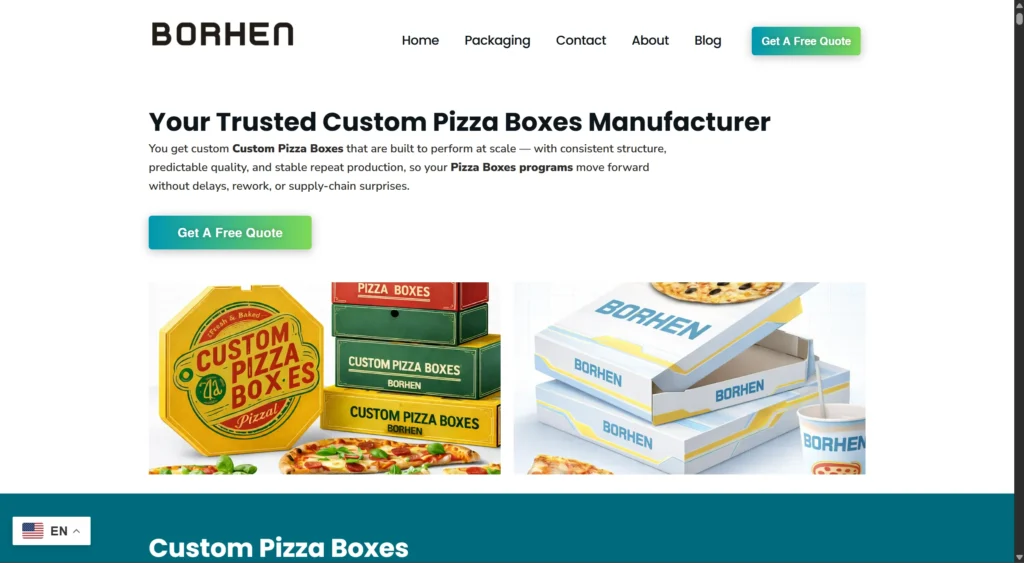
When I talk about BorhenPack, I don’t frame us as a company that simply prints pizza boxes. I position us as a manufacturing partner built for distributors and wholesale traders who need consistency, scalability, and long-term reliability. Even though BorhenPack is still building its public-facing materials, our philosophy is already clear. We are shaped by what works best in the market and refined by what distributors actually struggle with every day.
From studying established players in the pizza packaging space, one lesson stands out to me: the strongest manufacturers are not the loudest. They are the ones that quietly deliver the same box, the same quality, and the same performance every time a reorder happens. That is the mindset behind BorhenPack.
Why I Built BorhenPack Around Distributor Needs, Not One-Off Orders
I’ve seen too many packaging suppliers focus on short-term wins. They chase single orders, promise everything, and then struggle to repeat results. BorhenPack was designed differently. From day one, I envisioned us as a manufacturer that understands how distributors operate. Distributors don’t sell one box. They sell systems. They manage SKUs, warehouses, delivery routes, and customer expectations at scale.
That’s why BorhenPack is built to support repeat production, stable specifications, and predictable lead times. Our goal is not to impress once. It is to perform consistently across hundreds of thousands of pizza boxes, month after month, market after market.
How We Think About Custom Pizza Boxes as an Operational Product
To me, a pizza box is not a marketing sample. It’s an operational tool. It has to survive heat, steam, grease, stacking pressure, fast assembly, and transportation without compromising food quality or brand image. That’s why we approach pizza boxes as engineered packaging, not decorative print jobs.
At BorhenPack, we focus on structure accuracy, board strength, fold precision, and locking performance. Whether the box is plain kraft, white, or fully printed, it must close cleanly, stack flat, and hold shape during real delivery conditions. Distributors value this because it reduces complaints, returns, and brand damage for their clients.
What Makes BorhenPack a Reliable Manufacturing Partner
One of the strongest common traits among leading pizza box manufacturers is control. Control over materials, printing, cutting, and finishing. BorhenPack follows the same principle. We prioritize manufacturing discipline so that every production run aligns with the approved sample.
We are structured to support digital and offset printing depending on order scale and branding needs. This gives distributors flexibility to serve both cost-sensitive clients and premium brands without changing suppliers. The focus is always on clarity, repeatability, and minimizing variation between batches.
Why Distributors and Wholesale Traders Trust Our Production Model
From my experience, distributors don’t want surprises. They want packaging that behaves exactly the same every time they open a new shipment. That’s why BorhenPack is built around predictable outputs rather than experimental customization.
We help distributors lock specifications early. Once dimensions, board grade, print method, and structure are approved, we treat that configuration as a long-term reference. This makes reordering simple, reduces internal approval cycles, and gives distributors confidence when onboarding new restaurant clients.
How Our MOQ and Scaling Strategy Supports Wholesale Growth
One major pain point I’ve seen in the market is MOQ rigidity. Some manufacturers demand huge volumes before they care. Others allow small runs but can’t scale cleanly. BorhenPack is designed to bridge that gap.
Our starting quantities are structured to support distributors testing new markets or onboarding smaller accounts. As volumes grow, scaling is seamless. The structure, material logic, and print standards remain stable. Only the production volume changes. This protects distributors from supply disruptions and quality drift as their business grows.
Export-Ready Thinking Is Built Into BorhenPack
Many distributors today operate across borders. Even domestic distributors often import or export within regional trade networks. That’s why BorhenPack treats export readiness as a baseline, not an add-on.
We design pizza boxes to ship flat efficiently, stack safely, and arrive in usable condition after long transit. Carton packing, pallet stability, and moisture considerations are planned from the start. This reduces damage risk and helps distributors control landed costs more effectively.
How We Support Multi-SKU Pizza Box Programs
Distributors rarely sell a single pizza box size. They manage ranges that include multiple dimensions, styles, and branding levels. BorhenPack supports this by treating pizza boxes as product families rather than isolated items.
We help align sizes, board grades, and structures across SKUs so warehouses can store and handle them more efficiently. For wholesale traders, this consistency simplifies inventory planning and reduces operational friction downstream.
Why Communication Is a Core Part of Our Value
Manufacturing quality alone is not enough. I believe communication is just as important. BorhenPack is committed to clear timelines, transparent discussions, and early problem detection. If there is a constraint, we address it before production. If there is a better option, we explain the trade-offs honestly.
Distributors appreciate this because it turns packaging sourcing into a controlled process rather than a recurring risk.
How I See BorhenPack’s Role in the Custom Pizza Boxes Market
I don’t see BorhenPack competing on noise or exaggerated claims. I see us earning trust through execution. Our role is to help distributors and wholesale traders deliver pizza packaging that performs reliably, looks consistent, and scales without friction.
When packaging works quietly in the background, distributors can focus on growing accounts, improving service levels, and expanding into new markets. That’s the role BorhenPack is built to play.
Final Perspective From Me
If you’re a distributor or wholesale trader, choosing a custom pizza box manufacturer is not about chasing the lowest price or the most dramatic sample. It’s about choosing a partner who understands repetition, stability, and scale.
BorhenPack exists for that reason. We are here to manufacture custom pizza boxes that work in real operations, repeat without surprises, and grow alongside your distribution business. That is the value I believe matters most, and that is the standard we are building BorhenPack around.
Fantastapack
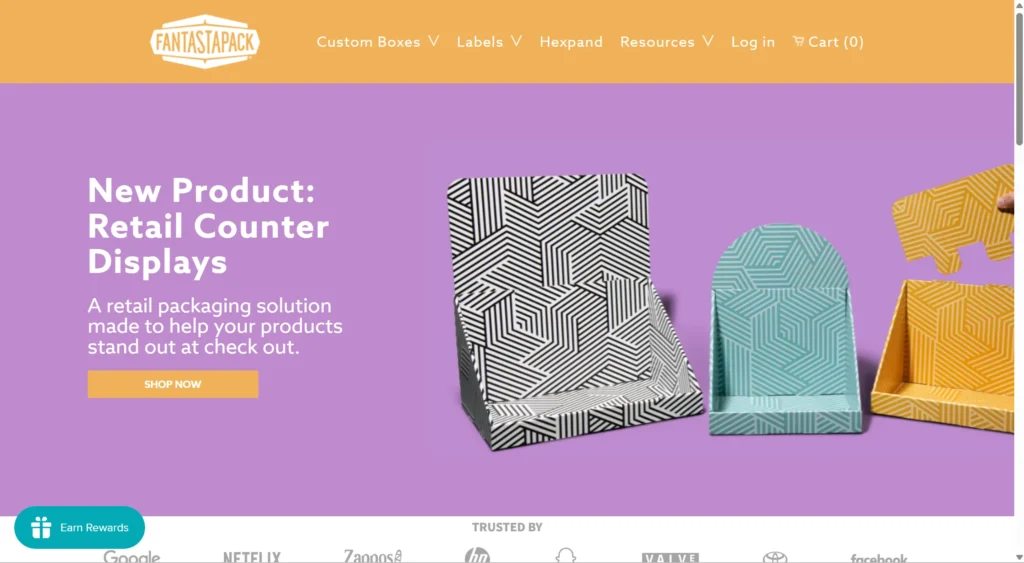
When I look at Fantastapack from a distributor or wholesale trader’s perspective, I don’t evaluate it like a traditional corrugated box factory. I evaluate it as a packaging infrastructure. Fantastapack is not built around individual transactions or negotiated production runs. It is built around a repeatable system that allows packaging to move at the same speed as modern commerce. That distinction matters deeply when your business depends on reliable replenishment rather than one-off orders.
What immediately stands out to me is that Fantastapack was designed from the beginning to remove friction from sourcing. Every decision, from digital print adoption to web-based ordering, reflects an understanding that distributors and wholesale traders need predictability, speed, and control more than endless customization.
Why Fantastapack’s Manufacturing DNA Signals Long-Term Stability
I always pay attention to where a packaging company comes from, because origin often predicts behavior under pressure. Fantastapack’s roots in The BoxMaker give me confidence that this is not a platform built on outsourced capacity or temporary supply agreements. It is backed by decades of hands-on manufacturing experience, which shows in how production constraints are defined and communicated.
This manufacturing DNA matters for distributors because it means Fantastapack understands real-world production limits. Instead of promising everything to everyone, it builds standardized offerings that can actually be delivered consistently. In wholesale distribution, that honesty prevents downstream problems long before they happen.
How Web-to-Pack Infrastructure Changes the Distributor–Manufacturer Relationship
From my experience, one of the biggest pain points in wholesale packaging is coordination. Fantastapack’s web-to-pack platform fundamentally changes how that coordination works. Orders are placed through a structured system, artwork flows through automated preflight, and production is triggered almost immediately.
For distributors, this removes layers of manual communication. There is no constant chasing for proofs, no uncertainty about whether files are print-ready, and no ambiguity about order status. The platform becomes an extension of the distributor’s own operations, which reduces administrative overhead and allows teams to focus on sales and customer relationships instead of production management.
Why Digital Print Is Especially Valuable for Pizza Box Distribution
Digital print is not just a technical choice for Fantastapack; it is a strategic one. I see this as particularly important for pizza boxes because demand patterns in foodservice are rarely linear. Promotions, seasonal campaigns, store openings, and rebranding efforts all create fluctuations.
With digital print, Fantastapack can support short runs, rapid design changes, and exact volume ordering without penalizing distributors with high minimums. This flexibility allows wholesale traders to align inventory more closely with actual consumption. It reduces overstock risk while still maintaining professional print quality that meets brand expectations.
How In-House Production Protects Distributors From Supply Chain Shock
One of the reasons distributors gravitate toward Fantastapack is its in-house manufacturing model. From my perspective, this is a risk management decision as much as a production one. When a manufacturer controls printing, cutting, finishing, and quality inspection internally, timelines become far more dependable.
For wholesale traders supplying restaurants or chains, supply disruptions can cascade quickly. Fantastapack’s ability to control its own production flow reduces the likelihood of last-minute delays caused by third-party dependencies. That stability becomes especially valuable during peak seasons when packaging demand spikes unexpectedly.
Why Clear Product Specifications Matter More Than Broad Customization
When I review Fantastapack’s pizza box specifications, I see a deliberate effort to standardize what works. Sizes are clearly defined, structural limits are explained upfront, and materials are chosen for performance rather than novelty. This level of specification is often underestimated, but it is critical for distributors.
Clear specifications shorten the sales cycle. Distributors can confidently present options to their customers without endless back-and-forth. Samples match production. Repeat orders behave the same way. In a high-frequency product like pizza boxes, this consistency is what keeps operations running smoothly month after month.
How Speed Becomes a Strategic Asset for Wholesale Traders
Fantastapack talks openly about speed, but what impresses me is how speed is embedded into the process rather than treated as an exception. Sampling timelines, standard production windows, and rush options are all clearly structured within the ordering flow.
For distributors, speed is not just about urgency. It is about synchronization. Packaging must arrive when restaurants open, when promotions launch, or when stock runs low. Fantastapack’s ability to align production speed with real business timelines allows distributors to make promises they can actually keep.
Why Fantastapack’s Platform Scales With Distributor Growth
As distributors grow, complexity grows with them. More customers, more designs, more replenishment cycles. What I see in Fantastapack is a system that scales alongside that growth. The same platform can support small initial orders and large repeat volumes without changing the underlying workflow.
This scalability is important because it allows distributors to standardize their internal processes. Fantastapack becomes a consistent manufacturing layer beneath a growing sales operation, which reduces friction as order volume increases.
How Sustainability Plays Into Wholesale Decision-Making
Sustainability is no longer optional in food packaging, especially for distributors serving regulated or brand-conscious markets. Fantastapack’s commitment to recyclable materials and responsible manufacturing practices gives distributors a clear narrative to pass downstream.
From my perspective, this reduces both reputational and compliance risk. Distributors do not have to validate sustainability claims order by order. They can rely on Fantastapack’s established practices as part of their own value proposition.
Why Distributors and Wholesale Traders Commit to Fantastapack Long-Term
When I step back and assess why distributors choose Fantastapack, the answer is not a single feature. It is the alignment between Fantastapack’s system and the realities of wholesale distribution. Predictable production, standardized specifications, fast turnaround, and a platform that reduces operational noise all contribute to long-term trust.
Fantastapack does not position itself as a bespoke engineering partner, and that is intentional. It positions itself as a reliable, scalable manufacturer for high-frequency packaging like pizza boxes. For distributors whose success depends on consistency rather than experimentation, that focus makes Fantastapack a logical long-term partner.
How Fantastapack Fits Into a Modern Custom Pizza Boxes Supply Strategy
In my professional judgment, Fantastapack fits best into a supply strategy that prioritizes repeatability and responsiveness. Pizza boxes are consumed daily, reordered frequently, and rarely tolerate delays. Fantastapack’s manufacturing and platform model align closely with those realities.
This alignment explains why Fantastapack continues to appear prominently among custom pizza boxes manufacturers in search results and buyer shortlists. It reflects not just good marketing, but a manufacturing approach that resonates with how distributors and wholesale traders actually operate.
Vistaprint
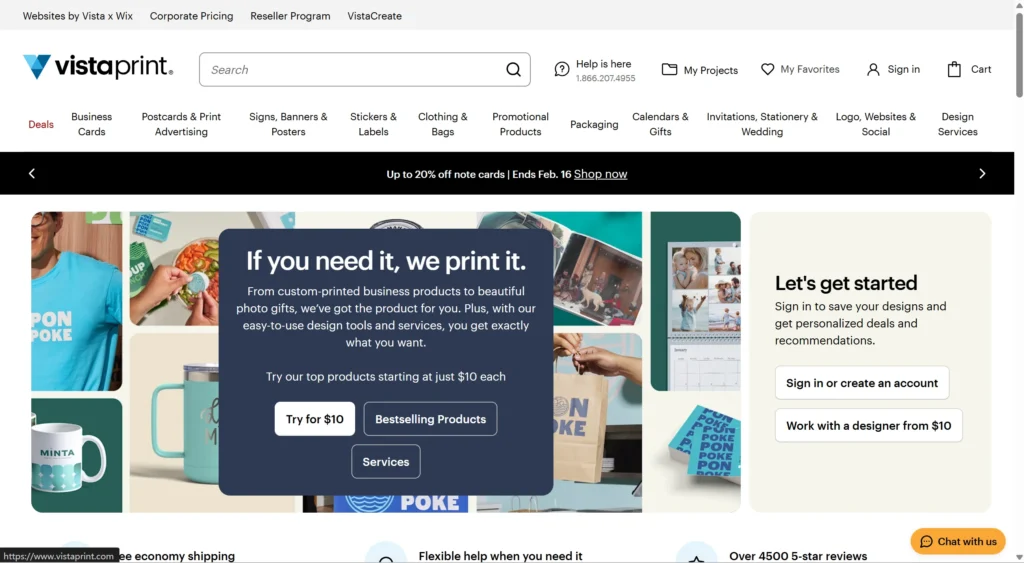
When I evaluate VistaPrint as a custom pizza boxes manufacturer, I do it through the lens of repeat procurement, not one-time buying. I am not asking whether VistaPrint can produce a pizza box. I am asking whether its system can support hundreds of small orders, constant reorders, predictable delivery windows, and stable unit economics over time. From that perspective, VistaPrint behaves less like a factory and more like an industrialized packaging distribution engine.
VistaPrint is part of Cimpress, and that matters far more than most buyers realize. This is a company that has spent decades solving one problem at global scale: how to mass-produce customized print products without losing speed or consistency. Pizza boxes are simply one category inside that infrastructure, and understanding that context is critical when distributors and wholesale traders decide whether VistaPrint belongs in their supplier mix.
Why VistaPrint’s Business Model Aligns With Distribution Reality
From my experience, distributors and wholesale traders rarely operate in clean, predictable demand cycles. Orders come in uneven waves. One week a customer needs 50 boxes for a pop-up event, the next week another customer needs 500 boxes for a seasonal promotion. VistaPrint’s model is designed for exactly this kind of fragmented demand.
The predefined size options, fixed B-flute construction, limited material choices, and standardized printing workflow are not signs of limitation. They are signs of discipline. By narrowing the production variables, VistaPrint can absorb fluctuating order patterns without breaking its delivery promises. For a distributor, this translates into a supplier that behaves consistently regardless of order mix.
How Standardization Protects Margins for Wholesale Traders
When I look at VistaPrint’s pizza box offering, I see a structure built to protect margins through predictability. Unit pricing scales clearly with quantity, and those price breaks are visible before an order is placed. That transparency is not just convenient, it is strategic.
For wholesale traders, pricing clarity allows immediate margin calculation. There is no waiting for quotes, no back-and-forth negotiation, and no surprise adjustments after artwork submission. This speed in pricing decisions directly shortens sales cycles and reduces administrative cost, which is often invisible but critical in distribution businesses.
Why VistaPrint’s Speed Solves a Real Supply Chain Problem
Speed is often used as a marketing phrase, but in VistaPrint’s case, speed is embedded into the system. Delivery timelines are presented upfront, fast production options are clearly priced, and logistics are integrated into the ordering flow. From my perspective, this indicates operational maturity rather than promotional exaggeration.
Distributors value this because speed reduces inventory risk. Instead of holding large quantities of pizza boxes in storage, they can rely on VistaPrint’s ability to replenish quickly. This flexibility frees up cash flow and warehouse space, both of which are constant constraints in foodservice distribution.
How the Design Platform Reduces Downstream Errors
One of the most underestimated risks in pizza box distribution is design inconsistency. VistaPrint’s design ecosystem, including templates, upload checks, and live previews, functions as a quality gate before production even begins. This has a direct impact on manufacturing outcomes.
From my experience, many disputes in packaging arise not from poor printing, but from mismatched expectations. VistaPrint’s controlled design environment reduces ambiguity. Customers see what they will get, approve it within defined parameters, and receive a product that matches those parameters. For distributors handling multiple clients, this consistency reduces costly reprints and reputation damage.
What Customer Reviews Reveal About Manufacturing Trade-Offs
I always read reviews carefully, especially critical ones. VistaPrint’s pizza box reviews reveal a consistent pattern. Structural quality and delivery speed are praised, while color matching sometimes falls short of customer expectations. This tells me exactly how the manufacturing system is optimized.
VistaPrint prioritizes throughput and repeatability within a CMYK digital print environment. Colors are consistent within that system, but not identical to RGB or Pantone designs created elsewhere. The key insight is not the limitation itself, but how VistaPrint handles it. The company explains the technical reasons openly and offers guidance for print-ready design. That transparency is what allows distributors to manage customer expectations effectively.
Why VistaPrint Works Especially Well for Multi-Account Distribution
When I imagine managing multiple restaurant accounts as a distributor, VistaPrint’s value becomes very clear. The platform supports parallel ordering, standardized specifications, and predictable outcomes across many customers at once. This makes it easier to scale operations without adding complexity.
Distributors can onboard new customers quickly, offer branded pizza boxes without long lead times, and fulfill repeat orders with minimal friction. VistaPrint absorbs much of the operational complexity that would otherwise fall on the distributor’s internal team.
How VistaPrint Fits Into a Balanced Supplier Portfolio
In my professional judgment, VistaPrint is not a replacement for every type of pizza box manufacturer. It is not designed for highly engineered structures, specialty coatings, or deep material experimentation. Instead, it fits perfectly as a standardized, fast-response supplier within a broader sourcing strategy.
Distributors who understand this use VistaPrint strategically. They rely on it for everyday pizza box programs, smaller orders, urgent replenishment, and clients who value speed and affordability over customization depth. This strategic placement is why VistaPrint continues to appear in distributor shortlists.
Why Wholesale Traders Trust VistaPrint Over Time
Trust in wholesale relationships is built through repetition, not promises. VistaPrint earns trust by delivering the same product behavior over and over again. Boxes arrive when expected, pricing behaves as projected, and reorders do not introduce surprises.
For wholesale traders, this reliability reduces stress. It allows them to commit to customers with confidence and focus their energy on sales growth rather than supplier management. Over time, this operational calm becomes a competitive advantage.
How VistaPrint’s Scale Reinforces Its Role Among Custom Pizza Boxes Manufacturers
VistaPrint’s scale is often misunderstood. It is not just about volume; it is about system resilience. The same infrastructure that prints millions of business cards also supports pizza box production. That cross-category scale allows VistaPrint to invest continuously in automation, logistics, and customer support.
From my perspective, this is why VistaPrint remains relevant among custom pizza boxes manufacturers. It is not trying to compete on craftsmanship or bespoke engineering. It competes on reliability, speed, and system efficiency, which are exactly the attributes distributors and wholesale traders depend on in high-frequency packaging categories.
Why I Include VistaPrint When Assessing Custom Pizza Boxes Manufacturers
When I compile or evaluate lists of custom pizza boxes manufacturers, I include VistaPrint because it represents a specific and important manufacturing archetype. It is the archetype of standardized, platform-driven production that aligns with how modern foodservice packaging is actually bought and replenished.
For distributors and wholesale traders, VistaPrint offers a low-risk, high-efficiency option that complements more traditional manufacturing partners. Its continued presence in search results and buyer consideration sets reflects not hype, but alignment with real-world distribution needs.
Yourbrandcafe
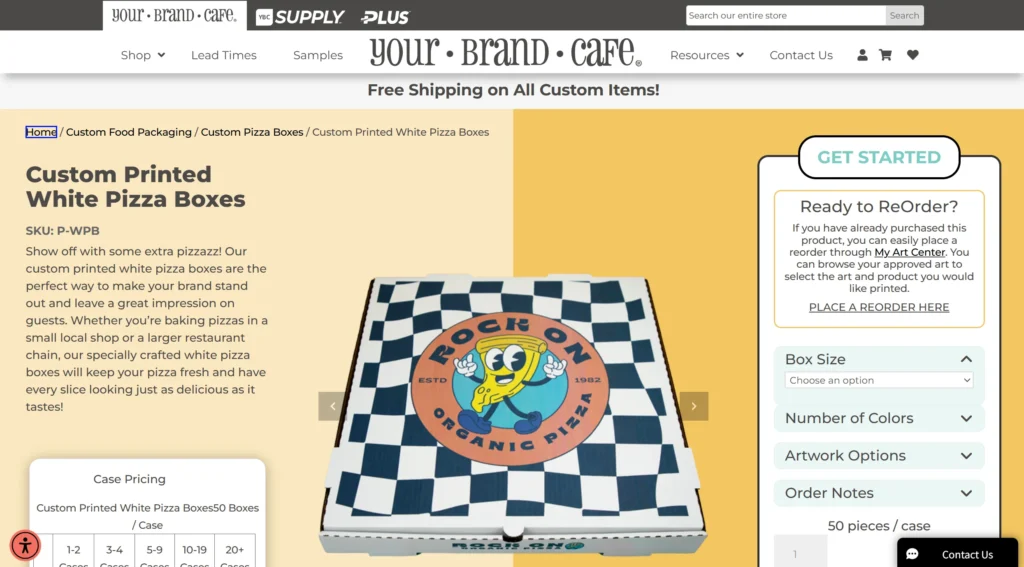
When I evaluate Your Brand Cafe as a custom pizza boxes manufacturer, I immediately place it in a very specific category. This is not a mass-industrial corrugated plant, and it is not a pure automation-driven print platform. It is a restaurant-centric packaging manufacturer built around the operational realities of small to mid-sized food businesses. Understanding that positioning is essential, because it explains why distributors and wholesale traders choose to work with them again and again.
From the very first interaction, I can tell that Your Brand Cafe is designed for repeat consumption, not one-time branding projects. Everything about the product structure, ordering flow, and communication style signals long-term usage rather than promotional experimentation. For distributors who live and die by reorders, this alignment is not accidental, it is foundational.
Why Their Manufacturing Philosophy Is Rooted in Foodservice Reality
One thing I pay close attention to is whether a manufacturer understands how pizza boxes are actually used. Your Brand Cafe clearly does. The focus on grease resistance, stackability, ease of assembly, and storage efficiency tells me this company designs from the kitchen outward, not from a marketing brief inward.
This matters for wholesale traders because foodservice packaging fails most often at the operational level, not the visual one. A box that looks good but slows down staff or collapses under heat becomes a liability. Your Brand Cafe’s emphasis on durable cardboard construction and consistent box behavior reflects real experience supplying restaurants that operate under pressure.
How Case-Based Ordering Creates Distribution Stability
The case-based pricing model immediately stands out to me as a distributor-friendly decision. Each pizza box size is sold in clearly defined cases, with pricing tiers that scale logically as volume increases. This structure mirrors how distributors actually manage inventory and logistics.
For wholesale traders, case-based ordering reduces complexity at every step. Storage planning becomes predictable, transportation is easier to optimize, and internal SKU management stays clean. Instead of constantly recalculating loose quantities, distributors can treat each box size as a standardized product unit, which improves operational discipline over time.
Why Low Minimums Are a Strategic Advantage, Not a Small Feature
Low minimums are often marketed as a benefit for small businesses, but from my perspective, they are just as important for distributors. Your Brand Cafe allows orders starting from a single case, which dramatically lowers the barrier for onboarding new customers.
This flexibility lets distributors test new accounts, seasonal concepts, food trucks, and pop-up operations without committing capital or warehouse space prematurely. Over time, these small accounts often grow into consistent reorder clients. The ability to support that growth curve without changing suppliers is one of the quiet reasons distributors stay loyal.
How the Proof-Approval Process Protects Everyone Involved
I consider the proof-approval workflow one of the most underrated strengths of Your Brand Cafe. Every order goes through a formal proof stage, and nothing enters production without explicit approval. This slows down impulsive orders, but it prevents far more costly issues downstream.
For distributors, this process shifts risk away from the supply chain. Customers approve what they will receive, manufacturers print exactly what was approved, and distributors avoid being caught between expectation and outcome. Over hundreds of orders, this discipline dramatically reduces disputes, reprints, and relationship strain.
Why CMYK Printing Is the Right Choice for This Market Segment
Your Brand Cafe’s use of CMYK printing technology aligns perfectly with the type of customers it serves. CMYK delivers sharp logos, clean lines, and reliable reproduction across reorders, which is what most foodservice brands actually need. It is not about experimental finishes or luxury effects, it is about consistency.
I also notice how Your Brand Cafe frames design expectations. The language focuses on clarity and vibrancy rather than promising exact color replication from RGB designs. This honesty allows distributors to educate customers properly, which in turn reduces friction and unrealistic demands.
How Standard Size Ranges Support Scalable Distribution
Offering pizza boxes from 10 inches to 18 inches may seem basic, but from a wholesale perspective, it is exactly right. These sizes cover the overwhelming majority of real-world pizza formats without introducing unnecessary variation.
Standard sizing allows distributors to consolidate inventory, simplify training for warehouse staff, and reduce picking errors. Customers receive boxes that fit their products reliably, and distributors benefit from predictable handling and storage. This balance between choice and control is essential for sustainable scale.
Why Easy Reordering Drives Long-Term Volume
One of the clearest signals that Your Brand Cafe is built for long-term relationships is its reordering system. Once artwork is approved, customers can reorder without restarting the design process. This seems simple, but its impact is significant.
For distributors, easy reordering locks in consistency. Customers are less likely to switch suppliers when reorders are effortless. Branding remains stable, operational friction drops, and demand becomes more predictable. Over time, this creates exactly the kind of repeat volume that wholesale traders depend on.
How Lead Times Reflect Operational Honesty
Your Brand Cafe’s stated lead times tell me a lot about how the company operates. A standard two-week production timeline reflects a controlled manufacturing process that prioritizes accuracy and quality over extreme speed. Rush options exist, but they are treated as exceptions rather than defaults.
From a distributor’s perspective, this honesty is refreshing. Predictable timelines allow better planning around promotions, openings, and seasonal demand. When speed is needed, there is a mechanism for it, but the baseline workflow remains stable and dependable.
Why Social Impact Strengthens Brand Alignment Without Complexity
The company’s commitment to supporting clean water initiatives adds an additional layer of value that resonates with many independent food businesses. From a distributor’s standpoint, this is not about marketing slogans, it is about alignment.
Many small restaurant owners care deeply about community and impact but lack the bandwidth to vet suppliers for ethical practices. By working with a manufacturer that integrates giving into its business model, distributors can offer a packaging solution that aligns with customer values without adding operational burden.
Why Distributors and Wholesale Traders Trust Your Brand Cafe
When I put everything together, the reason distributors choose Your Brand Cafe becomes clear. It is a manufacturer that reduces risk, simplifies decision-making, and supports gradual growth. It does not overwhelm customers with options, and it does not force distributors into rigid volume commitments.
Your Brand Cafe makes it easy to start small, reorder confidently, and scale naturally. That reliability builds trust over time, which is far more valuable in wholesale relationships than aggressive pricing or flashy features.
How Your Brand Cafe Fits Within Custom Pizza Boxes Manufacturers
In the broader ecosystem of custom pizza boxes manufacturers, I see Your Brand Cafe occupying a very deliberate and defensible position. It serves the independent and regional foodservice segment with precision. It bridges the gap between mass platforms and industrial factories by offering structure without rigidity.
For distributors building a balanced supplier portfolio, Your Brand Cafe often becomes the preferred partner for local restaurants, growing chains, and customers who value clarity and consistency. That focus is exactly why it continues to earn attention among buyers searching for dependable custom pizza box manufacturers.
Why I Include Your Brand Cafe in Any Serious Manufacturer Evaluation
Whenever I assess custom pizza boxes manufacturers for distributors or wholesale traders, I include Your Brand Cafe because it represents a manufacturing philosophy grounded in real usage. It is not chasing extremes, it is optimizing the middle where most food businesses actually live.
That alignment with reality is what keeps distributors coming back. Over time, predictability beats novelty, and process beats promises. Your Brand Cafe understands that, and it shows in how its manufacturing model supports long-term distribution success.
Avcoboxes
When I evaluate Avco Boxes as a custom pizza boxes manufacturer, I do not start by asking whether they can print a good-looking box. That is table stakes. I start by asking whether their manufacturing and distribution model can survive real commercial pressure. Avco stands out because it was clearly designed around repeat demand, regional distribution, and brand consistency rather than one-off packaging projects.
What I see immediately is a company that understands packaging as part of a live operating system. Avco is not selling packaging in isolation. It is selling reliability, speed, and control to businesses that cannot afford uncertainty. That perspective aligns very closely with how distributors and wholesale traders actually think.
Why Avco’s “Made in the USA” Model Matters in Practice
From my experience, U.S.-based production only matters if it actually changes outcomes. In Avco’s case, it does. Domestic manufacturing combined with regional distribution centers fundamentally reshapes the supply chain. It shortens lead times, stabilizes freight costs, and removes the unpredictability of overseas shipping, customs delays, and geopolitical disruption.
For distributors, this means fewer surprises. Instead of planning months ahead and buffering inventory to protect against delays, wholesale traders can operate closer to real demand. Avco’s regional footprint allows inventory to move faster and more predictably, which directly improves cash flow and reduces warehousing pressure.
How Regional Fulfillment Supports Multi-Market Distribution
One of the most important operational details I look for is whether a manufacturer can support geographic expansion without friction. Avco’s distribution centers across multiple U.S. states are not just a logistics feature, they are a growth enabler.
For distributors serving brands with multiple locations, regional fulfillment means consistent service levels across markets. Orders can be shipped from the closest facility, transit times are reduced, and service reliability improves. This kind of infrastructure allows wholesale traders to scale accounts nationally without needing to constantly renegotiate logistics solutions.
Why Avco’s Lead Time Discipline Signals Manufacturing Maturity
Avco’s standard production window of roughly 7 to 10 business days after artwork approval tells me a lot about how the company runs internally. This is not a reactive shop scrambling to meet deadlines, and it is not a slow industrial plant locked into rigid cycles. It is a controlled manufacturing environment built around predictable throughput.
For distributors, predictability often beats speed. Knowing exactly when an order will ship allows better coordination with customer launches, promotions, and replenishment schedules. When rush options exist but are gated and intentional, it shows the manufacturer understands how to protect quality while still offering flexibility when it truly matters.
How Bundle-Based Ordering Aligns With Wholesale Operations
Avco’s bundle-based pricing structure immediately resonates with me as someone who thinks in distribution terms. Bundles create natural order units that map cleanly to pallets, shelves, and reorder points. This is far easier to manage than loose unit counts or custom quantities that vary from order to order.
For wholesale traders, bundles simplify everything from forecasting to warehouse picking. Internal systems stay clean, training is easier, and errors decrease. Over time, this structural clarity compounds into meaningful operational efficiency.
Why Low Minimums Are Strategically Important for Distributors
Low minimum order quantities are often framed as a small-business benefit, but from my perspective, they are just as valuable to distributors. Avco’s low minimums allow wholesale traders to say yes to more opportunities. New restaurants, pop-ups, seasonal menus, test markets, and pilot programs all become viable without forcing inventory risk upstream.
This flexibility allows distributors to grow accounts organically. Customers can start small, build confidence, and increase volume over time without switching suppliers. Avco’s model supports that progression instead of penalizing it.
How CMYK Printing and Proofing Reduce Downstream Conflict
Avco’s use of full-color CMYK printing combined with digital proof approval is not about aesthetics alone. It is about alignment. Proofing creates a shared understanding between customer, distributor, and manufacturer before production begins.
From a wholesale standpoint, this is critical. Most disputes in packaging do not come from poor production, they come from mismatched expectations. Proof approval protects all parties by locking in design intent early, reducing reprints, and preserving margins.
Why Avco Designs for Real Kitchen and Delivery Conditions
When I examine Avco’s product descriptions, what stands out is the emphasis on performance under real conditions. Grease resistance, durability, stackability, and ease of assembly are consistently highlighted. This tells me the company designs with the kitchen and delivery environment in mind, not just the marketing table.
For distributors, packaging failures quickly become reputation failures. Boxes that warp, leak, or slow down service create complaints that ripple back through the supply chain. Avco’s focus on food-safe, durable materials reduces those risks and builds long-term trust.
How Sustainability Adds Value Without Operational Burden
Avco positions itself as an eco-friendly packaging provider, and importantly, it integrates sustainability into its standard offering rather than treating it as an add-on. From a distributor’s perspective, this matters because many customers want sustainable packaging but lack the resources to validate claims independently.
By partnering with a manufacturer that already aligns with sustainability expectations, distributors can meet customer demand without complicating procurement or logistics. This increasingly influences purchasing decisions, especially for premium and urban food brands.
Why Avco Works So Well for Brand-Driven Food Businesses
Avco’s emphasis on branding is not superficial. It is embedded in the consistency of printing, the reliability of materials, and the predictability of reorders. For distributors serving brand-conscious restaurants and chains, this consistency is essential.
Packaging becomes a touchpoint that reinforces brand identity rather than undermining it. When boxes look the same across locations and over time, customers trust the brand more. Distributors benefit because they are associated with that consistency rather than blamed for variation.
Why Distributors and Wholesale Traders Choose Avco Boxes
When I step fully into the distributor mindset, the reason Avco is chosen becomes very clear. It reduces uncertainty. It lowers operational friction. It allows wholesale traders to respond quickly to customer needs without overcommitting inventory or sacrificing quality.
Avco makes it easier to support growth at every stage, from a single location to multi-market expansion. That reliability is what distributors value most, even more than aggressive pricing or exotic customization.
How Avco Fits Among Custom Pizza Boxes Manufacturers
Within the broader landscape of custom pizza boxes manufacturers, I see Avco occupying a highly defensible position. It sits between offshore mass producers and niche boutique printers, offering speed and scale without losing brand integrity.
For distributors building a balanced supplier portfolio, Avco often becomes the preferred partner for U.S.-based, brand-forward food businesses that demand consistency and responsiveness. That clarity of purpose is why Avco continues to attract serious buyer attention.
Why I Always Include Avco in Manufacturer Shortlists
Whenever I evaluate custom pizza boxes manufacturers for distributors or wholesale traders, I include Avco because it represents a mature, resilient manufacturing model. It is designed for reorders, regional scale, and operational reality rather than theoretical efficiency.
Over time, distributors learn that predictability and partnership outperform novelty. Avco understands this deeply, and its production, pricing, and distribution systems reflect that understanding at every level. That is why it remains a trusted choice in competitive foodservice packaging markets.
Performance
When I look at Performance Foodservice through the lens of custom pizza boxes manufacturing, I don’t start with graphics or box styles. I start with infrastructure. In distribution, packaging is only as good as the system that delivers it consistently, on time, and at scale. Performance stands out because their packaging capability is built on top of one of the most mature foodservice distribution networks in the United States.
From my perspective, that instantly changes the risk profile. I’m not betting on a single factory line or a third-party freight lane. I’m plugging into a nationwide logistics machine that already moves millions of cases every week. Custom pizza boxes, in this context, are not a side product. They are a controlled extension of an existing supply chain.
Why Performance’s Distribution DNA Matters More Than Factory Size
Many packaging suppliers talk about manufacturing capacity, but very few understand foodservice velocity. Performance does. Their entire organization is designed around high-frequency replenishment, tight delivery windows, and zero tolerance for disruption.
As someone responsible for wholesale fulfillment, this matters deeply. Pizza boxes are a high-consumption item with no flexibility when they run out. Performance’s ability to manufacture, store, and deliver boxes within the same operational rhythm as food products means there is no disconnect between packaging availability and kitchen demand.
That alignment is what keeps restaurants running and distributors trusted.
How Custom Pizza Boxes Become Part of a Unified Restocking System
What I find particularly compelling is how Performance integrates custom pizza boxes into a one-stop ordering environment. Boxes are not ordered in isolation. They are reordered alongside cheese, flour, proteins, and disposables through the same platform.
For distributors and wholesale traders, this eliminates one of the biggest hidden costs in the business: coordination. There is no separate vendor onboarding, no separate payment cycle, no separate delivery tracking. Packaging becomes just another dependable line item in a unified procurement flow.
That simplicity compounds over time.
Why Performance’s Box Engineering Is Built for Real Kitchens
Performance’s approach to pizza box engineering tells me they design for operations, not theory. The way they specify flute types, box depths, and liner combinations reflects a deep understanding of heat retention, grease resistance, stack strength, and delivery handling.
From a distributor’s point of view, this reduces downstream issues. Fewer crushed boxes mean fewer complaints. Better insulation means better food quality upon arrival. Safer handling protects drivers and customers alike.
When boxes perform consistently, everyone in the chain wins.
How Standardization Protects Distributors at Scale
One of the most overlooked advantages of Performance’s model is standardization. Their predefined size ranges, flute options, and liner combinations are not limitations. They are safeguards.
For wholesale traders managing hundreds or thousands of accounts, standardization keeps inventory manageable and forecasting accurate. It allows distributors to stock confidently without ballooning SKU counts. It also ensures that when customers expand locations, packaging scales seamlessly with them.
That kind of predictability is rare and extremely valuable.
Why One-Time Plate Charges Signal Long-Term Thinking
When I see Performance’s one-time plate charge model, I immediately recognize a supplier thinking beyond the first order. This structure lowers the barrier to entry for customization while encouraging repeat business over time.
From the distributor side, this helps customers commit to branded packaging without fear of ongoing setup costs. Once the system is in place, reorders become routine, fast, and economical. That repeatability strengthens relationships and stabilizes demand.
It’s a quiet but powerful advantage.
How Low Minimums Actually Strengthen Wholesale Relationships
Low minimums might sound like a small-business feature, but in wholesale distribution they serve a strategic role. Performance’s ability to support low minimums allows distributors to onboard emerging brands, seasonal concepts, and test locations without friction.
As those customers grow, their packaging volumes grow organically within the same system. There is no painful supplier transition. No retraining. No operational reset.
This continuity is what turns small accounts into long-term revenue streams.
Why Performance’s Digital Ordering Tools Matter to Distributors
Performance’s digital infrastructure, particularly tools like CustomerFirst, adds another layer of value that many packaging manufacturers simply do not offer. Reordering custom pizza boxes becomes data-driven rather than reactive.
From my perspective, this improves forecasting accuracy, reduces ordering errors, and shortens procurement cycles. Distributors gain visibility. Customers gain confidence. Everyone spends less time chasing paperwork and more time running their business.
In distribution, time saved is margin earned.
How Performance Balances Local Flexibility With National Consistency
One of Performance’s greatest strengths is its ability to operate locally while thinking nationally. Regional distribution centers allow for faster delivery and local service, while centralized standards ensure consistency across markets.
For distributors serving multi-location restaurant groups, this balance is critical. A brand can maintain the same box design and performance whether it operates in one city or ten states. That reliability strengthens brand identity and simplifies logistics.
Few suppliers can execute this balance well.
Why Distributors and Wholesale Traders Choose Performance Foodservice
When distributors choose Performance for custom pizza boxes, they are not just choosing a manufacturer. They are choosing operational insurance. Performance reduces supply risk, simplifies procurement, and supports growth without adding complexity.
Their boxes arrive when expected. Their specifications stay consistent. Their systems scale smoothly. That reliability builds trust, and trust is the foundation of every long-term wholesale relationship.
Where Performance Fits Among Custom Pizza Boxes Manufacturers
In the broader landscape of custom pizza boxes manufacturers, Performance occupies a unique position. They are not competing purely on price, nor are they chasing niche customization. They compete on system reliability, logistical strength, and service integration.
For distributors and wholesale traders, those qualities matter more than aesthetics. A dependable partner who understands foodservice realities will always outperform a cheaper or flashier alternative.
Why I See Performance as a Manufacturing Partner, Not Just a Distributor
From where I stand, Performance Foodservice has effectively become a supply-chain manufacturer. They control the specifications, the production flow, the delivery timing, and the reorder systems. That level of control is what manufacturing truly means in a modern foodservice environment.
For distributors, this distinction is crucial. It means fewer variables, fewer surprises, and more confidence in long-term planning.
Final Perspective From a Distributor’s Point of View
When I evaluate custom pizza boxes manufacturers for wholesale and distribution use, I ask one question: will this partner make my operation easier or harder over the next five years? Performance Foodservice consistently makes it easier.
Their combination of infrastructure, engineering discipline, digital tools, and service culture transforms pizza boxes from a fragile dependency into a stable asset. That is why distributors choose them, stay with them, and build around them.
And that is why Performance belongs in any serious discussion of top custom pizza boxes manufacturers.
Packsales
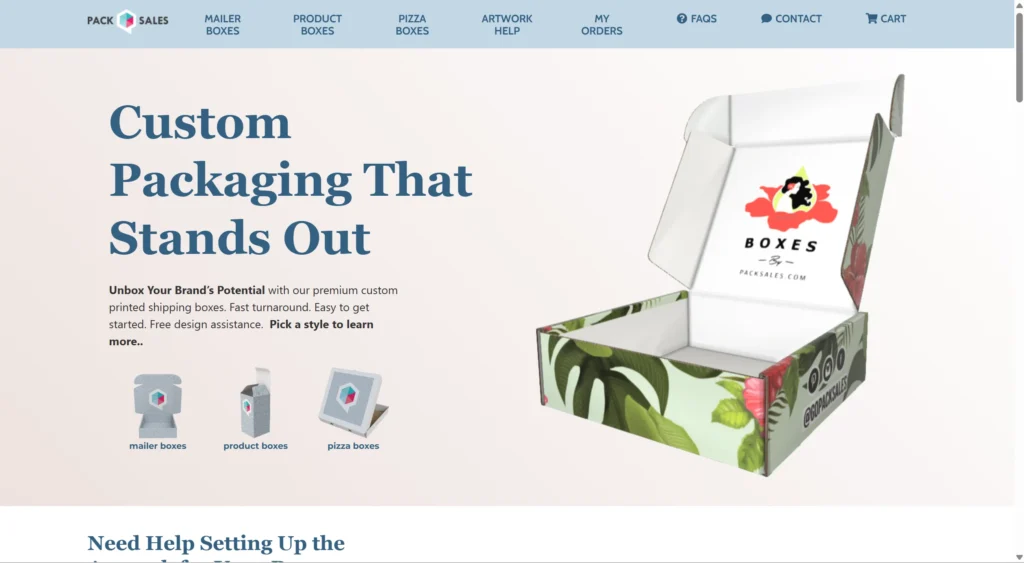
When I analyze PackSales as a custom pizza boxes manufacturer, I do not look at it through the lens of a typical DTC print platform. I look at it the way a distributor or wholesale trader would, by asking whether the company’s manufacturing logic can survive real operational pressure. What immediately stands out to me is that PackSales has been designed around repeat orders, predictable outcomes, and scalable simplicity rather than one-off customization theatrics.
PackSales is not trying to be everything to everyone. Instead, it has deliberately narrowed its focus to box styles, materials, and workflows that work reliably at volume while still feeling accessible to smaller buyers. This balance is extremely difficult to achieve in food packaging, and it is one of the main reasons PackSales appears repeatedly in distributor shortlists.
The Manufacturing Philosophy Behind PackSales’ Pizza Boxes
From my experience, true manufacturers reveal themselves not through marketing language but through the constraints they choose to enforce. PackSales standardizes box structures, flute types, and print finishes in a way that signals discipline rather than limitation. The use of E-flute corrugated cardboard is a particularly telling decision, because it reflects an understanding of both branding and logistics.
E-flute provides a flatter print surface than traditional B-flute, which improves color consistency and graphic clarity. At the same time, it remains strong enough for pizza delivery and takeout environments. This tells me PackSales is not optimizing for novelty but for performance across thousands of identical use cases. Distributors benefit from this because consistency reduces complaints, returns, and reprints over time.
Why Pack-Based Ordering Matters to Wholesale Buyers
One of the most underappreciated strengths of PackSales is its decision to sell pizza boxes in clearly defined packs rather than vague minimum order quantities. From a wholesale perspective, packs of twenty-five create a clean unit of trade that aligns perfectly with how distributors price, store, and resell packaging.
When I think about distribution efficiency, I always come back to predictability. PackSales’ pack structure allows distributors to forecast inventory, manage storage, and respond quickly to customer demand without being forced into excessive stock positions. This is especially important for distributors serving food trucks, event caterers, seasonal pop-ups, and independent pizzerias where demand fluctuates constantly.
How Design Support Reduces Sales Friction for Distributors
In distribution, design is often the hidden bottleneck. Customers want custom packaging, but they arrive with wildly different levels of design readiness. What I appreciate about PackSales is that it absorbs this variability without pushing the burden onto the distributor.
By offering self-design tools, assisted design, and professional templates simultaneously, PackSales ensures that no customer is blocked at the design stage. This matters because distributors are not design agencies. They need manufacturers who can quietly solve design complexity in the background while keeping the sales process moving forward.
Proof Speed as a Signal of Manufacturing Maturity
Whenever I evaluate a manufacturer, I pay close attention to proof turnaround times. PackSales’ commitment to delivering digital proofs within twenty-four hours tells me that their prepress workflow is automated, standardized, and well-controlled. This is not something a loosely organized print operation can promise consistently.
For distributors, fast proofs mean faster approvals and faster order confirmations. More importantly, they reduce the emotional uncertainty that often slows purchasing decisions. Customers see exactly what they are getting, distributors lock in expectations, and production begins with minimal back-and-forth. Over dozens or hundreds of orders, this speed becomes a competitive advantage.
How Printing Choices Protect Brand Consistency at Scale
PackSales’ use of full-color CMYK printing across all pizza box orders is another indicator of long-term thinking. CMYK digital printing allows PackSales to maintain consistent output across small and mid-volume runs without introducing the setup costs and variability associated with traditional analog methods.
From a distributor’s standpoint, this consistency protects brand relationships. When a customer reorders the same pizza box design months later, the colors and details remain stable. That reliability builds trust not only in the manufacturer, but also in the distributor who recommended them.
Why Standardized Box Structures Reduce Operational Risk
The front-locking roll-end box structure used by PackSales may seem like a technical detail, but in distribution, it has real financial implications. Boxes that assemble quickly and behave predictably reduce training time for restaurant staff and lower the risk of misuse.
When packaging fails in the field, distributors often absorb the reputational damage even if the manufacturer is at fault. By standardizing proven structures, PackSales minimizes these risks and protects downstream partners from unnecessary friction.
Sampling as a Tool for Accelerating Buying Decisions
I see PackSales’ sample program as a strategic decision rather than a courtesy. Allowing customers to order a single box sample removes hesitation without forcing commitment. Crediting the sample cost back toward a full order further nudges buyers forward instead of leaving them stuck in evaluation mode.
For distributors, samples are not just quality checks. They are sales accelerators. A physical sample closes the gap between interest and confidence, and PackSales has structured this process in a way that aligns with wholesale conversion cycles.
Turnaround Times That Match Real Market Expectations
PackSales’ stated production timelines reflect realism rather than ambition. Typical one to two week turnaround times, combined with optional rush upgrades, tell me the company values reliability over aggressive promises. This matters deeply in food packaging, where missed timelines can disrupt entire operations.
Distributors rely on manufacturers who deliver when they say they will. Predictable lead times allow distributors to plan launches, promotions, and replenishment schedules with confidence. PackSales’ approach supports this planning rather than undermining it.
Sustainability as a Built-In, Not an Add-On
I pay close attention to how manufacturers talk about sustainability. PackSales integrates recyclable materials, FSC-certified sourcing, and eco-conscious inks into its standard offering. This signals that sustainability is part of the manufacturing baseline, not a premium upsell.
For distributors, this simplifies conversations with customers who increasingly expect environmentally responsible packaging. There is no need to justify material choices or manage separate eco SKUs. The sustainability story becomes clear, consistent, and credible.
What Customer Feedback Reveals About Manufacturing Reality
Customer reviews often reveal more than marketing copy ever could. In PackSales’ case, feedback consistently emphasizes print quality, durability, and turnaround speed. These are the attributes that matter most in high-frequency packaging categories like pizza boxes.
For distributors, this volume of positive feedback reduces perceived risk. It reinforces confidence when recommending PackSales to new accounts and supports long-term supplier relationships built on performance rather than promises.
Why Distributors and Wholesale Traders Choose PackSales
When I step back and look at the full picture, it becomes clear why distributors and wholesale traders choose PackSales as a custom pizza boxes manufacturer. The company simplifies complexity without sacrificing quality. It supports a wide range of customer profiles without destabilizing production. It delivers predictable outcomes in a category where predictability is rare.
PackSales allows distributors to grow their packaging business without constantly redesigning internal processes. That operational alignment is the true reason it continues to earn trust in the wholesale market.
How PackSales Fits Into the Broader Manufacturer Landscape
Within the broader landscape of custom pizza boxes manufacturers, I see PackSales occupying a well-defined and defensible position. It is neither a mass commodity printer nor a bespoke factory chasing ultra-low volume artistry. Instead, it operates as a systemized manufacturer built for repeatable success.
For distributors evaluating long-term partners, this clarity of role is invaluable. It allows PackSales to complement other suppliers rather than compete directly with them, strengthening the overall supply network.
Why I Always Include PackSales in Manufacturer Shortlists
Whenever I assess manufacturers for distribution or wholesale use, I include PackSales because it represents a mature understanding of how packaging actually functions in the market. It respects the realities of inventory, cash flow, design readiness, and operational risk.
By focusing on systems rather than spectacle, PackSales has built a manufacturing model that scales with its partners. That is why, from my perspective, it deserves serious consideration in any discussion of leading custom pizza boxes manufacturers.
Ibexpackaging
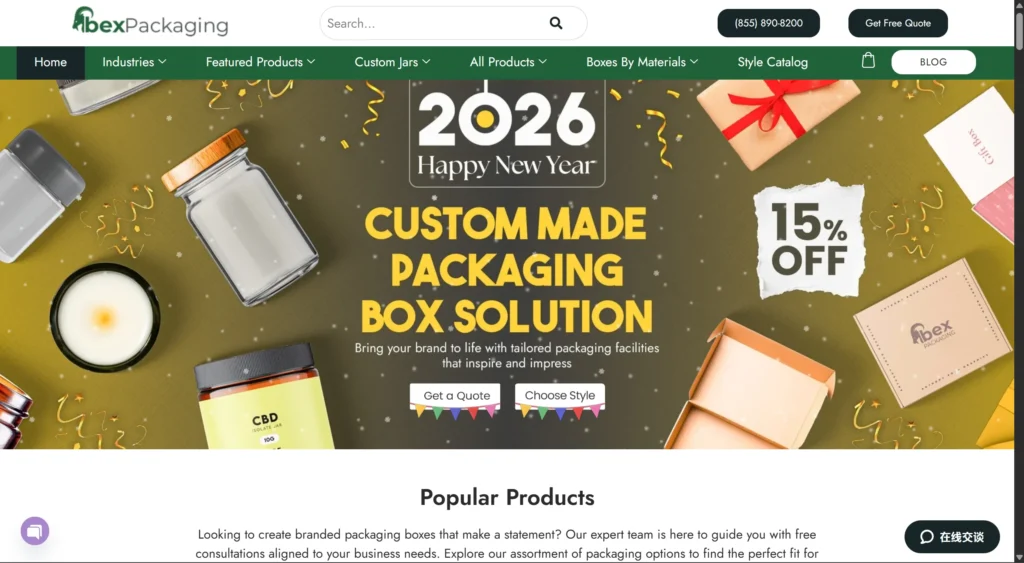
When I look at Ibex Packaging, I don’t read their website the way a first-time buyer does. I read it the way a distributor or wholesale trader would, scanning for operational signals, risk points, and long-term reliability clues. What immediately stands out to me is that Ibex is not positioning itself as a boutique packaging studio. It is positioning itself as a high-volume, commercially aggressive manufacturer that wants to win on price, speed, and repeatability rather than storytelling alone.
That matters, because distributors don’t survive on beautiful one-off projects. They survive on suppliers that can absorb pressure, handle volume fluctuations, and deliver the same result again and again without renegotiating every detail. Ibex’s language, structure, and calls-to-action are clearly built around that reality.
What Their Pricing Language Tells Me About Their Market Role
When a manufacturer openly claims “60% lower than market” pricing, I pay attention. Not because I blindly believe the number, but because it tells me how they want to compete. Ibex is deliberately signaling that they want to be compared on cost efficiency, not just design creativity. For a distributor or wholesale trader, this is a critical starting point.
In wholesale food packaging, especially pizza boxes, margins are often thin and volumes are high. If a supplier cannot stay competitive on unit economics, no amount of service will save the relationship. Ibex’s aggressive pricing posture suggests they are optimized for cost control, bulk material sourcing, and standardized production workflows. That is exactly the kind of foundation a distributor needs when pricing stability matters more than novelty.
How Their Turnaround Promises Fit Wholesale Realities
Ibex consistently emphasizes delivery windows in the 7–12 day range, with many projects reportedly completed even faster. From my experience, turnaround claims only matter when they are repeatable under pressure. What I like here is not just the speed claim itself, but how confidently it is stated across the site.
For distributors, fast turnaround is not about urgency marketing. It is about inventory planning. When a trader supplies restaurants, chains, or regional resellers, delays ripple outward and damage trust. A supplier that builds speed into its core messaging usually has internal systems designed around throughput and queue management. Ibex appears to understand that delivery time is a commercial promise, not a courtesy.
Why Their Global Shipping Focus Matters to Traders
Ibex places heavy emphasis on worldwide delivery and free shipping across many regions. As someone who evaluates suppliers for cross-border trade, I see this as a signal that they are comfortable operating beyond domestic fulfillment. That matters because distributors often serve fragmented markets where packaging needs to move across borders, ports, and regulatory zones.
A manufacturer that already frames itself as globally accessible is more likely to understand export documentation, packaging standards consistency, and logistics coordination. While this does not guarantee perfection, it reduces friction for wholesale traders who cannot afford to babysit every shipment.
How Their Customization Philosophy Aligns With Distribution Needs
Ibex promotes “unlimited customizations” and lists finishes like embossing, foil stamping, lamination, and spot UV. On the surface, this sounds like a branding pitch. But when I look deeper, I see flexibility rather than forced upselling.
Distributors often serve mixed customer profiles. Some clients want plain kraft pizza boxes at scale. Others want branded white boxes with sharp CMYK printing for marketing campaigns. A manufacturer that can handle both without pushing unnecessary complexity is valuable. Ibex’s wide material and finishing vocabulary suggests they can adjust specifications without forcing distributors into a one-size-fits-all model.
Why Their Material Breakdown Is Important for Pizza Packaging
Ibex explains cardboard, kraft, corrugated, and rigid materials in detail, including flute types and wall strength. For pizza boxes, this is not academic information. It directly affects heat retention, grease resistance, stackability, and delivery performance.
As a distributor, I need a supplier that understands these trade-offs and can guide decisions rather than simply taking orders. Ibex’s focus on stock adjustment, endurance testing, and structural proofing tells me they are aware that pizza packaging fails most often at the material level, not the artwork level. That awareness is essential when scaling food packaging across different climates and delivery distances.
How Their Quality Control Narrative Supports Repeat Orders
I pay close attention to how manufacturers talk about quality. Ibex does not simply say “we ensure quality.” They describe a sequence: artwork proofing, stock testing, endurance checks, die structure validation, and prototyping. This tells me they view quality as a process, not a final inspection.
For wholesale traders, this matters because repeat orders depend on controlled variables. If the box strength changes between runs, or the dimensions drift slightly, downstream customers notice immediately. Ibex’s structured quality language suggests they are building institutional memory into their production, which is exactly what distributors want when they reorder the same SKU every month.
What Their Dedicated Expert Model Means in Practice
Ibex emphasizes that each project has a dedicated industry expert. From a distributor’s perspective, this is less about friendliness and more about continuity. Wholesale buyers hate re-explaining specifications, target costs, and delivery constraints every time they reorder.
If Ibex truly assigns stable contacts who understand the food and pizza category, it reduces miscommunication and accelerates approvals. That translates directly into fewer delays and fewer costly mistakes. This is one of the quiet but powerful reasons distributors stay loyal to certain manufacturers.
Why Their Pizza Box Category Is Built for Scale, Not Just SEO
Ibex lists an extensive range of pizza box styles, sizes, shapes, and use cases. While this clearly supports search visibility, it also serves a wholesale purpose. It creates a standardized catalog that distributors can map directly to customer requests without reinventing specifications each time.
When a supplier already has predefined size ranges, structural options, and material choices, distributors can sell faster and quote more confidently. Ibex’s detailed size charts and custom sizing options suggest they are prepared to support both standardized inventory and special orders without breaking their production rhythm.
How Their Finishing and Coating Options Impact Food Use Cases
Ibex offers coatings like aqueous, UV, lamination, and soft-touch finishes. In pizza packaging, these options must be applied thoughtfully. What reassures me is that Ibex frames these as options, not defaults. This leaves room for distributors to balance cost, food safety, and visual impact depending on the client’s needs.
For wholesale traders, flexibility here is critical. Some markets prioritize eco-friendly kraft with minimal treatment. Others demand bright branding for promotional campaigns. A manufacturer that can support both without forcing complexity onto every order is easier to work with at scale.
Why Distributors and Wholesale Traders Choose Ibex Packaging
From my perspective, distributors choose Ibex Packaging because it aligns with how wholesale actually works. They emphasize pricing efficiency, predictable turnaround, scalable customization, and structured quality control. These are not emotional selling points. They are operational necessities.
Ibex positions itself as a partner that can handle volume, absorb variation, and still maintain consistency. For wholesale traders, that means fewer supplier headaches, smoother reordering, and better margin control. When a manufacturer understands that reliability beats novelty in distribution, it earns long-term relevance.
Where I Would Personally Validate Before Scaling Volume
Even with strong positioning, I would still validate Ibex through controlled test orders. I would check color consistency across reorders, board strength stability when switching materials, and adherence to promised lead times during peak periods. These tests are standard practice in wholesale sourcing, not signs of distrust.
If Ibex performs well across these checkpoints, it becomes the kind of supplier distributors build systems around rather than replacing every year. That is the real benchmark of a strong custom pizza boxes manufacturer.
Why Ibex Belongs in Any Serious “Custom Pizza Boxes Manufacturers” Comparison
I include Ibex Packaging in serious comparisons because it represents a commercially grounded, scale-ready manufacturing model. It is not built for one-off projects or niche storytelling. It is built for businesses that need packaging to work consistently, predictably, and profitably.
For distributors and wholesale traders, that mindset matters more than marketing polish. If Ibex continues to deliver on the operational promises it makes, it earns its place as a dependable partner in the global pizza packaging supply chain.
Cartonbar
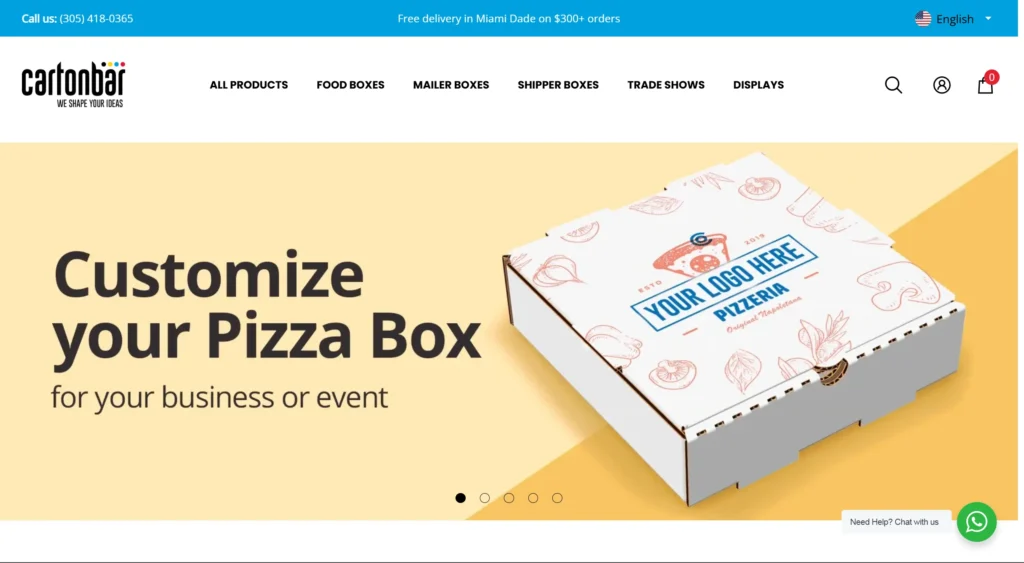
When I spend time studying Cartonbar, I don’t approach it as a casual buyer or a small business owner. I read it through the eyes of a distributor or wholesale trader who needs reliability more than promises. What immediately becomes clear to me is that Cartonbar is not trying to be a global mass-production giant. Instead, it positions itself as a design-led, locally manufactured packaging partner built for speed, flexibility, and controlled scale. That distinction is important, because in pizza packaging, consistency and responsiveness often matter more than chasing the absolute lowest unit price.
Cartonbar’s identity as an industrial design–driven manufacturer based in Miami gives me a strong signal. This is a company that understands cardboard not only as a container, but as a commercial tool. That mindset shapes everything from how their pizza boxes are sized to how their customization options are structured.
What Their Manufacturing Location Really Means for Distributors
When I see that Cartonbar manufactures entirely in the United States, I immediately think about supply chain risk. For distributors, domestic production is not about nationalism or branding. It is about predictability. Producing locally reduces exposure to port delays, customs bottlenecks, and sudden freight cost spikes.
From a wholesale perspective, this gives Cartonbar a major advantage in time-sensitive food packaging. Pizza boxes are not luxury items that can wait six weeks at sea. They are operational supplies. When restaurants run low, distributors need replenishment fast. Cartonbar’s US-based production model supports short lead times and tighter delivery windows, which makes inventory planning far more manageable for traders serving regional or national markets.
How Their Standardized Pizza Box Sizes Support Wholesale Operations
One of the first things I notice when reviewing Cartonbar’s pizza box offering is how clearly standardized it is. Sizes like 8×8, 10×10, 12×12, 14×14, and 16×16 inches cover the majority of real-world pizza use cases. This is not accidental. It reflects a manufacturing philosophy built around repeatability.
For distributors, standardized SKUs are operational gold. They allow easier forecasting, simpler warehousing, and faster reordering. When a supplier keeps changing dimensions or pushing overly custom structures, it creates friction. Cartonbar avoids that by anchoring its offering in familiar, proven formats that distributors can confidently sell again and again.
Why Their Low Minimum Order Quantities Matter in Real Distribution
From my perspective, Cartonbar’s willingness to start orders from as low as 50 units is one of its most strategic choices. Wholesale traders often serve a fragmented customer base. Some clients are growing chains, others are single-location pizzerias, food trucks, or seasonal businesses.
A supplier that forces high minimums pushes risk downstream onto the distributor. Cartonbar’s lower entry point allows distributors to onboard smaller clients, test new territories, and respond to fluctuating demand without overcommitting inventory. This flexibility is not just convenient. It directly improves cash flow and reduces unsold stock risk.
How Their Turnaround Speed Impacts Distributor Credibility
Cartonbar frequently emphasizes fast production timelines, sometimes as short as five to seven business days. I interpret this less as marketing and more as a structural advantage tied to local manufacturing and streamlined processes.
For distributors, speed translates into credibility. When a trader promises a restaurant a delivery date, that promise is only as strong as the manufacturer behind it. A supplier that consistently delivers quickly allows distributors to commit confidently, handle urgent reorders, and respond to seasonal spikes without damaging relationships. Cartonbar’s emphasis on speed aligns well with how foodservice distribution actually works.
What Their Customization Model Tells Me About Operational Maturity
I pay close attention to how manufacturers talk about customization. Cartonbar does not claim that everything is customizable at any volume. Instead, it clearly distinguishes between basic logo applications and full-color custom designs that require higher quantities.
This clarity signals operational maturity. For wholesale traders, nothing is more frustrating than vague promises that later turn into production limitations. Cartonbar’s structured customization approach allows distributors to set accurate expectations, price correctly, and avoid last-minute surprises. It also makes it easier to scale clients from simple branding to more complex designs over time.
Why Their Design Background Improves Pizza Box Performance
Because Cartonbar originates from industrial design rather than pure box trading, I expect a higher level of attention to structure. Pizza boxes face unique stresses from heat, moisture, stacking, and transport. A design-led manufacturer tends to solve these problems through smarter die-lines and fold logic rather than just thicker material.
For distributors, this matters because structural failures create downstream costs. Boxes that collapse or warp generate complaints, refunds, and reputational damage. A manufacturer that treats cardboard as a design medium is more likely to deliver consistent performance across different conditions, which protects the distributor’s relationship with end customers.
How Their Environmental Positioning Fits Commercial Reality
Cartonbar emphasizes recyclable materials and environmentally friendly inks, and I view this as more than a branding exercise. In many markets, especially urban areas, sustainability has become a baseline expectation rather than a differentiator.
For distributors, working with a supplier that already aligns with these expectations reduces friction during sales conversations. It allows traders to meet regulatory requirements and customer preferences without sourcing separate eco-focused alternatives. Combined with local production, this environmental positioning becomes both credible and commercially useful.
Why Distributors and Wholesale Traders Choose Cartonbar
From my analysis, distributors choose Cartonbar because it reduces uncertainty. The pricing is transparent, the sizes are standardized, the turnaround is fast, and the customization rules are clear. These qualities make Cartonbar easy to integrate into an existing wholesale operation.
Instead of forcing distributors to adapt their systems, Cartonbar adapts to how distribution actually functions. That alignment is what turns a manufacturer into a long-term partner rather than a short-term vendor.
Where Cartonbar Sits Among Custom Pizza Boxes Manufacturers
In any serious comparison of custom pizza boxes manufacturers, I see Cartonbar as a strong regional production partner with design depth and operational discipline. It is not trying to dominate global volume or compete solely on price. It focuses on speed, flexibility, and quality consistency within a controlled scale.
For distributors serving the US market or nearby regions, that positioning is often more valuable than chasing overseas cost advantages. Cartonbar fills the role of a dependable, responsive manufacturer that supports growth without introducing unnecessary complexity.
How I Would Personally Work With Cartonbar in a Wholesale Model
If I were structuring a wholesale supply chain, I would use Cartonbar as a core supplier for standardized pizza box SKUs and rapid-turn custom runs. I would rely on their low MOQs to onboard new clients and their fast production to support promotions and seasonal demand.
This is not a supplier built for experimentation. It is a supplier built for repetition and reliability. And in wholesale food packaging, that is exactly what keeps businesses running smoothly over the long term.
Arka
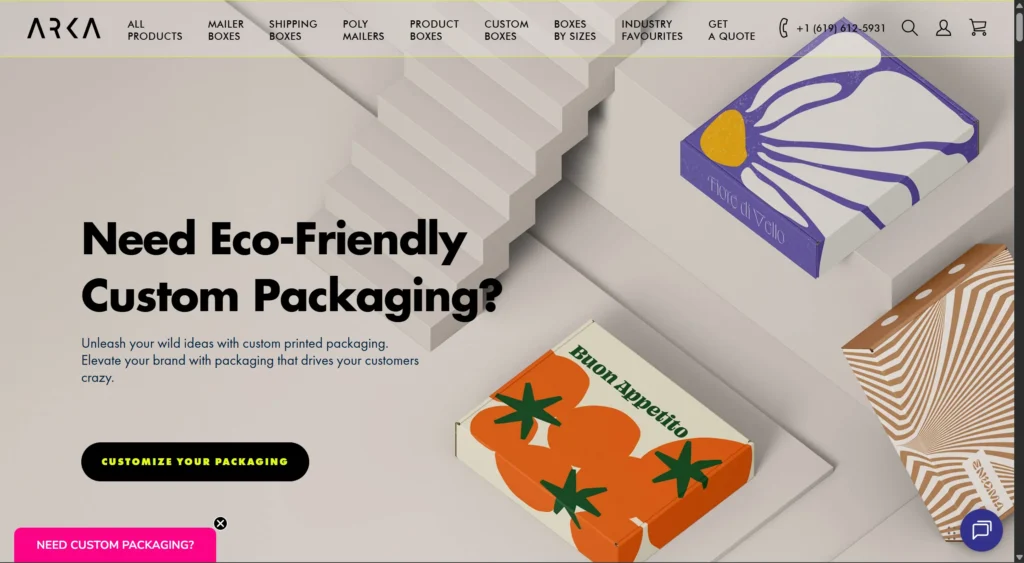
When I evaluate Arka, I don’t look at it like a one-time buyer who wants a nice-looking pizza box for a weekend event. I look at it like someone who has to supply dozens or hundreds of food-service customers, keep stock moving, protect cash flow, and avoid the kind of packaging mistakes that quietly destroy distributor profit. That mindset changes everything. With Arka, what stands out to me is not only the box, but the operating model behind it: a self-serve platform built to make custom packaging repeatable, fast, and scalable—without forcing every order to become a long sourcing project.
The reason this matters is simple. In distribution, I’m not just buying a box. I’m buying predictability. I’m buying a process that can handle messy real-world customers, last-minute changes, small tests, and urgent reorders while still producing consistent results. Arka’s entire message is engineered around that reality.
What Arka Is as a Manufacturer, Beyond the Marketing Headlines
Arka positions itself as an eco-friendly custom packaging manufacturer with low minimums, quick turnaround, and full customization. But when I look deeper, I see a manufacturer that is built like a packaging “engine.” The manufacturing part is only one piece. The bigger system is proofing, design tooling, standardized sizes, and a workflow that makes ordering feel like e-commerce instead of traditional packaging procurement.
That difference matters because most “custom pizza box manufacturers” still behave like factories that happen to take orders. Arka behaves like a productized service that happens to manufacture. For a distributor, that usually means fewer manual steps, fewer misunderstandings, and faster cycle time from customer request to delivered cartons.
The Real Product Is the Workflow: How Arka Turns Custom into Routine
I always ask one question when I assess a supplier: “Can I make this repeatable without adding staff?” Because in wholesale, growth kills you if your process is too manual. Arka’s three-step structure—select the box type, create the design, approve proof, then produce—sounds simple, but it solves a major distributor pain point: turning custom packaging into a routine reorder product instead of a one-off headache.
When a customer comes back in three weeks and says, “We need the same box, but for our new 14-inch size,” I don’t want to start over from scratch. I want continuity: same brand look, same print profile, same box style logic, same approval rhythm. Arka’s model is built for that.
Low Minimums Are Not a Small-Business Feature; They’re a Wholesale Weapon
A lot of brands talk about low MOQs like it’s a kindness. I see low minimums as a wholesale growth lever. The reason is practical. Many food businesses are cautious with branded boxes. They’re not sure if the design will print correctly, they worry about storage space, and they don’t want to tie cash into pallets of inventory before they know the packaging works for their operation.
Low minimums let me as a distributor sell branded packaging as an easy upgrade instead of a risky commitment. It becomes a trial product, not a major investment. That changes conversion rates, especially for customers like food trucks, small chains, pop-ups, catering teams, and new franchise locations. In wholesale, the first order is rarely huge. The win is getting the second order. Low minimums help you get that first “yes,” and then you scale it.
Proofing and Approval: Where Distributors Actually Make or Lose Money
If I’m being honest, the biggest profit killer in custom packaging isn’t shipping cost or unit price—it’s mistakes. Wrong dielines. Wrong placement. Colors that shift. Customers who upload RGB artwork and expect neon results. Teams that assume “white box” means the same white across every print run.
Arka emphasizes proofing and approval before production, and I see that as distributor protection. The proof stage creates a checkpoint that forces clarity. It turns subjective expectations into a documented approval. That matters when a buyer complains later, because the truth is: most disputes come from assumption, not manufacturing failure.
When I work with wholesale accounts, I need a supplier that is structured to prevent mistakes by default. Proofing is part of that safety net, and Arka makes it central to how they operate, not an afterthought.
Their 3D Design Studio Solves a Problem Most Distributors Don’t Talk About
Most distributors quietly struggle with one reality: many customers don’t have clean print-ready files. They have a logo in the wrong format, a screenshot, a Canva file, or a social media profile image. They still want branded packaging, but they’re not equipped to prepare packaging artwork properly.
Arka’s design tooling and “upload and customize” approach is useful because it reduces the dependency on the customer being professional. From a distributor point of view, that expands the addressable market. I can sell custom packaging to customers who are not design-savvy because the platform is built to guide them toward something workable.
This matters because distributors don’t want to become design agencies. Every hour spent fixing artwork is an hour that doesn’t generate margin. A supplier that reduces that friction is effectively increasing distributor capacity.
Full-Color CMYK Printing: Why It Changes the Sales Conversation
When Arka highlights full-color CMYK printing and “no hidden costs” around colors, I interpret it as commercial positioning. In wholesale, one of the hardest moments is when a customer asks, “Can we add another color?” and the answer changes the entire price.
With digital CMYK logic, the conversation becomes simpler: design freely, focus on brand clarity, and treat color as part of the creative process rather than a pricing trap. That’s important because distributors win when the ordering experience feels simple. Complexity reduces conversion.
At the same time, I always keep expectations realistic. CMYK printing behaves differently from RGB screens and Pantone spot colors. A strong manufacturer doesn’t just promise “vibrant color.” They help buyers avoid disappointment through proofing and print-ready guidelines. Arka’s workflow implies that discipline, especially since proof approval is built into the process.
Turnaround Time Is Not a Convenience; It’s Inventory Risk Management
Arka’s stated production window after proof approval is positioned as quick, with rush options available. In food-service distribution, speed is not a luxury—it’s risk management.
Restaurants don’t reorder pizza boxes when they’re organized. They reorder when they’re running low and suddenly realize the weekend rush is coming. Catering operations can spike unpredictably. Ghost kitchens can scale fast, then pivot menus. If I’m supplying these customers, I need a supplier that can compress lead times when necessary.
That’s why I pay close attention not only to production time, but to where the supplier puts the “clock start.” Arka is clear that production begins after proof approval, and that’s realistic. It tells me they operate with a structured pipeline rather than vague promises. I would rather work with a supplier who is honest about process triggers than one who promises speed but blames “artwork issues” later.
Sustainability That Actually Helps Distributors Sell, Not Just Look Good
Arka’s sustainability messaging matters because the market is changing. Eco-friendly packaging is no longer a “nice-to-have” for many food businesses. Customers ask about it, cities regulate it, and brands increasingly want packaging that aligns with their public identity.
From a distributor standpoint, sustainability isn’t only ethics—it’s sales enablement. It gives me a higher-value narrative to attach to the product line. It reduces sales friction because the buyer feels safer making the decision. If the packaging is FSC chain-of-custody certified paper and positioned as sustainable, that’s a language customers can repeat confidently. And in wholesale, anything that helps the customer explain the purchase decision reduces churn.
The Pizza Box Itself: What I Notice About Structure and Performance
When I think about pizza boxes for distribution customers, I focus on three functional realities: heat retention, grease management, and stacking strength. The box has to survive delivery, hold shape under stacking, and not turn the product into a soggy mess.
Arka’s positioning around durable construction and structural design elements matters because distributors often get blamed for performance issues. If a box collapses or the lid warps, the restaurant doesn’t blame the manufacturer—they blame the supplier who sold it. That’s why I care about the engineering narrative.
Even when Arka uses marketing language like “keeps pizza fresh and warm longer,” what I’m really listening for is whether the brand signals competence: clear materials, defined production workflow, and consistent quality control behavior. The more structured the supplier looks, the safer it is for wholesale use.
Why Distributors and Wholesale Traders Choose Arka in Real Life
If I compress it into plain business logic, distributors choose Arka because it helps them sell customization without operational chaos. It supports small trial orders that convert cautious buyers, it offers a workflow that reduces artwork errors, and it creates a reorder path that feels predictable.
Arka also helps distributors move customers away from commodity thinking. The moment a customer sees a pizza box as branding, the discussion shifts from “cheapest per unit” to “best overall value.” That is where wholesale margin becomes healthier. A manufacturer that supports that shift—through design tools, proofing, and premium presentation—becomes commercially valuable to trade buyers.
Where I Think Arka Fits in the Custom Pizza Boxes Manufacturer Landscape
I don’t see Arka as a “bulk commodity corrugated supplier.” I see it as a manufacturer optimized for branded packaging at speed, with sustainability built into the default story. It’s ideal when the buyer cares about presentation, wants flexibility, and needs a process that feels modern.
For wholesale and distributors, that creates a very specific role: a reliable supplier for branded runs, pilots, seasonal campaigns, and fast-moving growth accounts. If I were building a supplier portfolio, I’d place Arka in the segment where I want repeatable customization with low friction—especially for customers who are not sophisticated procurement teams.
How I Would Personally Use Arka Inside a Distributor Product Strategy
If I’m serving distributors and wholesale traders, I would use Arka as a bridge product: the easiest step from plain boxes into branded packaging. I would introduce it to customers who want better presentation but fear complexity. I would use it for pilot programs, new store openings, franchise onboarding packs, and event-driven demand like sports nights, holidays, weddings, and catering spikes.
And when a customer successfully runs a branded pilot and sees the impact, I would scale them. That’s the distributor’s game: start small, prove value, then expand volume. Arka’s entire system is designed to make that growth path feel smooth.
Boxtech
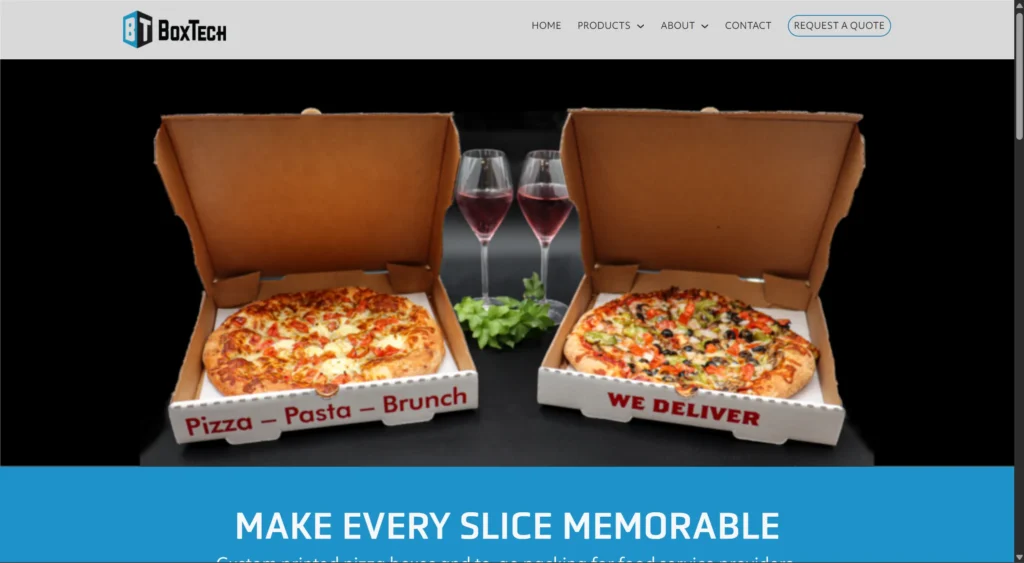
When I analyze BoxTech, what immediately becomes clear to me is that this is not a general packaging company that happens to sell pizza boxes. BoxTech is a manufacturer that has deliberately centered its entire operation around pizza and foodservice packaging. From my perspective, that decision shapes everything else they do. Their language, their specifications, their minimums, and even their design workflow all reflect a deep understanding of how pizza businesses actually operate day to day. They are not chasing trends across dozens of packaging categories. They are refining one category until it performs exceptionally well.
Why BoxTech Feels Built for the Foodservice Supply Chain
What stands out to me most is how clearly BoxTech positions itself inside the foodservice distribution ecosystem rather than outside of it. They openly state that they supply full-line corrugated pizza box programs to foodservice distributors, including national broadline distributors, independent specialty distributors, and paper and disposable wholesalers. That tells me they understand who really controls volume and repeat purchasing in this industry. They are not trying to compete with distributors or sell around them. Instead, they design their entire manufacturing and service model to support distributor success.
How Manufacturing Partnerships Create Stability at Scale
From my point of view, BoxTech’s partnership with one of the largest fully integrated corrugated companies in the United States is one of the most important signals they send to the market. Distributors and wholesale traders care deeply about consistency because their own customers expect reliability across every delivery. When a pizza chain expands from ten locations to fifty, or when a regional distributor rolls out a standardized pizza box program, even small inconsistencies can create operational headaches. BoxTech’s manufacturing backbone gives distributors confidence that box strength, flute quality, depth, and print alignment will remain stable over time.
Why Narrow Product Focus Is a Competitive Advantage
I often see packaging suppliers try to win by offering everything, but BoxTech does the opposite. They win by doing fewer things extremely well. Their focus on custom pizza boxes, generic pizza boxes, and specialty formats like Detroit style, Sicilian style, catering boxes, and pizza party boxes makes their offering easier to understand and easier to sell. From a distributor’s perspective, this focus reduces complexity. Sales teams can confidently recommend BoxTech without worrying about edge cases or unsupported formats. Inventory planning becomes simpler, and long-term programs become more predictable.
How BoxTech Treats the Pizza Box as a Branding Tool
One thing I genuinely appreciate is how BoxTech reframes the pizza box as a marketing asset rather than just a container. They consistently talk about making every slice memorable and turning to-go packaging into a brand amplifier. From my experience, this aligns perfectly with how restaurants think today. Pizza boxes are seen by customers in their homes, at parties, and at events. BoxTech understands that distributors can use this story to help restaurants justify custom printing as an investment rather than a cost.
Why the Design Process Works for Wholesale Environments
The design workflow BoxTech promotes feels very practical to me. They don’t overload customers with complicated online tools or endless customization decisions. Instead, they rely on a state-of-the-art design team that works directly from a high-resolution logo and a clear brand vision. Proofs within forty-eight hours are especially important in wholesale environments, where distributors may be managing dozens of active accounts at once. Speed keeps deals moving. Delays kill momentum. BoxTech clearly understands that reality.
How Controlled Print Options Improve Consistency
At first glance, limiting color capability to one, two, or three colors might seem restrictive, but I actually see this as a strength. In foodservice distribution, consistency matters more than visual excess. By controlling print complexity, BoxTech reduces the risk of color drift, misregistration, and production delays. Distributors benefit because they can confidently promise uniform results across repeat orders. Restaurants benefit because their brand looks the same on every box, whether it’s ordered this month or six months from now.
Why Low Minimums Matter Beyond Small Restaurants
Low minimums are often marketed as a benefit for small pizza shops, but from my perspective, they matter just as much to distributors. Low minimums allow distributors to onboard new accounts without forcing them into risky inventory commitments. They make it easier to test new markets, pilot new branding programs, or support seasonal campaigns. BoxTech’s willingness to support low minimums gives distributors flexibility, which is one of the most valuable currencies in wholesale operations.
How BoxTech Supports Both Chains and Independents
What I find particularly smart is how BoxTech designs its programs to work for both multi-unit chains and independent neighborhood shops. Their standardized size range, depth options, and material choices allow distributors to serve diverse customer profiles without switching suppliers. A distributor can use BoxTech to support a regional chain rollout while still serving local independents who need smaller volumes and faster turnaround. That versatility strengthens distributor loyalty over time.
Why Distributors Trust BoxTech as a Long-Term Partner
In my view, distributors and wholesale traders choose BoxTech not because of flashy claims, but because of operational reliability. BoxTech offers predictable lead times, stable manufacturing quality, focused product lines, and a design process that respects how fast-paced foodservice sales really are. They make it easier for distributors to sell, easier to fulfill, and easier to scale. That kind of support builds long-term relationships rather than one-off transactions.
How I Would Define BoxTech’s Role in the Market
If I step back and look at the bigger picture, I see BoxTech as a purpose-built custom pizza box manufacturer designed specifically for the foodservice distribution channel. They don’t try to be everything to everyone. They choose to be excellent at one thing and structure their entire business around it. From manufacturing partnerships to design workflows to distributor alignment, everything feels intentional. And in an industry where consistency and trust drive repeat volume, that clarity of focus is exactly why BoxTech continues to earn the confidence of distributors and wholesale traders.
Oxopackaging
When I talk about OXO Packaging, I’m not describing a factory that simply prints boxes. I’m describing a manufacturing operation built around understanding how real food businesses, distributors, and wholesale traders actually work. From my perspective, OXO Packaging operates as a U.S.-based custom packaging manufacturer that blends production capability, design intelligence, and commercial awareness. Every custom pizza box we produce is the result of deliberate decisions around material strength, food safety, branding visibility, and logistics efficiency. That mindset is exactly why distributors don’t treat us as a short-term vendor, but as a long-term manufacturing partner.
Why I Don’t Treat Pizza Boxes as a Commodity Product
One thing I’ve learned over years in packaging is that pizza boxes are often underestimated. I never see them as a low-value, disposable item. In reality, they are heat containers, moisture regulators, brand carriers, and stacking units all at once. When I manufacture custom pizza boxes, I focus on how they perform during real delivery conditions, not just how they look on a screen. I pay attention to ventilation placement, flute strength, grease resistance, and lid stability because distributors rely on me to protect their clients’ reputations, not just their pizzas.
How My Manufacturing Process Supports Distributors at Scale
When distributors and wholesale traders work with me, they are trusting my production system to support their growth. I’ve structured manufacturing so that box dimensions, die-lines, materials, and finishes remain consistent across repeat orders. This consistency matters deeply to distributors who supply restaurant chains, franchise groups, and regional food service networks. They cannot afford variability. I make sure that when a distributor places a second, third, or tenth order, the boxes perform and appear exactly as expected, no surprises, no rework, no excuses.
Why Flexible Volumes Matter to Wholesale Traders
I understand that wholesale businesses grow in phases, not all at once. That’s why I intentionally support low starting quantities while maintaining the ability to scale into large-volume production. Distributors often begin by testing new clients, markets, or seasonal programs. I allow them to do that without forcing risky inventory commitments. As demand increases, my production scales smoothly, without changes to structure, print quality, or turnaround reliability. This flexibility gives wholesale traders the confidence to expand their customer base using my factory as a stable foundation.
How Speed and Predictable Lead Times Protect Distributor Relationships
In distribution, speed is not about rushing. It’s about predictability. I’ve designed our workflow so that once artwork is approved, production and delivery timelines are clear and dependable. Distributors value this because it allows them to make firm commitments to their own clients. When a wholesale trader promises delivery to a restaurant chain or food brand, their credibility is on the line. I take that responsibility seriously and treat every timeline as a reflection of their brand, not just mine.
Why Printing Quality Is a Non-Negotiable Standard for Me
Printing is where many manufacturers fail distributors, and I refuse to let that happen. I invest heavily in digital and offset printing technologies to support both small-batch flexibility and high-volume efficiency. Digital printing allows fast turnaround, precise color control, and low minimums, while offset printing delivers cost efficiency and color consistency for large wholesale orders. This dual capability means distributors never outgrow my factory. Whether they’re serving a local pizzeria or a national food chain, I support their needs without forcing a supplier change.
How Customization Becomes a Sales Tool for Distributors
One reason distributors choose to work with me is that I give them real customization power. I don’t restrict them to fixed templates or limited finishes. I support custom sizes, unique structures, branded color systems, inside and outside printing, premium coatings, and specialty finishes. This allows distributors to position themselves as solution providers rather than box resellers. When their clients ask for something specific, unusual, or brand-driven, distributors can confidently say yes, knowing my production team can execute it.
Why Sustainability Strengthens Distributor Market Access
Sustainability is no longer a marketing slogan. It’s a requirement. I manufacture pizza boxes using recyclable and biodegradable materials, responsibly sourced paper stocks, and water-based or soy-based inks. For distributors, this matters because it removes friction when selling into eco-conscious markets or regulated food service environments. By aligning our manufacturing with sustainability standards, I help wholesale traders unlock larger accounts and meet evolving compliance expectations without sacrificing performance.
How I Support Distributors Beyond the Factory Floor
What truly differentiates my approach is what happens beyond production. I don’t disappear after the order is placed. I provide free design consultation, structural guidance, material recommendations, and responsive customer support throughout the process. Distributors are never left managing factory challenges alone. I work with them to prevent issues before they reach the end customer. That collaborative mindset is why many distributors treat OXO Packaging as an extension of their own operations.
Why Wholesale Traders Stay with Me Long Term
In the end, distributors and wholesale traders choose OXO Packaging because I reduce their risk. I offer predictable pricing, consistent quality, scalable production, fast turnaround, and full customization without forcing trade-offs. I don’t compete with my partners for end customers. Instead, I focus entirely on strengthening their ability to serve their markets. That trust, built through repeat orders and long-term collaboration, is what defines OXO Packaging as a custom pizza boxes manufacturer that distributors rely on, not just try once.
After reviewing and comparing these Top 12 Custom Pizza Boxes Manufacturers for 2026 & 2027, one thing becomes very clear to me: there is no single “best” manufacturer for everyone, but there is a right manufacturing partner for each sourcing model, volume structure, and growth stage.
The strongest manufacturers on this list all share a few critical traits. They understand that pizza boxes are not just packaging, but operational tools. They are built to handle heat, grease, stacking pressure, transport, and fast-paced service environments. More importantly, they are designed for repeatability. Consistent structure, stable printing results, predictable lead times, and clear communication matter far more than flashy promises.
As we move into 2026 and 2027, I believe buyers will continue shifting toward manufacturers who think long-term. That means partners who can support growing order volumes, manage multiple SKUs without confusion, adapt to sustainability requirements, and maintain quality across reorders—not just the first shipment. The companies featured here have demonstrated those capabilities in different ways, which is why they deserve serious consideration.
That said, evaluating manufacturers should never stop at a list. The real question is how well a supplier aligns with your specific needs—whether that’s high-volume distribution, multi-market importing, branded restaurant programs, project-based promotions, or price-driven standard sizes. The best outcomes always come from working with manufacturers who understand how your business actually operates.
This is exactly the mindset behind BorhenPack.
At BorhenPack, we approach custom pizza boxes from a manufacturing and supply-chain perspective first. I believe packaging should be easy to reorder, consistent to reproduce, and reliable at scale. We focus on practical structures, stable materials, clear specifications, and export-ready production—so your pizza box programs can grow without friction. Whether you’re building a long-term distribution line, launching a branded rollout, or sourcing cost-efficient standard sizes, our goal is to make the process predictable, transparent, and scalable.
If you’re planning your custom pizza box sourcing for 2026 or 2027 and want a partner who values consistency as much as customization, I invite you to explore what we do at BorhenPack. Start with a conversation, compare specifications, and see how a manufacturing-first approach can simplify your next packaging decision.