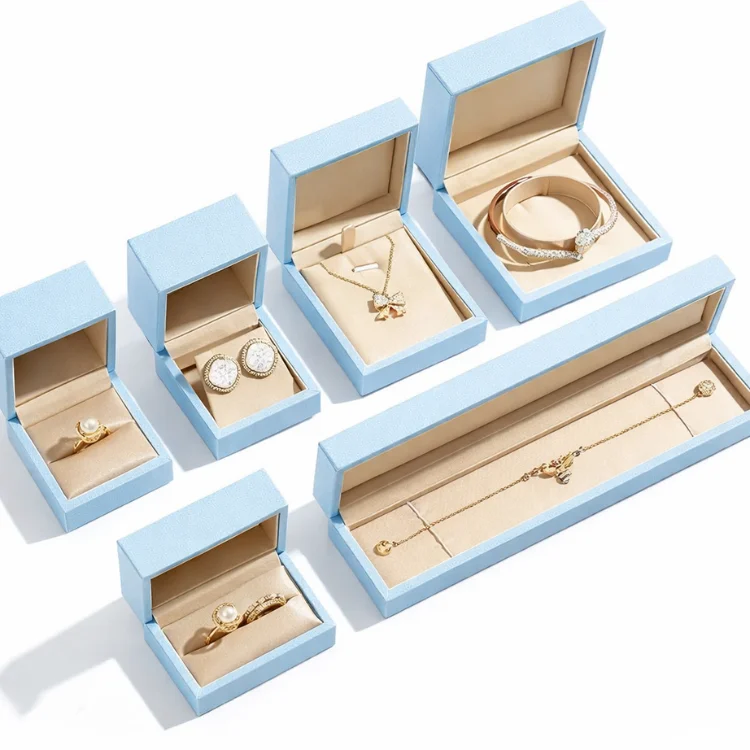
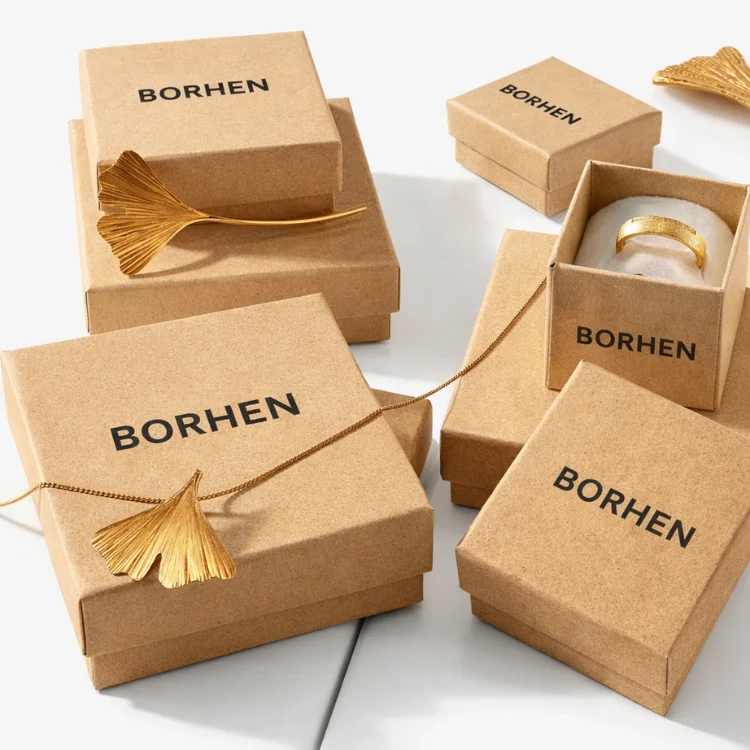
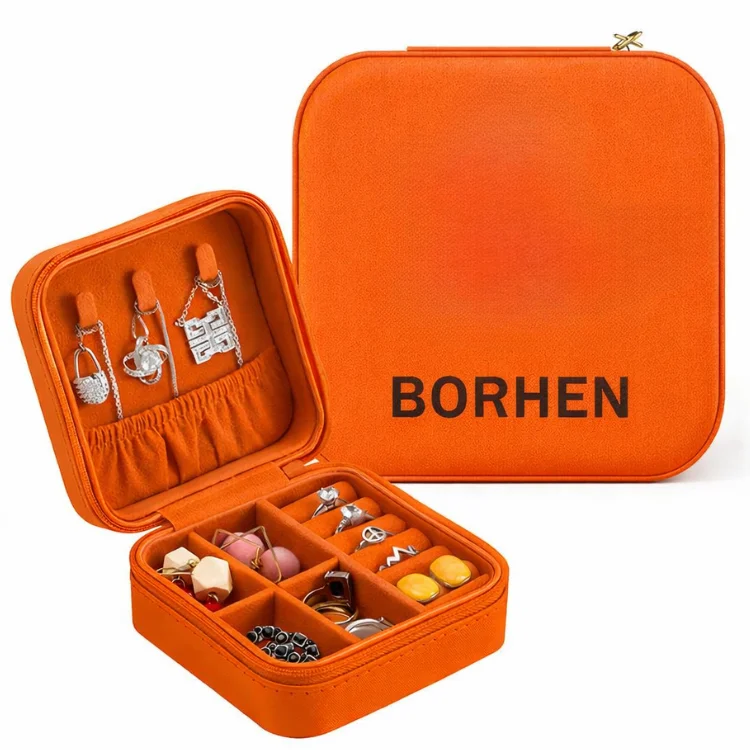
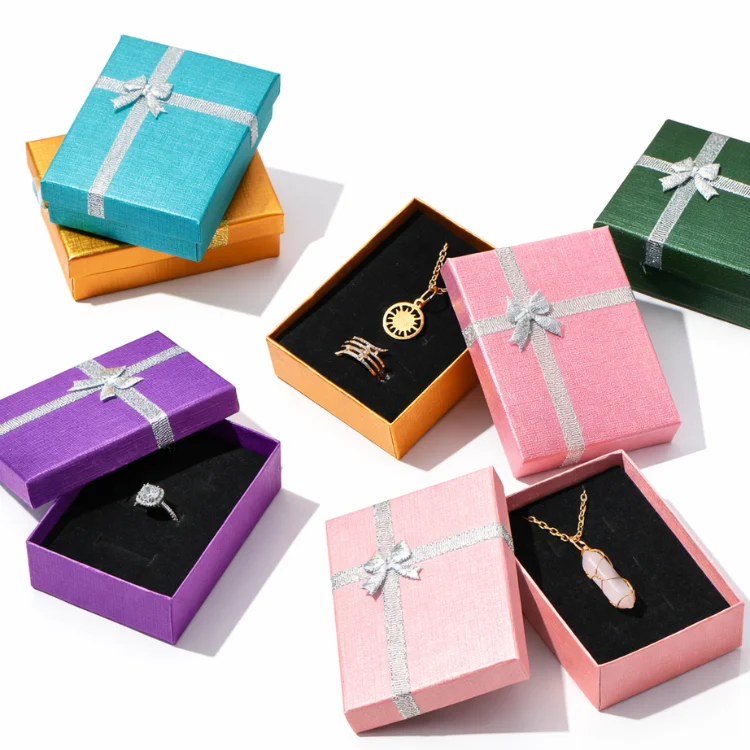
Your Trusted Jewelry Box Manufacturer
We help you launch with confidence, start lean with flexible MOQs, and elevate your brand through fully customized jewelry boxes—engineered for protection, presentation, and consistent quality as your business scales.

Custom Jewelry Box
At Borhen Pack, we understand that a great jewelry box isn’t just a container — it’s part of how your brand is perceived the moment a customer opens it. The weight, the texture, the fit of the insert, even how the lid closes — all of these details shape whether your packaging feels premium, reliable, and worth keeping. That’s why we approach custom jewelry box manufacturing from a brand and execution perspective, not just a production one.
We work with jewelry brands, DTC sellers, design studios, and sourcing teams who need boxes that are visually refined, structurally sound, and consistent across repeat orders. From rigid jewelry boxes with custom foam or velvet inserts, to magnetic gift boxes, drawer-style boxes, and eco-conscious paper solutions, we design and manufacture packaging that aligns with how today’s jewelry is sold — online, in boutiques, and as gifts. We study real brand use cases, production constraints, and market expectations so the boxes we produce are not only beautiful, but practical to scale.
As your manufacturing partner, we don’t just “make boxes.” We help you translate your design and brand positioning into a jewelry packaging solution that can actually be produced, shipped, and reordered without surprises. Whether you’re launching a new collection with low MOQ requirements or upgrading your packaging for a more premium retail feel, we’ll guide you through materials, inserts, finishes, and production details — so your jewelry boxes protect your products, elevate your brand, and support long-term growth.

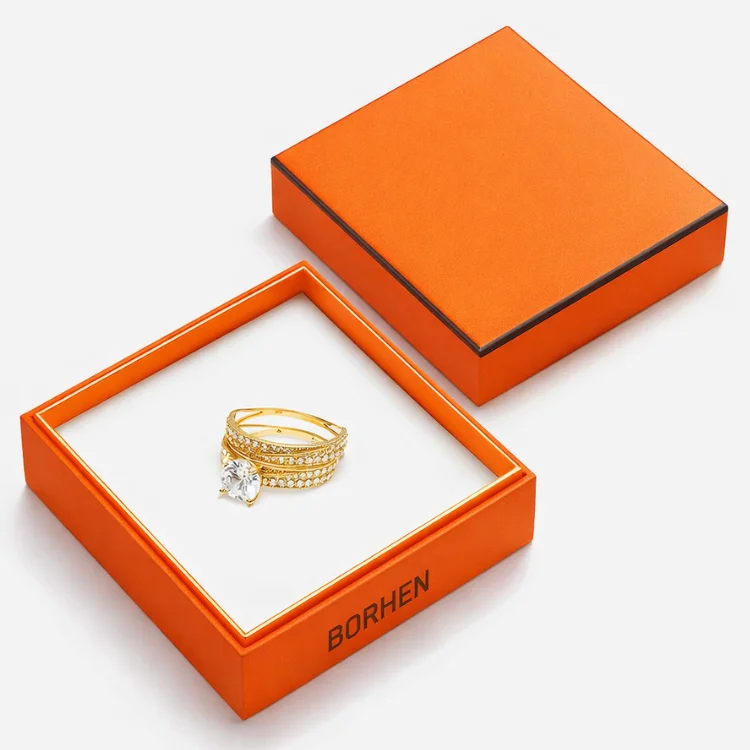
Rigid Jewelry Boxes (Most Common & Premium)
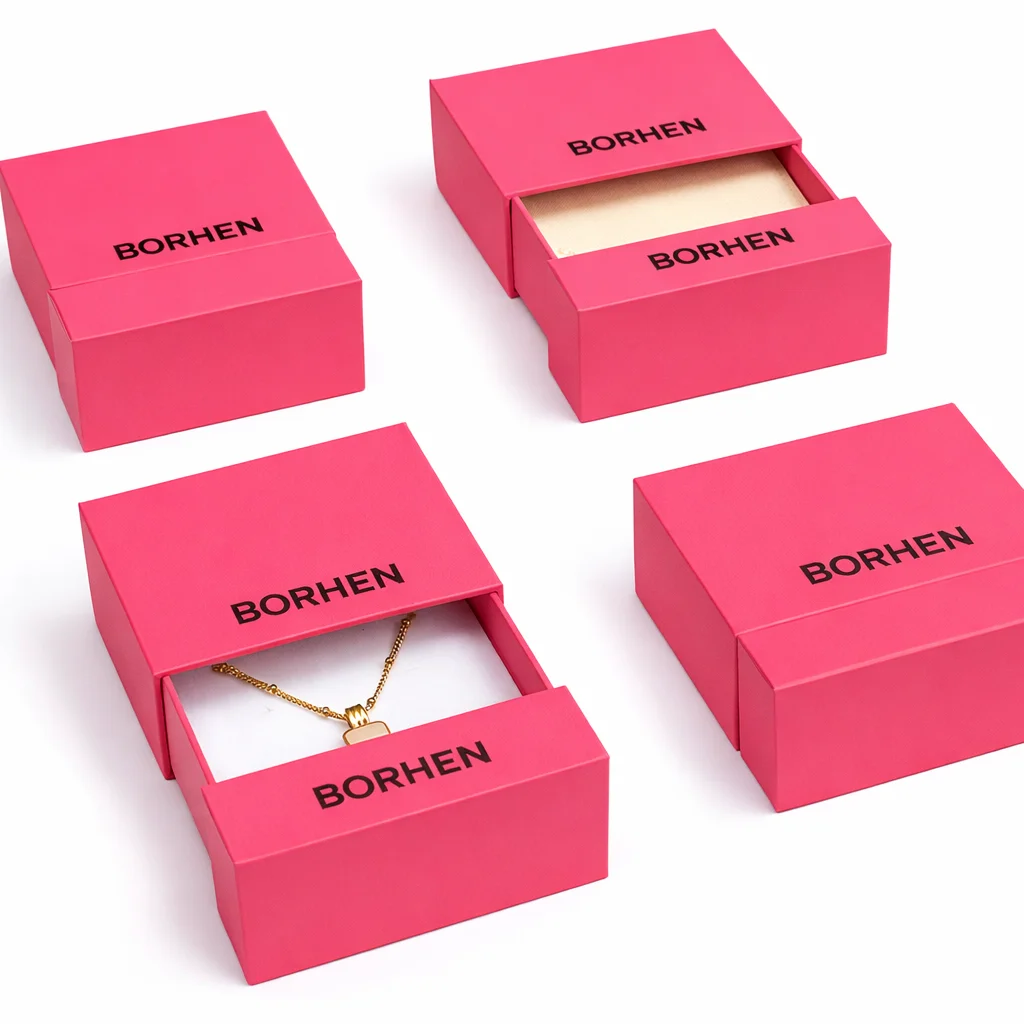
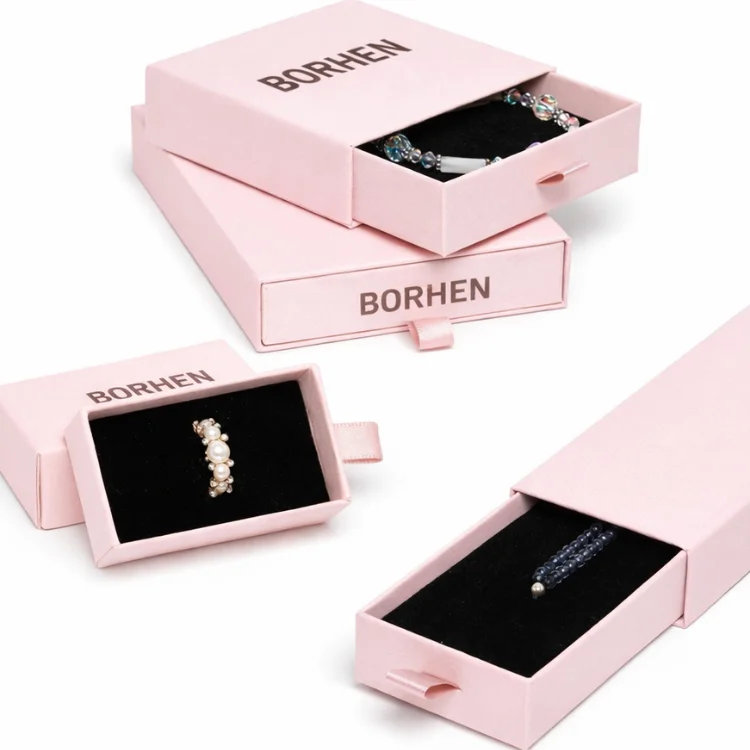
Drawer-Style Jewelry Boxes (Sliding Boxes)
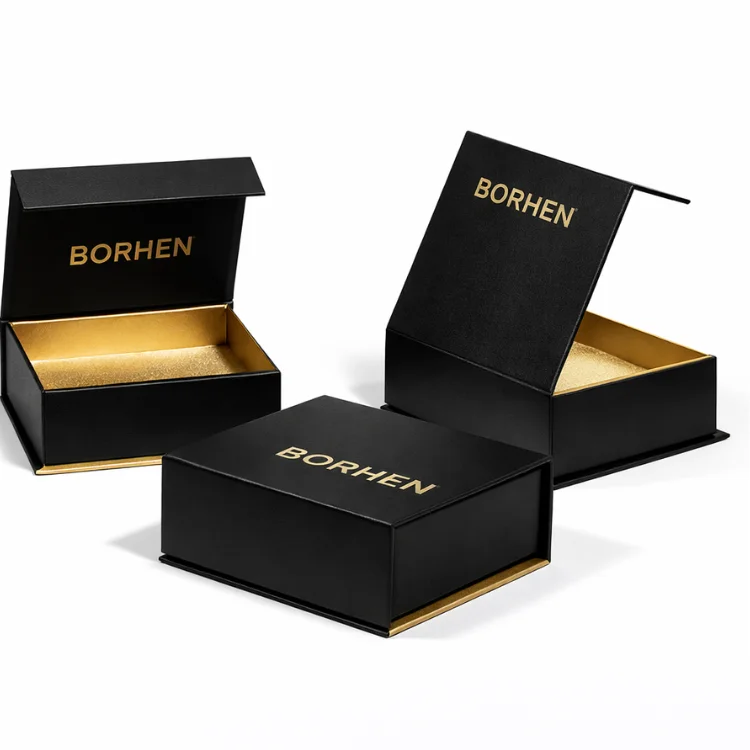
Magnetic Closure Jewelry Boxes
Foldable Jewelry Boxes (Cost-Efficient)
Jewelry Boxes with Custom Inserts (Critical Category)
Eco-Friendly Jewelry Boxes
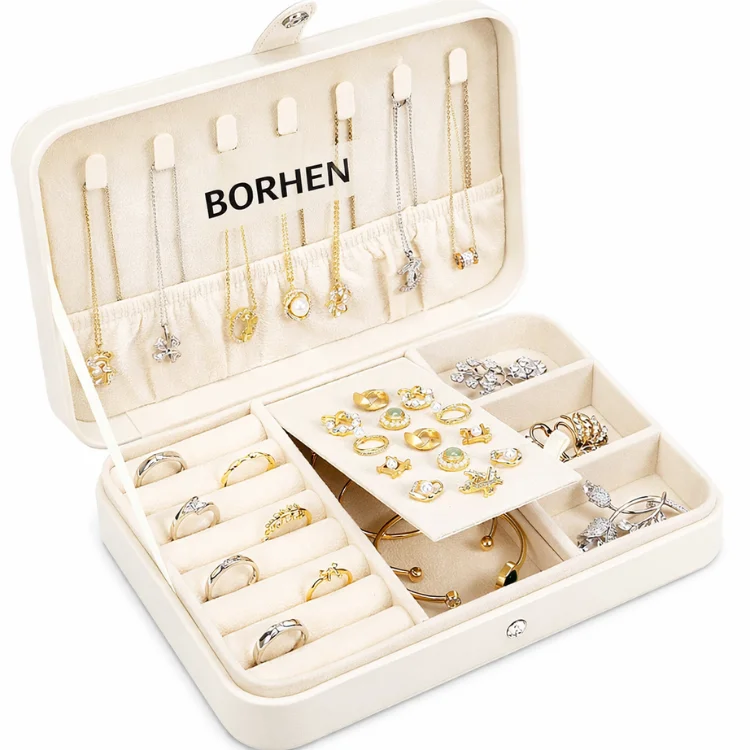
Travel & Compact Jewelry Boxes
Jewelry Gift Sets & Multi-Piece Boxes
Build a Custom Jewelry Box That Truly Elevates Your Brand
At Borhen Pack, we understand that a successful jewelry box isn’t just about holding a product — it’s about protecting value, enhancing perception, and reinforcing your brand the moment the box is opened. Today’s jewelry customers don’t want generic packaging. They expect thoughtful structure, refined materials, precise inserts, and an unboxing experience that feels intentional and premium. That’s why every custom jewelry box we manufacture is built around real brand needs, proven structures, and practical production logic.
Whether you’re launching a new DTC jewelry brand, upgrading from stock boxes, or preparing a premium gift collection, we help you create packaging that looks right, feels right, and works at scale. We work closely with jewelry brands, designers, and sourcing teams to turn design ideas into boxes that can actually be produced consistently — without surprises in quality, color, or delivery. Our approach is guided by real market usage, retail expectations, and what brands repeatedly reorder, not just what looks good in a mockup.
We also make sure your custom jewelry boxes are production-ready and export-friendly. From material selection and insert protection to structural strength and shipping efficiency, we help you launch, test, and scale your packaging with confidence — knowing your boxes are stable, repeatable, and suitable for long-term brand growth.
💡 Our Most In-Demand Custom Jewelry Box Types
1️⃣ Rigid Jewelry Boxes – Premium, durable boxes for fine jewelry, boutiques, and luxury positioning.
2️⃣ Drawer-Style Jewelry Boxes – Sliding drawer designs for modern brands and elevated unboxing experiences.
3️⃣ Magnetic Closure Jewelry Boxes – Gift-ready boxes with clean lines and easy open-close function.
4️⃣ Foldable / Flat-Pack Jewelry Boxes – Cost-efficient structures ideal for startups and overseas shipping.
5️⃣ Jewelry Boxes with Custom Inserts – Foam, velvet, or suede inserts designed to protect rings, necklaces, and sets.
6️⃣ Eco-Friendly Jewelry Boxes – FSC paper, recyclable materials, and plastic-free insert solutions.
7️⃣ Travel & Compact Jewelry Boxes – Small formats for subscriptions, influencers, and promotional kits.
8️⃣ Jewelry Gift Set Boxes – Multi-piece boxes for collections, holidays, and limited editions.
🎯 MOQ & Customization Options (Built for Real Brands)
At Borhen Pack, we keep custom jewelry box projects practical and brand-friendly:
Product MOQ: Most custom jewelry boxes start from 500–1,000 pieces, depending on structure and materials.
Fully Customized Printing & Materials: Custom colors, logo finishes, and special papers typically start from 2,000–3,000 pieces.
Customization Options Available:
- Box structures (rigid, drawer, magnetic, foldable)
- Insert materials (EVA foam, velvet, suede, paper pulp)
- Logo finishes (hot stamping, embossing, debossing, UV)
- Paper, fabric, or specialty wrap materials
Included Support Every project includes structural advice, insert fitting guidance, material recommendations, sampling coordination, and production consistency checks — so your jewelry boxes protect your products, present your brand correctly, and reorder smoothly as you grow.

More Than Just a Custom Jewelry Box Manufacturer
At Borhen Pack, we don’t just manufacture jewelry boxes — we help shape how customers experience your brand from the very first touch. Every rigid box, drawer box, magnetic box, or insert we produce is designed to protect your jewelry, elevate its perceived value, and create an unboxing moment that feels intentional and premium across e-commerce, retail, and gifting scenarios.

✅ Build Packaging That the Market Already Accepts
We design custom jewelry boxes based on real brand usage, not guesswork. By working closely with jewelry brands, designers, and sourcing teams, we understand what actually works in the market — from box structures that ship well, to insert layouts that protect delicate pieces, to finishes that customers recognize as “premium.” Whether it’s minimalist DTC packaging, boutique retail boxes, or gift-ready collections, we help you launch packaging that fits how jewelry is bought, sold, and reordered today.
✅ Low MOQ That Makes Brand Growth Practical
We make it easier to start smart and scale smoothly. Many of our custom jewelry box projects can begin from 500–1,000 pieces, allowing brands to test new collections or upgrade packaging without heavy inventory pressure. As your demand grows, moving to 2,000–3,000+ pieces with fully customized materials, colors, and finishes is straightforward — without changing structures, suppliers, or production logic. The goal is simple: no dead ends as your brand grows.
✅ Quality & Consistency You Can Reorder With Confidence
That’s why we focus on production consistency from the start. We control materials, structure tolerances, insert fitting, and finishing details so your boxes look and feel the same across repeat orders. The result is packaging that protects your jewelry, reduces damage risk, and maintains brand consistency as you scale across SKUs, seasons, and markets.

✅ Export-Ready Production for Global Brands
We build custom jewelry boxes with international shipping and distribution in mind.
From material durability and structural strength to packing methods and volume efficiency, we help ensure your boxes are suitable for overseas transport and global fulfillment. Whether you’re selling in the US, Europe, the Middle East, or through cross-border e-commerce, we help you avoid packaging issues that cause delays, damage, or unexpected costs.
✨ Build Custom Jewelry Boxes That Truly Elevate Your Brand
When you work with Borhen Pack, you’re partnering with a custom jewelry box manufacturer that understands packaging is not an afterthought — it’s part of your product experience. We help turn jewelry packaging ideas into boxes that are structurally sound, visually refined, and ready for global shipping. Our focus is on protection, presentation, and consistency, so your jewelry feels premium the moment the box is opened.
Whether you’re launching a new DTC jewelry brand, upgrading from stock boxes, or preparing a high-end gift collection, we design every jewelry box to feel intentional. From rigid boxes and drawer-style boxes to magnetic closures and custom inserts, our solutions are built to hold jewelry securely, open smoothly, and leave a lasting impression that customers remember — and trust.
🧱 Custom Structures That Support Real Brand Value
We don’t push one-size-fits-all box designs.
Every custom jewelry box starts with how your product is used, displayed, and shipped. We work with proven structures and refine them to fit your brand — adjusting box depth, opening style, insert layout, and materials to protect rings, necklaces, earrings, or full sets properly.
Our team guides you through insert options such as EVA foam, velvet, suede, or paper-based solutions, balancing protection, cost, and presentation. If there’s a better way to improve fit, reduce movement, enhance durability, or elevate the unboxing experience, we explain it clearly and help you choose the right direction. This practical, collaborative process helps your packaging stand out from generic boxes and supports long-term brand credibility.
📦 Packaging That Grows With Your Brand
We believe great packaging should be launch-friendly and scalable. You can start with 500–1,000 pieces using flexible materials and standard structures to test the market or support a new collection. When demand grows, scaling to 2,000–3,000+ pieces with fully customized papers, finishes, colors, and logo techniques is seamless — without redesigning everything from scratch.
Packaging Notes:
- Standard custom jewelry boxes: starting from 500–1,000 pcs
- Fully customized materials, colors, or finishes: typically from 2,000–3,000 pcs
- Insert customization (foam, velvet, suede): matched to box structure and jewelry type
We handle structure coordination, inserts, logo finishes, and outer cartons — so your packaging stays cohesive, retail-ready, and consistent across repeat orders.
⚙️ A Clear, Reliable Production Process
Everything is handled through a clear, coordinated workflow — from structure confirmation and sampling to material approval, mass production, and quality checks. We communicate openly, flag risks early, and keep timelines realistic. Many of our clients see us not just as a supplier, but as an extension of their operations team, helping them avoid costly packaging mistakes.
🌿 Built for Long-Term Growth, Not One-Off Orders
We measure success by how well your packaging performs over time.
That’s why we focus on stable structures, repeatable materials, flexible MOQs, and production consistency that supports reorders as your brand grows. Whether you sell through e-commerce, boutiques, international distributors, or gift channels, we help you build jewelry packaging that scales smoothly and protects your brand reputation.
With Borhen Pack, your custom jewelry boxes are designed to launch smoothly, feel premium, and grow confidently with your business — not just for one project, but for the long run.

Who We Work With (And Why They Choose Us)
We work with startup founders, DTC sellers, and small creative brands who want to move fast — without worrying about complex supply chains.

For New Brands & First-Time Founders
You’re launching something new — and every dollar matters.
We make packaging simple, low-risk, and ready to test.
- MOQ from 500 units — ideal for first production runs
- Standard structures + custom branding — save time and design cost
- Free material samples — check quality before committing
💡 Why it works: lower upfront cost, faster approval, and clear next steps.
For DTC & E-Commerce Brands
You already know what sells — you just need packaging that fits your fulfillment flow.
- Fast sampling (7–10 days) for quick product drops
- Custom dieline & structural optimization to reduce shipping costs
- FSC-certified luxury finish options for better unboxing experiences
💡 We help you launch faster and look better online.
For Boutique & Established Teams
When you need precision and reliability for your repeat orders.
- Color-controlled reorders to maintain brand consistency
- QC + AQL reports for compliance and documentation
- Dedicated account manager for ongoing coordination
💡 We make sure every batch looks and feels exactly right.
FAQs Jewelry Box
For your convenience, we’ve gathered the most commonly asked questions about our Jewelry Box. However, should you have any further queries, please don’t hesitate to reach out to us.
1. What types of custom jewelry boxes can you manufacture?
We manufacture a full range of custom jewelry boxes, including rigid boxes, drawer-style boxes, magnetic closure boxes, foldable boxes, travel-size boxes, and multi-piece gift set boxes. We also specialize in custom inserts for rings, necklaces, earrings, bracelets, and full jewelry sets. Whether you need a minimalist DTC box or a premium boutique gift box, we can build it.
2. Can you help us choose the right box structure and insert?
Yes — this is one of the most important parts of our job.
We don’t expect you to know box structures or insert materials. We’ll guide you through options like EVA foam, velvet, suede, or paper-based inserts, and recommend structures based on protection, presentation, shipping, and cost. Our goal is to make sure your jewelry fits securely and looks right when opened.
3. What’s your minimum order quantity (MOQ) for custom jewelry boxes?
Most custom jewelry box projects start from 500–1,000 pieces, depending on the structure, materials, and level of customization. For fully customized papers, colors, or special finishes, the MOQ is typically 2,000–3,000 pieces. We’ll always explain these numbers clearly and help you choose a realistic starting point.
4. Can we start with a small order and scale later?
Absolutely. Many of our clients start with smaller quantities to test a new collection or upgrade their packaging. We design box structures and inserts that can scale smoothly — so when you reorder at higher volumes, you don’t need to change suppliers or redesign everything from scratch.
5. How long does it take from design to production?
On average, sampling takes 2–3 weeks, depending on structure and materials. Mass production usually takes 20–30 days after sample approval. If you’re working with a launch date or seasonal deadline, let us know early — we’ll help plan the timeline realistically.
6. Can you match our brand colors and logo finishes accurately?
Yes. We support Pantone color matching and a wide range of logo techniques, including hot stamping, embossing, debossing, UV spot, and specialty finishes. We always confirm materials and finishes at the sampling stage to ensure color consistency and quality before mass production.
7. Do you offer eco-friendly or sustainable jewelry box options?
Yes. We offer FSC-certified paper, recyclable materials, plastic-free inserts, and eco-conscious box designs. If sustainability is important to your brand or market, we’ll help you balance environmental goals with structure, durability, and cost.
8. Will the boxes be strong enough for international shipping?
We design jewelry boxes with shipping in mind.
That includes structural strength, insert stability, outer carton packing, and volume efficiency. Whether you’re shipping to the U.S., Europe, the Middle East, or other regions, we help reduce damage risk and avoid packaging-related issues during transport.
9. Do you support design agencies or clients with finished artwork?
Yes. We work with both design agencies and brand owners. If you already have artwork, we’ll review it for production feasibility. If you need support with layout, dielines, or print setup, we’ll guide you so your design translates correctly into a finished box.
10. Do you ship globally and support international buyers?
Yes, we work with clients worldwide. We support export packaging, documentation coordination, and international shipping arrangements. Whether you’re a brand owner, distributor, or sourcing agent, we’re familiar with global workflows and help make the process smooth and predictable.
What impressed us most was how clearly Borhen Pack explained every step of the packaging process. From structure selection to insert fitting and production timing, everything was transparent and well-managed. The final jewelry boxes matched our expectations perfectly, and reordering has been smooth and consistent.
Daniel Rodriguez, Product Development Managerfrom United States
We had worked with other packaging suppliers before, but Borhen Pack stood out for their attention to detail. They helped us refine the box structure and inserts so our jewelry felt more premium without unnecessary cost. Communication was straightforward, and the quality stayed consistent across repeat orders.
Sophie Laurent, Brand Operations Directorfrom France
Borhen Pack felt less like a supplier and more like a partner. They flagged potential issues early, offered practical alternatives, and kept timelines realistic. The boxes were sturdy, well-finished, and suitable for international shipping, which reduced problems for our fulfillment team.
James Whitmore, Sourcing & Supply Chain Managerfrom United Kingdom
As a growing jewelry brand, we needed flexible MOQs and guidance we could trust. Borhen Pack helped us start with a smaller order and plan for scaling later without changing the packaging structure. The process was much smoother than we expected, and the end result elevated our brand presentation.
Emily Carter, Founderfrom Australia
What we valued most was consistency. The samples, first production run, and reorders all matched in color, structure, and finish. Borhen Pack clearly understands how important repeatability is for established brands, and that gave us confidence to move forward with long-term cooperation.
Marco De Luca, Purchasing Managerfrom Italy
Borhen Pack in Numbers
Happy Clients
0 +
Million-dollar Buyers
0 +
Formulation
0 +
Professional Staffs
0 +
Your Ultimate Guide to Jewelry Box
If you’re planning to develop custom jewelry boxes—whether it’s for a new brand launch, a packaging upgrade, or a more scalable supply solution—you’re not just choosing a box. You’re shaping the very first physical impression your customer has of your brand. Jewelry packaging carries emotional weight. Customers expect protection, refinement, and a sense of value the moment they open the box, and the right packaging often determines whether a piece feels memorable or forgettable.
We’ve watched jewelry packaging evolve far beyond simple storage. At Borhen Pack, we’ve worked with startup founders building their first branded box, growing DTC and Amazon brands balancing cost and presentation, design studios translating creative concepts into real production, and established brands rethinking structure, materials, and logistics for scale. What we’ve learned is that jewelry boxes look simple on the surface, but the decisions behind them—structure, inserts, materials, printing, and shipping—are far more complex than most people expect.
This guide is built from that behind-the-scenes experience. It’s not theory, and it’s not marketing language. It’s a practical breakdown of how custom jewelry boxes are actually designed, produced, and delivered in real supply chains. We cover what affects durability and cost, how different structures behave in shipping, why inserts matter more than decoration, how MOQs really work, and where sustainability claims make sense—or fall apart—in practice.
Table of Contents
Choosing the Right Jewelry Box Based on Brand Positioning
Jewelry Boxes Communicate Brand Value Before the Product Is Touched
When I evaluate jewelry packaging, I always start from the same perspective: a jewelry box speaks before the jewelry ever does. Long before a customer examines the craftsmanship of a ring or the brilliance of a stone, the box has already framed their expectations around quality, price, and brand credibility. This first impression happens instantly and subconsciously, which is why jewelry boxes are not just containers but silent brand communicators. If the box feels thoughtful and aligned, customers are more willing to trust what’s inside. If it feels generic or mismatched, doubt appears before the product is even seen.
Brand Positioning Should Define the Packaging Direction
I’ve learned that packaging decisions become much clearer once brand positioning is defined properly. Minimalist brands, premium brands, and luxury brands all communicate value differently, and their jewelry boxes should reflect that difference clearly. When packaging is chosen without a strong connection to brand positioning, the result often feels confusing rather than intentional. A well-aligned jewelry box reinforces the brand story, while a poorly aligned one creates friction that customers can sense immediately, even if they cannot articulate why.
Minimalist Brands Rely on Restraint and Clarity
When I work with minimalist jewelry brands, the focus is almost always on restraint. These brands tend to value clean structures, balanced proportions, and neutral materials because simplicity itself becomes part of the brand promise. The jewelry box should feel calm, controlled, and unobtrusive, allowing the product to take center stage. Excessive weight, decorative finishes, or complex opening mechanisms often work against minimalist positioning by introducing unnecessary visual or tactile noise. In this context, simplicity is not about cost-saving; it is a deliberate aesthetic and strategic choice.
Premium and Luxury Brands Emphasize Weight and Sensory Experience
For premium and luxury jewelry brands, the conversation shifts toward physical presence and sensory feedback. I’ve found that weight plays a surprisingly important role in perceived value. A jewelry box that feels solid and substantial in the hand immediately signals care, craftsmanship, and intention. Surface texture also matters significantly, as refined materials and controlled finishes contribute to a sense of quality that customers associate with higher price points. In luxury packaging, even the way a box opens and closes becomes part of the experience, reinforcing the idea that nothing has been rushed or overlooked.
Structure Influences How a Brand Is Perceived
Structure is one of the most underestimated elements in jewelry box design, yet it has a strong influence on brand perception. Different structures carry different emotional signals, whether a brand intends them or not. Through experience, I’ve seen how certain box structures naturally align with modern, traditional, gift-oriented, or understated brand identities. Choosing a structure purely based on availability or habit can unintentionally reposition a brand in the customer’s mind. Structure should always be selected based on how the brand wants to be perceived, not just how the box is produced.
Finishes and Materials Shape Tactile Trust
Beyond appearance, materials and finishes define how a jewelry box feels during handling. I often remind brands that jewelry is a tactile product, and packaging should respect that sensory expectation. The surface texture, firmness, and even temperature of materials influence how premium a box feels. When finishes are chosen carefully and applied consistently, they contribute to a sense of reliability and attention to detail. When they are chosen casually, the box can feel disconnected from the jewelry it is meant to protect.
The Most Common Positioning Mistake I See
The most common mistake I see brands make is choosing jewelry boxes in isolation, based on visual appeal alone. A box can look impressive on its own and still be wrong for the brand it represents. When packaging feels more luxurious than the jewelry, customers may question the product’s value. When it feels cheaper than the brand promise, trust erodes. Alignment matters more than impressiveness. The best jewelry boxes rarely draw attention to themselves; instead, they support and amplify the brand’s existing identity.
Why Alignment Matters More Than Trends
Trends come and go, but brand positioning should remain stable. I’ve found that packaging decisions guided by trend-chasing often age poorly, while decisions grounded in brand alignment remain relevant longer. When structure, material, finish, and opening experience all reinforce the same message, customers feel consistency and confidence. That coherence builds trust quietly and effectively. In the jewelry industry, where trust and perceived value are inseparable, this alignment is not optional—it is foundational.
Print Accuracy, Color Matching, and Logo Finishing Basics
Why Print Accuracy Is Where Most Packaging Disappointments Begin
In my experience, more packaging disputes begin with printing than with any other aspect of jewelry box production. Structure can be measured, materials can be specified, but printing lives in a gray zone between expectation and reality. What makes print accuracy so challenging is that it sits at the intersection of design intention, physical materials, machine behavior, and human judgment. When brands feel disappointed by the final result, it is rarely because something went “wrong” technically. It is usually because the process was misunderstood from the beginning.
The Fundamental Difference Between Digital Design and Physical Print
One of the first realities I explain to any brand is that digital design and physical print exist in completely different visual systems. A screen produces color through light, while printed packaging reflects color through pigment. This difference alone makes exact translation impossible. Screen brightness, contrast, and saturation are artificially enhanced, which means colors often appear cleaner and more vibrant digitally than they ever can in print. I have learned that once teams accept this limitation, they begin making better, more realistic decisions about color and finish.
Why Pantone Is a Control System, Not a Promise
Pantone is often misunderstood as a guarantee of exact color replication. I see it instead as a control system. Pantone defines ink formulas so that printers around the world are working from the same reference point. However, ink does not exist in isolation. It interacts with paper fiber, surface coating, and ambient light. A Pantone color printed on uncoated paper will never look identical to the same Pantone printed on laminated or fabric-wrapped surfaces. Understanding Pantone as a reference rather than a promise helps teams avoid unrealistic expectations.
Paper Absorption and the Behavior of Ink
Ink absorption is one of the least visible yet most influential variables in print accuracy. Different paper stocks absorb ink at different rates, which directly affects color density and edge sharpness. In my experience, uncoated papers soften colors and reduce contrast, while coated papers preserve sharpness but can amplify imperfections. Textured papers introduce additional complexity because ink settles unevenly across raised and recessed areas. These behaviors are not flaws, but characteristics that must be anticipated during design.
How Surface Finishes Alter Color and Perception
Surface finishes do more than protect printed surfaces; they actively change how color is perceived. Matte laminations reduce glare and mute contrast, often making colors feel more refined and understated. Gloss finishes intensify saturation and sharpness, but they also highlight fingerprints and surface wear. Soft-touch coatings introduce a tactile element that changes how customers emotionally respond to the box, yet they slightly dull color vibrancy. I always evaluate finishes not just visually, but in how they support the brand’s intended emotional tone.
Sampling as the Only Reliable Decision Tool
From my perspective, physical sampling is not optional. It is the only moment when all variables come together in a way that can be evaluated realistically. Samples allow brands to see how color behaves under natural and artificial lighting, how finishes feel in hand, and how logos interact with surface textures. I have seen many projects salvaged at the sampling stage simply because teams were willing to adjust expectations rather than push forward with a flawed assumption. Sampling is not about perfection; it is about alignment.
Hot Stamping and the Illusion of Precision
Hot stamping appears deceptively simple, yet it is one of the most technically sensitive finishing methods. Foil reacts to heat, pressure, and surface texture simultaneously. I have seen stamped logos look crisp on one material and distorted on another, even when the same die was used. Metallic foils also reflect light differently depending on viewing angle, which can change how a logo reads in different environments. Understanding these variables is essential before committing to hot stamping at scale.
Embossing and Debossing as Structural Expressions
Embossing and debossing shift branding from visual contrast to physical form. I often associate these techniques with brands that value restraint and sophistication. However, these finishes demand material stability above all else. Even slight variations in paper thickness can soften edges or reduce definition. Over time, poorly executed embossing can lose sharpness, especially if the underlying board compresses. When done correctly, these techniques feel timeless. When done casually, they feel imprecise.
UV Coating and the Risk of Over-Emphasis
UV coating is frequently used to add emphasis, but I have learned that restraint is critical. Spot UV works best when it highlights a single element with intention. Overuse quickly turns emphasis into distraction. UV coating also demands extremely accurate registration. Any misalignment between printed artwork and glossy areas becomes immediately visible, especially against matte backgrounds. This sensitivity makes UV coating a finish that rewards precision and punishes shortcuts.
Cost Implications That Are Easy to Miss
Finishing techniques often appear inexpensive when viewed individually, but their cumulative impact can be significant. Each technique introduces additional tooling, setup time, and quality control requirements. I have seen projects exceed budget simply because finishing decisions were made without understanding their operational cost. When finishes are chosen strategically rather than emotionally, they add value without creating unnecessary complexity.
Why Samples and Mass Production Always Differ Slightly
One of the hardest lessons for brands to accept is that samples and mass production will never be perfectly identical. Samples are produced slowly, often with extra attention, while mass production prioritizes efficiency and repeatability. Minor variations in pressure, speed, or material batches are inevitable. In my experience, success comes from defining acceptable tolerance rather than chasing absolute sameness. Brands that understand this tend to have far smoother production experiences.
Education as the Best Tool for Alignment
Most printing frustration stems from lack of shared understanding. When designers, brand owners, and production teams operate with different mental models of how printing works, disappointment becomes almost inevitable. I see education as the most powerful tool in packaging. Once teams understand Pantone systems, material behavior, and finishing limitations, approval becomes confident rather than anxious. Decisions become intentional rather than reactive.
Print Accuracy as a Long-Term Discipline
I view print accuracy not as a one-time challenge, but as a discipline that evolves over time. Each production run teaches something new about material behavior and process control. Brands that treat print accuracy as an ongoing learning process build stronger consistency across collections and seasons. In custom jewelry box manufacturing, print accuracy is not about achieving perfection once. It is about maintaining credibility every time a box is produced.
Jewelry Box Structures Explained: When to Use Each Type
Why Structure Is the Hidden Backbone of Jewelry Packaging Decisions
When I look back at the packaging projects that succeeded and those that caused problems later, structure is almost always the dividing line. Jewelry box structure is not a decorative choice and it is not something that should be decided at the end of the design process. Structure determines how a box holds weight, how it survives shipping, how it opens in the customer’s hands, and how consistently it can be reproduced over time. Once a structure is chosen, many other decisions are locked in, which is why treating structure as an afterthought often leads to avoidable compromises.
How Structure Influences Cost Beyond the Unit Price
One detail that is often overlooked is how structure affects cost beyond the obvious per-unit quotation. From my experience, rigid boxes usually carry a higher unit cost, but they also reduce the likelihood of damage, deformation, and customer complaints. Drawer-style and magnetic boxes may look similar in price at first glance, yet they introduce different assembly steps, tolerance requirements, and quality control risks. Foldable boxes often appear cheaper, but their real advantage shows up in shipping volume, storage efficiency, and long-term logistics savings. Understanding these hidden cost layers helps brands make smarter decisions instead of reacting only to initial pricing.
Rigid Jewelry Boxes and the Psychology of Weight and Permanence
Rigid jewelry boxes are the structure I most often associate with long-term brand thinking. When I handle a rigid box, the weight alone communicates permanence and care. This structure naturally supports fine jewelry, heavier pieces, and collections intended for retail display or gifting. The thickness of the board and the stability of the walls create a sense of protection that customers instinctively trust. However, I always remind brands that rigid boxes demand discipline in material selection and packing, because their bulk increases shipping volume and requires thoughtful carton planning to avoid inefficiencies.
Drawer-Style Boxes and the Role of Controlled Reveal
Drawer-style jewelry boxes create a very different emotional experience. I’ve noticed that this structure changes how customers interact with the product because the sliding motion slows the moment of reveal. That pause, however brief, adds anticipation and intention. This makes drawer boxes especially effective for modern brands that emphasize experience and storytelling. At the same time, drawer structures require precision. If tolerances are off or inserts are poorly designed, the drawer may feel loose or resist movement, which undermines the premium effect. This is why drawer boxes work best when execution quality is prioritized over decorative complexity.
Magnetic Closure Boxes and the Balance Between Convenience and Proportion
Magnetic closure boxes are often chosen for their smooth, satisfying opening motion, and I understand their appeal. They feel intuitive and polished, particularly for gift-oriented jewelry. That said, I’ve seen magnetic boxes used in situations where they added more bulk than value. Magnets increase material thickness and cost, and if the jewelry itself is small or lightweight, the box can feel disproportionate. In my view, magnetic closures make sense when the packaging is meant to be reused or displayed, not when efficiency and compactness are the primary goals.
Foldable Boxes as a Strategic Tool, Not a Compromise
Foldable jewelry boxes are frequently misunderstood, yet they play a crucial role in many successful packaging strategies. I often recommend foldable structures for brands that ship internationally, manage limited storage space, or plan frequent SKU changes. When designed properly, foldable boxes can still feel structured and intentional while offering dramatic savings in shipping volume. The key is recognizing that foldable structures prioritize efficiency over permanence. When brands accept this trade-off consciously, foldable boxes become a strategic advantage rather than a compromise.
Structural Durability and How Boxes Behave in Transit
One aspect I always examine closely is how a jewelry box behaves outside of ideal conditions. Boxes do not live in showrooms alone. They are stacked, compressed, transported, and handled repeatedly. Rigid boxes generally maintain shape under pressure, while drawer and magnetic structures rely more heavily on insert stability and internal friction. Foldable boxes demand careful outer carton packing to prevent corner collapse. Evaluating structure based on real shipping conditions rather than ideal presentation helps prevent damage claims and operational headaches later.
Over-Engineering Versus Under-Engineering in Real Projects
In practice, I see brands fall into two structural traps. Over-engineering happens when complex structures are chosen to appear premium, even though the jewelry and brand do not require that level of complexity. This often leads to unnecessary cost and production risk. Under-engineering occurs when a box fails to adequately protect or support the jewelry, which can result in damaged products and disappointed customers. The right structure finds balance. It supports the product and the brand without drawing attention to itself or introducing avoidable risk.
Structure Should Follow How the Jewelry Is Sold, Not Just How It Looks
One of the most valuable questions I ask is how the jewelry will actually be sold and delivered. Will the box be mailed directly to customers, displayed in retail, or used in subscription or promotional campaigns? Each scenario places different demands on structure. A box that performs well in a boutique may struggle in direct-to-consumer shipping, while a structure optimized for shipping may feel out of place in a luxury retail environment. Aligning structure with sales channels prevents mismatches that weaken brand perception.
Why Getting the Structure Right Simplifies Everything That Follows
When the correct structure is chosen early, everything downstream becomes easier. Insert design becomes more intuitive, materials are easier to standardize, and quality control becomes more predictable. In contrast, forcing a design into the wrong structure leads to constant adjustments and compromises. From my perspective, jewelry box structure is not just a packaging decision. It is the foundation upon which consistency, scalability, and brand credibility are built.
Jewelry Box Inserts: Balancing Protection and Presentation
Why Inserts Are the Most Underestimated Part of Jewelry Packaging
When I review jewelry packaging projects, inserts are almost always underestimated. Many brands treat them as a visual accessory, something to be decided after the box structure and artwork are finalized. In reality, inserts do far more than decorate the interior of a box. They are responsible for holding the jewelry in place, absorbing movement during transport, and shaping how the product is revealed to the customer. If an insert fails, everything else fails with it, regardless of how premium the outer box looks.
Inserts Define Whether a Box Is Functional or Just Decorative
I often say that a jewelry box without a properly designed insert is only half a package. The outer box may communicate brand positioning, but the insert determines whether the jewelry arrives intact and presented as intended. Inserts control alignment, spacing, and orientation. When they are poorly designed, jewelry shifts, chains tangle, and pieces arrive off-center. When they are well designed, the jewelry appears calm, deliberate, and secure, even after long-distance shipping and repeated handling.
How Inserts Interact With Box Structure
In my experience, inserts cannot be designed independently from the box structure. A shallow box limits insert depth, while a deeper rigid box allows more flexibility in cushioning and cut design. Drawer-style boxes introduce additional movement during opening and closing, which inserts must compensate for. Magnetic boxes often encourage reuse, which means inserts should remain stable over time rather than deform quickly. Understanding this interaction early prevents the common mistake of forcing an insert into a structure that does not truly support it.
Foam Inserts and the Reality of Long-Term Stability
Foam inserts are widely used because they offer strong holding power and design flexibility, but not all foam behaves the same. I have seen low-density foam compress after repeated use, causing jewelry to loosen and shift. Higher-density foam holds shape better but can feel too rigid if not properly cut. The depth and angle of the cut matter just as much as the material itself. When foam inserts are designed correctly, they quietly absorb vibration and prevent impact damage without making the jewelry difficult to remove.
Fabric-Covered Inserts and the Psychology of Touch
Velvet and suede inserts change how customers emotionally respond to jewelry packaging. From my perspective, these materials work on a psychological level as much as a functional one. Soft surfaces signal care, craftsmanship, and luxury. Customers associate fabric-lined interiors with higher value, even before they examine the jewelry closely. However, fabric alone does not provide structure. Beneath every velvet or suede surface must be a stable core that maintains shape and holding force. Without that foundation, presentation quickly deteriorates.
Paper-Based Inserts and the Complexity of Sustainable Design
Paper-based inserts are often chosen for sustainability reasons, but I always caution brands to approach them thoughtfully. Paper inserts can work beautifully for lightweight jewelry and controlled fulfillment environments, especially when sustainability is central to brand identity. However, paper behaves differently under pressure, humidity, and vibration. If thickness, layering, or reinforcement are insufficient, paper inserts can warp or lose grip. In my experience, paper-based solutions require more engineering, not less, to perform reliably.
Jewelry Size, Weight, and Movement as Design Drivers
One of the most common issues I encounter is brands trying to standardize inserts across different jewelry pieces. Jewelry size and weight fundamentally change how inserts should be designed. A small stud earring, a heavy ring, and a long necklace all behave differently during movement. Heavier pieces require deeper support and stronger resistance, while lighter pieces need precise positioning to avoid sliding. When inserts ignore these differences, packaging performance becomes inconsistent and unpredictable.
Inserts and the Moment of Removal
The unboxing experience does not end when the box opens. I pay close attention to how easily jewelry can be removed from the insert. If customers struggle to lift a ring or untangle a chain, frustration replaces excitement. Inserts should guide the hand naturally, allowing the jewelry to be removed without force or awkward angles. Achieving this balance requires careful consideration of cut depth, spacing, and flexibility, not just visual symmetry.
How Inserts Perform During Real Shipping Conditions
I always evaluate inserts under realistic conditions, not ideal ones. Jewelry boxes are rarely transported gently. They are tilted, stacked, vibrated, and sometimes dropped. Inserts must prevent jewelry from rubbing against hard surfaces or shifting enough to cause micro-scratches. Foam inserts typically perform well under vibration, while fabric-covered inserts rely heavily on their internal structure. Paper inserts must be tested carefully to ensure they maintain shape throughout the journey.
The Tension Between Clean Presentation and Secure Holding
There is an inherent tension between making an insert look clean and making it hold jewelry securely. Inserts that grip too aggressively can appear industrial and distract from the jewelry. Inserts that prioritize visual openness may sacrifice stability. In my experience, the best insert designs are almost invisible. They do their job without drawing attention, allowing the jewelry to remain the focal point while staying perfectly in place.
Why Insert Decisions Affect Long-Term Consistency
Insert design also plays a major role in long-term consistency. Inserts that rely on fragile materials or overly tight tolerances can change over time, especially across repeat orders. Small variations in material behavior can lead to noticeable differences in fit. When inserts are designed with stability and repeatability in mind, reorders become smoother and quality remains consistent across production batches.
Treating Inserts as a System, Not an Accessory
I always encourage brands to treat inserts as part of a system rather than an accessory. Inserts influence box dimensions, structure depth, material choices, and even shipping cost. When insert design is delayed, the entire packaging system becomes compromised. When it is planned early, everything else aligns more naturally. From my perspective, inserts are not secondary details. They are central to how jewelry is protected, perceived, and trusted.
Why the Best Inserts Are Rarely Noticed
In the end, the most successful inserts are the ones customers barely notice. Jewelry sits securely, looks intentional, and is easy to remove. There is no noise, no movement, no struggle. That quiet success is not accidental. It is the result of thoughtful material selection, precise fitting, and a clear understanding of how jewelry behaves in the real world. When inserts work this way, they support both protection and presentation without ever competing for attention.
Understanding MOQ in Custom Jewelry Box Manufacturing
Why MOQ Is a Planning Logic, Not a Sales Barrier
When I talk with jewelry brands about packaging, MOQ is almost always framed as an obstacle. I see this as a misunderstanding of what MOQ actually represents. MOQ is not a rule designed to pressure brands into ordering more than they need. It is a reflection of how manufacturing systems work in the real world. Every custom jewelry box passes through multiple stages—material sourcing, printing, cutting, assembly, and quality control—and MOQ exists to ensure those stages can operate consistently. Once brands understand MOQ as a planning logic rather than a limitation, conversations around packaging become far more productive.
How Production Setup Determines the Lower Limit
One of the least visible factors behind MOQ is production setup. Before a single box is assembled, machines must be adjusted, cutting dies aligned, printing calibrated, and workflows synchronized. These setup steps take time regardless of whether the order is small or large. From my experience, this is why extremely low quantities often struggle to achieve the same consistency as larger runs. MOQ ensures that the time and effort required to prepare production can be justified without sacrificing quality. When setup is rushed or minimized, defects tend to appear later in the process.
The Relationship Between Structure Complexity and MOQ
Box structure plays a decisive role in how low or high MOQ can realistically go. Simple structures rely on established processes and predictable tolerances, which makes smaller runs more feasible. As structure complexity increases, so does the need for precision. Drawer-style boxes, magnetic closures, and multi-layer constructions require tighter control and more manual handling. I have found that these additional variables make low quantities far more difficult to manage without inconsistencies. MOQ increases not because manufacturers want more volume, but because complexity demands stability.
Material Sourcing and the Limits of Flexibility
Material sourcing introduces another layer of constraint that many brands overlook. Paperboard, wrapping paper, fabric, and specialty finishes are rarely purchased in exact quantities needed for a single project. Suppliers upstream often impose their own minimums, which ripple through the entire production chain. I have seen situations where the box manufacturer was fully capable of producing a small run, but the material supplier was not. This is why MOQ is often tied to material availability rather than manufacturing capacity alone.
Printing Methods as a Hidden MOQ Driver
Printing methods have a profound impact on MOQ, especially when color accuracy and surface quality matter. Digital printing allows flexibility at low volumes, but it has limits in consistency and finish depth. Offset printing delivers superior results but requires plates, calibration, and color balancing that only become efficient at scale. When brands request precise Pantone matching or premium logo finishes, offset printing is often unavoidable. In these cases, MOQ exists to protect print quality, not to inflate order size unnecessarily.
Customization Layers Multiply Production Variables
Customization is where MOQ logic becomes most visible. A basic logo on a standard box is relatively easy to execute at lower volumes. Once customization expands to include unique dimensions, custom inserts, specialty papers, and multiple finishes, the number of variables increases dramatically. Each variable introduces risk, and volume becomes the tool that stabilizes that risk. In my experience, MOQ grows in direct proportion to how many elements must be controlled simultaneously during production.
Low MOQ as a Strategic Testing Phase
Low MOQ has real value when used intentionally. I often see brands use smaller quantities to validate design, gather customer feedback, and test logistics before committing to scale. This approach makes sense, but it comes with trade-offs. Low MOQ runs usually involve higher unit costs, fewer material options, and less margin for error. Understanding these limitations allows brands to use low MOQ as a learning phase rather than expecting it to deliver the same results as full-scale production.
Why Scale Improves More Than Just Unit Cost
As production volume increases, the most noticeable improvement is not always price, but consistency. Larger runs allow manufacturers to standardize materials, stabilize processes, and reduce variation across units. From my perspective, this consistency is often more valuable than marginal cost savings. Jewelry packaging is highly visible, and customers notice small differences. Higher quantities make it easier to ensure that every box feels the same, looks the same, and performs the same across batches.
MOQ and the Long-Term Reality of Reorders
One of the most overlooked aspects of MOQ is how it affects reorders. Packaging that begins at very low quantities may need to be adjusted when volume increases, leading to subtle changes in structure or finish. These changes can disrupt brand consistency. I always encourage brands to think beyond the first order and consider how their packaging will behave over multiple production cycles. Planning with future MOQ thresholds in mind reduces the risk of redesigns that customers notice.
Inventory Risk Versus Operational Stability
MOQ decisions are ultimately about balance. Ordering too much too early increases inventory risk, while ordering too little can compromise quality and consistency. I have found that the best decisions come from understanding why MOQ exists rather than trying to push it as low as possible. When brands align their packaging strategy with realistic production logic, they gain more control, not less.
Why MOQ Should Be Integrated Into Brand Growth Strategy
In my view, MOQ should be treated as part of brand growth planning, not a constraint imposed from outside. It influences how packaging evolves, how costs stabilize, and how smoothly a brand can scale. Brands that understand MOQ early tend to make better structural and material decisions, which reduces friction later. In custom jewelry box manufacturing, MOQ is not just a number attached to a quote. It is a signal that reflects how design ambition, production reality, and long-term consistency intersect.
How Materials Affect Jewelry Box Cost and Durability
Why Material Decisions Are the Real Determinant of Packaging Quality
When jewelry boxes fail in the real world, it is almost never because the design looked wrong on paper. In my experience, failure usually traces back to material decisions that were made too casually or too late. Materials define how a box behaves under pressure, how it responds to humidity and temperature changes, and how consistent it remains across multiple production runs. A jewelry box is not a static object. It is a physical system, and materials determine whether that system remains stable or slowly breaks down over time.
Paperboard Thickness and the Physics of Structural Strength
Paperboard thickness is often discussed in terms of cost, but I evaluate it primarily in terms of physics. Thicker board resists bending, compression, and edge deformation far more effectively than thinner alternatives. Even a small reduction in thickness can significantly increase the likelihood of warped lids, softened corners, or misaligned openings after storage or shipping. At the same time, thicker board increases weight and volume, which directly affects freight efficiency. The right thickness is never about maximizing or minimizing material, but about matching structural strength to how the box will be handled throughout its lifecycle.
The Long-Term Behavior of Wrapped Materials
Wrapping materials are often chosen based on color and texture, yet their long-term behavior is just as important as their initial appearance. Paper wraps absorb moisture differently depending on fiber composition and coating, which can lead to expansion or contraction over time. Fabric wraps introduce softness and perceived luxury, but they rely heavily on uniform tension and stable bonding beneath the surface. I have seen boxes that looked flawless at production develop rippling, looseness, or corner lifting months later simply because the wrap material behaved differently than expected under real storage conditions.
Surface Finishes as Wear Surfaces, Not Just Visual Enhancements
Surface finishes are frequently treated as purely aesthetic decisions, but I always approach them as wear surfaces. Matte laminations, soft-touch coatings, and specialty finishes all experience friction during packing, transport, and handling. Some finishes scuff easily, others show fingerprints or uneven sheen, and some degrade when exposed to repeated contact. Choosing a finish without considering how the box will be touched, stacked, and shipped often results in packaging that looks aged long before it reaches the customer. Durability, not just visual appeal, should guide finish selection.
Adhesives and Their Invisible Role in Box Longevity
Adhesives rarely receive attention, yet they are responsible for holding the entire structure together. From my perspective, adhesives are structural materials in their own right. Different adhesives react differently to temperature fluctuations, humidity, and long-term stress. When the wrong adhesive is used, joints weaken, wraps lift, and corners separate gradually rather than failing immediately. These issues are particularly damaging because they often appear after delivery, when quality problems are hardest to trace back to their source.
Material Compatibility and Internal Stress
One of the most overlooked causes of jewelry box deformation is incompatibility between materials. Every material expands and contracts at its own rate. When paperboard, wrap material, finish, and adhesive are not well matched, internal stress builds within the box. Over time, this stress manifests as warped lids, uneven gaps, or twisted edges. I have learned to evaluate materials as an integrated system rather than as individual components. Stability depends not on the strength of one material, but on how well all materials work together.
Color Stability Across Materials and Production Batches
Material choice plays a significant role in color stability, especially for brands that rely on precise color identity. Different paper stocks absorb ink differently, and certain finishes alter how color is perceived under various lighting conditions. I have seen cases where repeat orders appeared mismatched simply because the underlying paper batch changed slightly. Without controlling material variables, maintaining color consistency becomes increasingly difficult as production scales.
Cost Viewed Through Performance, Not Price
Many brands focus on material cost per unit, but I evaluate cost through performance. Materials that reduce initial cost but increase the likelihood of damage, rework, or customer dissatisfaction often cost more in the long run. From my experience, true cost includes the ability of a box to survive production, shipping, storage, and customer handling without degradation. Materials that perform reliably across these stages often deliver better value even when their upfront price is higher.
Durability as a Lifecycle Concept
A jewelry box does not begin and end its life at unboxing. It passes through packing lines, shipping networks, warehouses, and sometimes reuse by the customer. Each stage applies stress to materials in different ways. I always assess durability across this full lifecycle rather than focusing on first impressions alone. Materials that perform well only at the beginning but deteriorate quickly undermine brand trust and consistency over time.
The Risk of Late-Stage Material Changes
Material changes made late in the development process often introduce unintended consequences. Adjusting board thickness, switching wrap papers, or altering finishes can affect structure, color, and adhesive performance simultaneously. In my experience, many packaging problems originate from last-minute material substitutions driven by cost or availability. Early material evaluation reduces the need for reactive changes and helps maintain consistency across production cycles.
Materials as the Foundation of Repeatability
For brands planning long-term growth, repeatability matters as much as initial quality. Materials determine whether a jewelry box can be reproduced consistently across seasons and collections. When materials are stable and well understood, reorders feel predictable and controlled. When they are not, every new production run becomes a risk. I see material selection as the foundation of repeatability. Without it, consistency remains fragile no matter how refined the design appears.
Why Material Knowledge Separates Sustainable Packaging from Fragile Packaging
In the end, durable jewelry packaging is not about using the most expensive materials. It is about using materials intelligently. When paperboard thickness, wrapping materials, finishes, and adhesives are chosen with a deep understanding of their performance, packaging becomes resilient rather than fragile. From my perspective, material knowledge is what separates packaging that merely looks good from packaging that performs reliably over time. In custom jewelry box manufacturing, materials are not details. They are the backbone of durability, consistency, and brand trust.
Designing Jewelry Boxes for Shipping and Fulfillment
Why a Jewelry Box Is Only Successful If It Survives the Journey
When I evaluate jewelry packaging, I never start by asking how it looks on a desk or in a showroom. I start by asking whether it can survive the journey it is about to take. A jewelry box may travel thousands of kilometers, pass through multiple warehouses, and be handled by people who have no emotional connection to the product inside. If the packaging fails at any point along that path, the customer experience is already compromised before the box is opened. In my experience, shipping and fulfillment performance is the most honest test of whether a packaging design truly works.
Transportation Is a Series of Small Stresses, Not One Big Impact
Many brands imagine shipping damage as the result of dramatic drops or accidents, but I’ve learned that most damage comes from accumulation rather than impact. Jewelry boxes are exposed to constant vibration, repeated compression, and shifting pressure over time. They are stacked under varying weights, tilted during loading, and subjected to friction inside cartons. Even minor internal movement, when repeated over days or weeks, can result in misalignment, loosened inserts, or surface wear. Designing for shipping means accounting for these small stresses rather than assuming ideal handling.
Structural Decisions Determine How Boxes Handle Compression
Structure plays a critical role in how jewelry boxes behave under compression. Rigid boxes generally resist vertical pressure better, but they also transfer stress to edges and corners if stacking is not planned properly. Drawer-style and magnetic boxes introduce internal movement points that can amplify vibration if tolerances are loose. Foldable boxes reduce volume, but they require precise reinforcement to avoid collapse under load. I always evaluate structure in relation to how boxes will be stacked, not just how they appear individually. A structure that looks strong on its own may perform poorly when packed tightly in bulk.
Insert Fit as Internal Shock Absorption
I consider insert fit to be the internal shock absorption system of a jewelry box. Even when the outer structure remains intact, poor insert fit allows jewelry to move, collide, or rub against hard surfaces. During shipping, boxes are rotated and inverted repeatedly. Inserts must hold jewelry securely in every orientation, not just when the box is upright. I’ve seen situations where packaging arrived externally undamaged, yet jewelry inside was scratched or tangled because inserts were designed for appearance rather than real movement. Proper insert fit prevents these invisible failures.
Orientation and Movement Inside Master Cartons
One area I pay close attention to is how individual boxes behave inside master cartons. Cartons that are too large allow boxes to shift and collide, while cartons that are overpacked create pressure points that deform box walls. Orientation also matters. Boxes stacked in the wrong direction may place stress on lids or closures that were never designed to bear weight. From my experience, master carton design is just as important as the jewelry box itself. Packaging must be evaluated as a system that includes outer cartons, not as an isolated unit.
Volume Efficiency as a Long-Term Cost Driver
Volume efficiency has a much greater impact on logistics cost than many brands initially realize. Freight charges, warehouse storage fees, and fulfillment costs are often calculated by volume rather than weight. A jewelry box that is only slightly larger than necessary can multiply logistics costs over time. I have seen brands save more money by reducing box dimensions than by negotiating lower material costs. Efficient packaging design balances protection with compactness, ensuring boxes occupy as little space as possible without sacrificing structural integrity.
Storage Conditions and Long-Term Stacking Pressure
Shipping is only one part of the fulfillment lifecycle. Jewelry boxes often sit in warehouses for extended periods before being shipped to customers or retailers. During storage, boxes are stacked under sustained pressure, sometimes in environments with fluctuating temperature and humidity. I’ve observed that boxes not designed for long-term stacking can slowly deform, leading to warped lids or uneven edges. These issues may not be visible immediately, but they become obvious when boxes are finally unpacked weeks or months later.
Fulfillment Centers and the Reality of Fast Handling
Fulfillment centers operate on speed, not delicacy. Boxes are picked, packed, and transferred rapidly, often by multiple handlers. I always design packaging with the assumption that it will be handled quickly rather than carefully. Sharp edges, unstable closures, or unpredictable orientation increase the likelihood of damage during fulfillment. Packaging that is intuitive to handle, stable when placed on any surface, and resistant to quick movements performs far better in real-world operations.
Returns, Replacements, and Hidden Operational Costs
Packaging that ships poorly creates a chain reaction of hidden costs. Damage leads to returns, replacements, customer service inquiries, and inventory discrepancies. Over time, these issues consume far more resources than the initial savings achieved by cutting corners in packaging design. I’ve seen brands spend months addressing operational fallout that could have been avoided with better shipping-focused design. From my perspective, investing in shipping performance is not an added expense, but a form of risk management.
Testing Packaging Beyond Ideal Scenarios
I rarely trust packaging that has only been tested under ideal conditions. Real-world shipping is unpredictable, and boxes must be evaluated accordingly. I encourage testing that includes vibration, compression, and orientation changes to reveal weaknesses early. While this testing adds time to development, it often prevents repeated failures after launch. Brands that test realistically tend to experience smoother fulfillment and fewer surprises as volume grows.
Aligning Packaging With Fulfillment Strategy
Packaging must align with how a brand fulfills orders. Direct-to-consumer shipping places different demands on packaging than wholesale distribution or international freight. I’ve seen the same box perform well in one channel and fail in another because the fulfillment strategy was not considered during design. When packaging decisions are made with a clear understanding of distribution channels, performance becomes predictable rather than reactive.
Shipping-Ready Packaging as a Growth Enabler
In the long term, shipping-ready packaging enables growth by reducing friction across operations. When boxes arrive intact, store well, and move efficiently through logistics systems, brands can scale without constantly revisiting packaging decisions. From my perspective, packaging that ships well is not just a logistics solution. It is a strategic asset that protects margins, customer experience, and brand credibility as order volume increases.
Eco-Friendly Jewelry Boxes: Practical Sustainability Considerations
Why Sustainability in Packaging Is a Decision System, Not a Label
When I talk about sustainable jewelry packaging, I always start by reframing the conversation. Sustainability is not a material choice or a badge that can be added at the end of a project. It is a decision system that affects structure, materials, logistics, cost, and long-term consistency. In practice, every sustainable choice introduces a trade-off. If those trade-offs are not understood clearly, brands risk creating packaging that appears eco-friendly on the surface but performs poorly in real use. From my experience, sustainability only works when it is approached as a system rather than a claim.
Recyclability Versus Real-World Performance
Recyclability is often treated as the ultimate sustainability metric, but I have learned that recyclability alone does not guarantee environmental benefit. A box may be recyclable in theory, yet fail during shipping or storage due to weak structure or material instability. When that happens, damaged packaging must be replaced, increasing waste rather than reducing it. I always evaluate recyclability alongside durability. A box that survives its entire lifecycle intact often has a lower environmental impact than one that is recyclable but fragile.
FSC Paper and What It Actually Represents
FSC certification is one of the most commonly requested sustainability features, and it does represent responsible forest management. However, I’ve seen brands misunderstand what FSC paper can and cannot do. FSC certification speaks to sourcing, not performance. FSC paper still varies widely in strength, fiber composition, and surface behavior. If FSC paper is used without adjusting thickness or structure, boxes may warp, collapse, or deform under pressure. In my experience, FSC paper works best when it is paired with thoughtful structural reinforcement rather than treated as a standalone solution.
Plastic-Free Inserts and the Limits of Substitution
Plastic-free inserts are often positioned as an obvious sustainability win, yet they introduce one of the most complex trade-offs in jewelry packaging. Paper-based or molded pulp inserts reduce plastic usage, but they behave very differently under vibration and compression. Lightweight jewelry may be well suited to these materials, while heavier or high-value pieces often require stronger retention. I’ve seen brands push plastic-free inserts too far, only to face increased damage rates and replacements. Sustainability loses meaning when product protection is compromised.
Simplified Structures as the Most Effective Sustainability Lever
In my experience, the most impactful sustainability improvements often come from simplifying structure rather than changing materials. Complex boxes consume more resources, require more assembly steps, and increase shipping volume. Simplifying dimensions, reducing layers, and removing unnecessary decorative elements lowers material usage and energy consumption at every stage. When brands are willing to simplify intelligently, sustainability improves naturally without sacrificing performance or aesthetics.
Durability as an Overlooked Environmental Factor
Durability is rarely highlighted in sustainability discussions, yet it plays a crucial role in environmental impact. A jewelry box that maintains its shape through shipping, storage, and customer handling reduces the need for replacements and rework. From my perspective, durability should be considered an environmental feature. Packaging that lasts longer and performs consistently creates less waste over time, even if its materials are not the most visibly “green” option.
Logistics Efficiency and Its Environmental Cost
Shipping and logistics are often excluded from sustainability conversations, even though they represent a significant portion of environmental impact. Oversized or inefficient box designs increase freight volume, fuel consumption, and storage requirements. I’ve seen brands reduce their environmental footprint more effectively by optimizing box dimensions than by switching materials alone. Sustainability must include how packaging moves through the supply chain, not just what it is made from.
Cost Pressure and the Risk of Superficial Sustainability
Cost constraints frequently lead brands toward superficial sustainability decisions. Choosing the cheapest eco-labeled material may reduce upfront spend, but if that material performs poorly, the long-term environmental and financial cost increases. I have seen cases where packaging labeled as sustainable led to higher return rates and waste due to structural failure. True sustainability requires balancing environmental goals with functional reliability rather than prioritizing one at the expense of the other.
Aesthetic Expectations and the Eco-Premium Tension
Sustainability also interacts with aesthetics in complex ways. Natural textures, muted colors, and uncoated surfaces are often associated with eco-friendly design, but they may conflict with a brand’s premium positioning. I’ve worked with brands that struggled to reconcile sustainability goals with luxury presentation. In my experience, sustainable packaging does not need to look unfinished or rustic unless that aligns with the brand story. The challenge lies in integrating sustainable choices without undermining perceived value.
Greenwashing and the Importance of Precise Language
One of the biggest risks I see is unintentional greenwashing. Brands often highlight a single sustainable feature while ignoring other environmental impacts within the packaging system. This can damage credibility, especially in markets where consumers are increasingly informed. I always advise using precise language and avoiding broad claims. Saying exactly what has been improved builds more trust than implying perfection. Sustainability messaging should reflect reality, not aspiration.
Sustainability as Incremental Improvement, Not Perfection
In practice, sustainable packaging rarely arrives as a perfect solution. It evolves through incremental improvements. Reducing material usage, improving durability, optimizing shipping efficiency, or switching to responsibly sourced paper are all meaningful steps. I’ve learned that consistent, realistic improvements create more impact than radical changes that compromise performance. Sustainability is most effective when it is treated as progress rather than an endpoint.
Why Honest Sustainability Builds Long-Term Trust
Ultimately, sustainable jewelry packaging is about responsibility rather than image. When packaging decisions are grounded in realistic performance, clear trade-offs, and honest communication, they build long-term trust with customers and partners. From my perspective, the most credible sustainability efforts are often the quiet ones. They do not rely on exaggerated claims, but on packaging that performs well, lasts longer, and reduces waste through thoughtful design. In jewelry packaging, sustainability is not about being perfect. It is about being accountable.
Working with Manufacturers, Trading Companies, and Agencies
Why Sourcing Structure Is a Strategic Decision, Not an Operational One
When brands think about sourcing jewelry boxes, they often treat it as a purely operational task. In my experience, this is where many long-term problems quietly begin. The choice between a manufacturer, a trading company, or an agency is not just about who places the order. It determines how information flows, how decisions are made, and who absorbs risk when reality deviates from expectation. I’ve seen beautifully designed packaging fail simply because the sourcing structure could not support the level of coordination the project required.
Direct Manufacturers and the Reality Behind “More Control”
Working directly with manufacturers is often described as having more control, but that control comes with responsibility. When I engage directly with a factory, communication is technical and process-driven. Discussions revolve around materials, tolerances, tooling limits, and production sequencing. This environment rewards clarity and preparation. Buyers who can specify requirements precisely tend to benefit greatly from direct factory relationships. Buyers who cannot often feel overwhelmed, not because the factory is uncooperative, but because the factory assumes a level of packaging literacy that may not exist.
The Hidden Cost of Technical Miscommunication
One of the most common issues I see with direct manufacturing is not price or quality, but miscommunication. Factories tend to answer questions literally. If requirements are vague, the output will reflect that vagueness. I’ve seen buyers assume a factory would “understand the intent,” only to receive packaging that technically met instructions but missed the emotional or brand expectation entirely. Direct factory sourcing demands that buyers take ownership of clarity, including what is said and what is left unsaid.
Trading Companies as Buffers and Filters
Trading companies exist because not every buyer wants or needs to manage production complexity directly. From my perspective, their greatest value lies in buffering and filtering. They translate buyer expectations into production language and translate factory constraints back into buyer-friendly explanations. This can significantly reduce friction for simpler projects or for teams without dedicated packaging expertise. However, this filtering also means that some nuance is inevitably lost. The effectiveness of a trading company depends entirely on how deeply they understand packaging, not just sourcing.
When Convenience Masks Technical Risk
I’ve noticed that trading company workflows often feel smoother in the early stages. Quotes arrive quickly, samples appear with minimal questioning, and communication feels polished. The risk emerges later, when technical constraints surface unexpectedly. Because the buyer is one step removed from production, some issues only become visible once manufacturing is underway. For projects with tight tolerances or complex finishes, this delayed visibility can create costly revisions. Convenience is valuable, but it should not replace transparency.
Agencies and the Role of System Thinking
Packaging agencies operate in a different mental framework. When I work with agencies, the conversation shifts from individual components to systems. Agencies focus on how structure, materials, inserts, printing, and logistics interact as a whole. This makes them especially valuable for brands with strong visual identity, multiple SKUs, or long-term packaging programs. Agencies absorb complexity early by asking difficult questions upfront. This often slows the beginning of a project but stabilizes everything that follows.
Design Intent Versus Production Reality
One of the most important roles agencies play is defending design intent while respecting production reality. I’ve seen many cases where design looked perfect in concept but conflicted with material behavior or manufacturing constraints. Agencies sit at the intersection of creativity and feasibility. They help translate abstract brand goals into specifications that factories can actually execute. This translation work is invisible when done well, but painfully obvious when it is missing.
Accountability and Where Responsibility Actually Sits
Accountability differs dramatically across sourcing models. With direct manufacturers, accountability is clear but narrow. The factory is responsible for executing what was approved, not for questioning whether it was the right decision. With trading companies, accountability becomes layered, and responsibility can blur if expectations are not defined clearly. Agencies often take broader ownership of outcomes, but they still rely on factories for execution. In my experience, problems arise when buyers assume accountability without explicitly assigning it.
Project Complexity as the Deciding Factor
I always evaluate sourcing models through the lens of project complexity. Simple jewelry boxes with standard materials and finishes rarely need heavy coordination. Complex boxes with custom inserts, precise color matching, or tight shipping constraints benefit from deeper involvement. Problems occur when a complex project is handled through a sourcing model designed for simplicity. Matching complexity to capability is one of the most important sourcing decisions a buyer can make.
Internal Bandwidth and Decision Readiness
Another factor that cannot be ignored is internal bandwidth. Some teams have the time and expertise to manage detailed packaging decisions. Others do not. I’ve seen small teams burn out trying to manage factory-level detail without support. In those cases, intermediaries are not a weakness, but a strategic choice. The right sourcing model is the one that aligns with how decisions are actually made inside the organization, not how they are imagined.
Long-Term Relationships Versus Transactional Thinking
Sourcing models also influence relationship depth. Direct factory relationships often reward long-term commitment, improving consistency over time. Trading companies tend to operate more transactionally, which can be efficient but less stable across repeated orders. Agencies often build long-term frameworks that evolve with the brand. I’ve learned that frequent switching between models without adjusting expectations creates inconsistency. Stability comes from alignment, not loyalty alone.
Why Most Packaging Problems Are Structural, Not Technical
When packaging projects fail, the cause is rarely a single mistake. It is usually structural. The wrong sourcing model was chosen for the project’s complexity, timeline, or internal capability. Expectations were mismatched, accountability was unclear, or communication was filtered too much or too little. In my experience, technical issues are easy to fix when the sourcing structure is right. When the structure is wrong, even small issues escalate quickly.
Choosing a Model That Supports Better Decisions
In the end, I believe the best sourcing model is the one that supports good decision-making under uncertainty. Packaging is full of trade-offs, and someone must understand and manage them. Whether that role sits with the buyer, a trading company, or an agency depends on context. What matters most is clarity about who decides, who executes, and who takes responsibility. When that clarity exists, sourcing becomes a tool for growth rather than a source of friction.
From Concept to Production: How Custom Jewelry Boxes Are Made
Why Most Packaging Delays Are Caused by Misunderstanding the Process
When I look back at delayed or over-budget packaging projects, the cause is rarely manufacturing speed. In most cases, the real issue is that the people involved did not fully understand how the production process actually unfolds. Custom jewelry boxes are not made by simply “sending a design to a factory.” They are built through a sequence of interdependent decisions, each one narrowing the range of what is possible next. When brands underestimate this complexity, they tend to push changes late, assume flexibility where there is none, and misjudge how long certain stages truly take.
Concept Stage and the Difference Between an Idea and a Manufacturable Plan
At the concept stage, everything feels open. Brands talk about premium feel, sustainability, unboxing experience, and visual impact. From my perspective, this is the most creative but also the most dangerous phase, because ideas have not yet been tested against reality. A concept is not a plan. Until structure, size, and usage context are defined, the concept remains abstract. I have learned that the healthiest projects are the ones where concept discussions are grounded early by questions about use case, shipping method, and target cost rather than pure aesthetics.
Structure Selection as a Commitment, Not a Preference
Structure selection is often framed as a preference, but in reality it is a commitment. Once a structure is chosen, internal volume, wall thickness, insert options, material behavior, and even printing feasibility begin to lock into place. In my experience, brands that treat structure casually often discover later that their preferred inserts do not fit, their materials behave poorly, or their shipping costs explode. Structure is not just how the box opens. It is the physical framework that every other decision must respect.
Insert Design and the Moment Where Assumptions Break
Insert design is usually where early assumptions are challenged. Jewelry that looked simple in concept suddenly reveals weight imbalance, movement risk, or removal difficulty. I’ve seen brands realize at this stage that a box depth needs to change, or that a structure cannot support the level of protection required. Inserts expose the truth about how the product behaves in three dimensions. That is why insert design should never be rushed. Once inserts are finalized, the internal architecture of the box is effectively set.
Material Confirmation as the Irreversible Turning Point
Material confirmation is the point where flexibility begins to disappear. Paperboard thickness, wrapping paper, finishes, and adhesives all introduce physical constraints. From my experience, this is the moment when projects become real and risky at the same time. Materials that look good on a swatch may react poorly to folding, pressure, or humidity. Once materials are approved, changing them later often requires restarting sampling and recalibrating printing and tooling. This is why material decisions should be made with performance, not just appearance, in mind.
Sampling as a Reality Filter Rather Than a Showcase
I always describe sampling as a reality filter. It is not meant to impress, but to reveal. Samples show how color shifts under real light, how finishes feel after handling, how inserts hold jewelry, and how structure responds to pressure. Sampling is where optimism meets physics. In my experience, brands that treat sampling as confirmation rather than exploration miss its real value. The most successful projects use sampling to ask hard questions before production makes those questions expensive.
Iteration and the Difference Between Refinement and Disruption
Iteration is natural in custom packaging, but not all iterations are equal. Early iterations refine direction. Late iterations disrupt stability. I’ve seen projects derail when design changes were requested after materials were ordered or tooling was prepared. At that point, even small adjustments ripple through cost, timing, and consistency. Understanding where iteration belongs in the process helps teams protect both quality and momentum.
Transitioning From Sample Logic to Production Logic
One of the least understood moments in packaging is the transition from sample logic to production logic. Samples are made slowly, with individual attention. Production is about repeatability under speed. In my experience, this transition is where expectations must shift. Minor differences in pressure, alignment, or finish are inevitable. The goal is not to eliminate variation, but to control it. Brands that expect mass production to behave like sampling often feel disappointed, even when production quality is objectively high.
Mass Production as a Discipline of Consistency
During mass production, the focus shifts entirely from creativity to discipline. Machines are calibrated, materials are consumed in bulk, and processes are optimized for efficiency. I’ve learned that production success depends less on creativity and more on decision stability. Late approvals, unclear tolerances, or unresolved questions can slow production dramatically. When everything is aligned, production becomes predictable. When it is not, small uncertainties multiply quickly.
Quality Control as Ongoing Alignment, Not Final Judgment
Quality control is often misunderstood as a final inspection step. In reality, it is an ongoing alignment process. Quality checks ensure that materials, structure, printing, and assembly remain consistent with what was approved earlier. From my perspective, quality control works best when it is integrated throughout production rather than used as a last checkpoint. Catching deviation early prevents escalation and preserves timelines.
Timeline Planning and the Illusion of Compression
Many brands try to compress timelines without understanding which stages can actually move faster. In my experience, manufacturing speed is rarely the bottleneck. Decision speed is. Delays come from waiting on approvals, changing direction, or revisiting earlier decisions. When brands understand the workflow, they plan timelines that absorb feedback cycles rather than fight them. Rushed schedules often reappear later as quality issues or cost overruns.
Communication as the Most Critical Production Variable
Across every stage, communication is the variable that determines success. Clear approvals, timely feedback, and precise questions keep the process moving. Vague responses or delayed decisions create invisible stoppages. I’ve seen technically simple projects fail due to poor communication, and complex projects succeed because communication was disciplined. The production process itself is stable. Human coordination is where uncertainty lives.
Why Last-Minute Changes Cost More Than Money
Last-minute changes are rarely malicious. They usually come from a desire to improve. However, by the time production is ready, every component is interconnected. A change to one element affects several others. In my experience, the cost of last-minute changes includes lost time, strained trust, and compromised consistency, not just higher invoices. Understanding the process helps teams recognize when improvement is worth disruption and when it is not.
Thinking Beyond the First Order
The most successful packaging projects are designed with the second order in mind. Repeatability matters more than novelty. Decisions made during the first production define how easy reorders will be, how consistent branding remains, and how stable costs become. I always encourage brands to ask not only “Can we make this?” but also “Can we make this again, six months from now, without friction?” That question changes how decisions are made.
Process Knowledge as Creative Protection
In the end, understanding how custom jewelry boxes are made does not limit creativity. It protects it. When teams understand structure, materials, sampling, and production logic, their ideas survive contact with reality. From my perspective, process knowledge is the difference between a concept that looks good once and a product that can be produced consistently over time. Creativity without process is fragile. Creativity supported by process is scalable.
From Concept to Production as a Shared Responsibility
Custom jewelry box production is not something that happens to a brand. It is something a brand participates in. Every decision, approval, and change shapes the outcome. When brands understand their role in the process, production becomes collaborative rather than confrontational. That shared responsibility is what turns a concept into a physical product that performs reliably in the real world.
Why Partner with Borhen Pack for Your Custom Jewelry Box Program?
Entering a High-Impact, High-Expectation Packaging Category
If you’re planning to develop custom jewelry boxes for your brand—whether for a 2026 launch, a packaging upgrade, or a more scalable supply setup—you’re working in one of the most detail-sensitive categories in packaging. Jewelry boxes are not just containers. They shape first impressions, influence perceived value, and directly affect how customers judge quality before they ever touch the product. In jewelry, packaging is emotional. Customers expect protection, refinement, and a sense of intention, and they’re quick to notice when something feels mismatched or cheaply executed.
Real-World Experience Across Brands, Channels, and Markets
Over the years, we’ve worked with startup founders launching their first branded jewelry boxes, DTC and Amazon operators balancing cost with presentation, design studios translating creative concepts into production-ready packaging, and established brands rethinking structure and materials for scale. Across all these projects, one thing is consistent: jewelry boxes look simple on the surface, but success depends on dozens of interconnected decisions around structure, inserts, materials, printing accuracy, logistics, and repeatability.
Built from What We See Behind the Scenes
This guide is built from what we see every day inside real production workflows, not from theory. We focus on what actually works in custom jewelry box manufacturing, where problems typically appear, and how brands can avoid costly trial-and-error. From box structures that ship well to insert designs that protect jewelry properly, to material choices that stay consistent across repeat orders, our goal is to help brands make informed decisions before mistakes become expensive.
Developing Jewelry Boxes Customers Instantly Trust
We don’t rely on assumptions when developing packaging. Our approach is grounded in how jewelry is actually sold, shipped, stored, and unboxed across e-commerce, retail, gifting, and international distribution. By understanding how customers interact with packaging—and how fulfillment and logistics treat it—we focus on jewelry box solutions that perform reliably, look intentional, and reinforce brand credibility rather than undermine it.
Custom Box Solutions That Reflect Your Brand Positioning
There is no single “best” jewelry box. Every brand has a different audience, price point, and aesthetic direction. That’s why we tailor structure, insert layout, materials, surface finishes, and printing details to match your brand positioning. Whether the goal is minimalist elegance, premium weight and texture, or scalable efficiency, every box is developed with consistency and long-term production in mind, not just first-order appearance.
Production Control That Protects Quality and Timelines
Custom jewelry boxes involve more variables than most brands expect. Small changes in material, structure, or finish can create big differences in outcome. We manage these variables carefully through clear specifications, controlled sampling, and realistic production planning. This reduces surprises during mass production and helps brands avoid last-minute changes that cause delays or cost increases.
Packaging Designed for Shipping, Storage, and Fulfillment
A jewelry box that looks good but ships poorly creates long-term operational problems. We design packaging with real logistics in mind, including insert fit, outer carton packing, stacking behavior, and volume efficiency. By addressing these factors early, we help brands reduce damage rates, control fulfillment costs, and maintain consistent presentation from factory to customer.
Flexible MOQs That Support Real Growth Paths
Most brands don’t start with large volumes. They start with one or two SKUs and grow from there. We support that reality with flexible MOQs that allow market testing without locking brands into unnecessary inventory. As volumes increase, we focus on maintaining structural consistency, material continuity, and production stability so scaling does not introduce quality risk.
A Long-Term Custom Jewelry Box Manufacturing Partner
Working with Borhen Pack means partnering with a team that understands packaging as a system, not just a product. We combine structural engineering, material knowledge, printing accuracy, logistics awareness, and production control to help brands build jewelry packaging that performs in the real world. Many of our clients start with a single box project and continue working with us as their collections, channels, and markets expand.
At Borhen Pack, we don’t just manufacture custom jewelry boxes. We help brands create packaging that protects their products, elevates perceived value, ships reliably, and scales smoothly over time. Our role is to make sure your jewelry boxes are not only ready for launch, but built for long-term consistency and growth.
Ready to Start Your Custom Packaging Project?
🔒 Borhen Pack takes your privacy seriously. All information is strictly confidential and used only for technical and commercial communication.